Radyně Castle: A Historic Medieval Fortress in the Czech Republic
Visitor Information
Google Rating: 4.6
Popularity: Medium
Official Website: www.hrad-radyne.cz
Country: Czechia
Civilization: Medieval European, Modern
Site type: Military
Remains: Castle
History
Radyně Castle is situated within the municipality of Starý Plzenec in the present-day Czech Republic. It was constructed in the mid-14th century by the Kingdom of Bohemia under the reign of King Charles IV.
The castle, initially called Karlskrone, was established around 1356 and completed by 1361. Its purpose was to replace the earlier medieval stronghold of Starý Plzenec and serve as the royal administrative center for the surrounding Plzeň region. Radyně functioned as the residence of royal burgraves, officials charged with overseeing regional governance. These duties included maintaining security along important trade routes connecting Bohemia with cities such as Nuremberg and Regensburg, as well as administering justice.
During the late 14th century, Radyně remained royal property, but the castle was pawned by King Wenceslaus IV in 1400, indicating a change in its financial and political status. Through the period of the Hussite Wars in the early 15th century, Radyně served as a significant defensive refuge for the Catholic nobility. Notably, a priest named Šimon Burda stayed at the castle and composed commentaries on canon law there. Ownership shifted frequently among lower-ranking nobles in the 15th century, including Hrdoň of Dubňany and Dobeš Vrš of Modřejovice, reflecting its involvement in regional disputes and power struggles.
By the late 15th century, the castle transitioned largely into a hunting residence under the Šternberk family, marking a shift from military to recreational use. In the first half of the 16th century, Radyně suffered a destructive fire, likely caused when lightning struck the round tower. This blaze destroyed the palace and inflicted damage upon the square tower. After this event, documents from 1558 describe the castle as abandoned.
Throughout the 18th century, the ruins belonged to the noble Černín family, who chose not to restore the site. However, in 1823 the castle underwent a Romantic-style renovation. This restoration included refurbishing the square tower into a lookout point designed for enjoyment and display, complete with a furnished room featuring a fireplace, stained glass windows, and a large iron chandelier, reflecting 19th-century tastes.
In the 20th century, local authorities from Starý Plzenec acquired Radyně and formed a preservation society supported by public donations to carry out repairs. The state assumed ownership in the 1950s and installed a television signal transmitter in the square tower. Activities such as nearby quarrying caused structural damage, leading to further repairs during the 1970s. Since 1981, the castle has been accessible to the public, and ownership was returned to Starý Plzenec in the early 1990s.
Radyně Castle is also represented in local cultural heritage, notably depicted on the stage curtain of the Pilsener Theater, painted by Augustin Němejc between 1899 and 1902, emphasizing its visual prominence in the region around Plzeň.
Remains
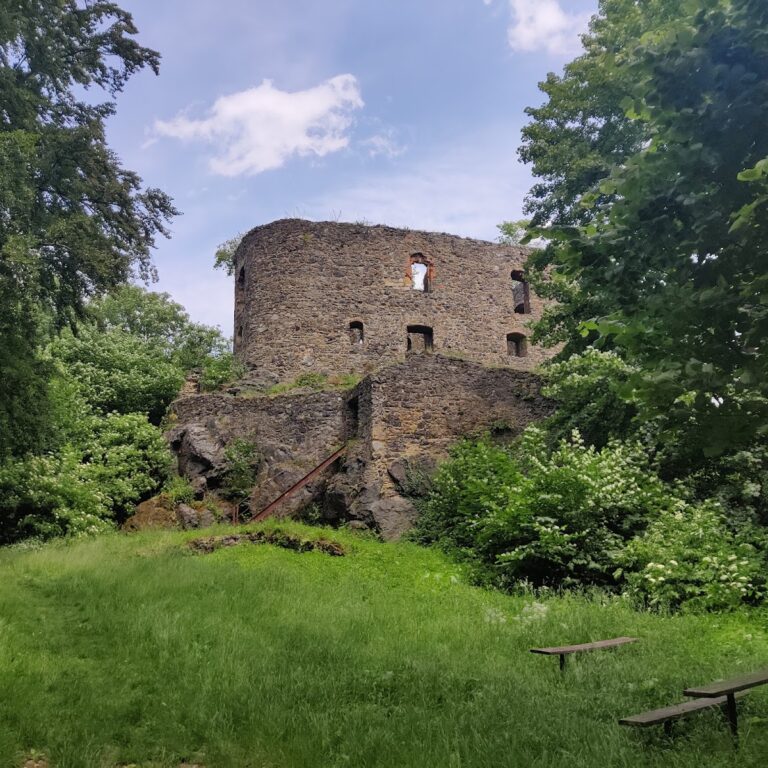
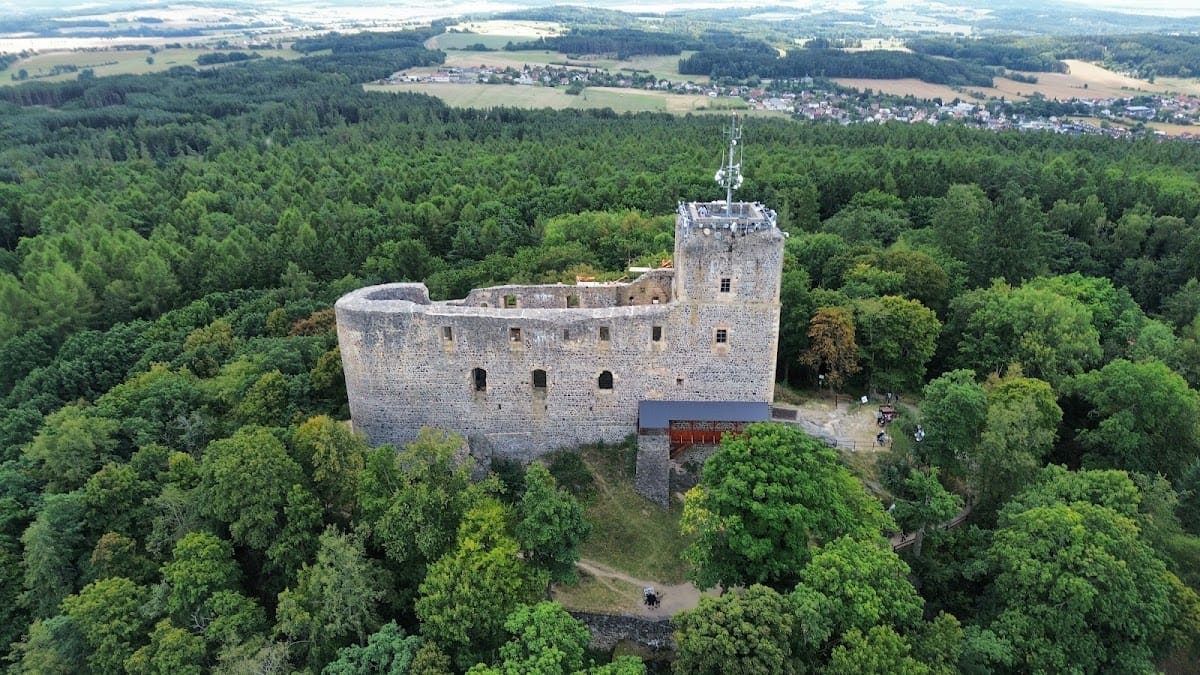
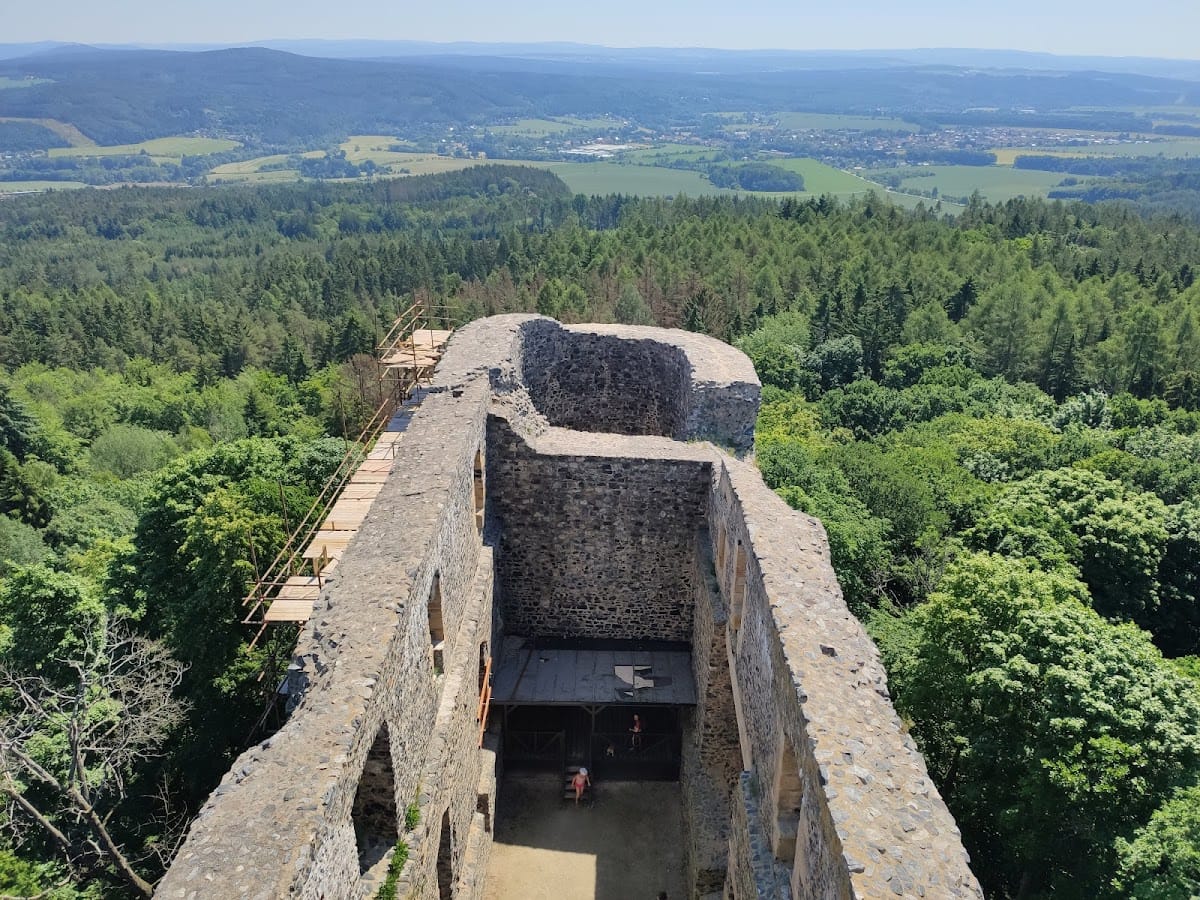
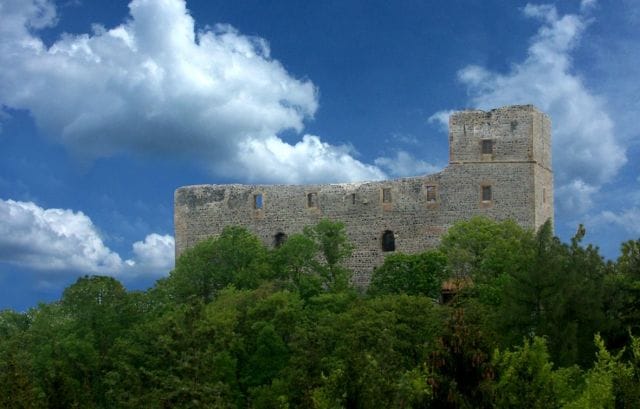
Radyně Castle occupies the summit of a sandstone hill rising to 567 meters above sea level. Its layout centers on a rectangular palace stretching roughly 49 meters in length and 11 meters in width, with internal spaces measuring nearly 27 meters long. The palace walls are notably thick, about 2.6 meters, reflecting the fortress’s defensive purpose.
At the shorter ends of the palace stand two residential towers of contrasting shapes. One is square in plan, housing a second-floor room illuminated by two large window openings fitted with seats. This chamber was heated by a sizable fireplace and included a private latrine, highlighting its role as living quarters. Above this living space are two additional rooms, one positioned at the level corresponding to a modern viewing platform. These upper rooms connect via a corridor running through the palace roof to the tower at the opposite end.
The semi-circular tower at the other end of the palace has an interior undivided up to its second floor and is believed to have functioned as a prison. This is supported by reports of two human skeletons discovered during debris clearance inside this tower, suggesting its use for detention or confinement.
Beneath the palace lies a basement segmented into three separate rooms. These spaces receive light and air through narrow slit windows and were originally linked by a passage to the square tower, forming part of the internal circulation within the building.
The location of the castle’s main entrance remains uncertain. It may have been accessed by means of a bridge supported by pillars attached to the palace’s northern wall or alternatively through an opening positioned above the current main entryway, which has since been blocked.
Inside, rooms were constructed with timber ceilings. Two wooden log cabins (referred to as roubené komory) within the structure have been identified as living quarters. Heating throughout other rooms was provided by tiled stoves, while the northeast corner of the first floor still retains remnants of a large fireplace. Large rectangular windows were predominantly situated on the northern facade, allowing daylight to enter. The second floor featured a spacious hall approximately 20 by 7.5 meters in size, connected by a corridor to the square tower, serving as a principal gathering space.
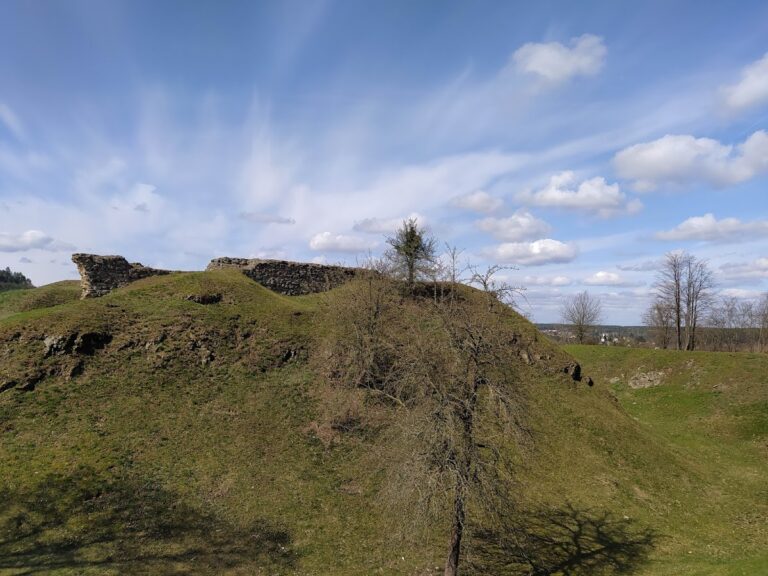
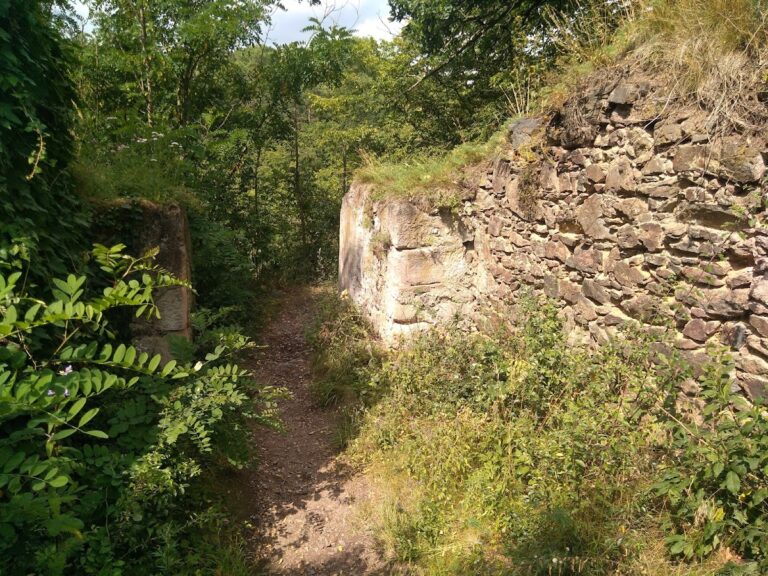
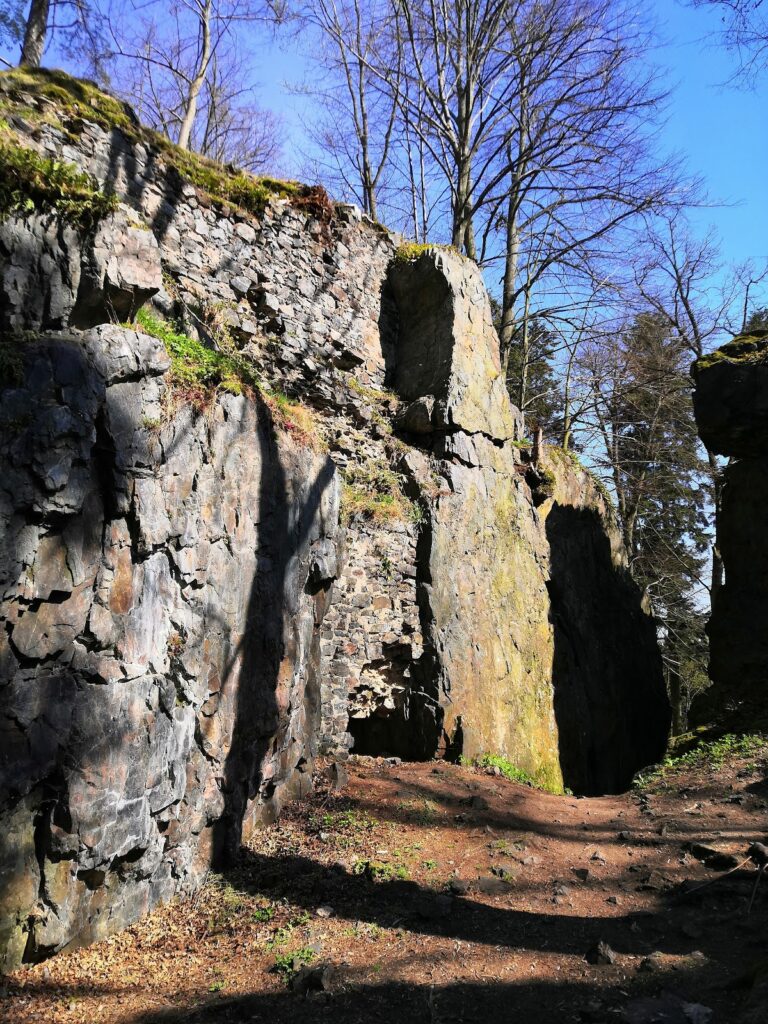
The castle’s defensive design was shaped by the narrow, rocky ridge on which it was built. This terrain limited the ability to encircle the site with a complete defensive wall. The primary entrance passed through a first gatehouse, protected by a short moat. From there, a bridge crossed the moat to reach a second gate tower. Curtain walls about 1.2 meters thick extended outward from this tower. The southern approach was further reinforced by a barbican, a fortified outwork, and a horseshoe-shaped bastion believed to have been constructed in the 15th century. This bastion included defensive loopholes positioned at its base, enabling defenders to cover the moat below.
On the northern side, the curtain wall connected to a rectangular building measuring roughly 9 by 6 meters, likely serving as a stable. From this point, a thinner wall descended the steep hillside toward the semi-circular tower, creating a defensive boundary on that slope.
There is evidence suggesting the presence of a possible third gatehouse. This feature appears to have narrowed the passage between the outer defensive wall and surrounding rock formations to just two or three meters, controlling access to the site.
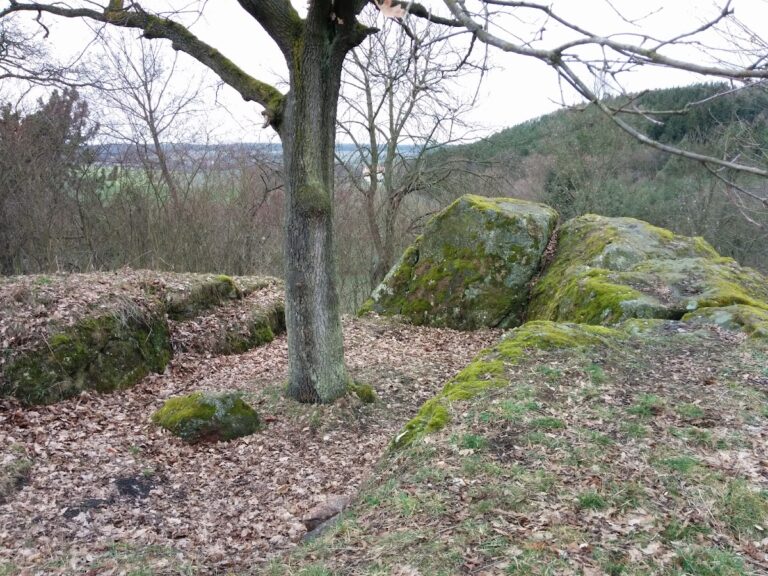
West of the square tower lies a small courtyard area, which housed economic buildings and a cistern cut about 10 meters deep into the sandstone rock. This courtyard enclosed a space approximately 18 by 16 meters, once surrounded by a wall that has nearly disappeared over time.
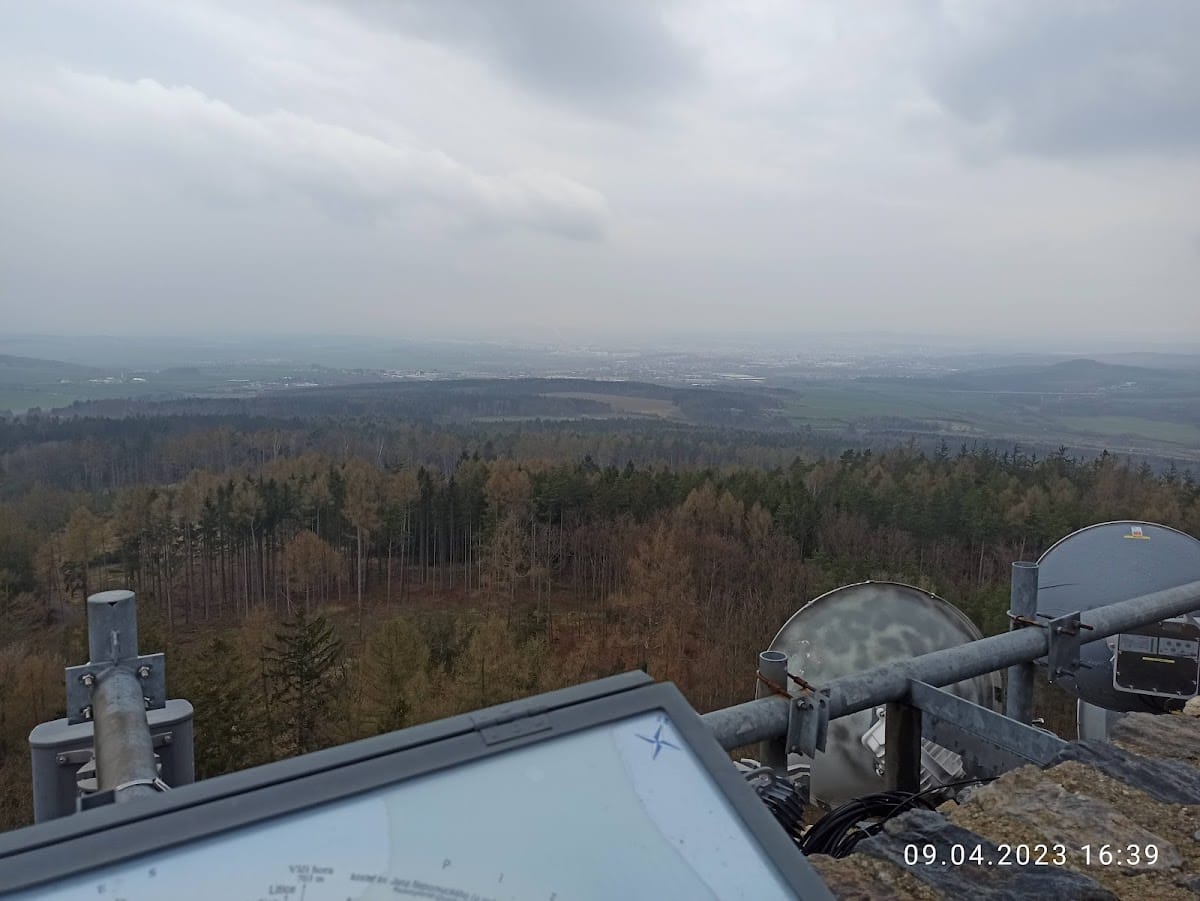
Today, Radyně stands as a ruin but retains significant structural elements. The square tower, notably restored during the 19th-century Romantic renovation, was converted into a habitable chamber furnished with period details. Its elevated position now functions as a lookout, offering expansive views, while inviting visitors to explore the castle’s layered history through its remaining architectural fabric.
Nearby sites