Picton Castle: A Medieval Castle and Historic Estate in Wales


Site at a Glance
- Rating
- 4.4
- Popularity
- Low
- Country
- United Kingdom
- Primary era
- Medieval
- External website
- Open
- Eras represented
- Medieval, Early Modern, Modern
- Civilizations
- British, English
- Site type
- Military
- Remains
- Castle
On this page11 sections
History
Picton Castle is a medieval castle in Wales near Haverfordwest, developed under Norman rule and rebuilt in stone between 1295 and 1308. Its unusual seven-towered form, later remodelling, and long association with the Philipps family reflect the changing political and social history of Pembrokeshire.
Norman settlement and the first fortress
Until the late eleventh century, the area formed part of Deheubarth, a medieval Welsh kingdom in southwestern Wales. After King Rhys ap Tewdwr was killed at the Battle of Brecon in 1093, Norman forces seized much of southern Wales. Following a failed Norman revolt against Henry I of England in 1102, the king reorganised the region around the Daugleddau Estuary, Milford Haven, and the Penfro peninsula as the Marcher Lordship of Pembroke. A Marcher Lordship was a frontier territory whose lord exercised unusually broad powers on behalf of the English crown.
Flooding in Flanders in 1108 led Henry I to settle many Flemish refugees in the hinterland of the lordship, including Haverford and Dungleddy. In Dungleddy, a historical region east of the Daugleddau Estuary, the settlers were led by Wizo, lord of Wiston, who distributed estates among his followers. One unnamed Flemish mesne lord, a feudal landholder who held land from a superior lord, received land at Picton, about three miles south of Wiston.
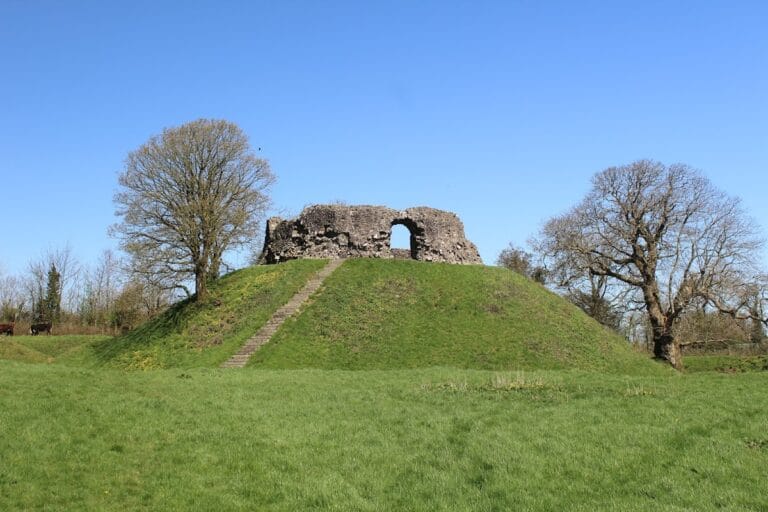
The first fortress at Picton was probably a timber structure on a raised earthwork mound, or motte, several hundred yards east of the present castle, although the precise location remains uncertain. By the end of the thirteenth century, a castle stood at the present site and was held by the Wogan family, who also owned Wiston Castle. The circumstances of the transfer to the Wogans are unclear. They may have inherited the estate through the failure of a male line or gained it through the marriage of an heiress.
The Wogan castle
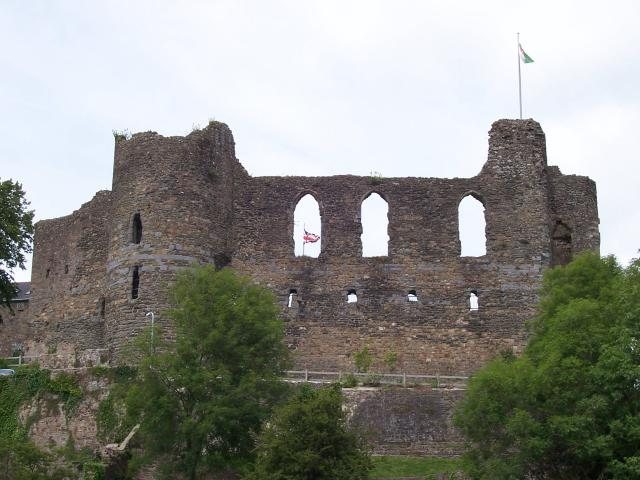
By the thirteenth century, Wiston Castle appears to have been abandoned, and the Wogans moved their principal residence to Picton. Sir John Wogan, a vassal of William de Valence, reconstructed Picton in stone between 1295 and 1308. The later Wogans were also connected by descent and marriage to Cadifor ap Collwyn, traditionally regarded as a lord of Dyfed during the time of Rhys ap Tewdwr.
Picton was attacked and seized in 1405 by French troops supporting Owain Glyndwr, a Welsh prince who led a revolt against English rule in the early fifteenth century. The castle and estate were seized again in 1645 by Parliamentary forces during the English Civil War.
The Philipps family and the estate
The male line of the Wogans ended in the fifteenth century. Their heiress Katherine married Owen Dwnn, and their grandson, Sir Henry Dunn, had only daughters. In the 1490s, Sir Henry’s daughter Jane married Sir Thomas ap Philipps of Cilsant, transferring Picton to the Philipps family.
The Philipps family remodelled the castle and remained associated with it for several centuries. During the seventeenth and eighteenth centuries, the family became one of the most powerful in Pembrokeshire. Its members held extensive estates and supplied sheriffs, justices of the peace, lords lieutenant, and members of the House of Lords. A justice of the peace was a local magistrate, while a lord lieutenant was the Crown’s senior representative in a county. Picton Castle consequently became a centre of local social and cultural life.
In 1611, Sir John Philipps paid £1,095 for a hereditary baronetcy, a title below the ranks of the peerage. The payment formed part of King James I’s scheme to finance his army in Ireland and was described as sufficient to maintain thirty soldiers for three years.
Picton also has a connection with the history of slavery and domestic service in Britain. In June 1762, Cesar Picton, a Black child presumed to have been taken from Senegal, travelled with the Philipps family from Norbiton Place in Kingston upon Thames to Picton Castle. He remained at the castle when the family returned to England in October, apparently to be trained as a servant. He later adopted the surname Picton, possibly because of his brief residence there.
Nineteenth-century succession and modern stewardship
Richard Philipps received the title Baron Milford in 1776. After his death in 1823 without male descendants, the estate passed to his cousin Richard Grant. Grant assumed the Philipps surname, became a baronet in 1828, and was created Baron Milford in 1847. That title ended after his death in 1857 because he also had no male descendants.
The estate then passed to Grant’s half-brother, the Reverend James Henry Alexander Philipps, formerly Gwyther, who assumed the Philipps name and arms by royal licence. After his death, the estate went to his son-in-law Charles Edward Gregg Philipps, who became a baronet of Picton in 1887. It later passed to Sir Richard Foley Foley-Philipps, a descendant of Charles Edward Gregg Philipps.
Picton Castle is now owned and managed for public benefit by the Picton Castle Trust, a registered charity. The castle is a Grade I listed building. The walled garden is Grade II listed, and the gardens and park are designated Grade II* on the Cadw/ICOMOS Register of Parks and Gardens of Special Historic Interest in Wales. These grades identify protected historic buildings and designed landscapes, with Grade I and Grade II* representing the highest levels of special interest within their respective systems.
Remains
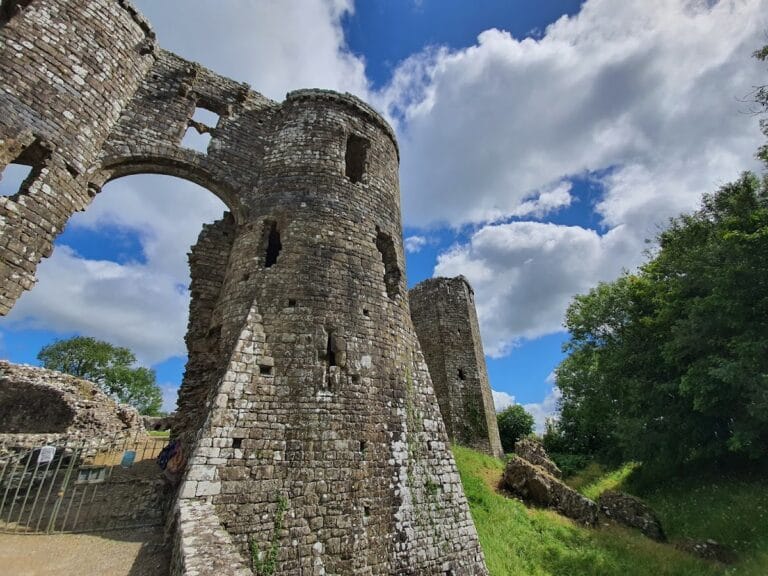
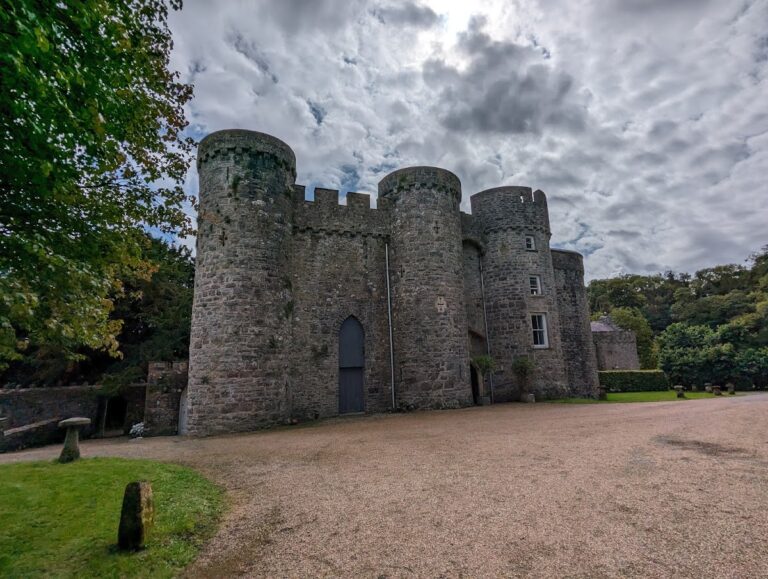
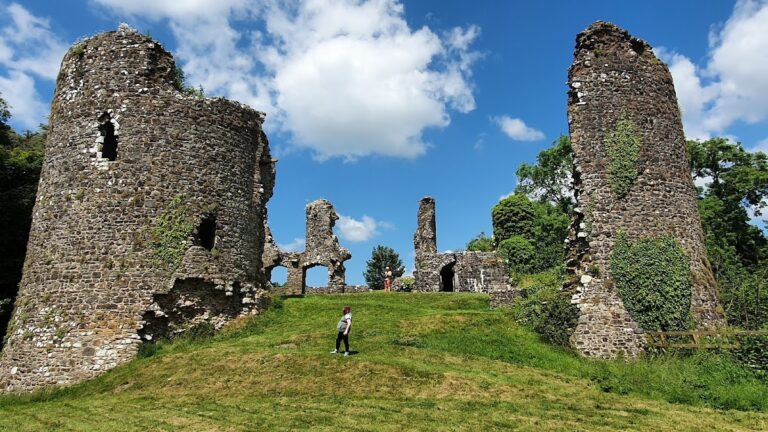
Picton Castle consists of a rectangular main building enclosed by seven projecting circular towers rather than an internal courtyard. Four towers occupy the corners, two stand at the eastern entrance, and one projects from the west side. A walled courtyard lies outside the castle. The design developed from the earlier motte castle and has been compared with thirteenth-century Irish castles, although Picton’s arrangement of seven towers differs from the four corner towers generally used in those examples.
The medieval castle and later alterations
Seven-towered building
The two eastern towers were joined to form a gatehouse, a structure combining an entrance with defensive rooms. Its portcullised entrance, fitted with a vertically dropping defensive gate, opened directly into the vaulted lower part of the great hall instead of leading into an internal courtyard. The earliest windows were narrow defensive slits. Around 1400, they were replaced or enlarged as large windows, and a grand recessed arch containing a large window was added to the gatehouse.
Georgian and Regency changes
In 1697, John Philipps, the fourth Baronet of Picton Castle, built parallel walls in front of the gatehouse and formed a terraced approach to the first floor, creating the principal entrance. He also inserted another floor above the great hall and probably altered some windows and rooms. Between 1749 and 1752, John Philipps, the sixth Baronet, remodelled the interior in the Georgian style. The work renovated and replastered rooms above the basement and introduced panelling, wooden floors, vertically sliding sash windows, and at least four marble-effect fireplaces.
Around 1800, the entrance was altered again. The large arch was reduced and replaced by a smaller round-arched window, while a small porch with a balcony was placed before the main entrance. A four-storey west wing in the Regency style, associated with the early nineteenth-century period around the Regency, was added several years later. Around 1820, the terrace before the entrance was greatly enlarged and given its present rounded form. The porch and balcony were removed and replaced by a portal with a Gothic round arch, above which two round-arched windows were installed.
Gardens and estate features
The grounds cover more than 40 acres and include the Walled Garden, Jungle Garden, Peach House Woods, Peep-In Woods, Dew Pond, Fernery, and Apothecary’s Garden. The estate also contains gatehouse lodges, a restaurant, a shop, and self-catering accommodation. The walled garden and the wider gardens and park form part of the protected historic landscape associated with Picton Castle.
The Picton Renoir
The castle houses a painting known as the Picton Renoir. It was featured in the 2015 television programme Fake or Fortune?, which examined disagreements among art authorities and controversies surrounding the Wildenstein Institute, an art-research and authentication institution involved in evaluating works attributed to Pierre-Auguste Renoir and other artists.