Upton Castle: A Medieval Fortified Mansion in Pembrokeshire


Site at a Glance
- Rating
- 4.5
- Popularity
- Low
- Country
- United Kingdom
- Primary era
- Medieval
- External website
- Open
- Eras represented
- Medieval, Modern
- Civilizations
- Norman
- Site type
- Military
- Remains
- Castle
On this page10 sections
History
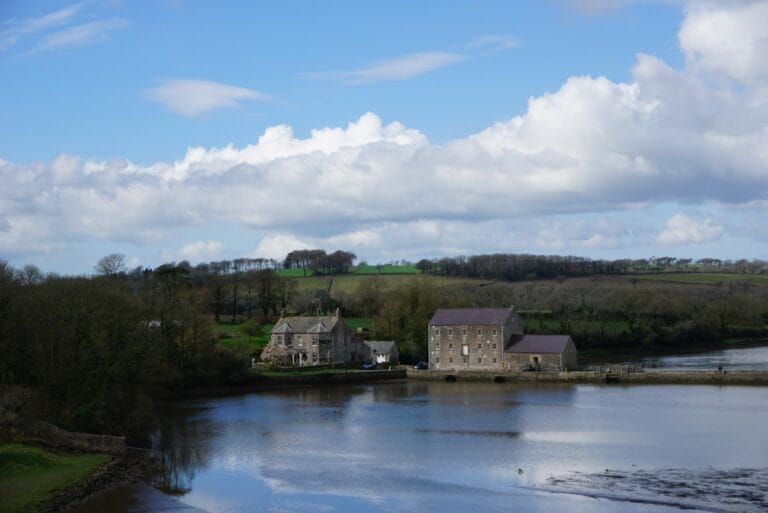
Upton Castle is a medieval fortified mansion in the United Kingdom, at Cosheston in Pembrokeshire, built probably in the thirteenth century during the period of Norman control in South Pembrokeshire. It formed part of a chain of defensive structures established to secure a fertile and strategically important area near a creek of the River Cleddau. The castle stands beside an older Christian site, making its history extend beyond the construction of the surviving medieval residence.
Early Christian and Norman foundations
The place had an association with early Celtic Christian worship before the castle was built. Christian burials around Upton Chapel have been radiocarbon-dated to approximately 1010–1160. Archaeological work also identified an apse, a rounded or polygonal end commonly found at the eastern end of a church and characteristic here of a twelfth-century Norman Romanesque building. The chapel at Upton was mentioned by Gerald of Wales, a medieval cleric and writer, by 1188. Investigation in 2012 confirmed that the chapel predates the castle.
The settlement appeared under several forms of its name, including Ucceton, Ockendon, Octon, Oucheton, and Openton. The first known owners of the castle were the Norman Malefant family. They retained it until the fifteenth century, when it passed through marriage to a family that adopted the name Bowen.
Ownership and transformation
John Tasker, a bachelor connected with the East India Company, purchased Upton Castle in December 1789 for £7,000. The company had combined commercial and colonial authority in South Asia and elsewhere, while Tasker himself served as Master Attendant of the Port of Bombay, a senior official overseeing shipping and harbour operations. He may have been responsible for constructing the walled garden. In 1791, he lent John Cambell of Stackpole Court £10,000 through a mortgage.
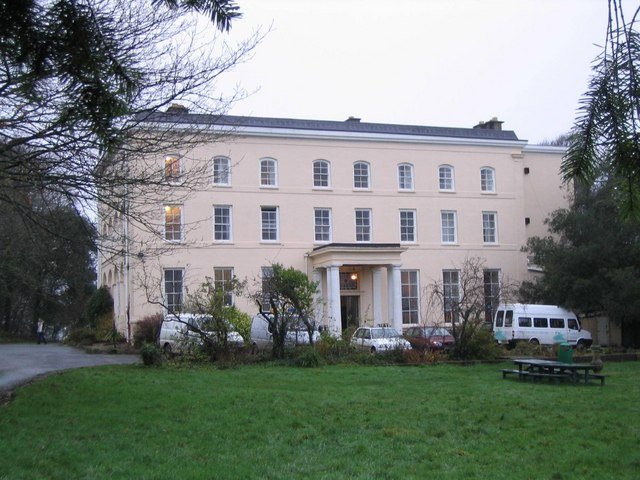
When Tasker died in 1800, the estate passed to his three nieces and eventually to his grand-niece Maria. She married first the Reverend Thomas Woods and later the Reverend William Evan of Hook Norton. Nicholas Carlisle described the castle as being in ruins in 1811. Major alterations followed between 1828 and 1860, including the insertion of a new door and the construction of two towers facing west.
In 1867, Sir Henry Halford Vaughan moved to Upton Castle as a tenant with his wife, Adeline Vaughan. Vaughan was a historian and Regius Professor of History at Oxford, a holder of an academic chair established by royal authority. Virginia Woolf was rumoured to have visited her aunt at the castle, although no written evidence confirms the visit.
Fire, gardens, and modern stewardship
A fire broke out at the castle in January 1883 while Vaughan still lived there. A crew from the 23rd Regiment, Royal Welsh Fusiliers, attended. The damage was limited to timbers, walls, and a chimney-piece.
Stanley Neale, a ship owner from Cardiff, bought Upton Castle in 1927. He landscaped the terraces and planted the arboretum, a managed collection of trees. The gardens had already undergone substantial improvement during the early twentieth century. Management later passed to Pembrokeshire Coast National Park, and the gardens opened to the public in 1976. After the park authority withdrew its funding, the property changed hands in 2007. The new owners, assisted by volunteers, restored and reopened the gardens.
Upton Castle remains privately owned. The castle is a Grade II listed building, while Upton Chapel has Grade I status. The gardens are listed at Grade II on the Cadw/ICOMOS Register of Parks and Gardens of Special Historic Interest in Wales. Cadw is the Welsh Government’s historic-environment service, and ICOMOS is an international organisation concerned with cultural-heritage conservation.
Remains
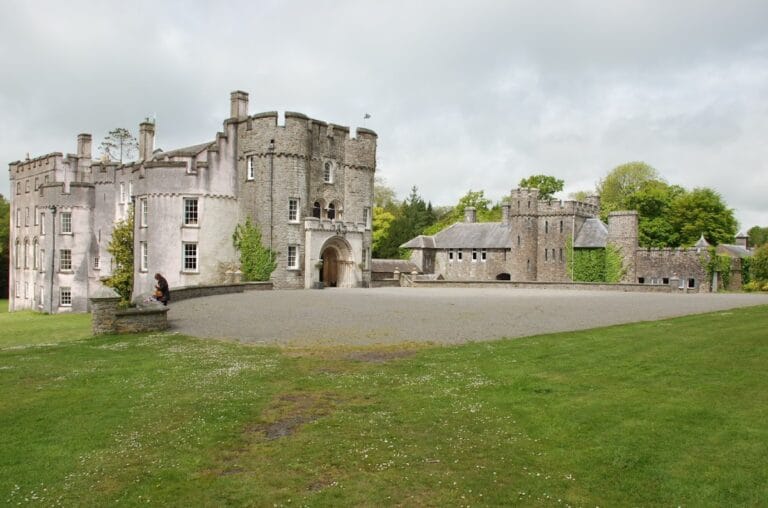
Upton Castle is a small fortified mansion, a residence equipped with defensive features without following the formal plan of a full castle. Its medieval exterior survives at the north-east end of the range. Three early towers dominate the principal range, with short stretches of curtain wall between them. The curtain wall links the fortified structures, while a plain parapet, or low protective wall, runs along the tops on projecting corbels that support the masonry.
The castle buildings and grounds
Towers and curtain walls
The three early towers give the medieval part of the building its defensive character. Their strength is unusual among comparable fortified mansions. The towers are joined by the surviving curtain-wall sections and have plain parapets carried on corbels. Later work altered the building, including the new door and two west-facing towers constructed between 1828 and 1860.
Medieval interiors
Inside the castle, medieval features include two fireplaces, a spiral staircase, and a vaulted ceiling. These elements survive within the altered range and retain evidence of the building’s earlier domestic and defensive phases.
Walled garden and landscaped grounds
A walled garden is associated with the castle and may date from John Tasker’s ownership. The grounds contain landscaped terraces and an arboretum. Their present form also reflects the twentieth-century planting and landscaping undertaken before and during Stanley Neale’s ownership.
Upton Chapel
Upton Chapel stands close to the castle and is dedicated to Saint Giles, a Christian saint traditionally associated with protection from illness and hermit religious practice. Dating from the twelfth or thirteenth century, it consists of a small nave, the main central part of a church, and a chancel, the area around the main altar traditionally reserved for clergy. The chapel contains an effigy of William Malefant, who died in 1362, shown wearing chain mail made from interlinked metal rings, together with an effigy of a female member of the Malefant family. The chapel interior was restored by the castle’s owner in 1978.