Narberth Castle: An Anglo-Norman Stronghold in Wales


Site at a Glance
- Rating
- 4.2
- Popularity
- Low
- Country
- United Kingdom
- Primary era
- Medieval
- External website
- Open
- Eras represented
- Medieval
- Civilizations
- Norman
- Site type
- Military
- Remains
- Castle
On this page12 sections
History
Narberth Castle is a ruined Anglo-Norman stronghold in Narberth, Wales, in the United Kingdom. Standing at the southern edge of the town centre, it developed as the centre of a small lordship after the Norman conquest of south-west Wales, although the origins of the castle remain uncertain. Local tradition connects the site with Pwyll, a legendary prince of Dyfed in the medieval Welsh prose tales known as the Mabinogion.
Norman Origins and Welsh Conflict
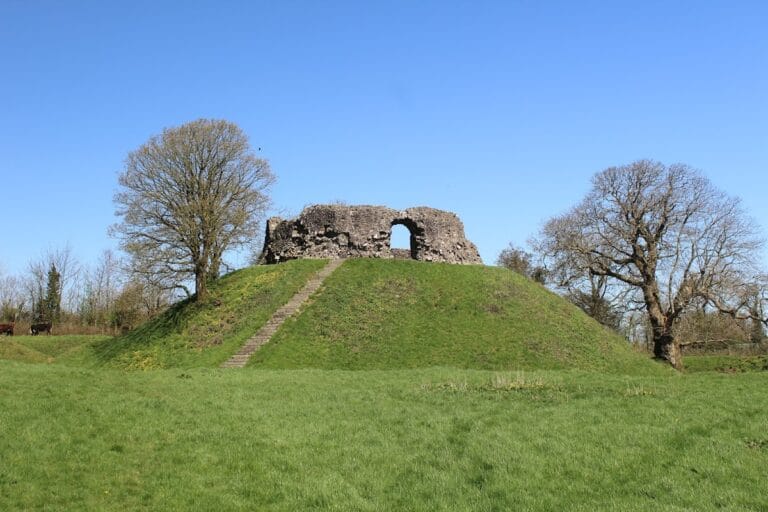
A first Norman castle was probably established by a follower of Arnulf de Montgomery. It may have been a motte-and-bailey, a raised earth mound beside an enclosed defensive yard, both probably protected by timber and earthworks. The location of this early stronghold is disputed. It may have stood at Sentence Castle near Templeton, about 3 kilometres south of Narberth, or on the site of the present ruins. No archaeological evidence confirms that the current castle occupies the location of the first Norman foundation.
A tradition dates the castle’s construction to 1092 and attributes it to Sir Stephen Perrot, but this account is unsupported, and even the historical existence of Stephen Perrot is uncertain. The Norman castle was probably attacked during a Welsh uprising in 1113. Gruffydd ap Rhys captured and destroyed it in 1116, after which it was rebuilt. Henry I of England mentioned Narberth in a document issued in 1130.
Around 1130, the district was granted to Henry FitzHenry, who used the title Lord of Narberth. He was killed in battle against the Welsh in 1157, and the succession of the Anglo-Norman lords after his death is uncertain. Renewed warfare between the Welsh, led by Lord Rhys, and the English probably brought Narberth into contention from about 1189.
The Marshals and Mortimers
By no later than 1199, Narberth and Pembrokeshire had passed to William Marshal, 1st Earl of Pembroke. The Welsh under Llywelyn ab Iorwerth probably captured the castle in 1215 or 1220. William Marshal, 2nd Earl of Pembroke, recovered it in 1223.
After Anselm Marshal died in 1246, Narberth passed to Roger Mortimer of Wigmore. It then became the centre of an independent lordship in the Welsh Marches, the border territories between Wales and England where marcher lords exercised considerable authority. A stone castle may have been begun under the Mortimers, perhaps after Llywelyn ap Gruffydd destroyed an earlier stronghold in 1257 during the Anglo-Welsh war that had begun the previous year.
Roger Mortimer of Chirk inherited Narberth in 1282. During a Welsh revolt in 1299, the castle was burned while he was campaigning in Gascony for the king. Nearby St Clears Castle was also burned. Narberth was subsequently rebuilt.
Roger Mortimer of Chirk later joined an unsuccessful rebellion against Edward II during the Despenser War, a conflict between the king, the Despenser family, and opposing English nobles. After the rebellion, he lost his estates. Edward II granted Narberth Castle and its lordship to the Welsh nobleman Rhys ap Gruffydd, who was required to surrender it to Edward III in 1337. Edward III granted Narberth to Roger Mortimer, 2nd Earl of March, in 1354. Roger Mortimer, 4th Earl of March, later transferred the lordship to his younger brother, Edmund Mortimer.
Rebellion, Crown Control, and Decline
Edmund Mortimer joined the Welsh rebels during the rebellion led by Owain Glyndwr. Henry IV confiscated Narberth in 1402, and the castle remained under English control with a small garrison. Its commander, Thomas Carew, was made Lord of Narberth in 1404. After the rebellion ended, the lordship returned to Edmund Mortimer’s nephew, the 5th Earl of March.
When the 5th Earl died without children in 1425, Richard of York inherited the lordship. In 1449 he granted Narberth to the Welsh landowner Gruffudd ap Nicolas. Gruffudd had been overthrown by no later than 1456, and the castle returned to the Crown in 1460. By that time it had already lost its military importance.
Henry VIII granted Narberth Castle to Rhys ap Thomas in 1516. Rhys was the powerful deputy justiciar of South Wales, and he may have converted or enlarged the castle as a residence, although this attribution remains disputed. After Rhys’s grandson, Rhys ap Gruffydd Fitzurien, was executed for treason in 1531, Narberth returned to the Crown.
By the sixteenth century, the fortifications were already considered ruinous. The Laws in Wales Acts of 1535 ended Narberth’s status as an independent lordship. Around 1620, the landowner George Barlow bought the ruined castle, its estate, and its remaining rights. Despite its deteriorated condition, the castle still served as a courthouse at that time.
Narberth played no significant role in the English Civil War. A tenant probably occupied part of the ruins until about 1677. The castle was then permanently abandoned, used as a source of stone, and left to decay. Pembrokeshire County Council later leased the ruins. Archaeological investigations in 2003 and 2004 were followed by restoration and consolidation. Narberth is now a Grade I listed historic monument and a protected Scheduled Monument, a legally protected archaeological or historic site considered nationally important.
Remains
Layout and Defences
Narberth Castle occupies a rocky site with steep drops on three sides, a position that allowed control of the valley and the Narberth Brook. The stronghold formed an irregular rectangle around a single courtyard. It was relatively small, measuring about 50 metres from north to south and approximately 25 metres across.
Four round corner towers formed the principal defensive arrangement, supplemented by a small tower in the western wall and a gatehouse. The northern entrance was protected by a ditch. A bailey may have stood on the north side, although this has not been demonstrated. A semicircular outwork protected the southern side of the castle.
Southern Towers
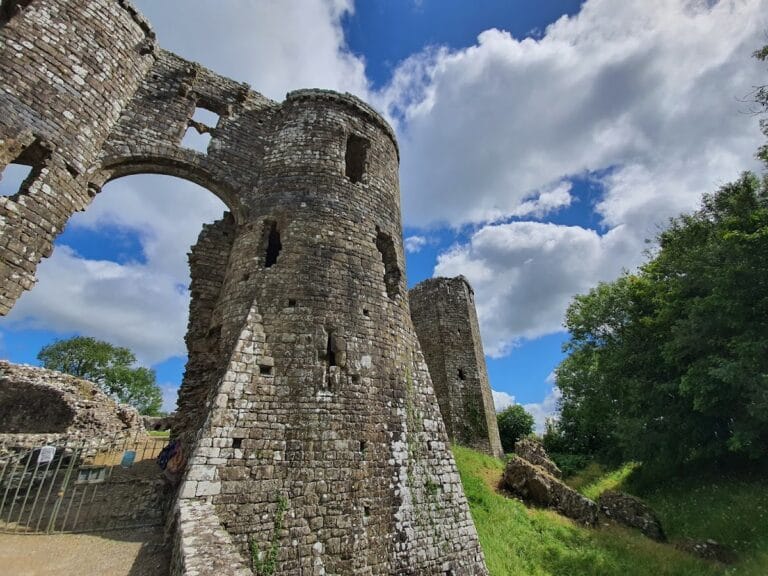
The two southern corner towers survive as ruins. The south-western tower, known as the Chapel Tower, retains three storeys and is the best-preserved part of the castle. It also served as a bakehouse. The south-eastern tower survives only in parts, with sections of its structure remaining at the southern edge of the courtyard.
Northern Defences and Gatehouse
Only slight remains survive from the two northern towers, while almost nothing remains of the gatehouse. The northern ditch and the surviving fragments of the enclosing walls nevertheless indicate how the entrance and outer defences were arranged.
Courtyard Buildings
Southern Residential Range
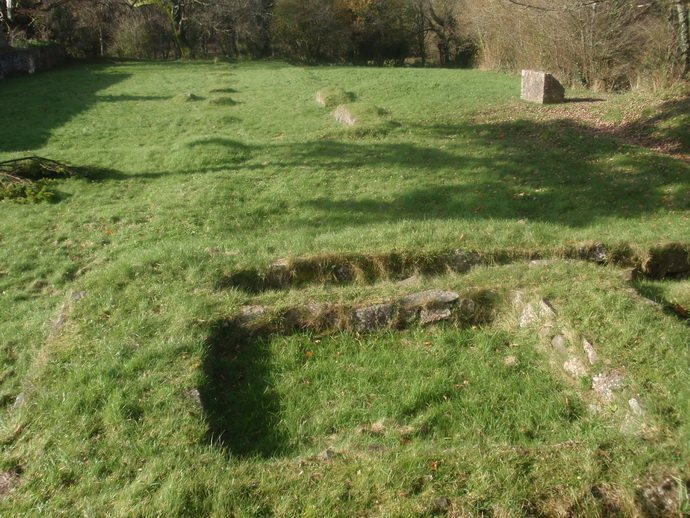
A probable two-storey residential building stood along the southern side of the courtyard. Sections of its ground-floor courtyard wall remain. The lower level contained a kitchen, while the upper storey held a residential hall.
Eastern Building
A further building on the eastern side was probably also residential. Its surviving remains consist of a vaulted basement, which preserves part of the building’s original arrangement and construction.
Earlier Burial Evidence
The rebuilding of Narberth in stone may have involved moving a church and cemetery that probably occupied the site earlier. Human remains found in the area support this possibility, although the interpretation is not certain. This evidence adds a possible pre-castle phase to the history of the ground later enclosed by the stone stronghold.