Takht-e Fulad: A Historic Cemetery and Funerary Complex in Isfahan, Iran
Site at a Glance
- Popularity
- Very High
- Country
- Iran
- Primary era
- Medieval
- Eras represented
- Medieval, Early Modern, Modern
- Civilizations
- Afsharid, Ilkhanate, Qajar, Safavid, Zand
- Site type
- Burial
- Remains
- Necropolis
On this page20 sections
History
Origins and early associations
Takht-e Fulad is a historic cemetery and funerary complex in Isfahan, Iran. Its establishment is generally placed around the 10th century, although a pre-Islamic origin has also been proposed. The complex later expanded under Safavid rule and includes features associated with Safavid architecture.
In 316 AH, Mardavij, a ruler of the Ziyarid dynasty, held the ancient Iranian midwinter festival of Sadeh, traditionally marked with fire, on land between the Zayandeh River and Hazar Darreh. This wider area included Takht-e Fulad and Lisan al-Arz, and was probably uncultivated at the time. A tradition recorded by French traveler and writer Jean Chardin links the place to a military commander of the Daylamid dynasty, who was said to have had a small palace and a stone platform-like seat from which he watched wrestling. It remains uncertain whether a mystic of the fifth century AH took an epithet from the place or the place acquired its name from him.
Ilkhanid and Safavid periods
During the Ilkhanid period, when a Mongol dynasty ruled Iran, the cemetery became associated with Baba Rokneddin, a prominent Persian Sufi of the 14th century, and was subsequently named for him. It also became a gathering place for Sufi mystics and dervishes, followers of Sufism, a mystical tradition within Islam. A khanqah, or Sufi lodge, was established there.
The cemetery grew and gained prominence under the Safavids, a dynasty that ruled Iran. The construction of a large communal prayer ground and Baba Rokneddin’s mausoleum drew the attention of officials, religious scholars, and the public. During this period, Takht-e Fulad served as an exclusive burial ground for prominent figures of the state. Under Shah Suleiman I, it reached its greatest extent and may have included as many as 400 tekyehs, religious gathering places also associated with burials, and khanqahs.
During the reign of Shah Sultan Husayn, the Shi’a scholar Mohammad-Baqer Majlesi ordered Sufis expelled from Isfahan and their tekyehs at Takht-e Fulad destroyed. Many mausoleums from the Ilkhanid period were also demolished. Sufis and dervishes, whether Shi’a or Sunni, were barred from visiting the cemetery.
Afsharid decline and Qajar renewal
Takht-e Fulad received little attention during Nader Shah Afshar’s rule, apart from a small number of burials. Its buildings and gardens deteriorated during the Afsharid and Zand periods, which followed the Safavids.
The cemetery regained prominence under the Qajars. Mohammad-Hossein Sadr Isfahani, Isfahan’s first governor and later grand vizier to Fath-Ali Shah, was associated with this revival. Fath-Ali Shah built a tekyeh at Takht-e Fulad and dedicated it to his mother. Many more tekyehs were built for prominent scholars. During the reigns of Mohammad Shah and Naser al-Din Shah, while Mass’oud Mirza Zell-e Sultan governed Isfahan, many Safavid buildings at the cemetery were deliberately demolished.
Modern cemetery and heritage status
During Reza Shah’s reign, burials in Isfahan’s other city cemeteries were prohibited and those cemeteries were levelled. Takht-e Fulad consequently became the city’s principal burial ground. Its tekyehs filled with graves, while agricultural and unused land within the complex was converted to burial areas. By the late Pahlavi period, the cemetery was full.
In the 1980s, ordinary burials at Takht-e Fulad stopped and were transferred to Bagh-e Rezvan. Burials continued for war dead at Golestan-e Shohada, a sub-cemetery developed after the Iranian Revolution and during the Iran-Iraq War, the conflict between Iran and Iraq. Golestan-e Shohada was enlarged to include adjacent burial areas and contains victims of the 1981 Haft-e Tir bombing and people killed during the revolution.
In 1387 in Iran’s Solar Hijri calendar, the demolition of a lodge and mausoleum associated with a sheikh of the Gonabadi dervishes was accompanied by clashes between dervishes and security forces. The mausoleum had been listed as a national monument. Takht-e Fulad entered Iran’s National Heritage List on 15 June 1996, and its constituent parts were later listed individually.
Remains
Layout and entrance
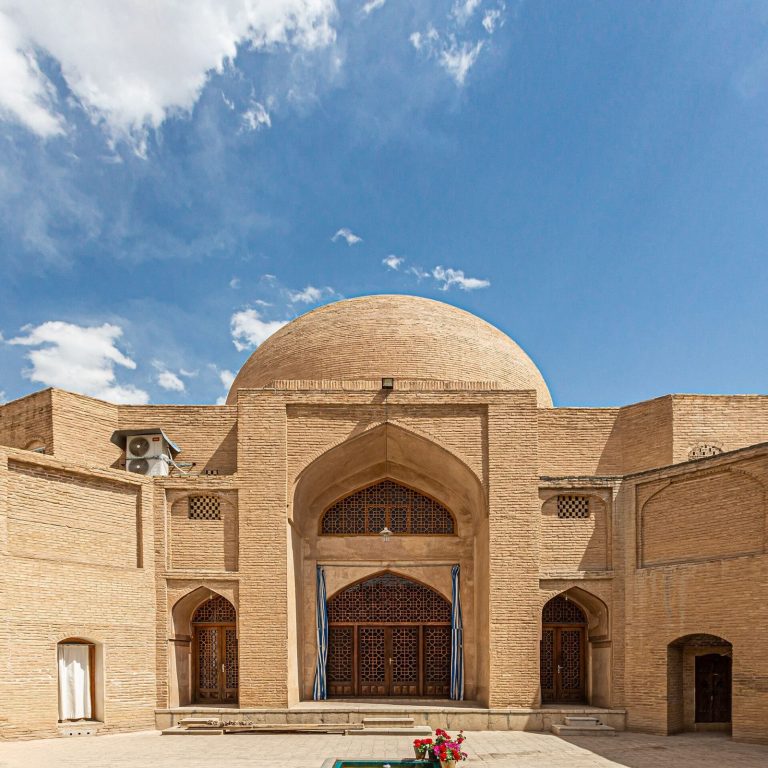
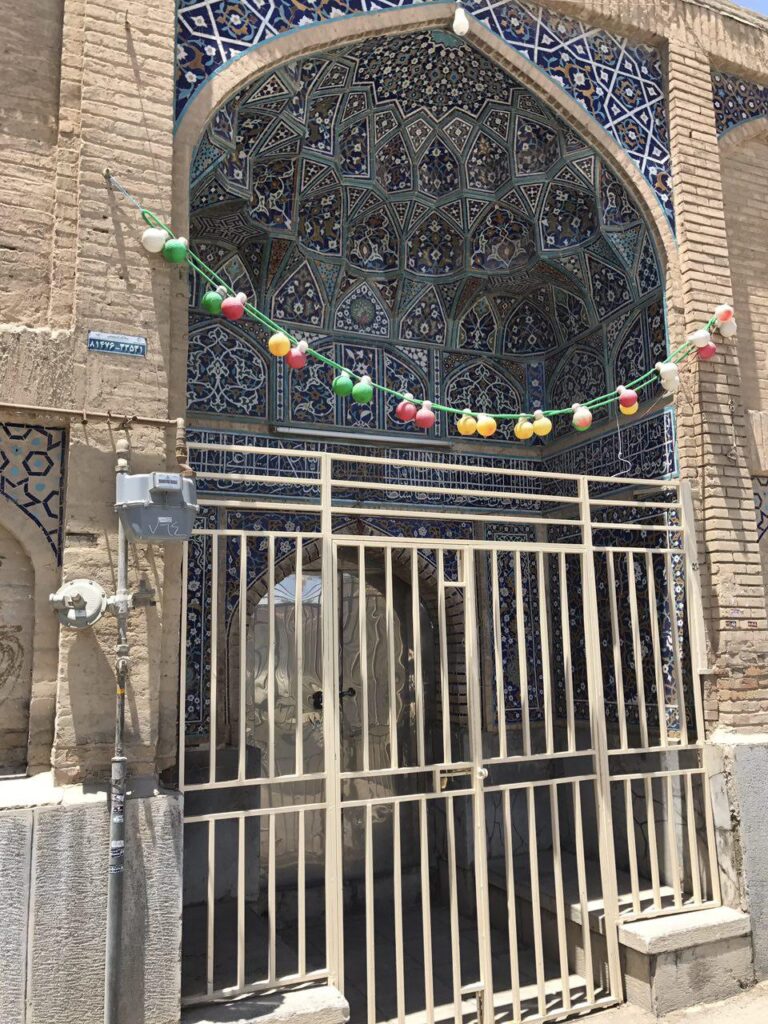
The funerary complex covers about 75 hectares on the southern side of the Zayandeh River, at the end of one of Isfahan’s historic north-south axes. Its varied layout includes mausoleums, mosques, religious gathering places, subsidiary cemeteries, and individual graves. The main entrance is an iwan, a vaulted portal open on one side.
Mausoleums and tomb complexes
Baba Rokneddin Mausoleum
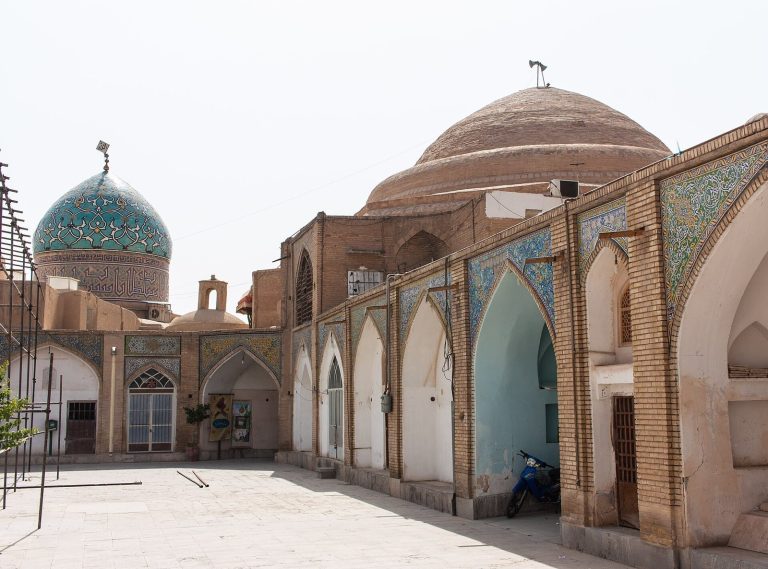
Built during the Ilkhanid period and later restored under Shah Abbas I, Baba Rokneddin’s mausoleum has a blue, pyramidal dome. It is the cemetery’s only surviving Ilkhanid structure.
Khatoon Abadi Mausoleum
The Khatoon Abadi mausoleum forms part of a religious gathering complex and holds the graves of clerics from the Khatoon Abadi family, including the Shi’a scholar of religious traditions Mohammed Hossein Khatunabadi. A small cellar beneath a tomb is believed to have served as a place where a family member withdrew for solitude and meditation.
Mir Fendereski’s Grave
A stone marker at Mir Fendereski’s grave bears the date 1640, the year of his death. Nearby, a lyric poem by Hafez appears in stucco on a wall, written in Nastaliq, a style of Persian calligraphy, by Mir Emad Hassani.
Agha Hossein Khansari Mausoleum
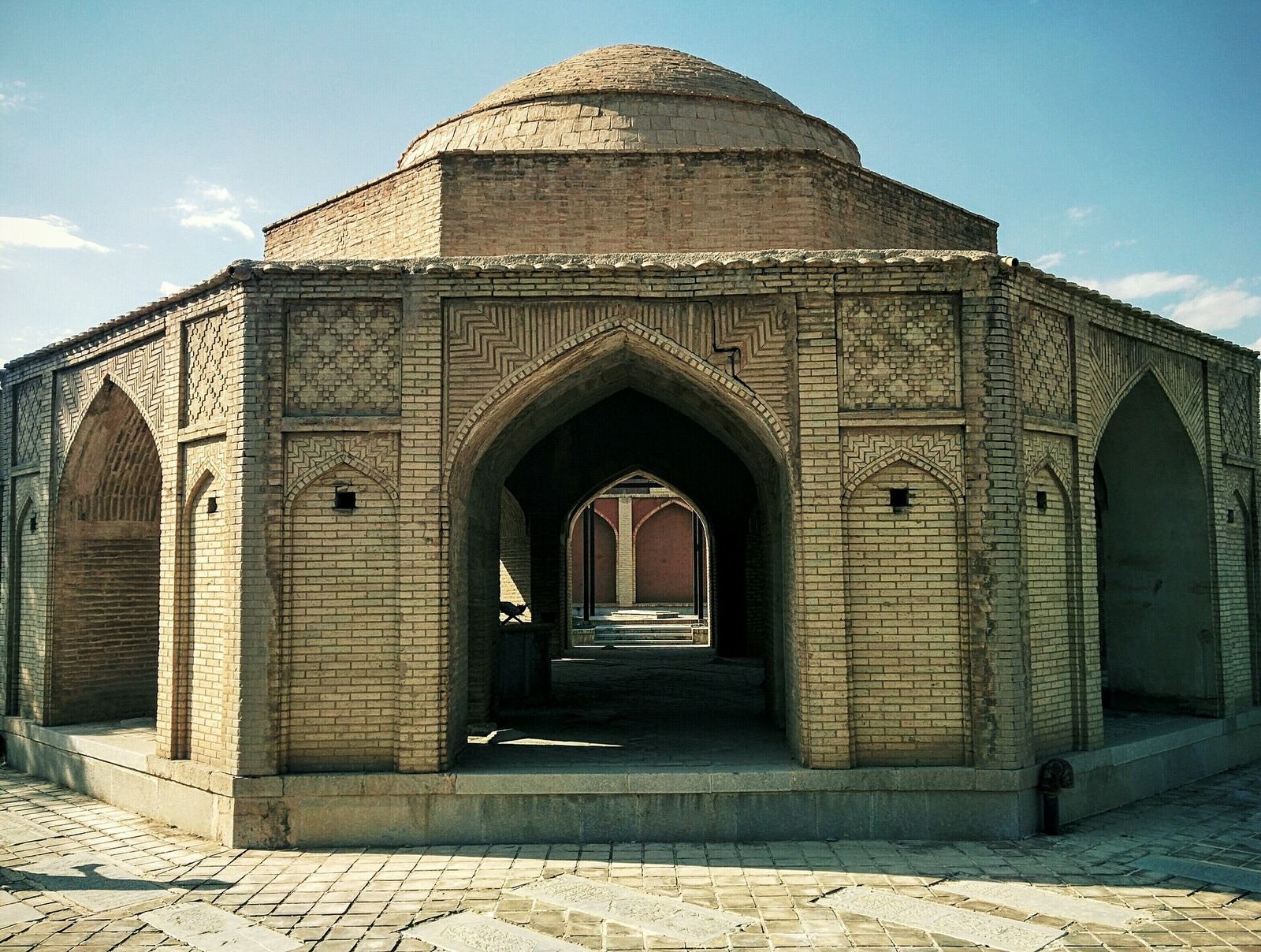
A single dome tops the mausoleum of Agha Hossein Khansari. It is the cemetery’s only mausoleum built for a scholar or engineer.
Mosques and prayer buildings
Roknolmolk Mosque
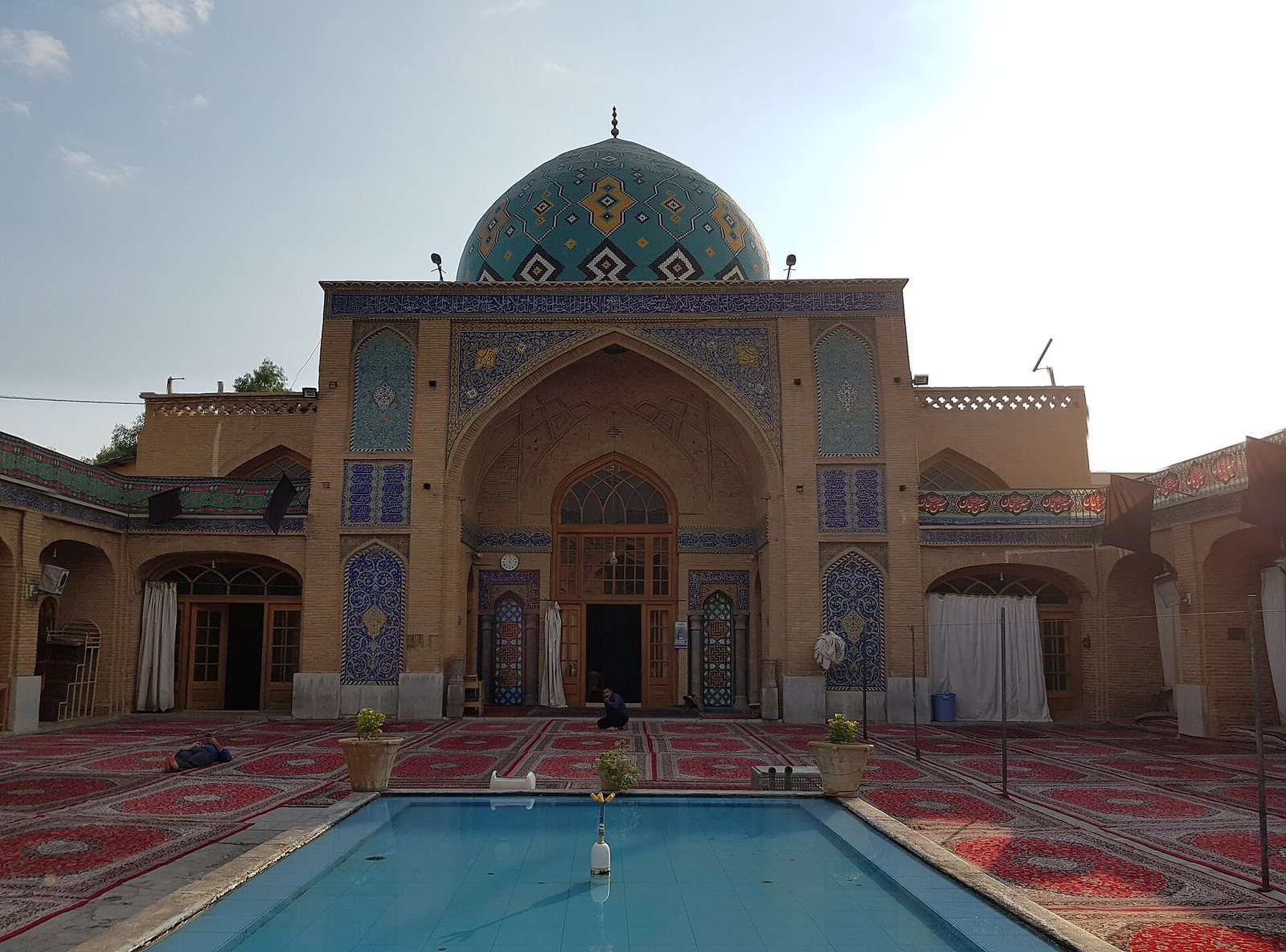
Built during the Qajar period at the edge of the cemetery, Roknolmolk Mosque was formerly called Aksa Mosque, in reference to Jerusalem’s al-Aqsa Mosque. A room near its entrance holds the graves of Roknolmolk and his wife. The mosque also includes a mausoleum for clerics of the Kalbasi family. Roknolmolk is the cemetery’s only surviving mosque.
Mohammad Jafar Abadei Tekyeh
Established by the Qajar viceroy Roknolmolk, the Mohammad Jafar Abadei religious gathering place stands beside Roknolmolk Mosque.
Musallas and demolished buildings
Two Safavid communal prayer grounds stood in the cemetery’s southwest section. One was restored in 1300 AH on the order of Hajj Mohammad-Taqi Naghshineh. Both were later demolished and replaced by Isfahan’s large modern prayer ground. Other losses include a Safavid mosque associated with a religious gathering complex, a Qajar-era mosque, and cisterns linked to five such complexes.
Other remains and burial areas
Caravanserai and smaller structures
A Safavid caravanserai stood beside the cemetery and served as the final stop for caravans arriving in Isfahan from the south. Traces of the building remain. Small shrines and four-pillared structures were among the modest additions made during the Afsharid and Zand periods.
Tombstones and archaeological finds
Finds from the cemetery include tombstones dating to the fourth and fifth centuries AH, among them a marker associated with a mystic of the fifth century AH.
Golestan-e Shohada
Attached to the main cemetery in the southern area associated with Lisan al-Arz, Golestan-e Shohada contains a cenotaph traditionally attributed to the biblical prophet Joshua. The monument commemorates him, but a burial at this location has not been established.