Palazzo Surian Bellotto: A Baroque Palace on Venice’s Cannaregio Canal


Site at a Glance
- Rating
- 4.8
- Popularity
- Very Low
- Country
- Italy
- Primary era
- Early Modern
- Eras represented
- Early Modern
- Civilizations
- Venetian
- Site type
- Domestic
- Remains
- Elite Residence
On this page6 sections
History
Seventeenth-century origins
Palazzo Surian Bellotto is a seventeenth-century Baroque palace in Venice, Italy, overlooking the Cannaregio Canal. Baroque architecture is known for dramatic forms, elaborate ornament, strong contrasts, and expressive spatial effects. The Surian patrician family, which was of Armenian origin, commissioned the building, whose design is attributed to Giuseppe Sardi, the architect also associated with nearby Palazzo Savorgnan.
Toward the end of the seventeenth century, ownership passed to the Bellotto family, who originated in Brescia. This change connected the palace’s later history to a second patrician household while its monumental form remained a defining feature of the Cannaregio district.
The French embassy and Rousseau
During the eighteenth century, Palazzo Surian Bellotto became the French embassy in the Republic of Venice. Jean-Jacques Rousseau, the philosopher and writer whose work influenced European political thought, educational theory, and literary culture, lived in the palace in 1743 and 1744 while serving as secretary to the ambassador, Count de Montaigu.
The palace was also represented in Venetian visual culture. Francesco Guardi depicted it in View of the Cannaregio Canal, painted around 1770.
Decline and renewed use
After the fall of the Republic of Venice, the palace entered a prolonged decline during the nineteenth century. Its sumptuous interiors, original internal structure, and decorations were irreparably lost.
Palazzo Surian Bellotto is among the few historic buildings in Venice still inhabited by Venetians. Since 9 December 2016, its ground floor has housed Laguna Libre, established after a major restoration carried out according to green-building principles. The venue serves as a restaurant and a jazz and world-music club, and provides space for exhibitions, book presentations, public debates, and other events. It also houses the headquarters of Smart Venice, a research and consultancy company concerned with gender equality, inclusive innovation, and sustainability projects.
The palace and Laguna Libre appeared in the France 3 documentary Notre-Dame, Chartres, Venise: chefs-d’oeuvre en renaissance, broadcast on 2 December 2020. The documentary presented them as examples of Venice’s possible recovery after the November 2019 high water and the COVID-19 pandemic of 2020 and 2021.
Remains
Canal facade
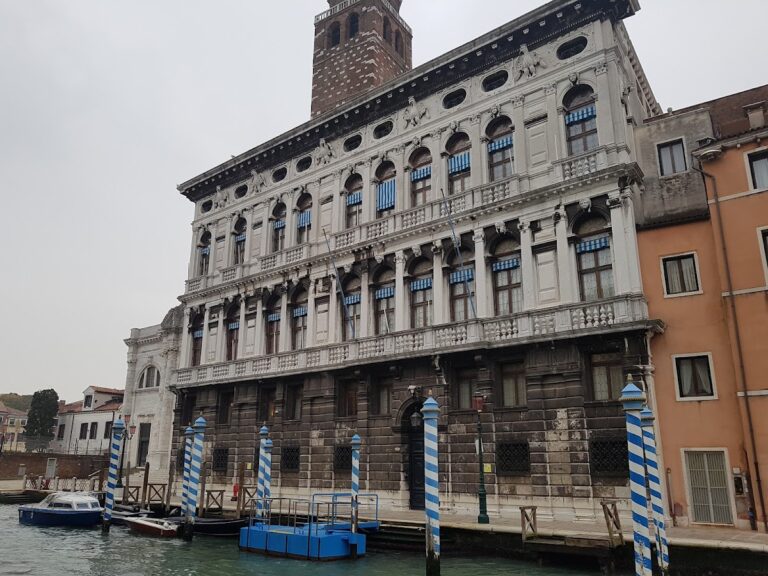
The palace stands in the Cannaregio district on the edge of the Cannaregio Canal. Its large Baroque facade rises four floors above the neighboring buildings and is organized around an asymmetrical design. The central axis shifts to the left, and the principal openings gather around this displaced center.
The shorter wing has two arched ground-floor portals decorated with mascarons, ornamental masks or face motifs, and framed by rusticated bands. Rustication emphasizes the joints or rough texture of masonry blocks. The longer wing has another portal at ground level.
The two noble floors, the principal residential levels of a Venetian palace, contain corresponding pairs of serlianas. A serliana is a three-part opening with a central arch flanked by two narrower openings, usually divided by columns or pilasters. The serliana on the second floor is partly walled up. Other openings on these levels are large single windows with stone frames that echo the serliana motifs.
Balustrades, railings formed from rows of supports beneath a top rail, accompany all the openings on the noble floors. Mascarons provide additional ornament. Above them, the fourth floor has a band of smaller rectangular windows. Elaborate string courses, horizontal bands separating the levels, mark the facade, while the top is finished with a dentiled cornice containing a row of small tooth-like blocks.
Nearby sites