San Giobbe: A Renaissance Church in Venice


Site at a Glance
- Rating
- 4.4
- Popularity
- Low
- Country
- Italy
- Primary era
- Medieval
- Eras represented
- Medieval, Early Modern
- Civilizations
- Venetian
- Site type
- Religious
- Remains
- Church
On this page27 sections
History
San Giobbe is a Roman Catholic church dedicated to Saint Job in Venice, Italy, in the Cannaregio district. Built principally between 1450 and 1493, it combines late Gothic elements with Renaissance architecture and became one of the city’s earliest Renaissance buildings. It was one of five votive churches built in Venice after the onset of plague, and it remains an active parish church administered by the Canossians.
A Hospice and Franciscan Foundation
The site began as a charitable foundation rather than as a major church. In 1378, Giovanni Contarini established a hospice for poor and elderly people on land near his house and built a small adjoining oratory dedicated to Saint Job. The hospice began receiving residents in 1380. After Contarini’s death, his daughter Lucia completed the foundation with assistance from the Observant Friars Minor, a reform branch of the Franciscan order that emphasized stricter observance of its rule.
The charitable institution was later administered by the Congregation of the Poor Hermits of Saint Jerome. On 24 November 1428, the hospice and oratory passed to the Observant Friars Minor, who added a monastery. This transfer established the Franciscan character that shaped the complex for centuries.
Bernardino of Siena and the Renaissance Church
Bernardino of Siena preached at the institution in 1443. His preaching helped inspire Cristoforo Moro, who later became doge, the elected head of the Venetian Republic. After Bernardino was canonized in 1450, Moro promoted a chapel dedicated to him, added his name to the church’s dedication, and supported the construction of a new building. A confraternity dedicated to Bernardino was founded on 20 May 1450.
Construction of the present church began in 1450 under Antonio Gambello. Work was interrupted and resumed around 1470, when the sculptor and architect Pietro Lombardo was invited to complete the building. Moro donated 10,000 gold ducats toward its completion in 1471, three months before his death, and was buried inside the church. The building was consecrated on 14 April 1493 by Bishop Bartolomeo Averoldi and consecrated again in 1587 after restoration. Its dedication eventually brought together Saint Job and Bernardino of Siena. Saint Job, the biblical figure whose suffering and perseverance came to represent suffering and divine mercy in Christian interpretation, remained the original patron.
The church’s decoration brought together works by leading Venetian and northern Italian artists, including Giovanni Bellini, Vittore Carpaccio, Marco Basaiti, Paris Bordone, Antonio Vivarini, Pietro Lombardo, and Luca della Robbia. San Giobbe therefore combined charitable origins, Franciscan devotion, and the artistic language of the Renaissance, a European movement that revived classical forms.
Suppression and Changing Uses
The church and monastery remained Franciscan until their suppression under Napoleonic measures. The process began with the decree of 5 June 1805, and the complex was formally dissolved in 1810. The friars were concentrated at San Francesco della Vigna, while the monastery was demolished in 1812.
The former monastery grounds were converted into botanical gardens in 1812 and were later partly damaged by Austrian bombardment. From 1887, part of the former convent area served a strategically important torpedo factory, which operated until 1901. From 1902, the area was used by an electrical company and later for a thermoelectric power station and other electricity-related technical services.
Parish Life and the Dispersal of Artworks
In 1844, the Canossians, a Catholic congregation founded in 1831 by Saint Magdalene of Canossa for charitable and educational work, moved into the surviving wing of the monastery. In June 1952, Patriarch Carlo Agostini established an autonomous parish at San Giobbe from territory detached from San Geremia. The church continues to serve as a parish and forms part of the Chorus Venezia association.
Changes in ownership and use also affected the church’s artistic contents. In 1815, the altarpieces by Giovanni Bellini, Marco Basaiti, and Vittore Carpaccio were transferred to the Gallerie dell’Accademia in Venice, where they remain. These works include Bellini’s Saint Job Altarpiece, Basaiti’s Prayer in the Garden, and Carpaccio’s Presentation of Jesus in the Temple. A reproduction of Bellini’s altarpiece is displayed in connection with the church.
Remains
Exterior and Overall Layout
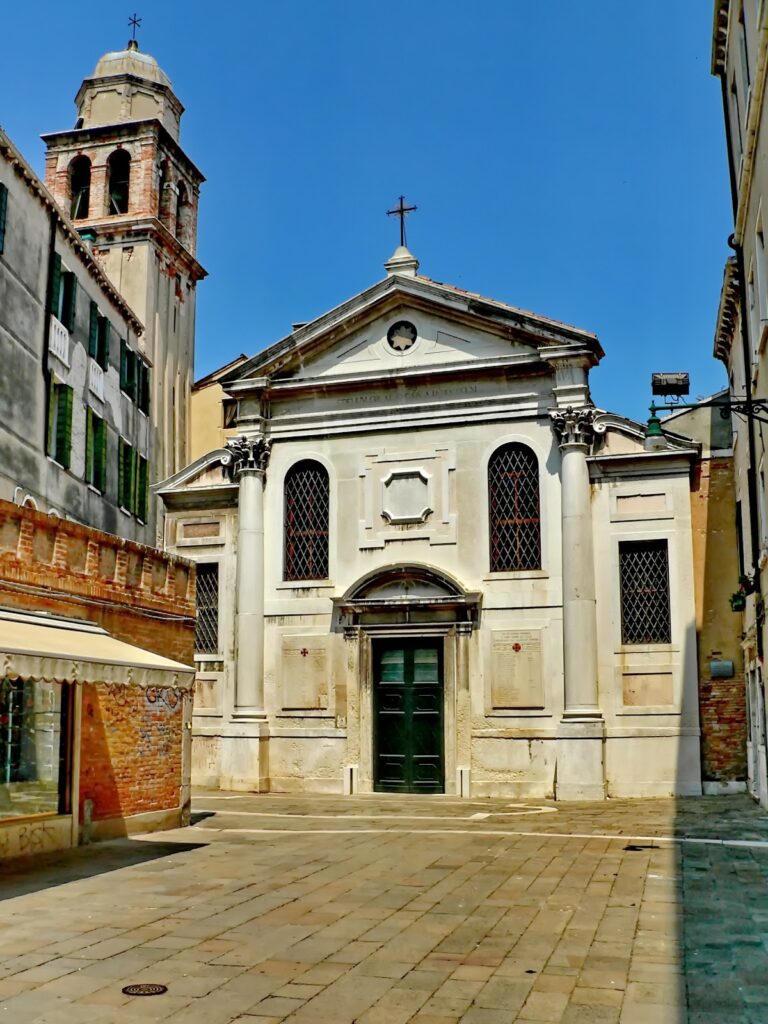
San Giobbe stands on the campo of the same name, also known in Venetian as Sant’Agiopo, on the south bank of the Cannaregio Canal near Ponte dei Tre Archi. The brick building is approximately 42 metres long and 20 metres wide and has a single nave. Its form combines late Gothic construction with Renaissance details. The original church was probably set at a right angle to the earlier oratory, which may have faced the canal. In 1451, Elisabetta Bragadin purchased an adjoining plot that allowed the church to be expanded.
The three-part facade has broad rectangular windows and pilasters and was subsequently rebuilt. Its principal portal, designed and executed by Pietro Lombardo, survives in a refined Renaissance form influenced by Florence. The semicircular area above the doorway, called a lunette, contains a relief of Saint Francis and Saint Job receiving heavenly glory. The surrounding frieze is filled with Franciscan imagery, including thorn branches, flowers, fruits, animals, and an eagle associated with renewal and resurrection. Statues of Bernardino of Siena, Louis of Toulouse, and Anthony of Padua stand above and beside the arch.
Bell Tower and Nave
Campanile
The campanile, or church bell tower, was built between 1451 and 1464 and is attributed to Antonio Gambello and Lorenzo di Gian Francesco. It rises 46 metres and has pointed-arch windows divided into two sections by central supports. These biforate openings are made of Istrian stone, while terracotta details may have come from a nearby brickworks. The bells are operated electromechanically. The tower was restored in 1903, 1905, and 1982.
Nave
The interior is arranged around a single nave and is asymmetrical because the former monastery adjoined the church on the right. Five chapels occupy the left side, while four altars form a linear sequence along the right wall. Large altarpieces and their illusionistic depth provide visual weight along the side without chapels. The nave was originally covered by a timber roof structure and now has a cross vault. The removal of several paintings left carved stone frames in place, including a dolphin-decorated frame formerly associated with Bellini’s altarpiece.
Presbytery and Sacristy
Presbytery
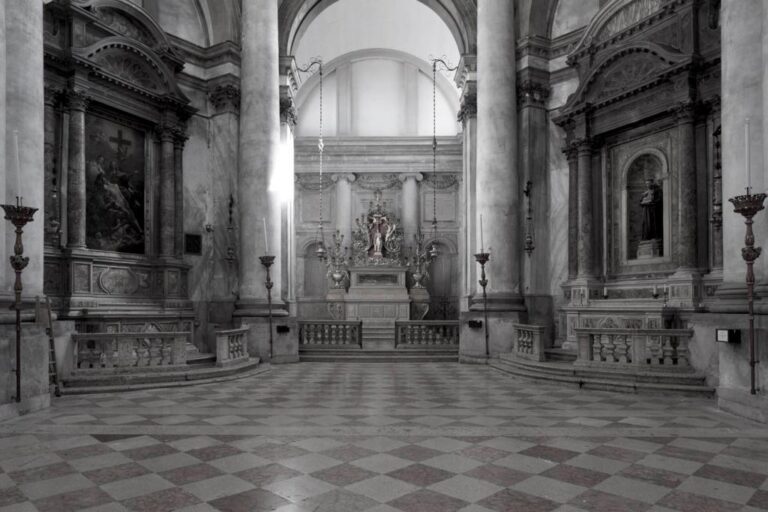
The presbytery is preceded by a triumphal arch, the principal arch separating the nave from the sanctuary. It rests on capitals and is flanked by statues of the Archangel Gabriel and the Virgin of the Annunciation. Old Testament prophets appear on the arch, with a putto at its keystone and the Lamb of God at its crown. The heraldic arms of Cristoforo Moro are displayed above the statues.
The square presbytery is enclosed by four columns and covered by a dome. Its pendentives, the curved triangular sections supporting the dome, contain four Evangelist medallions dated 1475. The medallions are attributed to Pietro Lombardo and made of colored majolica, a tin-glazed earthenware. Eight windows pierce the base of the dome, and an image of God the Father occupies its summit.
The high altar is largely the work of Pietro Lombardo and has a strongly Counter-Reformation character. On the right wall is a sixteenth-century copy of Giovanni Bellini’s portrait of Doge Cristoforo Moro. The floor contains the 1470 tombs of Moro and his wife, Cristina Sanudo. To the right of the presbytery stands the Corner family altar, founded by Piero Corner in 1586. The family arms appear at the column bases, and its altarpiece, Saint Joseph, is attributed to Antonio Marinetti, a pupil of Giovanni Battista Piazzetta.
Contarini Chapel
The Contarini Chapel is probably the surviving nucleus of the original church and retains its Gothic appearance. Monograms of Saint Bernardino on the keystones were added later, during Cristoforo Moro’s period. The chapel contains Girolamo Savoldo’s 1540 Nativity, also known as the Adoration of the Shepherds, together with a stucco tomb monument to Cardinal Marco Antonio Amulio from the workshop of Alessandro Vittoria.
Above the chapel doorway is a funerary monument to Paolo and Agostino, Procurators of Saint Mark, and to Ermolao Nani, made after 1641. A separate monument to Cardinal Marco Antonio Amulio stands above the doors leading to the sacristy.
Sacristy
The sacristy retains seventeenth-century wooden cupboards and a painted coffered ceiling whose panels depict prophets or saints. Its paintings include Andrea Previtali’s approximately 1504 Mystical Marriage of Saint Catherine and an approximately 1504 Madonna and Child with Saints John the Baptist and Catherine of Alexandria. On the front wall, Antonio Vivarini’s approximately 1447 Annunciation appears between Saint Anthony of Padua and the Archangel Michael. It is flanked by Lazzaro Bastiani’s Dead Christ and a fifteenth-century anonymous Head of Saint Bernardino.
Left-Side Chapels and Altars
Marina Altar
The first altar to the left of the presbytery is the Marina altar. Francesco Marin commissioned it, and his son Cristoforo supervised its construction in 1502. It contains a damaged early-sixteenth-century statue of Saint Francis, possibly a fragment of a larger composition from the workshop of Lorenzo Bregno.
Martini Chapel
Giovanni di Pietro Martini and his Florentine wife, Cornelia, built the Martini Chapel between 1471 and 1476. They belonged to a Luccan family involved in the silk trade. The chapel is an early Venetian example of Renaissance architecture with a strong Tuscan influence, and material for its vault was specially brought to Venice.
The chapel forms an independent cube-shaped space with a sail vault, a domed vault rising from a square base, faced in glazed terracotta. Its entrance arch is decorated with grapes and leaves and rests on an entablature supported by two fluted Corinthian pilasters. Five circular reliefs by Luca della Robbia decorate the vault. Christ as Alpha and Omega occupies the center, surrounded by the four Evangelists. The altar has a marble group of Saint John the Baptist between Saint Francis and Saint Anthony, made around 1475 in the workshop of A. Rossellino.
Grimani Chapel
The Grimani Chapel, also called the San Luca Chapel, was probably built before 1539, when Piero Grimani, a Procurator of Saint Mark, formally assumed its patronage. A Procurator was one of Venice’s highest-ranking magistrates, responsible for important state and ecclesiastical administration. The altar contains a white-marble group of Saint Luke between two angels, made in the early sixteenth century in the workshop of Antonio and Tullio Lombardo. A statue of Saint Peter was added in 1553, the year of Grimani’s death.
Testa Chapel
The Testa Chapel contains the tomb of the merchant Bernardino Testa, while the Testa family arms appear on its exterior. After the devotional confraternity Schola de Devozion de San Diego was founded there in 1610, the chapel became dedicated to Saint Didacus. Its late-sixteenth-century altarpiece shows Saint Didacus praying before the Virgin with the dead Christ, between Saints Francis and Anthony. The painting is attributed to Carletto Caliari or to his father’s workshop.
Foscari Chapel
The Foscari Chapel is dedicated to Saint Anthony and bears the noble family’s arms on its entrance arch. Its altar has a statue of Saint Anthony set against Antonio Balestra’s 1696 painting of the Madonna and Child in Glory, Saint John Capistran, and Saint Francis Solano baptizing people in the Americas.
Cendon Chapel
The Cendon family of Chioggia financed the Cendon Chapel, whose outer arch bears the family arms. It contains Carlo Zatti’s approximately 1870 painting The Virgin at the Tomb of Christ, Antonio Zucchi’s fourteen Stations of the Cross from 1750, and a 1512 tombstone for Girolamo Gallarate by an anonymous Venetian artist.
Right-Side Altars and Funerary Monuments
Gondoliers and Boatmen Altar
The Gondoliers and Boatmen altar was transferred and rebuilt in 1585 at the request of the confraternity Schola Picola de Sant’Andrea del Tragheto de Marghera e Mestre. Its altarpiece is Paris Bordone’s approximately 1565 Saints Andrew, Peter, and Nicholas of Bari. A late-sixteenth-century image of the Eternal Father was added because the reconstructed frame was larger than the original painting.
Monument to René Louis de Voyer de Paulmy d’Argenson
Beyond the Gondoliers and Boatmen altar stands the funerary monument to René Louis de Voyer de Paulmy d’Argenson, who served as French ambassador to Venice. The monument was made by the French sculptors Claude Perrault and Thomas Blanchet.
Sanudo Altar
The Sanudo family made the Sanudo altar in 1510 and dedicated it to the Presentation of the Lord. Its altarpiece, Madonna and Child with Saints Francis, Clare, Peter, Andrew, and James, was painted around 1543 by Bonifacio de’ Pitati and Jacopo Pisbolica. The painting came from Santa Maria Maggiore after that church was deconsecrated. Vittore Carpaccio’s Presentation of Jesus in the Temple had previously occupied the altar.
Saint Job Altar
The Saint Job altar was built in 1480 for the church’s original patron, and its architecture and dimensions echo the triumphal arch before the presbytery. Lattanzio Querena’s 1822 painting God Revealing Himself to Job replaced Giovanni Bellini’s 1478 Madonna Enthroned with the Child and Saints Francis, John the Baptist, Job, Dominic, Sebastian, Louis of Toulouse, and Musical Angels. Bellini’s altarpiece is now in the Gallerie dell’Accademia, while a reproduction is associated with San Giobbe.
Foscari Altar
The Foscari altar was built in 1510 as a foundation of the Foscari family, whose arms appear at the column bases. Its altarpiece, Saint Peter of Alcantara with Franciscan Saints Bonaventure, Francis Solano, Rose of Viterbo, Margaret of Cortona, and Clare, was painted around 1750 by Antonio Zucchi.
Nearby sites