Palazzo Malatestiano: A Malatesta Residence and Civic Palace in Fano


Site at a Glance
- Rating
- 4.4
- Popularity
- Low
- Country
- Italy
- Primary era
- Medieval
- External website
- Open
- Eras represented
- Medieval, Early Modern, Modern
- Civilizations
- Papal States
- Site type
- Civic
- Remains
- Palace
On this page18 sections
History
Palazzo Malatestiano is a historic Malatesta residence and civic palace in Fano, Italy, expanded in the Late Gothic style between 1413 and 1421 under Pandolfo III Malatesta. Its successive Renaissance, Gothic, and Classical phases reflect the political history of Fano and its long use as a centre of government, ceremony, culture, and collecting.
The Malatesta residence
The Malatesta lordship in Fano began in 1357, when Galeotto I Malatesta became the city’s formal lord with the title of Apostolic Vicar, an official exercising authority on behalf of the papacy. He commissioned an official residence for governing the city, known as the ancient Malatesta houses. The site beside the Palazzo della Ragione, in the square then called Piazza Maggiore and now Piazza XX Settembre, may already have included public buildings in the Roman and early medieval periods.
Pandolfo III Malatesta became lord of Fano in 1385 and enlarged his father’s residence westward. The new house of the lord was begun in 1413 and completed in 1421, when Pandolfo III settled there permanently with his court. His residence helped Fano develop as a centre of artistic and cultural activity. Around 1440, Sigismondo Malatesta further altered the palace with the assistance of the Fano architect Matteo Nuti.
The palace remained the Malatesta residence until the collapse of their lordship in 1463, when Fano passed to Federico da Montefeltro, Duke of Urbino. Tradition places the birth of Galeazzo Maria Sforza inside the palace in 1444. Cesare Borgia is also said to have established the seat of the commissariat of the Duchy of Romagna there.
Municipal government and public life
From 1463 to 1874, Palazzo Malatestiano served as the seat of the Municipality of Fano. The city obtained recognition from the Church as a commune rather than submitting to the Duchy of Urbino, and the palace became associated with this ecclesiastical liberty. The Borgia-Cybo Arch commemorated that political status.
During this period, the principal floor housed the municipality under a papal governor, the Church’s civil administrator in a territory under papal rule. The Great Hall became a setting for political and social life, including meetings, celebrations, banquets, and receptions. Its distinguished guests included Pope Clement VIII in 1598, Queen Christina of Sweden in 1655, and James III Stuart, King of England, in 1718.
A major fire in 1518 destroyed several rooms. The palace was then enlarged with another floor, its staircase was rebuilt under Pope Paul III Farnese, and its loggia was reconstructed with Ionic columns in Istrian stone. These changes added Renaissance and Classical elements to the earlier residence.
Damage, adaptation, and restoration
Looting during the Napoleonic period deprived Fano of much of its wealth, and the palace lost its former splendour. Its cultural use resumed in 1822, when the Great Hall was adapted for lyric and dramatic performances with theatre boxes and a stage while the Teatro della Fortuna was being restored. The provisional municipal theatre operated in the palace from 1841 until 1859.
An earthquake on 17 and 18 March 1874 caused the complete demolition of the principal floor, including the court chapel and several rooms. The municipal offices were subsequently transferred elsewhere. In 1882, the palace narrowly escaped total demolition for a proposed new municipal building.
In 1898, engineer Giuseppe Balducci adapted Pandolfo III’s northern wing for the Civic Museum and Picture Gallery. From 1930, after the Cassa di Risparmio di Fano purchased the ancient Malatesta houses, architect Calza Bini carried out a pseudo-Renaissance restoration described as a false Malatesta restoration. It makes the original core difficult to distinguish from later alterations. Calza Bini also demolished the Arch of Queen Christina of Sweden.
After the 1930 restoration, the palace underwent no major transformation, including during the Second World War, apart from the conversion of its inner courtyard into an open-air theatre. In 1957, the municipal council commissioned minor restoration work, including repairs to the Civic Museum and Picture Gallery rooms, with some of the work entrusted to architect Lamedica.
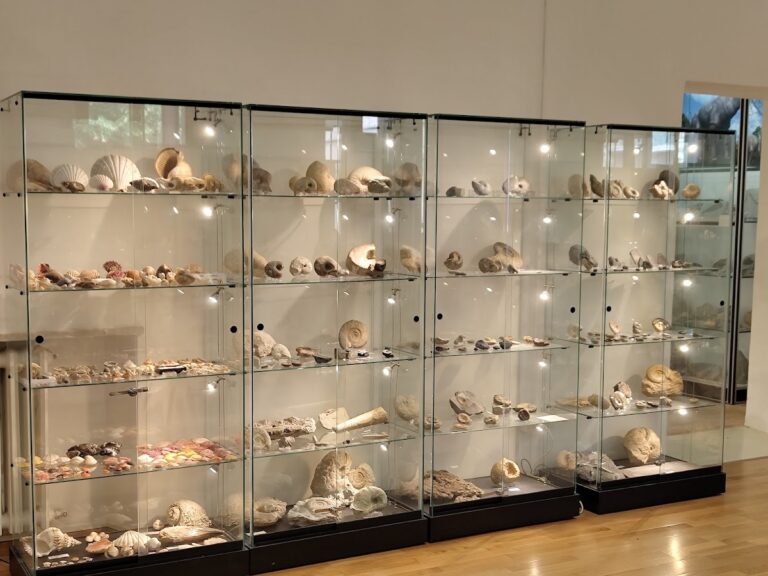
The northern part has housed Fano’s Civic Museum and Picture Gallery since 1898. The museum’s collections include archaeology, ceramics, coins, and paintings. The third-floor Foundation Carifano Hall houses the Ethnic Museum Bagnaresi, inaugurated on 22 June 2013 with the collection donated by Maria Teresa Bagnaresi to her native city.
Remains
Palazzo Malatestiano stands in central Fano overlooking Piazza XX Settembre, beside the Palazzo della Ragione and at the junction of Via Galeotto, Via Montevecchio, and Via Nolfi. Its present form combines Renaissance, Late Gothic, and Classical elements accumulated through six centuries of alteration. The original residence occupied the side facing Piazza Maggiore, while Pandolfo III’s northern wing now forms the museum wing.
Entrances and inner court
Borgia-Cybo Arch
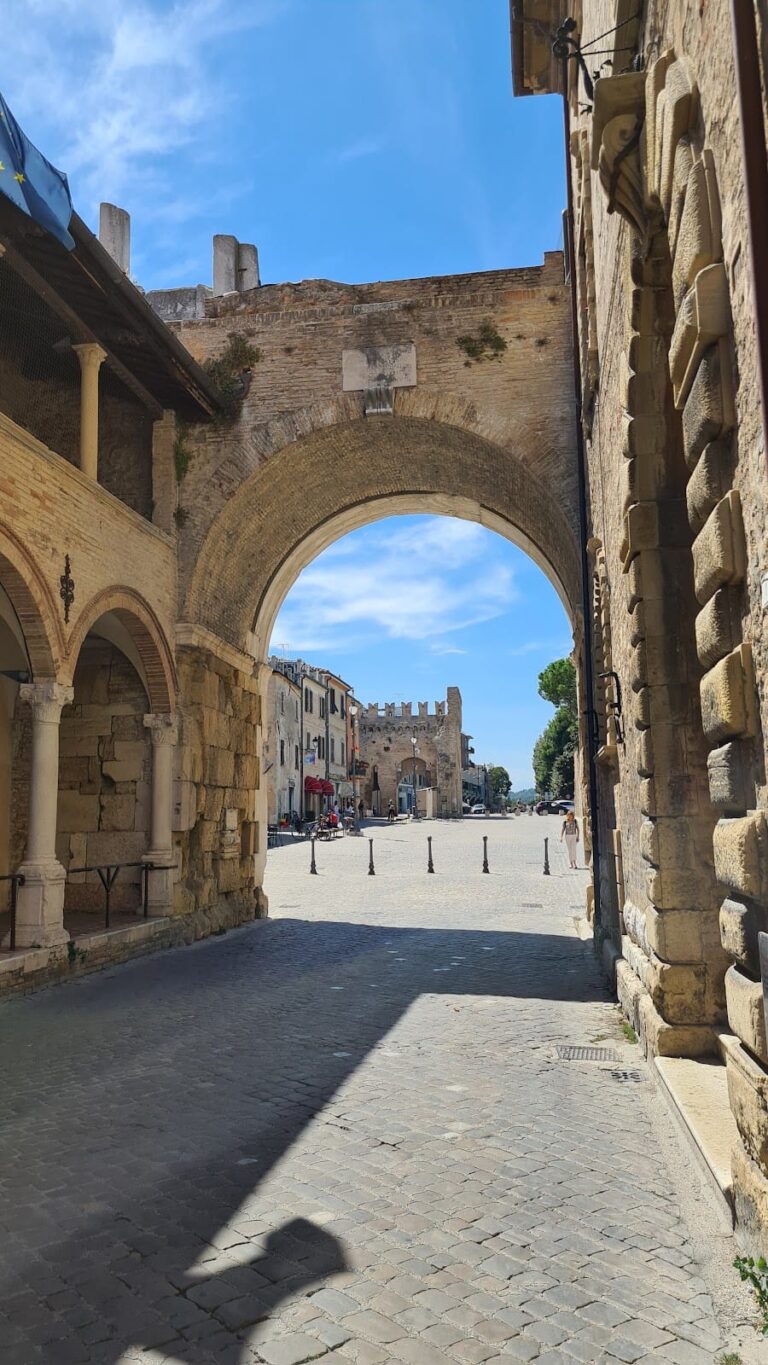
The principal entrance from Piazza XX Settembre is through the Borgia-Cybo Arch, built in 1491 and named for Popes Innocent VIII Cybo and Alexander VI Borgia. A covered bridge known as the Voltone del Teatro spans Via Malatesta above street level and connects the Malatesta residence with the Palazzo della Ragione. To the right of the entrance hall, a marble representation of the Madonna stands in a sixteenth-century framed niche. It is traditionally known as the Madonna of the Martinozzi.
Malatesta Court
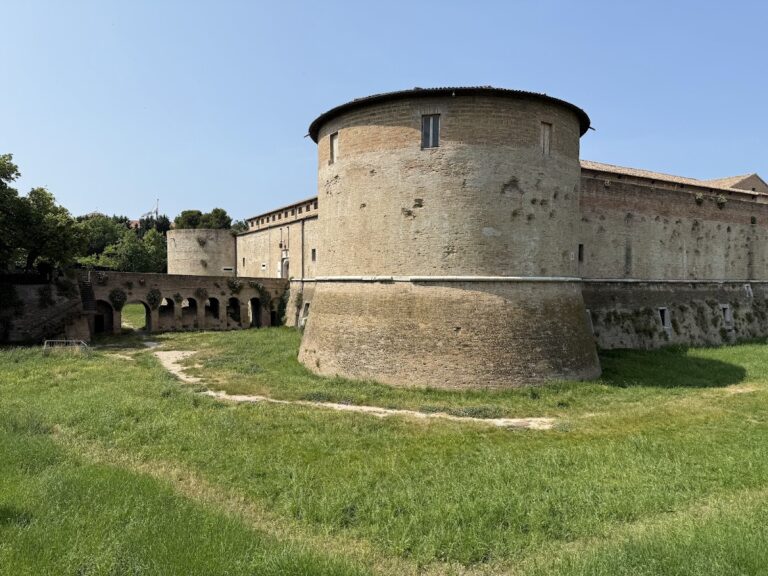
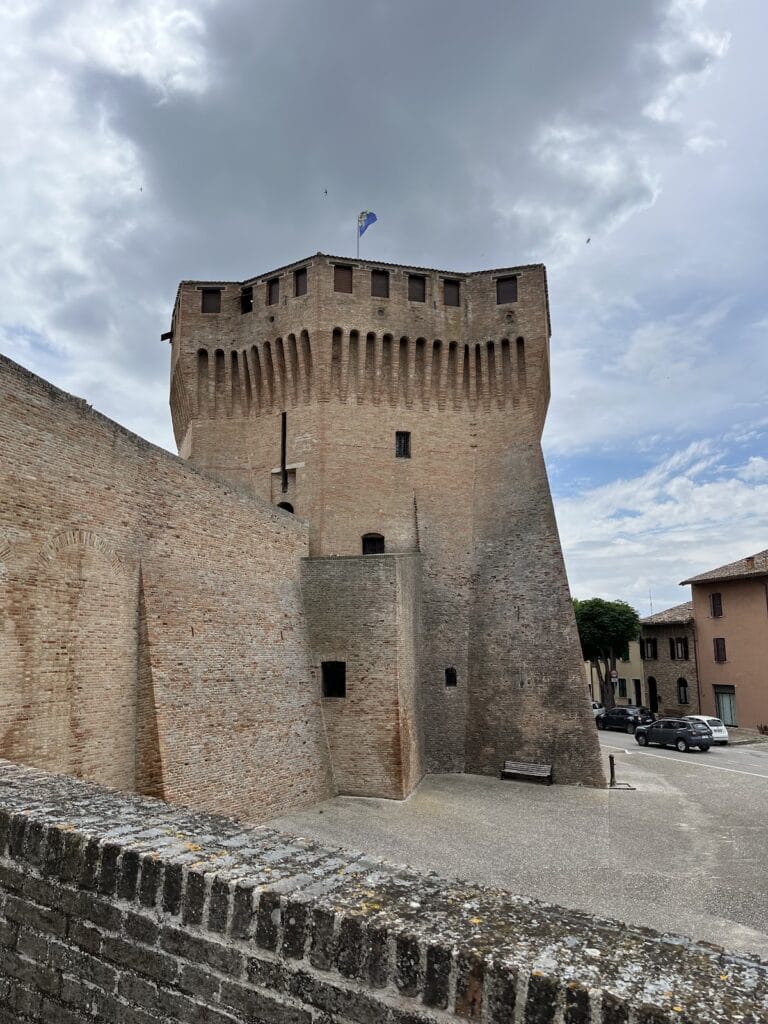
The inner Malatesta Court has a principal façade with a ramp leading to the first floor and two porticoes. The upper portico dates from the sixteenth century. The ground-floor portico, brought to light by Giuseppe Balducci in 1898, has Gothic capitals carved with Malatesta roses and is surmounted by four courtly-style mullioned windows. Two turrets rise from the court, including a cylindrical turret on the south side commissioned by Galeotto I Malatesta and a crenellated turret on the north side dating from Pandolfo III’s period.
A 1480 portal leads from the court, via the access ramp, to the first floor and the original bronze statue of Fortuna, the Roman goddess associated with fortune and fate. The inner court has since been adapted as an open-air theatre for conferences, theatrical and lyric performances, ballets, and concerts.
Museum wing and archaeological collections
Museum wing
Pandolfo III’s northern wing forms the museum wing. Its 1898 adaptation lowered the roof, reopened the inner portico, reconstructed a turret, and added Guelph crenellations, battlements with rectangular merlons traditionally associated with the papal political faction. The wing’s present appearance therefore includes both medieval forms and the interventions of its museum conversion.
Archaeological collection
The archaeological section occupies Pandolfo III’s under-portico and six ground-floor rooms. It presents evidence of prehistoric, pre-protohistoric, Italic, and Roman settlement in the Fano area, including the Metauro and Cesano valleys and the basin of the Arzilla stream.
Finds associated with the ancient Augustan colony of Fanum Fortunae, the Roman settlement that developed into Fano, include sculpture discovered near the San Filippo convent in 1899. Among the pieces are a fragmentary statue of the emperor Claudius and a female head probably representing Octavia, the sister of Augustus, Rome’s first emperor. The collection also includes funerary slabs, other stone material, floor mosaics depicting a panther and Neptune, the Roman god of the sea, and milestones, including the Gracchan cippus, a small upright stone monument.
Ceramics and coins
The ceramics rooms are located to the right of the bronze Fortuna. Their collection spans the fourteenth to the nineteenth century and includes material from the Sant’Elena pharmacy dating from the first half of the nineteenth century, as well as ceramics from the S. Croce Hospital.
The numismatic rooms contain Roman coins from the Republican and Imperial periods, coins produced by the ancient Fano mint, and medals from the Malatesta period.
Palace rooms and picture gallery
Picture Gallery
The Picture Gallery contains stage designs by Giacomo Torelli and paintings and altarpieces dating from the fourteenth to the eighteenth century. Its works are associated with artists and schools from the Marche, Veneto, Umbria, Bologna, and Naples. The collection includes polyptychs, altarpieces made from several connected panels, including one by the Venetian painter Michele Giambono, as well as nineteenth-century portraits and landscapes. Some works came from donated private collections or deconsecrated churches.
Fireplace Room and Great Hall
On the first floor, the Fireplace Room contains works from the fourteenth and fifteenth centuries. The Great Hall, formerly a representational room under Pandolfo III, has a trussed roof and a stone entrance portal. It contains paintings from the sixteenth and seventeenth centuries. The adjoining small Washbasin Room retains a Malatesta-period trefoil arch that once led to the destroyed Court Chapel.
Morganti Room
The ground-floor Morganti Room is entered through an original pointed-arch portal from the Malatesta period. Its exposed-beam ceiling has carved corbels and limited painted decoration. It may have served as an armoury during the Malatesta period and later as the municipal archive. The room now displays paintings from the late seventeenth and eighteenth centuries.
Malatesta houses and Foundation Carifano Hall
The ancient Malatesta houses retain two fourteenth-century ribbed cross vaults, vaulted ceilings supported by intersecting ribs, and a fifteenth-century hall whose ceiling rests on carved corbels. The Council Hall of the Cassa di Risparmio contains Guercino’s Marriage of the Virgin.
An internal staircase leads to the section devoted to nineteenth- and twentieth-century works. On the top floor, the upper loggia has six arches. The third-floor Foundation Carifano Hall contains Maria Teresa Bagnaresi’s collection of ethnic art and craft objects, including masks, Chinese porcelain, statues, weapons, jewellery, bronzes, brass objects, ivories, and copper and silver objects.
Architectural character
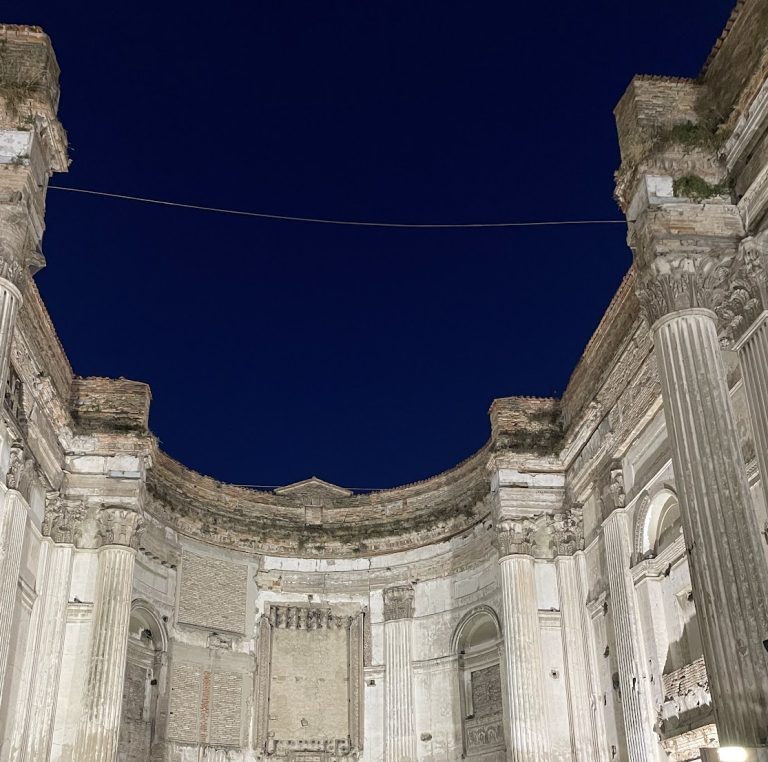
Palazzo Malatestiano is described as the earliest example of Renaissance architecture in the Metauro region. Its successive building phases remain visible in the combination of Gothic mullioned windows, Renaissance loggias, Ionic columns, and Classical capitals. The juxtaposition of these forms, together with the surviving court, towers, rooms, museum spaces, and archaeological collections, expresses the building’s development from a lordly residence into a civic and cultural complex.
Nearby sites