Novilara Necropolis: An Iron Age Picene Burial Ground
Site at a Glance
- Popularity
- Very Low
- Country
- Italy
- Primary era
- Iron Age
- Eras represented
- Iron Age
- Civilizations
- Unclassified
- Site type
- Burial
- Remains
- Necropolis
On this page19 sections
History
The Novilara necropolis is an Iron Age burial ground at Novilara, Italy, associated with the Picentes, an ancient people of the Adriatic region of central Italy. The Iron Age is the period when iron became a major material for tools and weapons. The cemetery’s use is broadly placed in the early first millennium BCE. Graves excavated by Edoardo Brizio were mainly dated to the eighth or seventh century BCE, while burials uncovered in 2012–2013 were assigned to the eighth century BCE. The site is among the best-studied Picene funerary grounds.
Discoveries and nineteenth-century excavations
A limestone slab depicting a naval scene was found near Novilara, at San Nicola in Val Manente, in 1860; the discovery reached the wider archaeological community in 1871. Another slab, bearing geometric and spiral designs, was found in 1865 in the courtyard of Romolo Molaroni, the local priest. Count Dario Bonamini attempted an excavation in 1873 and uncovered several graves, but records of the finds were lost.
After learning of earlier discoveries on Countess Servici’s estate, archaeologist Francesco Gamurrini excavated for one day in 1891 and found two graves. His published account prompted Brizio’s interest. Appointed by the Italian government, Brizio excavated from July 1892 through 1893, dividing the cemetery into the Servici and Molaroni areas, named after former landowners. He found at least 263 graves: 121 in Servici and 142 in Molaroni. During this work, Raniero Mengarelli classified burials by sex and age, drawing on grave goods and skeletal measurements. In 1893, Giuseppe Sergi examined skulls and estimated stature using skeletal measurements.
Later excavations and collections
In 1912, archaeologist Innocenzo Dall’Osso began further work in Servici and found 33 tombs. Most of those finds were held in Ancona and were lost when Allied bombing struck the city in 1944. Most objects from Brizio’s excavations went to the Oliveriano Museum. An earthquake damaged the museum in 1916, and German soldiers removed six boxes of grave goods during the Second World War; much of that material was later recovered. Finds from Novilara are now exhibited at the Oliveriano Museum in Pesaro, the National Archaeological Museum of the Marche in Ancona, and the Pigorini Museum in Rome.
Excavation began again in the Molaroni area in March 2012, prompted by work to expand the A14 motorway. From 2012 to 2013, a team led by archaeologist Chiara Delpino reexamined 36 previously excavated burials and uncovered 150 more. The work was organized in sections parallel or perpendicular to the tunnel, allowing excavation to continue alongside construction.
Genetic studies
A 2024 ancient-DNA study examined 67 people from Novilara and 10 from the Sirolo-Numana necropolis. The two Picene communities showed genetic similarities to one another and to other Iron Age populations of central Italy. Their profiles also differed from those of the Daunians of northern Apulia and the Etruscans and Latins of central Italy.
Earlier research identified mitochondrial DNA haplogroups H, H1, HV1, J1, and K among people from Novilara. Mitochondrial DNA is inherited through the maternal line; the study interpreted comparisons with people from several Italian regions as indicating maternal-lineage affinities, while noting that this evidence cannot establish paternal continuity. It measured genetic variation in the sample at 0.0087 ± 0.005, somewhat below the comparison level for modern Italians. Other comparisons found apparent affinities with Bronze- and Iron-Age Europeans, although limited molecular data made that interpretation uncertain. A comparison with Sirolo-Numana found close genetic similarity between the two cemeteries. Some Novilara individuals instead showed closer affinities to people from the Near East, central Europe, or the Caucasus; contact through trade was proposed as one possible explanation.
Remains
The excavated cemetery has unevenly occupied areas, and its graves are mostly simple trenches containing inhumations, or burials of uncremated bodies. One excavated grave was a cremation burial. In the 2012–2013 group, people were generally laid on their right sides with their bodies tightly bent. Wooden planks usually covered the graves and extended across their sides. The contracted posture has been interpreted as possibly indicating that some bodies were wrapped in tied shrouds.
Grave layout and burial practices
Burial placement and grave floors
Some grave floors were covered with sea pebbles. This feature occurred in about five percent of the burials uncovered in 2012–2013 and was confined to the cemetery’s northeastern section. These graves often contained more luxurious goods, and the practice may have marked a distinct group or social standing. A separate grave in Servici had lime and pebbles at its base, forming a layer between the deceased and the ground.
Groups and shared graves
Graves are more concentrated in some areas than in others, a pattern that may reflect kinship groupings. Adults and children occur across the same cemetery areas, and two burials contained both an adult and a child. Most graves held one person. Three contained two people buried at the same time, two incorporated an earlier burial, and one held two people interred at different times.
Grave 171 contained two adults, a woman and a person probably identified as a man, buried at separate times. Its goods included brooches and ornaments associated with women, as well as brooches associated with men placed across the woman’s body, perhaps once wrapped in cloth. The man may have been buried first, with his belongings moved when the grave was reopened. Analysis of autosomal DNA, inherited through chromosomes other than the sex chromosomes, found no family relationship between the pair, though a social or legal connection remains possible. DNA analysis of another double burial, containing two women, likewise found no family tie.
Grave goods and clothing
Women’s burials
Adult women’s graves often held equipment for textile work, including textiles, spools, needles, loom weights, awls, spindles, and spindle whorls. These burials generally contained more grave goods, and more elaborate ones, than men’s graves. Brooches, amber earrings, pendants, and clothing decorated with amber, glass, or bronze beads appear among the ornaments. A large brooch with an amber bead was sometimes placed near the top of the head, perhaps as part of a headdress or veil. Other decorations were associated with a garment laid flat over the body between the arms and pelvis. A bronze ring arrangement could be attached at its lower end, and the garment’s position suggests it may not have been worn.
The textile equipment and other objects have been interpreted as reflecting expectations that women would undertake domestic work, but they do not establish the full range of women’s activities. Textile-related objects occur in girls’ graves from adolescence. A girl aged about 12–15 was buried with a knife that may have been used for sewing. The appearance of gender-associated objects may reflect a transition toward adult social roles, possibly connected with puberty.
Weapons and armor
Spears, daggers, and axes
Men’s graves more often contained a small number of objects, particularly weapons. Spears were the most common: among 37 male burials in Servici, only four lacked one. Earlier spearheads were long and narrow; later forms were broader and leaf-shaped. Preserved wooden-shaft remains show that blades were fastened with bronze wire, and at least one had a bronze ring at the join. Daggers had curved, triangular, or straight blades tapering to a point and were probably carried in leather belts fastened with bronze buckles.
Axes may have been used in fighting or hunting. In grave 43, an axe was found with spits and a flesh-hook, an association that may indicate hunting or food preparation. One unusual bird-axe was suspended from a dragon-patterned brooch. It had a flaring blade, a knob at the opposite end, a handle of varying width and length, a raised band around its neck, and an image of a water bird. The Novilara example has a simpler bird image and a smaller, less elaborate blade than other Italian examples. Bird-axes are associated with men at some Italian sites, while evidence from other regions may link them with women.
Swords and shields
One sword form had a broad iron blade that curved backward near the hilt and was fixed to it with nails. Its wooden sheath could be decorated with bronze plates bearing engraved designs. Similarities to swords from cemeteries in Bosnia have prompted the possibility that examples of this type reached Novilara from the Balkans. A sword from Servici grave 101 measures 38 centimetres and was nailed to a wooden hilt. A double-edged sword from grave 44 measures 30.5 centimetres, with fragments of its wooden handle and sheath still on the blade.
A bronze disc measuring 25 by 30 centimetres had a grooved rim pierced at regular intervals by nails. It may have formed the raised central boss of a larger wooden shield, possibly oval in shape.
Helmets
A few men’s graves contained bronze helmets, perhaps associated with leadership. Some were made from hammered bronze sheets riveted together, with leather lining and internal padding. Two rounded nails at the top may have supported a plume. Other helmets were conical, formed from a single metal sheet, and finished with a ridge-shaped crest.
Children’s graves
Burial size and offerings
Children’s graves were generally smaller than those of adults, commonly about 90 by 50 centimetres. Of the burials uncovered in 2012–2013, 28 belonged to people who had not reached adulthood. Children’s assemblages usually contained fewer objects than adult burials. From about 18 months to two years of age, children could be buried with ceramic vessels, two-handled cups, bowls, small drinking vessels, brooches, and necklaces made with bronze pendants or shells. The number of objects did not consistently increase with age, and the goods found in older children’s graves were not invariably more numerous than those in infants’ graves. Their appearance may mark entry into a social group or a rite of passage, possibly associated with weaning.
Distinctive objects in young burials
A broken engraved vessel known as a cothon, a particular type of small ancient vessel, was found in the grave of a girl aged about 18 months to two years. Comparable vessels are otherwise associated with adult women, and the breakage may have been intentional. Some children’s graves combine objects associated with different adult genders: a probable girl aged three to five had a brooch otherwise linked with men, while a grave of undetermined sex contained a male-associated dragon-patterned brooch and two brooches associated with women. Such combinations may reflect ceremonial choices by surviving family members. Small pottery vessels, bowls with two horizontal handles, and drinking cups also occur; the handled bowls appear in only two graves and may have been sized for children or made as miniature ritual objects.
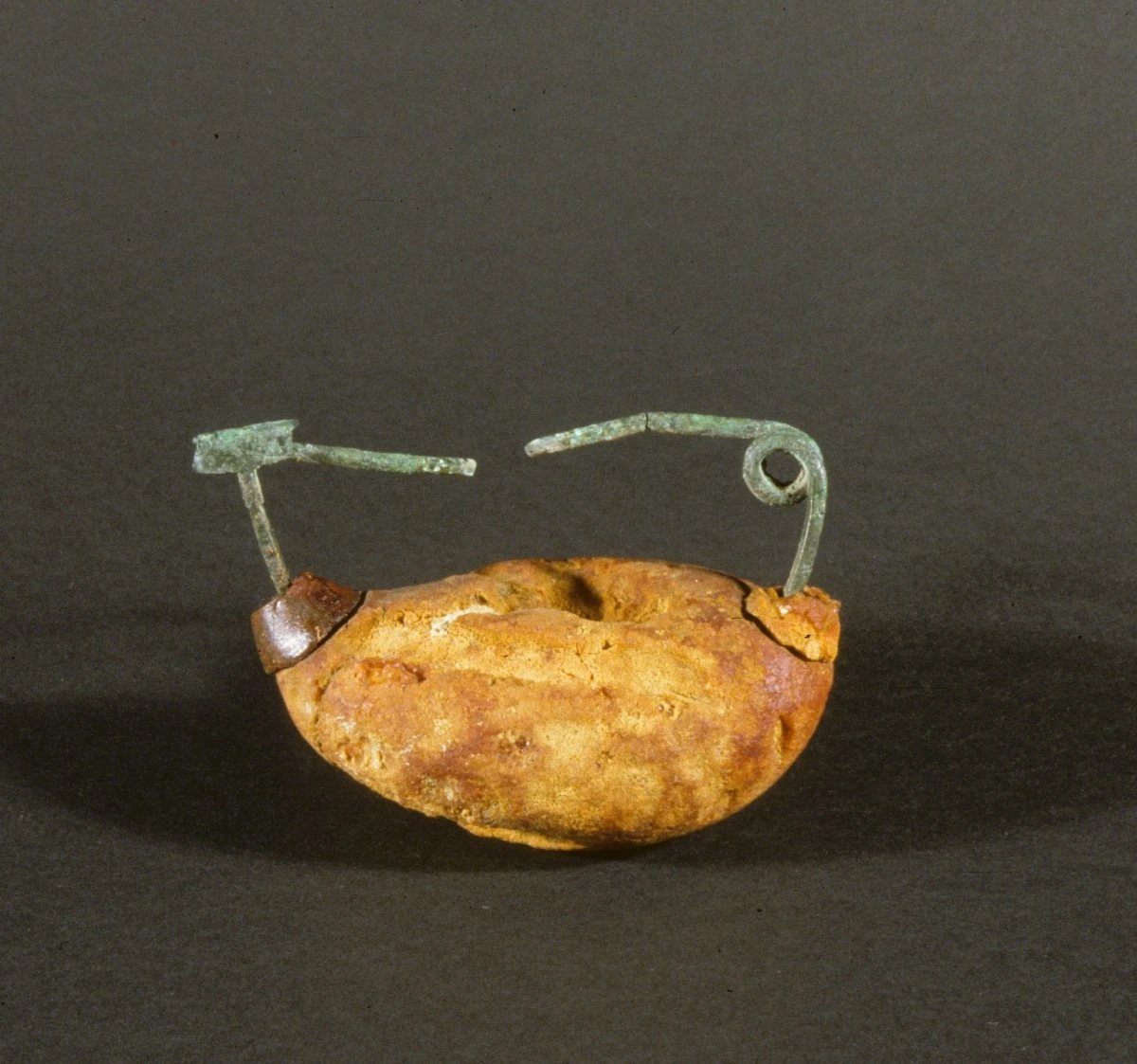
An infant in tomb 124, dated to the seventh century BCE, was buried with a two-handled drinking cup decorated with metal strips. Similar cups are known from later phases at Narce and from eighth-century BCE Veii. A mid-seventh-century BCE infant burial contained a leech-shaped brooch with two stylized designs that may represent birds. Comparable brooches are known from Verucchio in the late eighth and early seventh centuries BCE. The use of objects in earlier styles may have connected these burials with ancestors or commemorated family ties.
Skeletal evidence
Analysis of adult skeletons found no association between sex and the examined signs of physical stress, including porous changes around the eye sockets and skull, interruptions in tooth-enamel growth, and changes to the outer surfaces of bones. The first two indicators occurred less often in graves with more textile objects and garments, a pattern interpreted as possibly reflecting lower stress among people of higher status. These indicators represent only some influences on health, and some conditions may leave no skeletal trace before death. Other remains show traumatic injury or possible violence. One person had a sharp-force wound on the left side of the rear skull, perhaps from an arrow, dagger, or sword. The injury partly healed, suggesting the person survived and may have received treatment.
Carved stones and inscription
The limestone slab found near Novilara bears a naval scene, while the second slab carries geometric and spiral decoration. The necropolis also yielded the Novilara stele, an upright stone slab inscribed in North Picene, an ancient language known from inscriptions in the Picene area.