Palazzo Ischitella: A Noble Palace on Naples’ Riviera di Chiaia


Site at a Glance
- Rating
- 4.8
- Popularity
- Very Low
- Country
- Italy
- Primary era
- Early Modern
- External website
- Open
- Eras represented
- Early Modern, Modern
- Civilizations
- Habsburg, Kingdom of the Two Sicilies, Spanish
- Site type
- Domestic
- Remains
- Palace
On this page7 sections
History
Palazzo Ischitella is a seventeenth-century palace in Naples, Italy, on the Riviera di Chiaia. It was commissioned during the 1620s by the Spanish magistrate Matías de Casanate y Espés, also known as Mattia Casanate or Casanatte, who served as a lieutenant of the Regia Camera della Sommaria, a major financial and judicial institution of the Kingdom of Naples, and as prefect responsible for the grain supply.
Foundation and destruction
The palace was severely damaged in 1647 during the Neapolitan revolt led by Masaniello, the popular leader associated with the uprising against Spanish rule. It was later rebuilt or extensively restored. The ownership sequence after the destruction remains uncertain. The building may have passed first to Casanate’s eldest son, Giovanni, and then to his younger son, Cardinal Girolamo, before reaching the Pinto family. Another possibility is that the banker and merchant Luis Freitas Pinto bought it directly from Matías de Casanate in 1647 for 9,000 ducats.
The Pinto family and eighteenth-century splendour
Luis Freitas Pinto belonged to a wealthy Portuguese-origin family that had moved to Naples in the 1630s. His son Emanuele Pinto acquired the fiefs of Ischitella and Peschici from the Turbolo family and received the title Prince of Ischitella in 1681. The palace took its name from this title.
Emanuele Pinto and his descendants Luigi Emanuele Pinto (1667–1704) and Francesco Emanuele Pinto (1697–1767) invested heavily in the palace’s refurbishment. Payments made in 1700 record decorative work by Giacomo del Pò, Giuseppe Simonelli, and Lorenzo Vaccaro. Further work followed in 1715 under a team led by Ferdinando Sanfelice, which included the painters and stucco workers Tommaso Alfano, Gennaro Cioffi, and Costantino D’Adamo.
A lavish reception for Philip V of Spain after his landing in Naples in spring 1702 displayed the palace’s magnificence at the turn of the seventeenth and eighteenth centuries. During the period of Austrian viceregal rule, when Naples was governed by Habsburg Austria through a viceroy, the palace became particularly renowned for the nativity-scene collection assembled there by Prince Francesco Emanuele Pinto y Mendoza.
Nineteenth-century alterations and later use
Further extensions and alterations were made during the first half of the nineteenth century under Prince Francesco Emanuele Pinto y Mendoza (1788–1875). A soldier and politician, he served as Minister of War during the final years of the Kingdom of the Two Sicilies, the Bourbon monarchy that ruled southern Italy and Sicily until its incorporation into unified Italy in 1861. These works included the construction of the entire third floor.
When Giuseppe Garibaldi entered Naples in 1860, the prince went into exile in France. Part of the palace was subsequently occupied by the Grand Hôtel d’Angleterre, later identified as the Hôtel Grande-Bretagne-Riviera. Bombing during the 1943 attacks on Naples caused only limited damage. The interiors were later adapted into apartments, and some areas were reconstructed. The building remains in residential use as a condominium.
Remains
Facade and overall structure
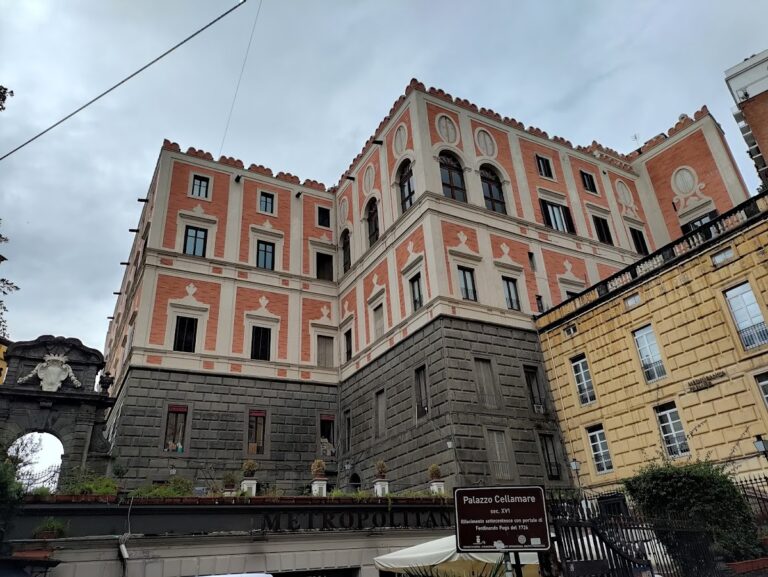
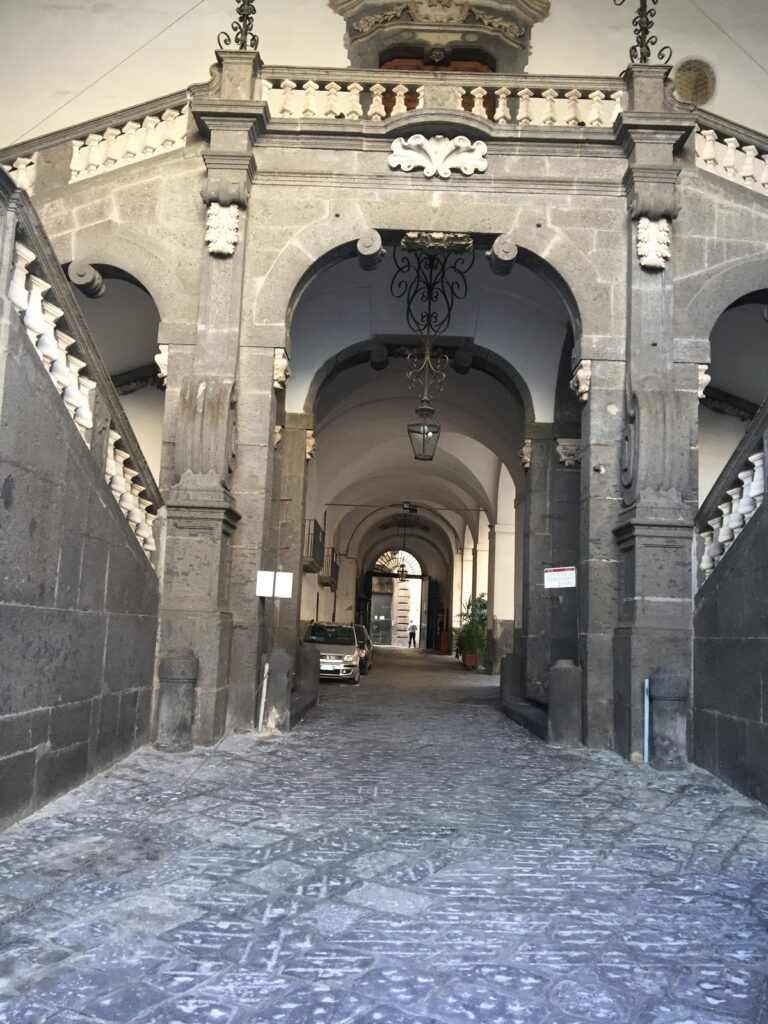
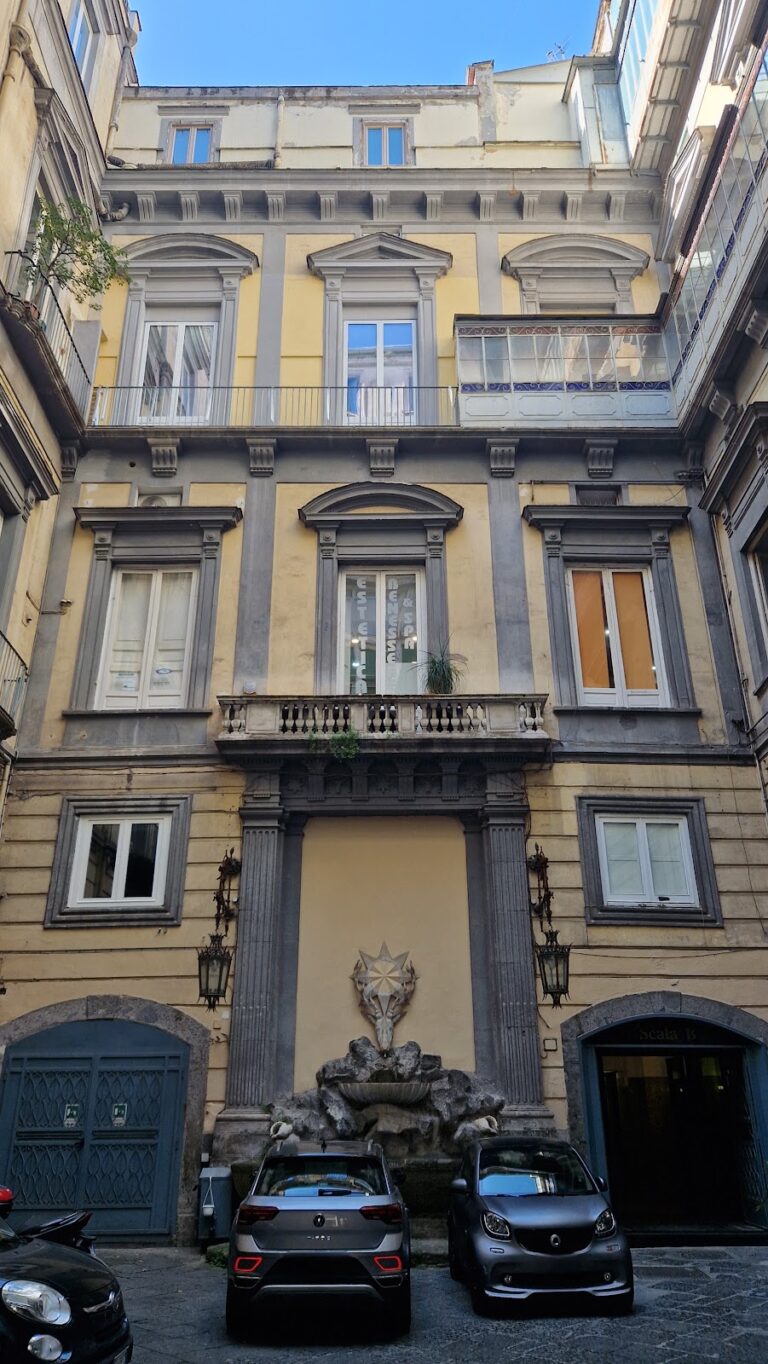
Palazzo Ischitella faces the Riviera di Chiaia in Naples’s Chiaia district. Its principal facade is organized around three portals, an unusual arrangement among noble residences in Naples and a defining feature of the building’s exterior. The palace retains the enlarged form created through successive rebuilding and alteration, including the complete third floor added during the nineteenth century. Later reconstruction affected parts of the building as its interiors were converted to apartments.
Decorated interiors
Numerous halls retain eighteenth- and nineteenth-century frescoes, stucco work, furnishings, and other decorative elements despite the conversion to residential use. The decorative campaign of 1700 included stucco statues by Lorenzo Vaccaro intended for the garden. Additional ornament was installed in 1715 by the group directed by Ferdinando Sanfelice, with work by Tommaso Alfano, Gennaro Cioffi, and Costantino D’Adamo.
Later decoration was carried out by the painter Pietro Bardellino. A frescoed vault in a room on the piano nobile, the principal ceremonial residential floor of an Italian palace, depicts Diana and Endymion and is attributed to him. Together with the surviving stucco, furnishings, and other interior details, the frescoes preserve the decorative character developed through the palace’s eighteenth- and nineteenth-century refurbishments.
Nearby sites