Castel dell’Ovo: Naples’ Medieval Fortress and Royal Stronghold
Site at a Glance
- Rating
- 4.6
- Popularity
- Very High
- Country
- Italy
- Primary era
- Early Modern
- External website
- Open
- Eras represented
- Classical, Medieval, Early Modern
- Civilizations
- Crown of Aragon, Kingdom of Naples, Kingdom of Sicily, Norman, Roman, Spanish
- Site type
- Military
- Remains
- Castle
On this page15 sections
History
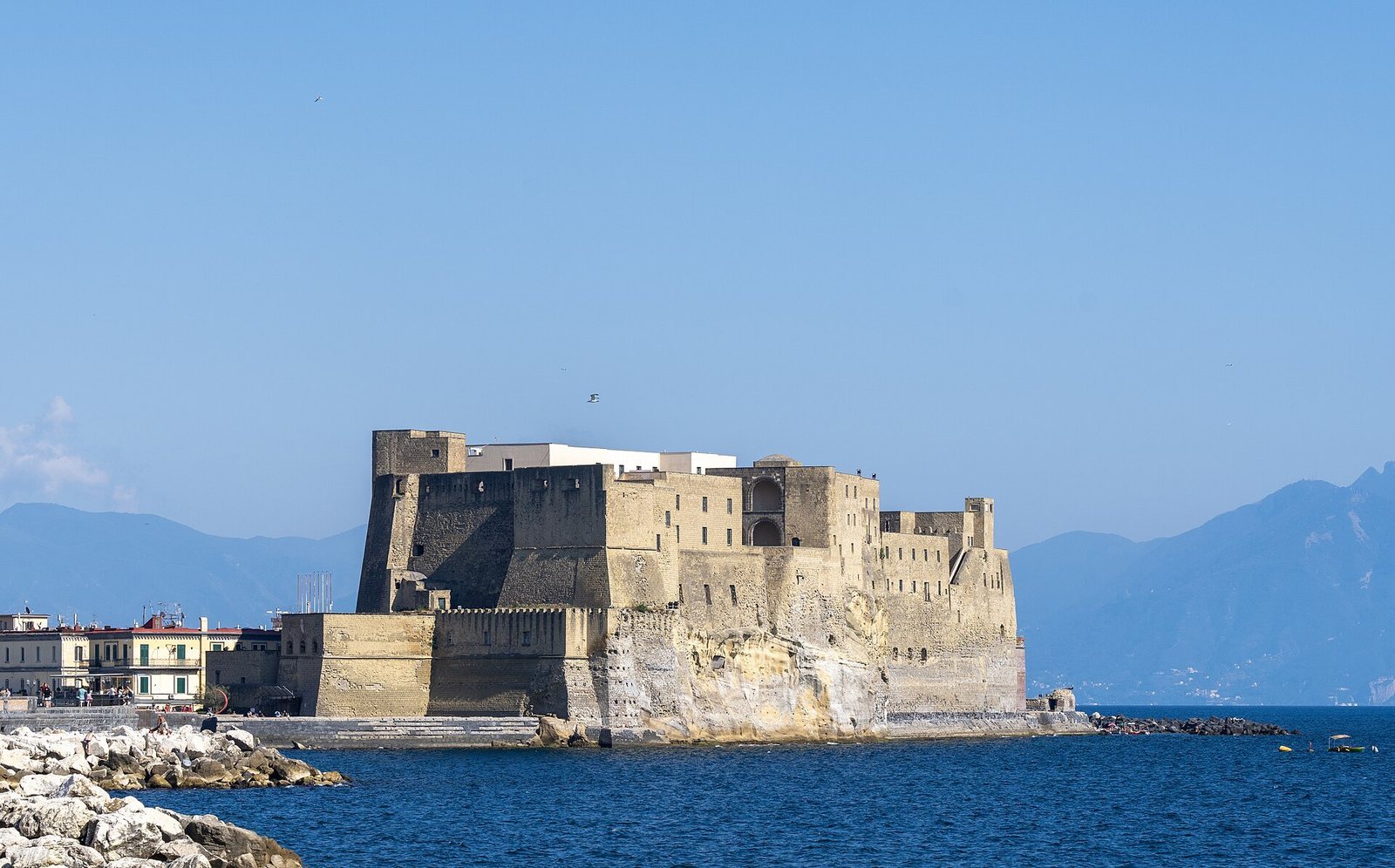
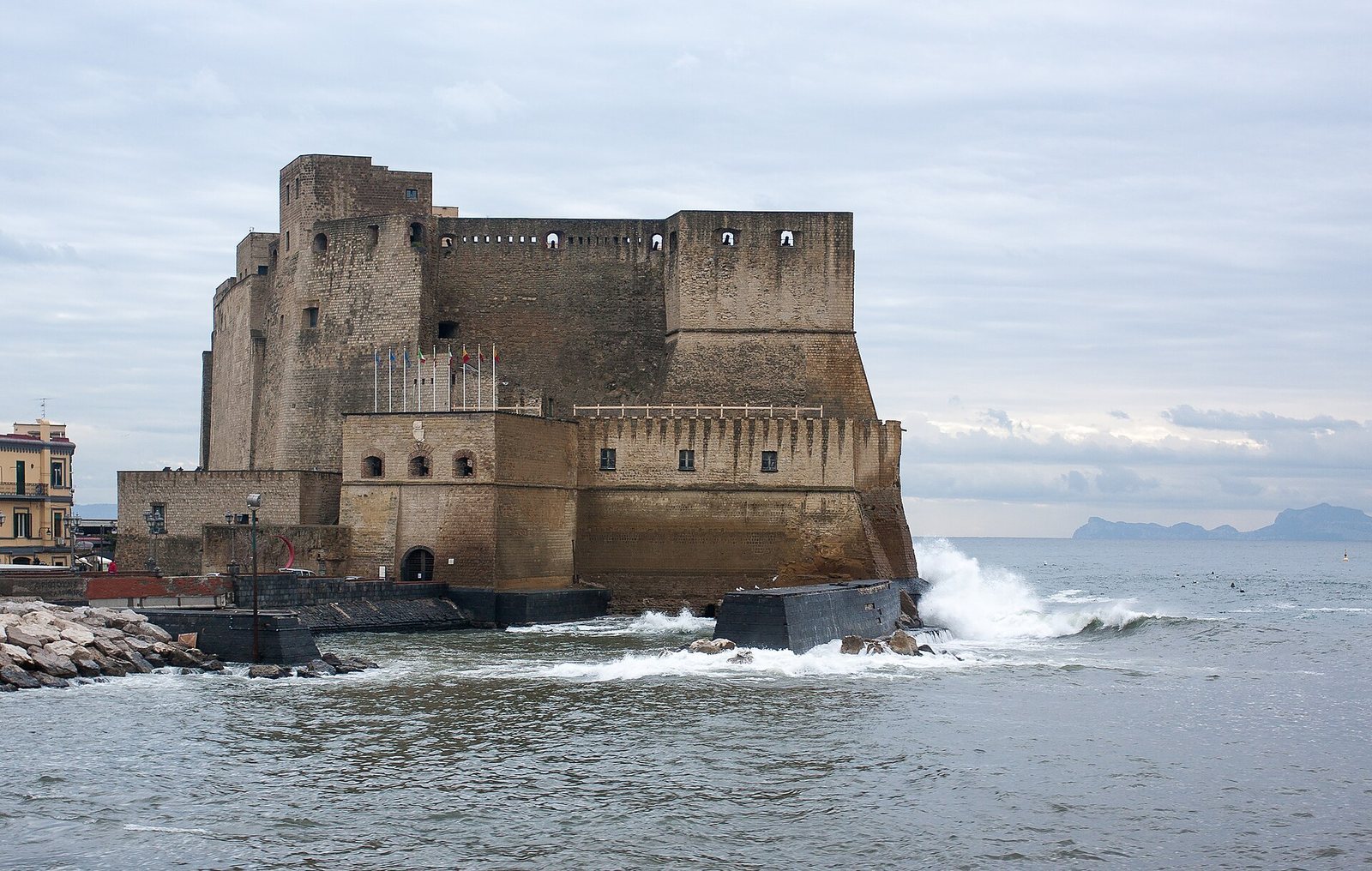
Castel dell’Ovo is a historic castle in Naples, Italy, standing on the tuff island of Megaride. Built as a Norman fortress in the twelfth century, it is considered the oldest castle in Naples and occupies a site associated with the ancient Greek foundation of Parthenope.
From Parthenope to the Roman villa
Megaride is a natural extension of Monte Echia, a hill overlooking the Bay of Naples. In antiquity, the island was connected to the mainland by a narrow rocky isthmus. Its history is linked to Parthenope, an ancient Greek settlement associated with the origins of Naples, founded by settlers from Cumae in the eighth century BC.
During the first century BC, the Roman general and statesman Lucius Licinius Lucullus acquired a large estate in the area and built a villa on the island. The Villa of Lucullus included a substantial library, farms for moray eels, peach trees brought from Persia, and cherry trees introduced from Cerasunto. The estate gave Megaride its late Roman name, Castrum Lucullanum.
In the middle of the fifth century, the Western Roman emperor Valentinian III fortified the villa. In 476, the deposed emperor Romulus Augustulus was exiled there. After his death, Basilian monks from Pannonia settled on Megaride and Monte Echia at the invitation of Barbara, a Roman matron, bringing with them the relics of the abbot Severinus. They first lived in separate hermit cells and adopted the Benedictine rule in the seventh century. The community also established an important scriptorium, a workshop where monks copied and produced manuscripts, probably drawing on surviving parts of Lucullus’s library.
The monastic settlement and early fortifications
In 872, Saracen forces captured Athanasius, the bishop of Naples, on the island, then known as San Salvatore. Fleets from the Duchy of Naples and Amalfi expelled the attackers and freed the bishop. At the beginning of the tenth century, the dukes of Naples demolished the monastic complex to prevent it from being reused as a base for a Saracen invasion. The monks withdrew to Pizzofalcone.
A fortification called Arx Sancti Salvatoris is recorded at the site in 1128. Its name referred to the church of San Pietro built there by the monks. The monastic settlement is also represented by the remains of its place of worship, whose earliest recorded notices date from 1324.
The Norman and Hohenstaufen castle
After Roger the Norman, or Roger II, conquered Naples in 1140, he built the castle. The architect Buono completed the work. Under Norman rule, systematic fortification began, with the Norman Tower serving as the first major strongpoint and carrying the banners.
In 1222, Frederick II, the Hohenstaufen emperor and ruler of the Kingdom of Sicily, strengthened the castle by adding the Colleville Tower, the Master Tower, and the Middle Tower. During this period Castel dell’Ovo served several royal functions. It was a residence, a state prison, and a repository for the royal treasury.
Angevin rule and royal imprisonment
Charles I of Anjou moved the principal court to Castel Nuovo but retained the royal treasury and other valuables at Castel dell’Ovo because it was regarded as the best-fortified location. He also kept the castle as a residence for the royal family and ordered numerous restorations and alterations.
The castle became a place of confinement for members of rival ruling families. Conradin of Hohenstaufen, the last Hohenstaufen claimant to the Kingdom of Sicily, was imprisoned there before his execution in Naples in 1268. The children of Manfred of Sicily and Queen Helena Angelina Doukaina were also held at Castel dell’Ovo.
A seismic event in 1370 caused the natural arch forming the island’s connection to the mainland to collapse. Queen Joanna I rebuilt the crossing in masonry and restored the Norman buildings. After living in the castle as queen, Joanna was imprisoned there by her nephew Charles of Durazzo before being exiled to Muro Lucano.
Aragonese rebuilding and the artillery age
Alfonso V of Aragon undertook further renovations, enlarging the royal palace, restoring the pier, strengthening the defenses, and lowering the towers. After French troops sacked Naples during the reign of his successor, Ferrante I had to bombard the castle with artillery to recover it.
French forces under Louis XII and Spanish forces under Gonzalo Fernández de Córdoba later damaged the fortress. In 1503, a siege conducted by Ferdinand II of Aragon, known as Ferdinand the Catholic, destroyed the remaining towers. The castle was then extensively rebuilt, acquiring much of the form visible today.
Military prison and modern cultural use
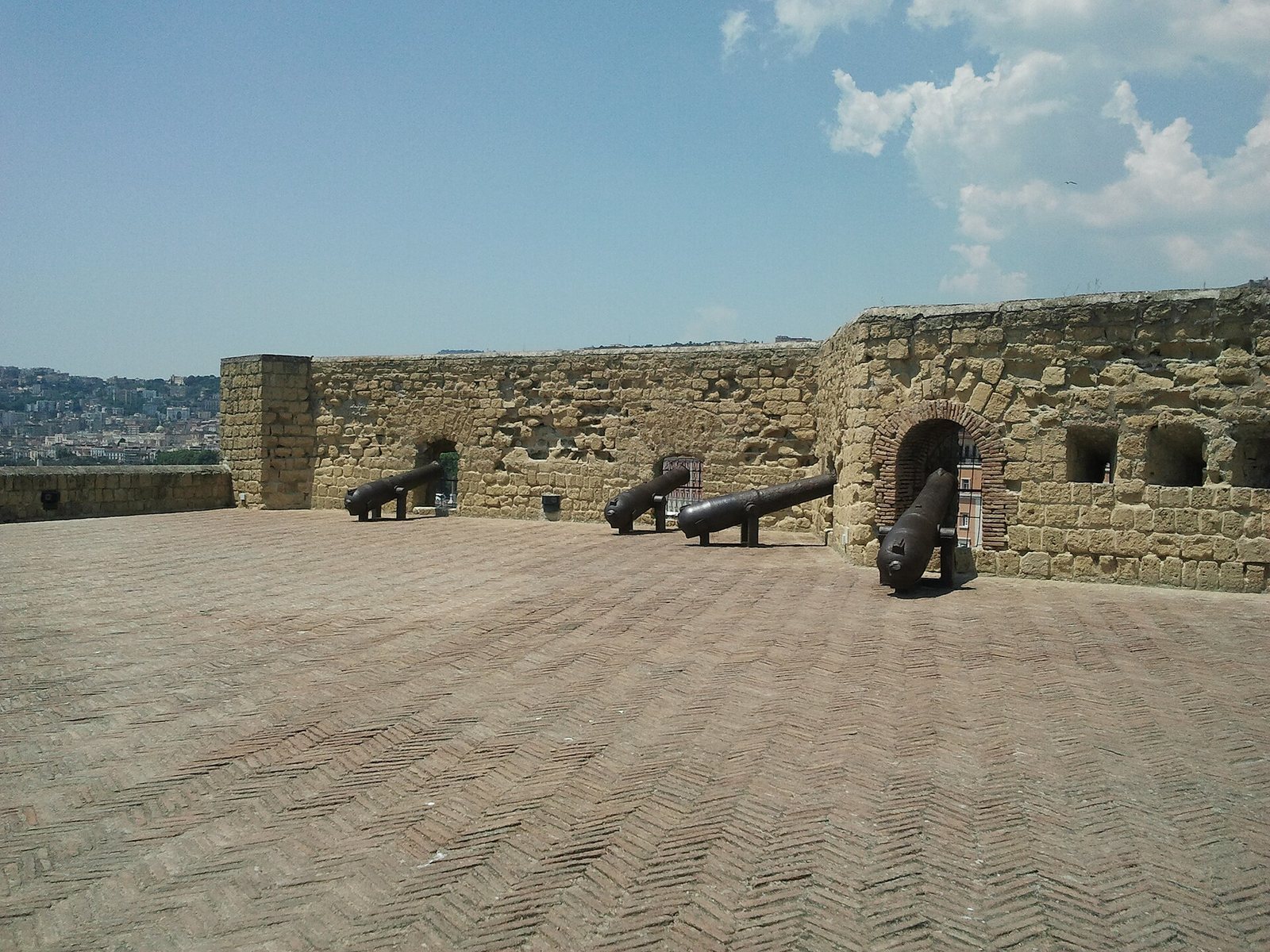
Under the Spanish viceroys and later the Bourbon rulers, Castel dell’Ovo received additional batteries and two drawbridges. It ceased to function as a royal residence and, from the eighteenth century, was no longer designated a royal establishment. Instead, it served as a military barracks, an outpost, and a prison.
Spanish forces used the castle to bombard Naples during the revolt led by Masaniello, the popular leader of the Neapolitan uprising of 1647. Other prisoners included Tommaso Campanella, a Dominican friar, philosopher, and political writer, as well as later Jacobins, Carbonari, and liberal prisoners such as Carlo Poerio, Luigi Settembrini, and Francesco De Sanctis.
During Naples’s post-unification redevelopment, a plan of 1871 proposed demolishing the castle to make space for a new district, but the proposal was not carried out. Restoration began in 1975. After the Second World War, some naval families lived within the castle until their eviction in 1980 as part of its rehabilitation and conversion into a cultural venue. The Municipality of Naples is identified as the owner. In 1943, the castle served as a defensive installation against attacks from the sea. Its large halls now host exhibitions, conferences, concerts, and other cultural events.
The name and its legends
The name Castel dell’Ovo, meaning “Egg Castle,” is documented from the thirteenth century. It probably refers to the castle’s ovular form, which tradition attributes to Roger the Norman’s reconstruction. A later medieval legend says that Virgil hid a magical egg in underground chambers beneath the castle. According to the story, if the egg were destroyed, the fortress and Naples would collapse. After the natural arch fell in 1370, Queen Joanna I was said to have sworn that she had replaced the egg to prevent public panic. The castle was also officially associated with San Salvatore, after the church located on the island.
Remains
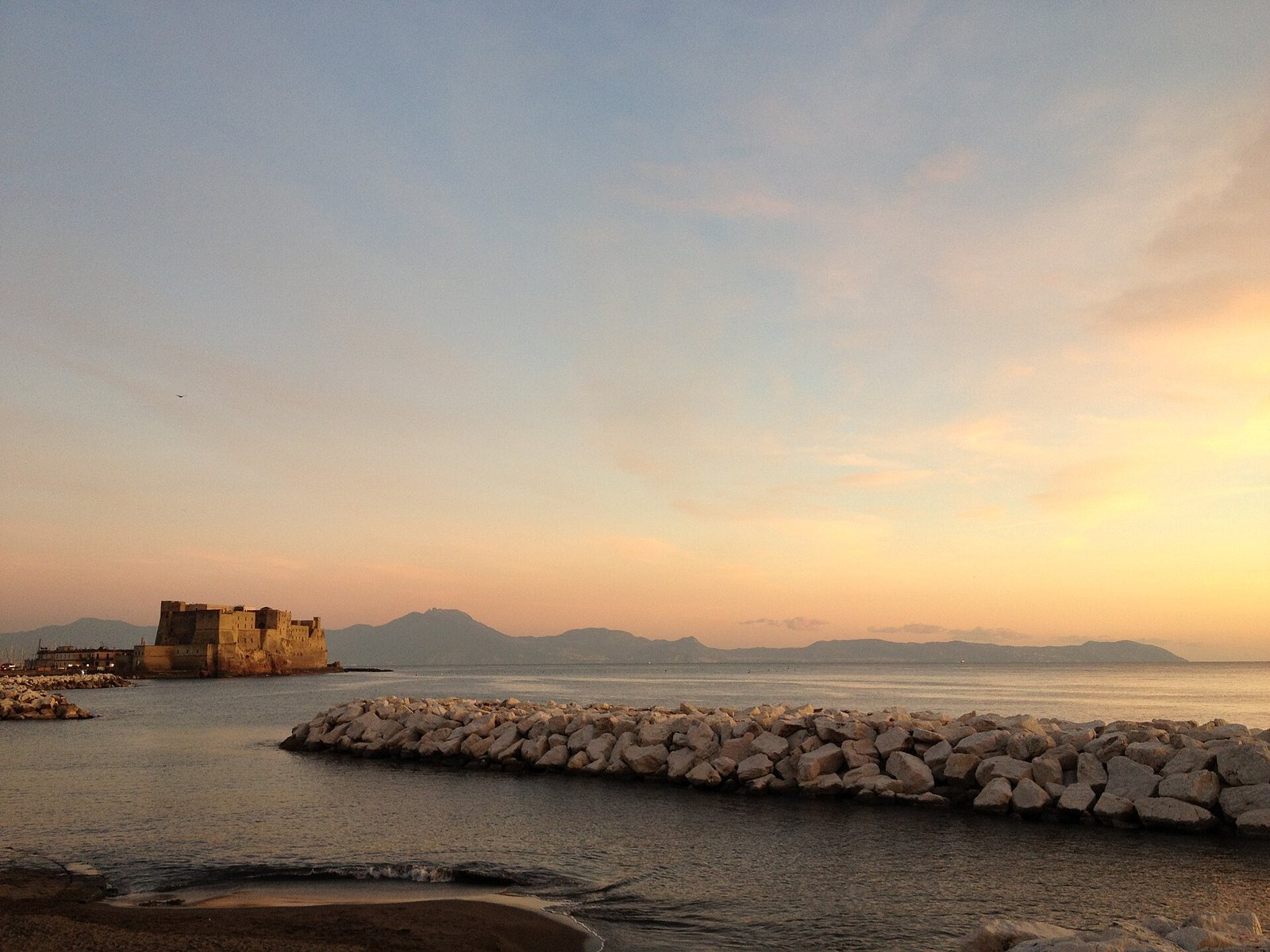
Castel dell’Ovo occupies the Megaride tuff islet between the Naples districts of San Ferdinando and Chiaia, opposite Via Partenope. Tuff is a porous volcanic rock widely used in local construction. The present complex incorporates successive layers from the Roman villa, the monastic settlement, the Norman castle, the Angevin royal and military complex, and the Aragonese, Spanish, and Bourbon fortress. Its current appearance differs substantially from the original Norman structure because repeated damage and rebuilding altered its towers, walls, and defensive orientation.
Defensive structures
Norman and medieval towers
The castle’s ovular form is associated with the origin of its popular name. The Norman reconstruction established the principal medieval fortress, with the Norman Tower as its first major defensive strongpoint. Frederick II’s work in 1222 added the Colleville Tower, the Master Tower, and the Middle Tower, expanding the fortified complex during its period as a royal residence, prison, and treasury.
Aragonese, Spanish, and Bourbon defenses
The rebuilding of 1503 transformed the towers into octagonal structures and thickened the walls. It also redirected the castle’s defenses toward the mainland rather than the sea, responding to the development of artillery, including bombards. Later Spanish and Bourbon interventions added batteries and two drawbridges. The masonry approach across the islet’s landward connection replaced the natural rocky isthmus after its collapse in 1370.
Monastic and interior spaces
Church of the Basilian monks
Within the castle are the remains of the monastic church founded by the Basilian monks. Its principal surviving architectural element is the entrance, which is preceded by the large arches of a loggia. The church forms part of the earlier religious settlement incorporated into the later fortress.
Halls and marina setting
The complex contains large interior halls used for exhibitions, conferences, concerts, and other events, while some rooms serve the municipal administration. At the base of the castle lies the marina of Borgo Marinari, with restaurants, bars, and historic Neapolitan nautical clubs. These spaces form part of the built environment around the fortress while the castle itself preserves the physical layers of its long military, royal, religious, and civic history.