Palazzo Cellammare: An Aristocratic Palace in Naples


Site at a Glance
- Rating
- 4.5
- Popularity
- Low
- Country
- Italy
- Primary era
- Early Modern
- Eras represented
- Early Modern, Modern
- Civilizations
- Kingdom of Naples
- Site type
- Domestic
- Remains
- Elite Residence
On this page14 sections
History
Palazzo Cellammare is a historic aristocratic palace in Naples, Italy, founded during the first decade of the sixteenth century and later restored in the characteristic architectural style of that period. Its development reflects the changing fortunes of Neapolitan noble families, its use during periods of crisis, and its transformation into a setting for art, ceremony, and urban life.
Sixteenth-century foundation and restoration
The palace was established at the initiative of Giovanni Francesco Carafa, abbot of Sant’Angelo di Atella. In 1531, his nephew and successor, Luigi Carafa della Stadera, Prince of Stigliano, commissioned Ferdinando Manlio to restore the entire building. The Carafas belonged to an aristocratic family whose members held important titles and offices in the Kingdom of Naples. The restoration gave the palace a more coherent sixteenth-century character and confirmed its role as a noble residence.
Seventeenth-century crisis and transformation
During the seventeenth century, the palace was attacked by the populace during the revolt of Masaniello, a popular uprising in Naples. In 1656, a plague epidemic led to its conversion into a lazaretto, a facility used to isolate people during epidemics. These events temporarily changed the building’s function from aristocratic residence to a place connected with public disorder and emergency measures.
Substantial modernization followed in the second half of the seventeenth century. Francesco Antonio Picchiatti carried out work on the interiors between 1668 and 1670, while also affecting the exterior and creating two gardens. He had previously built a monumental staircase in 1651, although that staircase was later demolished and replaced by one designed by Giovan Battista Manni. These interventions altered both the ceremonial movement through the palace and its relationship with its gardens.
Eighteenth-century noble residence
After Nicola Maria de Guzmán Carafa, the last Prince of Stigliano, died in 1689, the palace passed into state ownership. During the eighteenth century it was purchased by Antonio del Giudice, a Genoese duke who held the titles Prince of Cellamare and Duke of Giovinazzo. It later became the residence of Michele Imperiali, Prince of Francavilla, who held major parties and receptions there and at his hunting lodge at Chiatamone. Palazzo Cellammare consequently became a reception center for important members of the Italian nobility.
Further embellishment took place from 1726, when Ferdinando Fuga was called to work on the palace. The chapel dedicated to the Virgin of Carmel was created by Giovan Battista Nauclerio in 1727, and its altar received a painting by Agostino Masucci. The palace also hosted Giacomo Casanova, Angelica Kauffmann, Jakob Philipp Hackert, Johann Wolfgang von Goethe in 1787, Torquato Tasso, and Michelangelo Merisi da Caravaggio, commonly known as Caravaggio. It is described as Caravaggio’s last residence.
Collections, urban change, and modern use
At the beginning of the nineteenth century, part of the Bourbon collection was housed in the palace. It included works that Ferdinand IV, the Bourbon king of Naples and Sicily, had taken to Palermo in 1799 to protect them from confiscation when French forces arrived. It also included antiquities acquired in Rome by his emissary Domenico Venuti, both looted objects and newly purchased works.
Nineteenth-century urbanization around the palace greatly reduced its panoramic outlook and led to the removal of two of its three gardens. In the twentieth century, the building was the home of the mathematician Renato Caccioppoli, who died there by suicide in 1959. The French mathematician Claude Viterbo also spent his early years there. In 1948, the Metropolitan cinema-theatre opened in former tuff quarries beneath the palace. After a long closure, it reopened in the 2000s following adaptation works.
Restoration of the exterior and interior elevations began in September 2021. The work also included the entrance portal and historic garden, and was completed by 2024.
Remains
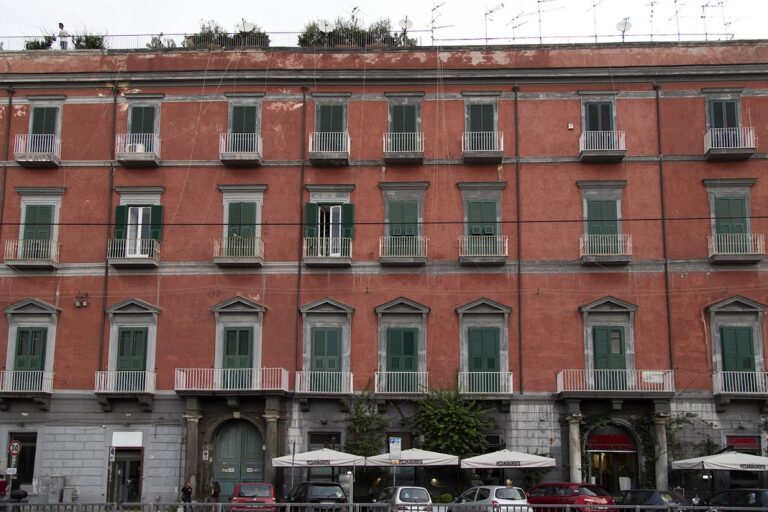
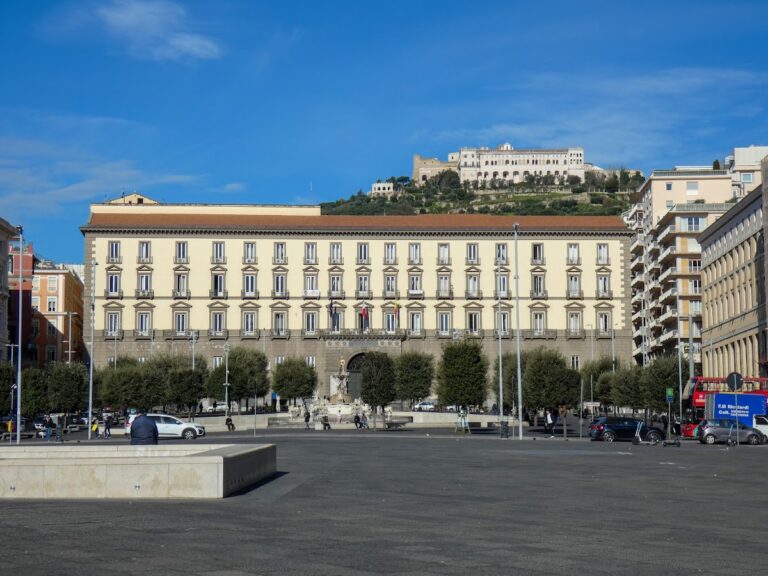
Palazzo Cellammare presents different architectural faces according to its surroundings. Toward Via Chiaia, it has the appearance of a fortified palace, with a sloping mezzanine faced in smooth rustication, masonry whose blocks or surfaces are deliberately emphasized. Its entrance is formed by a Baroque arch in piperno, a dark volcanic stone widely used in Naples. The elevation toward Via Filangieri instead follows the manner of an eighteenth-century aristocratic palace, showing the building’s successive architectural transformations.
Entrances and ceremonial interiors
Courtyard and staircase portals
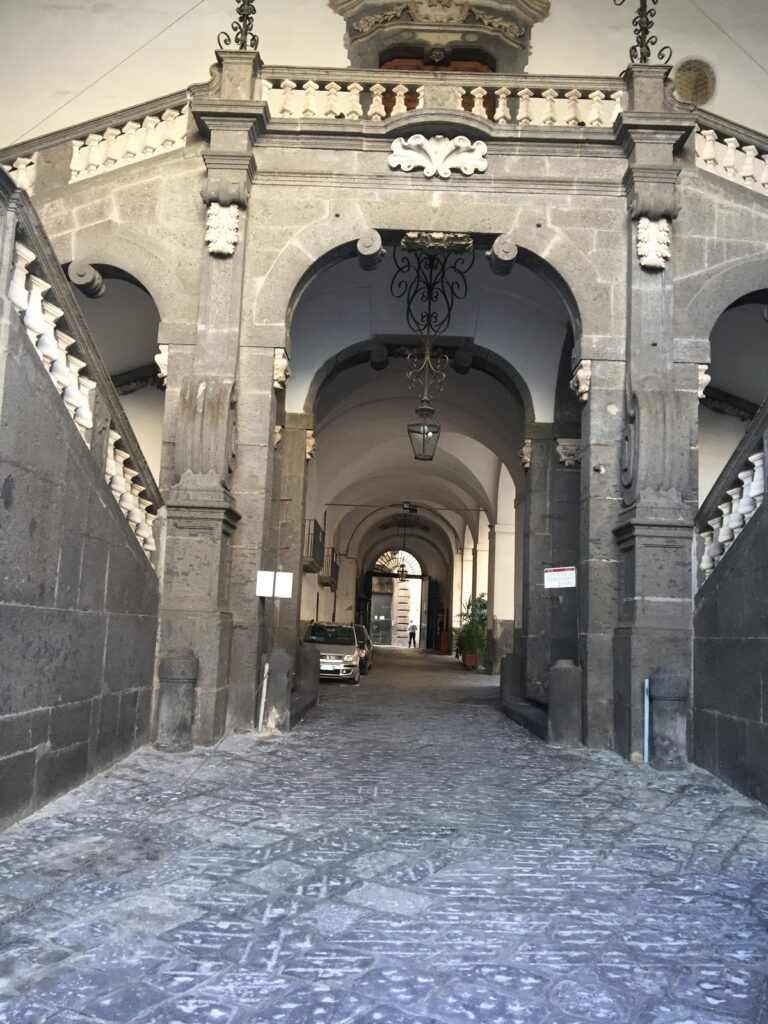
The entrance portal to the courtyard was executed by Ferdinando Fuga in a distinctly Neapolitan Baroque style. Inside, a portal with broken-line forms leads toward the staircase and is attributed to Ferdinando Sanfelice. The present staircase was designed by Giovan Battista Manni after the monumental staircase built by Francesco Antonio Picchiatti in 1651 had been demolished.
Chapel of the Virgin of Carmel
The Chapel of the Virgin of Carmel was created by Giovan Battista Nauclerio in 1727. Its altar bears a painting by Agostino Masucci, giving the chapel a clear place within the eighteenth-century decorative history of the palace.
Decorated apartments
Lower-floor apartment
The lower-floor apartment occupied by Filippo Giudice Caracciolo during the first half of the nineteenth century was later inherited by the Acton family, an Anglo-Italian aristocratic family. It contains a series of rooms with vaulted ceilings frescoed during the first half of the eighteenth century. A fresco is a wall painting applied to fresh plaster, and the surviving decoration preserves an earlier artistic layer within the later history of the apartment.
Piano nobile apartment
The piano nobile, the principal residential floor of an aristocratic palace, was first rented by Michele Imperiali and later by Queen Maria Carolina. Its four successive salons each have a frescoed vault. The decoration includes works by Pietro Bardellino, Giacinto Diano, Fedele Fischetti, and Alessandro Fischetti.
Rear garden
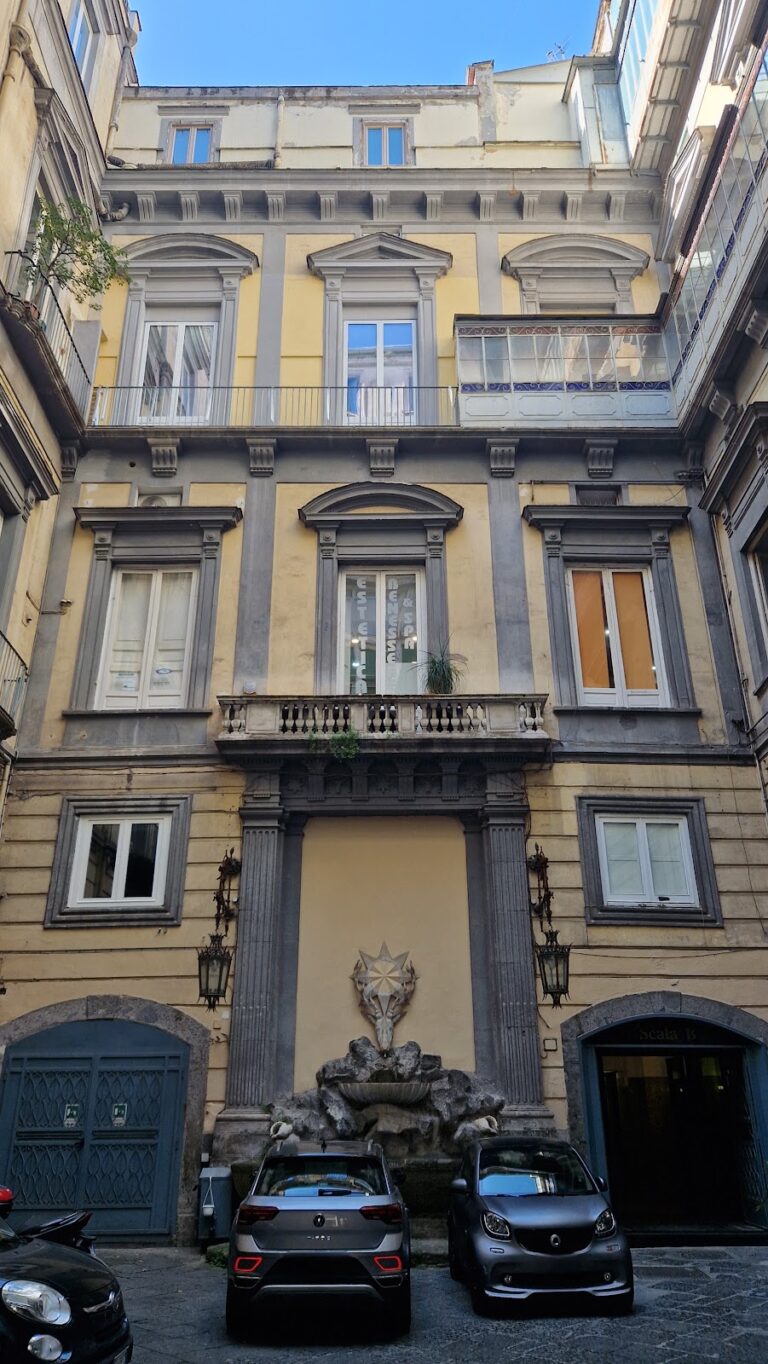
A large garden has occupied the rear of the palace since the middle of the sixteenth century. Its planted area was later expanded and then reduced during nineteenth-century urbanization, when two of the three gardens associated with the building were removed. The remaining garden contains fragments at its center of a fountain made by Giovanni da Nola, a Renaissance sculptor and architect.
Subterranean cinema-theatre
The Metropolitan cinema-theatre occupies former tuff quarries beneath the palace. These underground spaces had first been excavated to obtain construction material for the building. The cinema-theatre was designed by the architect Stefania Filo Speziale and originally contained approximately 3,000 seats, adding a modern public function to the palace’s earlier residential and ceremonial uses.
Nearby sites