Santa Maria in Portico, Naples: A Baroque Church and Convent
Site at a Glance
- Popularity
- Medium
- Country
- Italy
- Primary era
- Early Modern
- Eras represented
- Early Modern, Modern
- Civilizations
- Italian, Kingdom of Naples, Spanish
- Site type
- Religious
- Remains
- Church
On this page23 sections
History
Santa Maria in Portico is a Roman Catholic church in the Chiaia district of Naples, Italy. Built in the Baroque style, an ornate European artistic and architectural tradition, its construction began in 1632 to a design by Nicola Longo. Felice Maria Orsini, Duchess of Gravina, supported the project in memory of the Roman church of Santa Maria in Campitelli. The church was completed during the seventeenth century and is dedicated to the Virgin Mary.
Foundation and convent
The church formed part of a convent complex that originally consisted of three buildings, with gardens, fountains, and covered, open-sided galleries. The community and its church quickly gained prestige. In 1683, the complex temporarily housed the Marquess of Carpio, the Spanish nobleman serving as viceroy of Naples.
Religious community and later changes
Religious orders were suppressed in the early nineteenth century. The church closed in 1862, and the community was definitively expelled in 1866. Members known as the Fathers of Lucca, part of the Clerks Regular of the Mother of God, retained a small portion of the original complex and continued to live there. The order was founded by Saint John Leonardi, whose life is also commemorated in one of the church’s chapels.
Remains
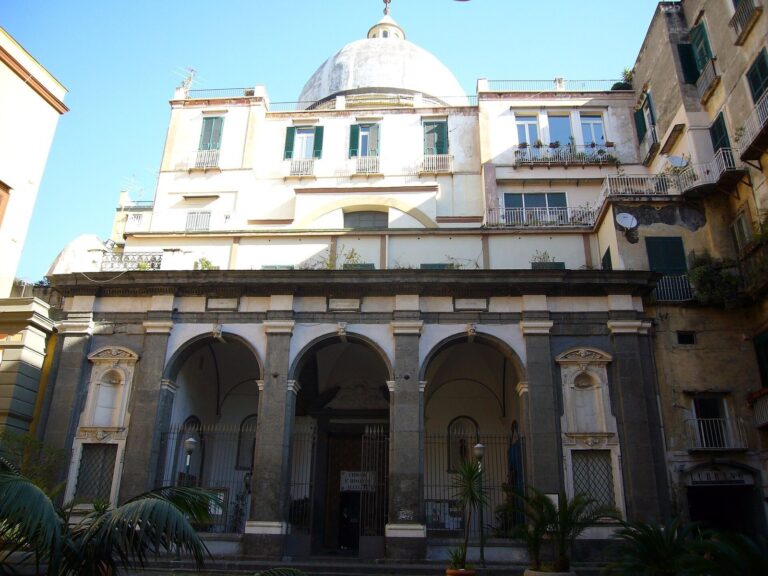
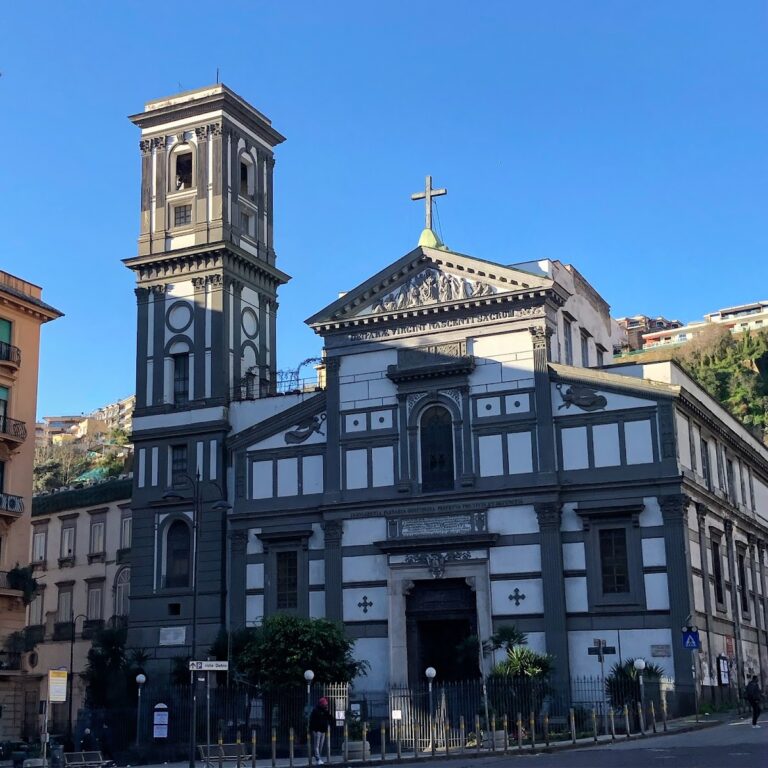
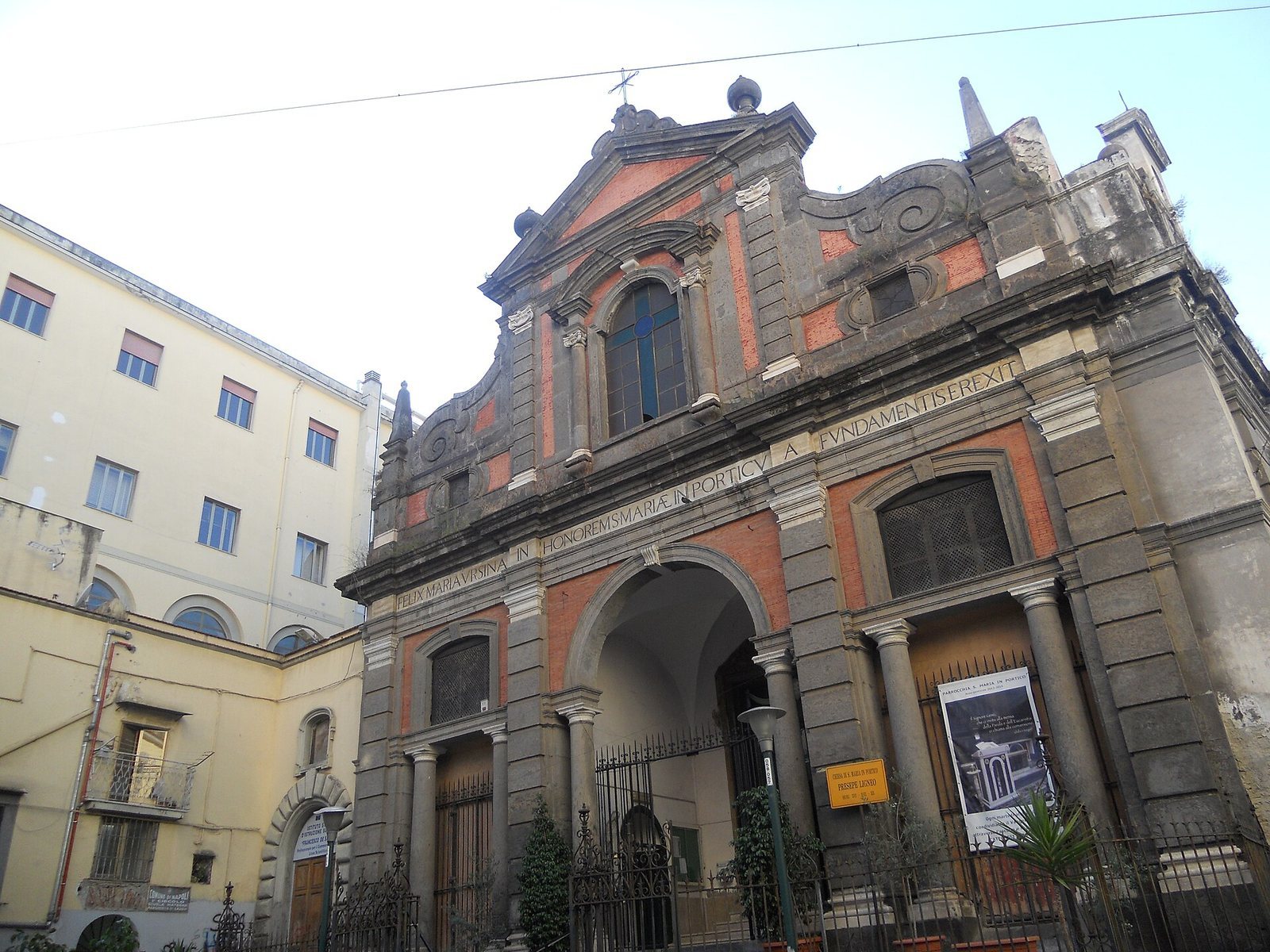
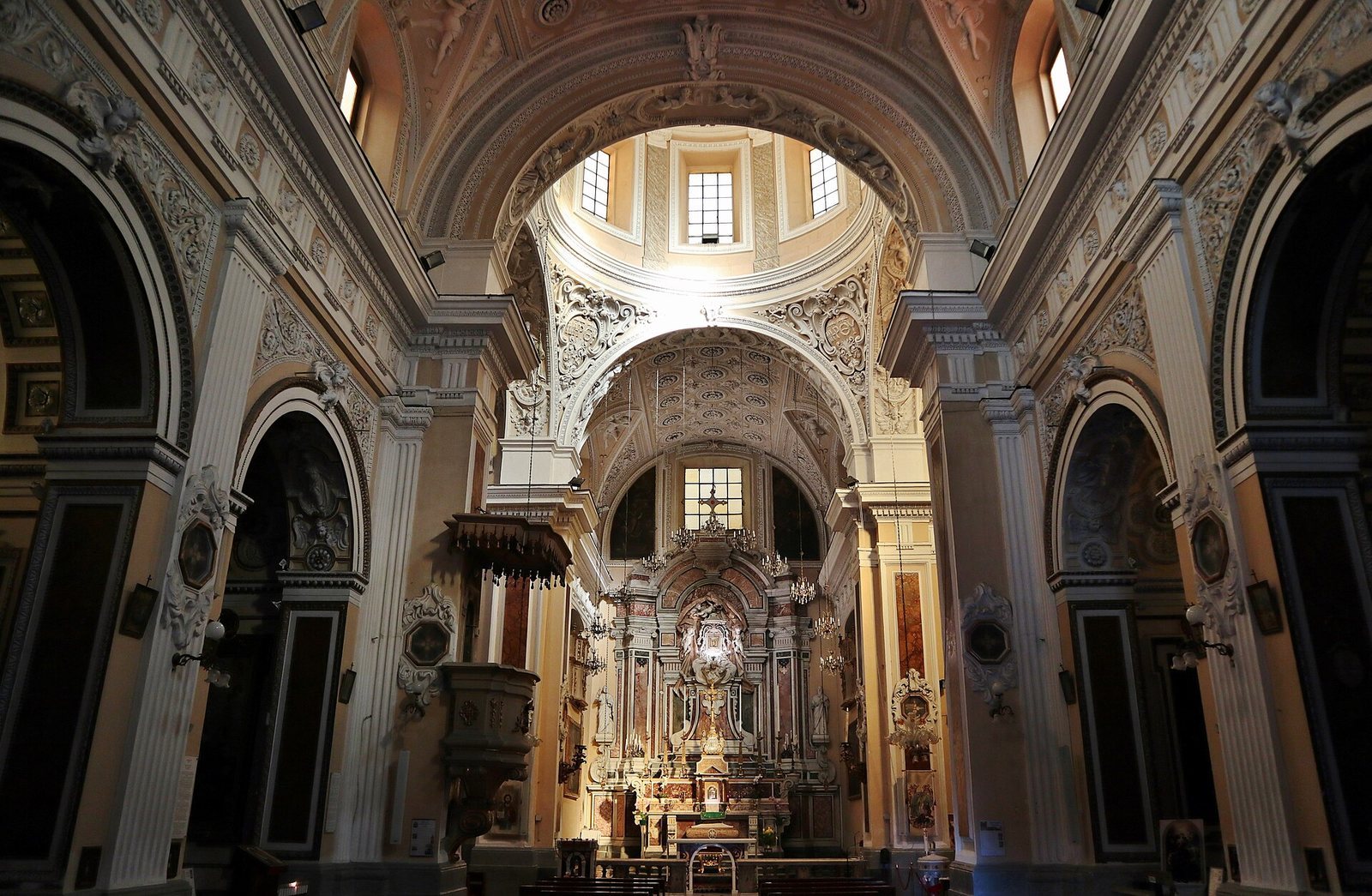
The church stands in an open space at the end of its namesake street, near the Riviera di Chiaia waterfront promenade. Its Latin-cross plan has a long central nave crossed by shorter transept arms, with three chapels on either side. A shallow transept and a sequence of vaulted spaces shape the interior, while the exterior is marked by a two-tier façade and a separate bell tower.
Plan and exterior
Nave and vaulted spaces
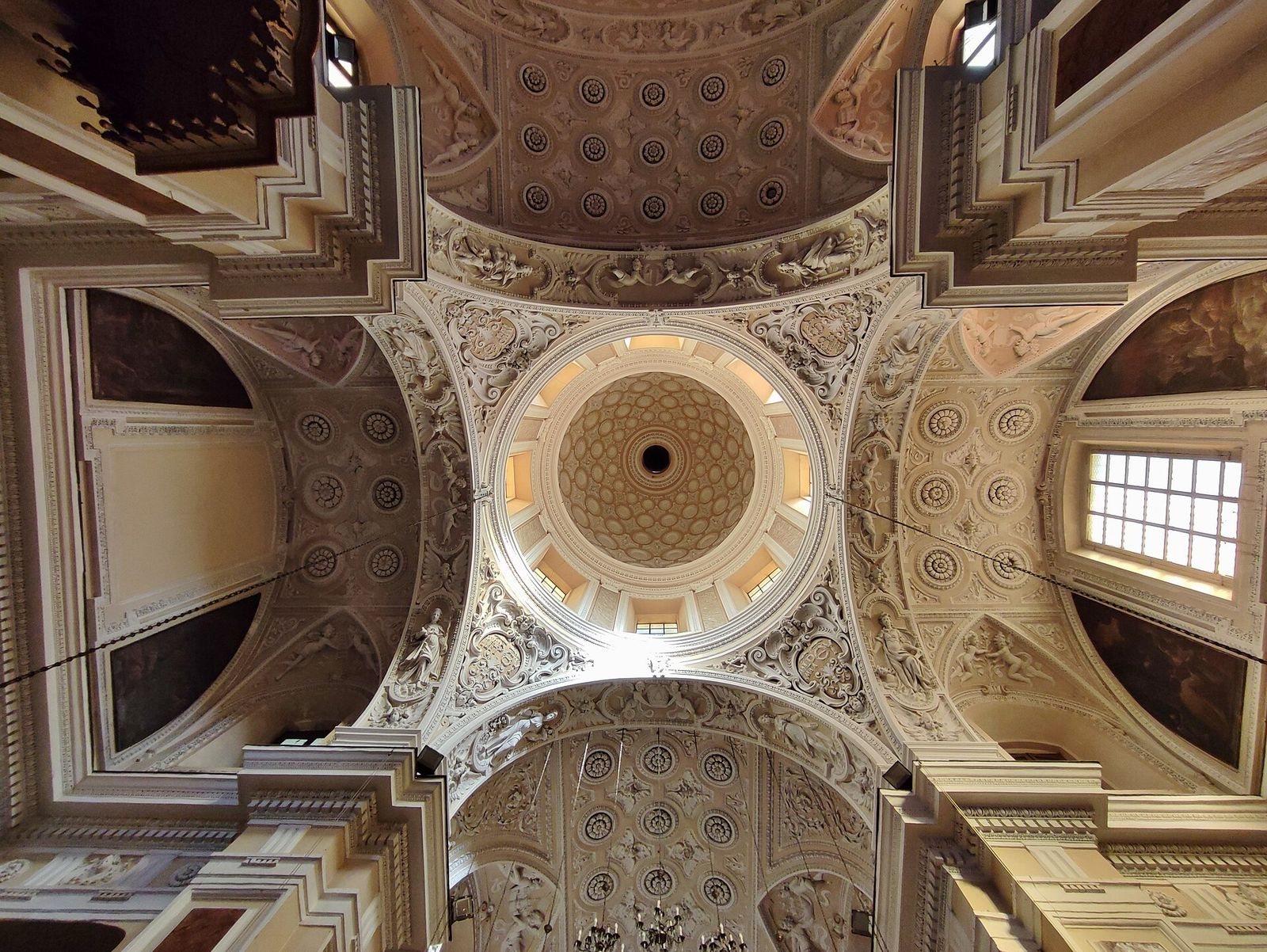
A single nave leads to the transept and altar area. Barrel vaults, continuous arched ceilings, cover the church, including the choir above the entrance atrium. Splayed windows bring light into the nave and cross-vaulted spaces, while curved openings illuminate the side chapels and emphasize the semicircular fields, or lunettes, on their end walls.
Dome
The central dome rises from a tall, eight-sided drum, the wall supporting the dome, pierced by eight windows. Its slightly raised outline is covered in yellow and blue tiles arranged in a fish-scale pattern. At the summit, a blind lantern, an upper structure without openings, is crowned by a copper sphere and cross. The curved supports between the square space and the dome are decorated with the Greek abbreviation for Mother of God.
Façade
Arcangelo Guglielmelli designed the façade, completed in 1682. Its arrangement follows a surviving drawing in his hand, and the design is attributed to Guglielmelli rather than Cosimo Fanzago. Two tiers are separated by a high band bearing a dedication. The lower level has a central arched opening flanked by smaller openings, a composition known as a Serlian motif. Its restrained color comes from marble, piperno, a volcanic stone used in Naples, and exposed brick.
Rusticated piperno pilasters, with white-marble bases and capitals, organize the lower tier. Above, a broad central window framed by columns is topped by a lunette-shaped pediment. The central section ends in a triangular pediment and a piperno finial, while scroll-shaped forms join it to the lower side wings. Obelisks and columns and pilasters of varying sizes contribute to the façade’s complex composition. Closing the two side openings of the entrance atrium in 1862 changed the spatial effect of the original design.
Bell tower
The square-plan bell tower was erected in 1645. Its top has an eight-sided, bud-shaped finial crowned by a cross and an iron-sheet weather vane shaped as a bear, the heraldic emblem of the Dukes of Gravina. A neighboring building was later raised, partly obscuring the tower’s former prominence in the cityscape.
Interior decoration and furnishings
Vaults and sculptural decoration
Stucco ornament on the nave vault dates to 1634 and bears the initials D.P. Flying child figures and representations of virtues decorate the arches. Between them, rosettes alternate with cherubs, while angels carrying symbols of the Virgin appear above the windows. The large arches around the dome feature allegories of the cardinal and theological virtues. The curved supports beneath the dome also carry the abbreviation for Mother of God.
Floor and fittings
The seventeenth-century terracotta floor includes marble panels and a central tomb slab for Felice Maria Orsini, dated 1647 and associated in design with Cosimo Fanzago’s work. Two marble holy-water basins at the entrance take inspiration from Lombard art. An early nineteenth-century gilded wooden episcopal chair stands in the altar area. Other furnishings include eighteenth-century Murano-glass chandeliers, walnut sacristy cupboards made in 1647 by Friar Francesco Meniconi, a washbasin by Domenico Antonio Vaccaro, and a seventeenth-century carved and gilded wooden pulpit with a canopy.
Main altar and choir
The main altar is made of colored marble and includes a small temple-shaped ciborium, a canopy over the altar, and a yellow-marble chest supported on lion’s feet. A balustrade and a floor of white, red, and black marble complete the altar area. Domenico Antonio Vaccaro’s 1732 altarpiece is framed by pilasters and an elaborate crowning feature, where three white-marble angels hold a draped cloth. Within an arch on Ionic pilasters is an image of the Virgin, copied from a thirteenth-century enamel image at Santa Maria in Campitelli in Rome. A seventeenth-century small choir is enclosed by a gilded, latticework wooden balustrade.
Paintings and chapels
Transept and apse paintings
An early eighteenth-century painting of the Stories and Miracles of Santa Maria in Portico is attributed to a follower of Luca Giordano. Six canvas sections in the large lunettes of the transept and apse, associated with Giordano’s school, depict miracles of the Virgin. Their subjects include the apparition to Saint Galla, an early Christian saint associated with Rome, and papal processions held in response to plague.
Three oil paintings from the second half of the seventeenth century are attributed to Giovanni Battista Benaschi. Among their identified subjects are the Adoration of the Magi, with the Virgin shown in three-quarter view and a kneeling Magus, and the Adoration of the Shepherds, in which the Child looks back toward the Madonna. The transept also contains copies of Mattia Preti’s Martyrdom of Saint Bartholomew and Job, both formerly in the Dragonetti collection, and Fabrizio Santafede’s early seventeenth-century Annunciation, showing the seated Virgin and the approaching Archangel Gabriel.
Sacristy
Giovanni Battista Benaschi’s Glory in the Name of Mary, dating to the second half of the seventeenth century, covers the sacristy vault and walls with groups of flying angels painted in very pale colors. Similar figures appear in oval panels in the side passages. Four stucco-framed door panels contain frescoed busts of King David, the Virgin, Saint Joachim, and Saint Joseph; the paintings are in very poor condition. The room also has a rector’s seat and Rococo choir stalls, a later and lighter decorative style, carved with fruit and garlands.
A Baroque pipe organ has a carved wooden case decorated with floral and fruit friezes, amphorae, and an angel’s head. In front of it, an openwork, gilded wooden balustrade bears the abbreviation for Mother of God at its center.
First chapel on the left
Dedicated to Saint Anne, Mary’s mother in Christian tradition, this chapel has stucco by Giacomo Colombo and angels by Domenico Antonio Vaccaro. Its paintings include the Annunciation and the Immaculate Conception, both attributed to Angelo Mozzillo, and Fedele Fischetti’s signed and dated 1760 Birth of the Virgin.
Second chapel on the left
The chapel dedicated to Saint Joseph, Mary’s husband in Christian tradition, combines marble and gilded stucco. Its paintings, from the Neapolitan school of the seventeenth and eighteenth centuries, include the Death of Saint Joseph, showing Christ embracing him; the Marriage of the Virgin; and Francesco Verini’s 1794 Dream of Saint Joseph, distinguished by subdued colors.
Third chapel on the left
Restored in 1909 and dedicated to Saint John Leonardi, this chapel has paintings by G. Rendesi depicting episodes from the saint’s life. They include the presentation of religious members to Mary and Leonardi’s meeting with Saint Philip Neri, founder of the Congregation of the Oratory. The new works replaced paintings from the eighteenth century.
First chapel on the right
Dedicated to the Immaculate Conception, this chapel has more restrained stucco decoration. Nicola Vaccaro’s paintings show the Christ Child having a vision of the Cross and the Virgin and Child with Saint Anne, Saint Joachim, and the young Saint John the Baptist. A colored statue of the Immaculate Conception, dated 1912, is also kept here.
Second chapel on the right
This chapel is dedicated to the Crucifix of Lucca, a venerated wooden crucifix copied from the original in Lucca. The walls also hold a seventeenth-century Neapolitan-school copy of Christ Crowned with Thorns and Mocked, based on a work by Ribera, and a Deposition attributed to Giacomo Farelli and copied from a painting by Andrea Vaccaro.
Third chapel on the right
Works by Giovanni Bernardino Azzolino and Paolo De Matteis fill this chapel. Azzolino’s paintings include Jesus Receiving the Soul of the Virgin, arranged in two registers with the Virgin reclining below and Christ embracing her, and the Coronation of the Virgin. De Matteis’s Assumption depicts the Virgin rising among angels and solid-looking clouds.
Nativity scene
Pietro Ceraso began the nativity scene in 1647 with life-size figures. He made hollow wooden bodies for the figures and used a particular paste for their faces. In 1690, Giacomo Colombo enlarged and renewed the scene, adding figures drawn from Neapolitan life, including two old men, a woman, and a young gentleman. Giuseppe Picano later contributed expressive figures, among them a poor man in adoration and the shepherd of the Annunciation. After the church closed in 1862, the scene was put away and damaged. Vincenzo Reccio restored and rearranged it in 1872, replacing the Madonna and adding figures. Further damage during the Second World War was followed by restoration in 1961 by Professor Lebro. The reassembled scene, combining works by Ceraso, Colombo, and Picano, now has a permanent place in a side room of the church.