Palazzo delle Opere sociali: A Neoclassical Social and Diocesan Palace in Vicenza


Site at a Glance
- Rating
- 4.3
- Popularity
- Very Low
- Country
- Italy
- Primary era
- Modern
- Eras represented
- Modern
- Civilizations
- Unclassified
- Site type
- Civic
- Remains
- Palace
On this page6 sections
History
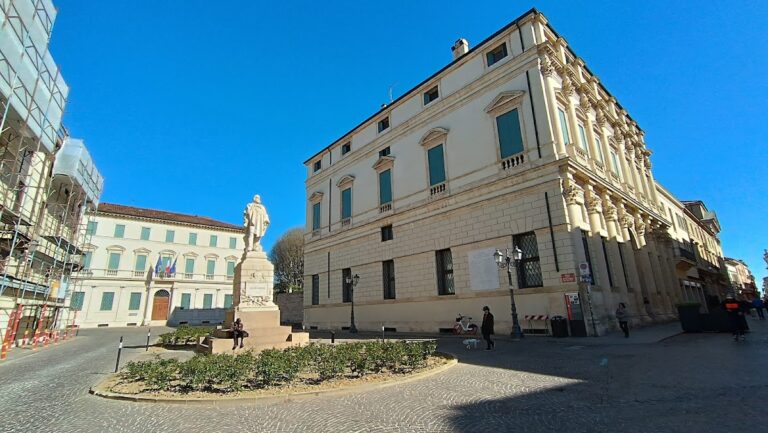
Palazzo delle Opere sociali is a neoclassical palace in Vicenza, Italy, constructed in 1808 by Giacomo Fontana on the site of the former Hospital of Sant’Antonio Abate. Located in Piazza del Duomo beside Vicenza Cathedral, the building reflects the transformation of a medieval charitable complex into a social institution for the upper bourgeoisie and later into a diocesan and cultural centre.
The Hospital of Sant’Antonio Abate
The earlier hospital complex was built between 1350 and 1364 near the cathedral’s bell tower. It included two attached churches, one dedicated to Santa Maria, Sant’Antonio Abate, and San Giorgio, and the other to San Gottardo. Sant’Antonio Abate is Saint Anthony the Great, an early Christian ascetic associated with monasticism and protection against disease and temptation.
The hospital was founded by Alberto di Billanth, a German knight and constable of Vicenza under the Scaligeri, the ruling dynasty of Verona and its territories during the medieval period. Alberto repeatedly devoted his own wealth to the construction and endowment of the hospital and its churches. He retained patronage rights for himself and his wife, Aquilina, and both were buried in a tomb set into the wall above the church’s high altar.
Administration belonged to the Confraternity of San Giovanni decollato, a religious brotherhood responsible for shared devotional and charitable duties. It originated from a Battuti association, a medieval lay penitential group whose members undertook religious and charitable activities. The confraternity was also called the Negroni because its members wore black cloaks while accompanying condemned people to execution and arranging their burials.
The Hospital of Sant’Antonio gained a strong reputation in Vicenza through fourteenth-century documents and stories of miracles attributed to the intercession of Saint Anthony the Great. These accounts encouraged donations, which supported the poor and helped finance valuable artistic works.
Suppression and transformation
By the late sixteenth century, the church required extensive repairs, and its condition worsened during the seventeenth century. In the following century, the hospital moved to the former monastery of San Bartolomeo. The Hospital of Sant’Antonio Abate was then suppressed, while the Confraternity of San Giovanni decollato transferred to the small Hospital of Sant’Ambrogio in Borgo Porta Nova.
In 1805, the Società del Casino Nuovo purchased the deteriorated hospital buildings and converted the site into a leisure and social venue for members of the upper bourgeoisie. The Casino Nuovo was a nineteenth-century social association and meeting place, not a gambling casino in the modern sense. Its character differed from that of the older Casino dei Nobili, which was reserved for the nobility. Fontana constructed the present palace on the site in 1808.
The palace later passed to the Diocese of Vicenza and acquired the name Palazzo delle Opere sociali cattoliche. It now houses diocesan offices and Catholic associations, while also providing spaces for exhibitions, conferences, conventions, and cultural activities. Events connected with the Festival biblico take place there in spring.
Remains
Palace and cathedral setting
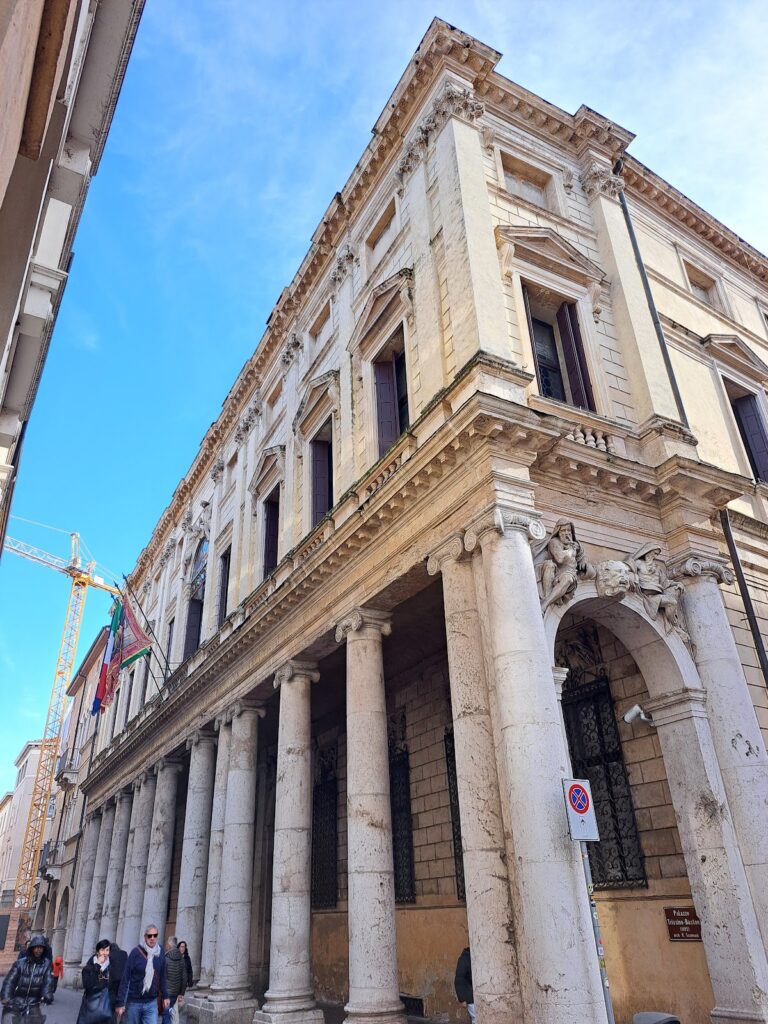
The palace is a sober neoclassical building that occupies the entire block in Piazza del Duomo. Its construction partially incorporated the bell tower of the Cathedral of Santa Maria Annunciata, linking the nineteenth-century palace to the cathedral complex and to the medieval hospital that previously stood on the site.
Interiors and surviving decoration
The Hall of Honour and other interior spaces follow a Neo-Palladian approach, a revival of Andrea Palladio’s principles of classical symmetry, proportion, and form. Surviving frescoes include figures painted by Giacomo Ciesa in 1807, framed by architectural elements created by David Rossi. These interiors and paintings preserve elements of the palace’s early nineteenth-century artistic conception.
Nearby sites