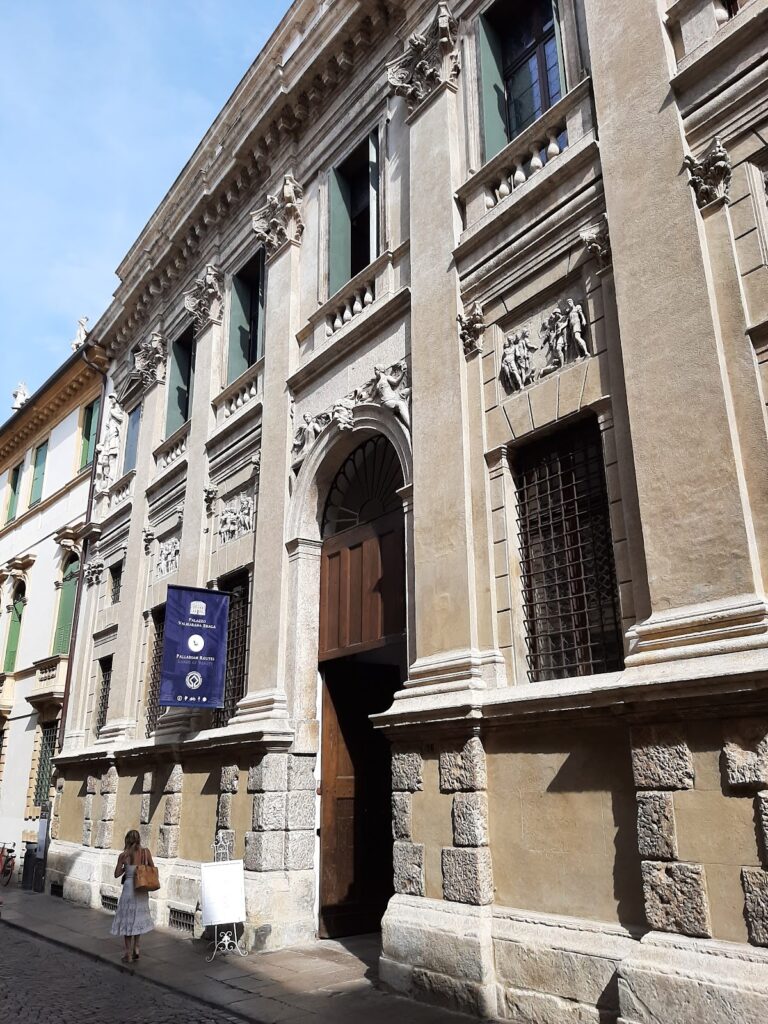
Palazzo Trissino al Corso: Municipal Palace of Vicenza


Site at a Glance
- Rating
- 4.5
- Popularity
- Very Low
- Country
- Italy
- Primary era
- Early Modern
- External website
- Open
- Eras represented
- Early Modern, Modern
- Civilizations
- Venetian
- Site type
- Civic
- Remains
- Palace
On this page15 sections
History
Palazzo Trissino al Corso is a late-sixteenth-century palace in Vicenza, Italy, commissioned by the Trissino family and designed in the Renaissance tradition by Vincenzo Scamozzi. It was built between the site of Count Achille Trissino’s residence and the end of the sixteenth century, becoming a major aristocratic residence before its later transformation into the principal seat of the Municipality of Vicenza.
Construction and Trissino ownership
In 1588, Galeazzo Trissino, the nephew of Count Achille Trissino, commissioned Scamozzi to construct a new palace. The building was completed before the close of the century. Alessandro Maganza and Andrea Vicentino added painted decoration in the early seventeenth century, establishing the palace’s long association with artists and craftsmen working for successive Trissino owners.
The palace passed between several branches of the family, and each generation altered parts of the interior. Count Cristoforo Trissino di Riale commissioned Giulio Carpioni to produce decorations and frescoes between 1653 and 1660. These included a cycle devoted to the life of Santa Savina, the saint later commemorated by the palace chapel and by one of its principal rooms.
Seventeenth- and eighteenth-century transformation
In 1662, Marcantonio and Ludovico Trissino dal Baston commissioned Antonio Pizzocaro, working with Carlo and Giacomo Borella, to complete the facade and side elevation. In 1729, Francesco Muttoni designed a chapel dedicated to Santa Savina in the southeast corner of the piano nobile, the principal residential floor. The chapel was commissioned by Francesca Maria Pompei Trissino.
Another Marcantonio Trissino dal Baston commissioned Ottone Calderari in 1768 to build the southwest wing and renew the decoration of the Salone degli Stucchi and Salone degli Uscieri. The new wing included rooms prepared for the marriage of Marcantonio Trissino dal Baston and Cecilia of the Counts Emilii. The palace therefore continued to develop as a family residence well into the eighteenth century.
Damage, municipal use, and restoration
Napoleon’s bombardments in 1805 and the revolts of 1848 caused minor damage. The lowering of the street level in 1864 required bases to be built for the columns of the external portico. Count Alessandro Trissino dal Baston, a Knight of Malta and provincial deputy, was the last member of the family to live in the palace. After his death, the building passed to the heirs of his sister Francesca, who was married to Count Ignazio da Porto.
The heirs initially rented the palace and transferred it to the Municipality of Vicenza in 1901. The municipality adapted it as its representative seat while largely preserving the existing decoration. The Santa Savina chapel was dismantled in 1908. The palace has remained the municipality’s principal seat since 1901 and contains the mayor’s office together with departments responsible for finance and budget, economic development, personnel, participation, and tourism.
Heavy bombing on 18 March 1945 brought down the ceilings of the main salon and the rooms facing Corso Palladio. The ensuing fire destroyed much of the interior decoration. Restoration campaigns in 1949 and 1950 and again in 1957 repaired stucco and decorative work, while the Santa Savina frescoes were restored in 1957. Further conservation took place in 1984 and 1990.
Palazzo Trissino is linked by an internal passage to the Palazzo del Capitaniato in Piazza dei Signori, whose Sala Bernarda is used for meetings of the municipal council. Several rooms in the palace have later been named for civic and political figures from Vicenza. The former Sala di Santa Savina was renamed for Luigi Faccio, a mayor removed by the Fascist regime and reinstated after the Liberation. Other rooms commemorate Mariano Rumor, Giuseppe Zampieri, Giuseppe Magnabosco, Luciano Rainaldi, Gabriele Collese, Antonio Dal Sasso, and Giovanni Chiesa.
Remains
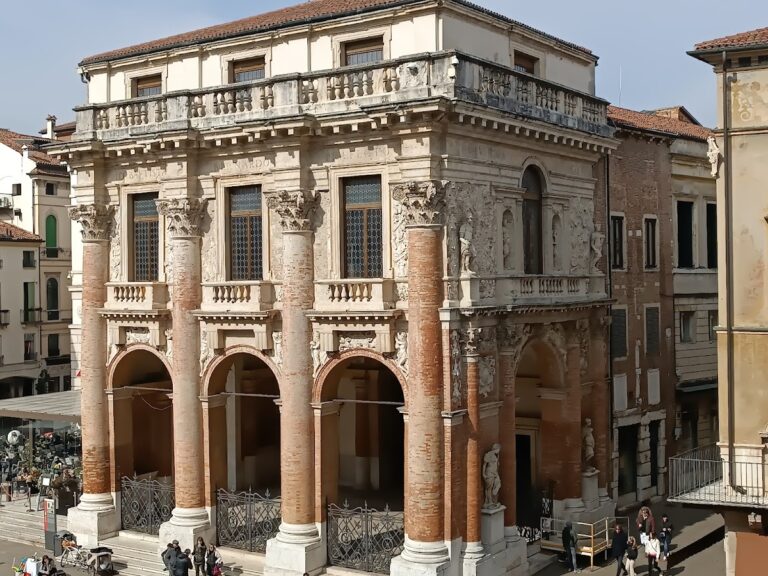
Palazzo Trissino al Corso is a three-storey building on a narrow, irregular site at the corner of Corso Andrea Palladio and Contrà Cavour. Its plan is organized around a square central courtyard. The exterior combines a ground-floor portico with white-stone columns and an upper level framed by composite pilasters, while the surviving rooms preserve layers of seventeenth-, eighteenth-, and twentieth-century decoration.
Exterior and courtyard
Portico and river statues
The ground floor is arranged as an Ionic portico, a covered entrance supported by columns. At the end toward Contrà Cavour, an exterior arch is surmounted by statues representing the Bacchiglione and Retrone rivers. Gian Battista Barberini made these figures and also produced much of the palace’s interior sculpture, decoration, and stucco, a molded plaster used for architectural ornament.
Courtyard and civic memorials
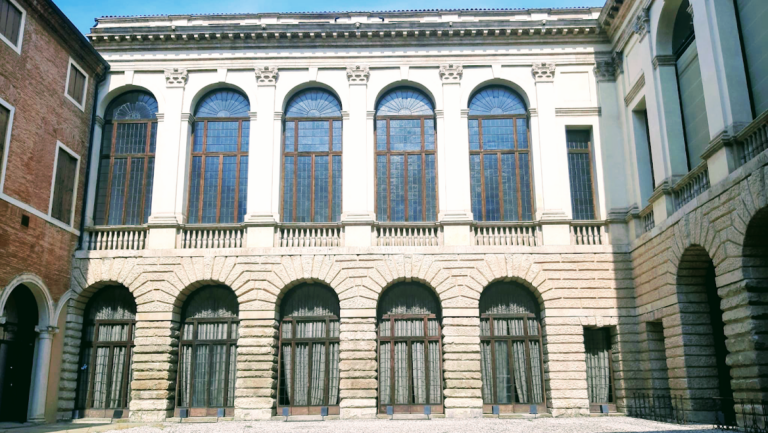
The square courtyard has Tuscan-order columns and a gallery extending along the full facade. Its projecting railing consists of wrought-iron ribbons. A loggia, an open gallery or balcony-like space, contains a monument to Sebastiano Tecchio, a Vicenza statesman and patriot who lived from 1807 to 1886. His bust was first placed in the Loggia del Capitaniato, moved to Palazzo Trissino in 1938, and installed in its present position in 1953.
The relief on Tecchio’s pedestal shows him in Venice reading the results of the 21 and 22 October 1866 Veneto plebiscite to a crowd near the Doge’s Palace. The vote confirmed Veneto’s union with the Kingdom of Italy. The courtyard also holds a memorial plaque to Vicenza’s deputies who died in the 1915 to 1918 war and a device for measuring horses, commissioned by Ludovico Trissino in 1775.
Principal interiors
Salone degli Stucchi
The Salone degli Stucchi was formerly the palace’s largest and most prestigious room. Its seventeenth-century ceiling depicted the Fall of the Giants, and its stucco and fresco program referred to mythological stories associated with the eagle in the Trissino family arms. The 1945 bombing and fire destroyed the stucco by Antonio Pizzocaro and Gian Battista Barberini, as well as much of the painting by Lodovico Dorigny.
The stucco was restored after the war. Frescoes that could not be recovered were replaced by seventeenth-century canvases from Villa Negri de’ Salvi at Albettone. They depict Dido suspecting that Aeneas’s fleet is departing and Dido committing suicide with Aeneas’s sword. A large chandelier and wall sconces made by Murano glassmakers in 1950 illuminate the room. Barberini’s statues, friezes, and stucco figures of Amazons, putti, and garlands decorate the entrances, while oval panels above the four doors show Cleopatra and Lucretia committing suicide, Jael killing Sisera, and Judith with the head of Holofernes. The room is used for conferences, concerts, and civil wedding ceremonies.
Sala di Santa Savina
The Sala di Santa Savina, also called the Sala della Giunta because the municipal executive meets there, contains a seventeenth-century painting of Saint Vincent holding a model of Vicenza. The work is attributed to the young Francesco Maffei.
A frieze made by Giulio Carpioni around 1665 presents episodes from Santa Savina’s life. The scenes show her receiving Communion, visiting the imprisoned Christian soldiers Nabore and Felice, finding their martyred bodies miraculously intact, invoking angels, and carrying their ashes in a barrel on an ox-drawn cart. According to the story represented, wine flowed from the cart when customs officials demanded payment. Further scenes show Savina handing the ashes to a bishop, receiving angels, and being raised to the Holy Trinity. Bombing damaged the cycle in 1945, and it was restored in monochrome in 1957 using earlier photographic documentation.
Mayor’s office
The present mayor’s office suffered severe damage in 1945. Its original decoration included frescoes by Giambattista Gattucci from 1662 and Giovanni Ghisolfi from 1664. The room now contains five of Giovanni Battista Zelotti’s twenty-six sixteenth-century frescoes, transferred from Villa da Porto at Torri di Quartesolo in 1926.
The office preserves Vicenza’s historic flag in a protective frame. On 19 October 1866, King Victor Emmanuel II awarded the city’s flag a gold medal for its revolt against Austrian rule in 1848, an uprising suppressed by General Radetzky. A display case holds this medal and Vicenza’s second gold medal, awarded for partisan activity between September 1943 and April 1945, when the partisan movement opposed German occupation and Fascist rule in Italy. The room also contains a portrait of Victor Emmanuel II by Giovanni Busato.
Southwest wing rooms
A room in the southwest wing, now the office of the municipal secretary general, was the finest room in the apartment prepared for the 1768 marriage of Marcantonio Trissino dal Baston and Cecilia of the Counts Emilii. Ottone Calderari designed its decoration between 1763 and 1768. A richly ornamented gilded coffered ceiling contains a central tempera painting by Giacomo Ciesa, showing a young couple accompanied by cupids.
The west wall holds a seventeenth-century copy of Paolo Veronese’s The Wedding at Cana, painted in 1563 and now preserved in the Louvre. The original bridal apartment also included the present Archivio Loschi room, which has comparable decoration.
Salone degli Uscieri
The Salone degli Uscieri stands opposite the Salone degli Stucchi across the courtyard. Its decoration includes eighteenth-century medallions depicting Roman emperors.
Former Santa Savina chapel
The room at the southeast corner was formerly the chapel dedicated to Santa Savina. Built in 1729 and dismantled in 1908, it is associated with a surviving stone dedication to the saint dated 30 June 1729 and commissioned by Francesca Maria Pompei Trissino.