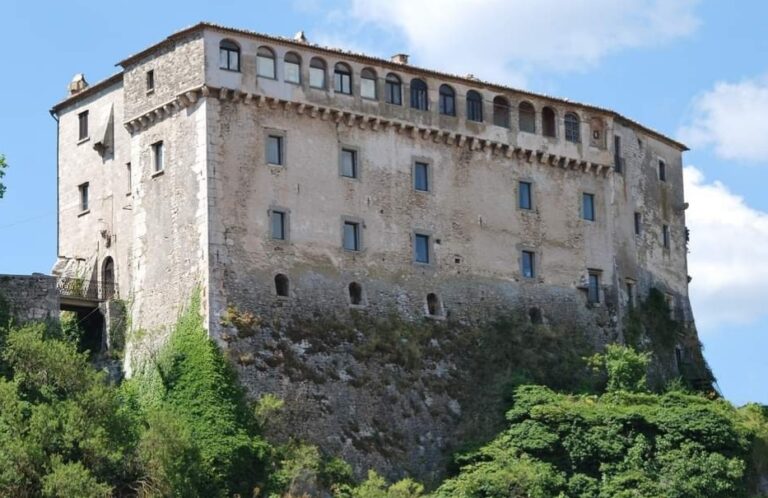
Palazzo Cannavina: An Aristocratic Palace in Campobasso


Site at a Glance
- Rating
- 4.6
- Popularity
- Low
- Country
- Italy
- Primary era
- Early Modern
- External website
- Open
- Eras represented
- Early Modern
- Civilizations
- Kingdom of Naples
- Site type
- Domestic
- Remains
- Palace
On this page8 sections
History
Palazzo Cannavina is an aristocratic palace in Campobasso, Italy, whose early history is associated with the Gonzaga family and whose present form dates from the late eighteenth century. It stands on Via Vittorino Cannavina, formerly Via Borgo, between Largo San Leonardo and Vico Fondaco della Farina.
Gonzaga and Carafa ownership
The original palace was probably built between 1500 and 1530. Its construction is associated with Ferrante I Gonzaga, an Italian nobleman who later became Viceroy of Sicily and Count of Guastalla. A coat of arms found inside the building connects this early phase with his marriage in 1530 to Isabella of Capua, Princess of Molfetta.
After the Gonzaga family, the property passed to Ottavio Vitaliano, a nobleman from Naples, and later to the Carafa family. The Carafa branch connected with the palace held the title of Dukes of Jelsi and exercised feudal authority in Campobasso. When Mario Carafa died without heirs in 1727, ownership passed to the town’s demanial authorities. These were public authorities responsible for property or territories that had returned to the public domain after the feudal arrangement ended. They had repurchased the fief, a territory held under a feudal system, and appointed the local farmer Salvatore Romano as baron.
The late-eighteenth-century rebuilding
The building now standing replaced the earlier palace during the late eighteenth century. In the early 1780s, Michelangelo of the Salottolo family acquired it for 1,800 ducats and carried out a complete renovation. This work removed the architectural characteristics of the original structure and created the form associated with Palazzo Cannavina today.
The Salottolo family retained the final portion of the building until the end of the nineteenth century. The palace was later acquired by the Cannavina family, whose name remained attached to the property. Its aristocratic history also continued through the people and objects associated with its rooms, including portraits of former owners, correspondence, and possessions connected with war, nineteenth-century politics, and the cultural life of the household.
The palace in modern times
In 2011, the palace and its furnishings were offered for sale by the heirs. The building’s contents preserved links to several strands of Italian political and intellectual history. A tricolour flag bearing the word “independence” was associated with Ferdinando Cannavina, who had waved it on the Neapolitan barricades in 1848.
Remains
Plan, courtyard, and facade
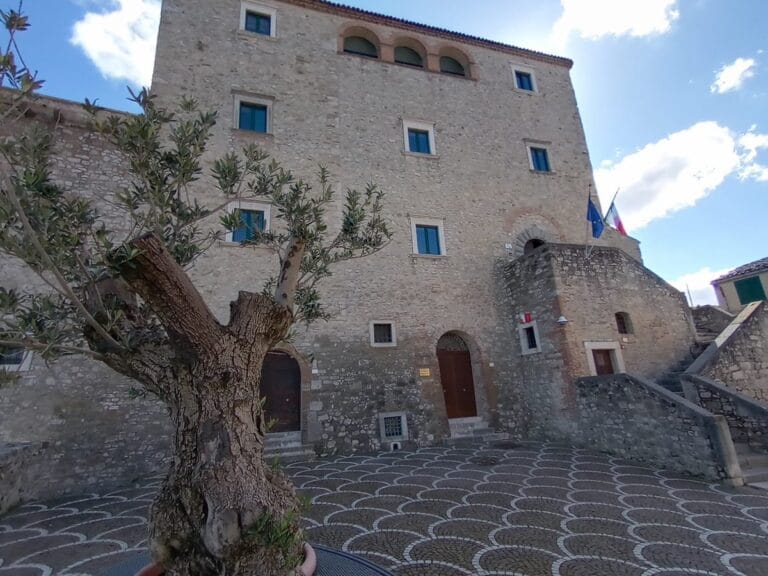
Palazzo Cannavina has a quadrangular plan organized around an internal courtyard. The building extends across a ground floor, two noble floors, and a mezzanine. The ground floor was formerly used for carriage storage and related spaces. The noble floors were the principal residential levels, intended for domestic and ceremonial rooms, while the mezzanine formed an intermediate or partial storey between the main floors.
The main facade is distinguished by an imposing Baroque-style portal. Above the entrance is a coat of arms showing a pine tree, two rampant lions facing one another, and three hills. An ornamental crown with five visible points surmounts the emblem, although this crown cannot be associated with any known noble crown.
Residential interiors and historic contents
The first noble floor formerly contained numerous richly furnished rooms. Its most imposing room was decorated in the Louis XVI style, a late-eighteenth-century French neoclassical style marked by restrained classical forms and ornament. The palace also contained portraits of its owners, pierced steel objects personalized with names and dedications, and a pianola associated with the elaborate balls held there.
The Trombetta photographic collection formed part of the preserved contents. Another object was a telescope that had belonged to Horatio Nelson, the British admiral known for his naval command during the Napoleonic Wars. Nelson’s sons donated the telescope to Tito Barbieri, a patriot from Molise, after which it was preserved in the palace.
The building also held letters exchanged with Francesco D’Ovidio and Antonio Ranieri. D’Ovidio was an Italian scholar and senator associated with the Accademia della Crusca and the Accademia dei Lincei. Ranieri, an Italian writer and politician, used his correspondence to request information about Gabriele Pepe, a patriot from Molise.
Private chapel
Two private chapels once served the noble floors, with one chapel on each level. One survives, retaining furnishings that include the Salottolo family coat of arms. Its survival preserves a direct architectural and heraldic connection with the family responsible for the palace’s major late-eighteenth-century renovation.
Nearby sites