Bojano Cathedral: An Italian Co-Cathedral Rebuilt Through Centuries of Earthquakes


Site at a Glance
- Rating
- 4.6
- Popularity
- Very Low
- Country
- Italy
- Primary era
- Modern
- Eras represented
- Medieval, Early Modern, Modern
- Civilizations
- Kingdom of Naples, Kingdom of Sicily, Lombard
- Site type
- Religious
- Remains
- Cathedral
On this page16 sections
History
Bojano Cathedral is an active Catholic co-cathedral in Italy, dedicated to Saint Bartholomew the Apostle and serving as the principal Catholic place of worship in Bojano. Its origins reach back to the second half of the eleventh century, when the medieval cathedral was established, while Romanesque elements in the crypt apse point to an eleventh-century date for the crypt. The church now belongs to the Archdiocese of Campobasso-Boiano, a co-cathedral being a cathedral that shares episcopal functions with another cathedral.
Early Diocese and Medieval Cathedral
Bojano was described as a diocesan see in 501, under Bishop Lorenzo, and the former Diocese of Bojano is dated to the sixth century. The earliest recorded reference to the cathedral itself comes from 1073, when Rodolfo di Moulins, Count of Bojano, restored it. The church was damaged by an earthquake in 1117. Bishop Poliziano reconsecrated it in 1215, and Bishop Giovanni commissioned its pointed-arch portal in 1239. An inscription preserves the record of that commission.
An earthquake in 1456 destroyed the cathedral and much of Bojano. Bishop Silvio Pandone rebuilt the church in 1513. Elements of the medieval building, including the south-side portal and rose window, were probably incorporated into the rebuilt structure. The former diocese was later suppressed, but the church continued to hold an episcopal connection that eventually became its co-cathedral status.
Earthquakes, War, and Reconstruction
The Sant’Anna earthquake of 26 July 1805, centred a few kilometres away in the Matese massif, almost completely destroyed the building. Its vault collapsed, and the bell tower and part of the facade were rebuilt during the subsequent Neoclassical reconstruction. That appearance lasted until 1943–44.
In 1927 the bishop’s seat moved to the Collegiate Church of the Holy Trinity in Campobasso, which became the principal episcopal seat of the archdiocese. Bojano Cathedral retained co-cathedral status. In 1930, Romeo Musa added frescoes to the Neoclassical barrel vault, dome, and presbytery, but bombing during the Second World War destroyed both the frescoes and the vault. The outer perimeter, bell tower, facade, and the side containing the walled Gothic portal survived.
The church was reconstructed soon after the war, broadly following the Neoclassical project, and Bishop Alberto Carinci reconsecrated it in 1948. The interiors were decorated afterward. Roof-consolidation work in 1994 led to excavation around the crypt’s ancient Norman presbytery. Further excavation in 1996 revealed the crypt and recovered ceramics, liturgical furnishings, and a bishop’s ring. During the first two decades of the twenty-first century, Rodolfo Papa created a new fresco cycle, inaugurated by Cardinal Angelo Bagnasco in September 2011.
Remains
Bojano Cathedral retains its ancient ground plan despite repeated earthquake damage and rebuilding. It follows a commissa cross plan, a cross-shaped arrangement in which the transept meets the nave at its end, and has three aisles, a west-facing facade, a projecting north transept, and a total length of 57 metres and width of 17 metres.
Exterior and Grounds
Facade
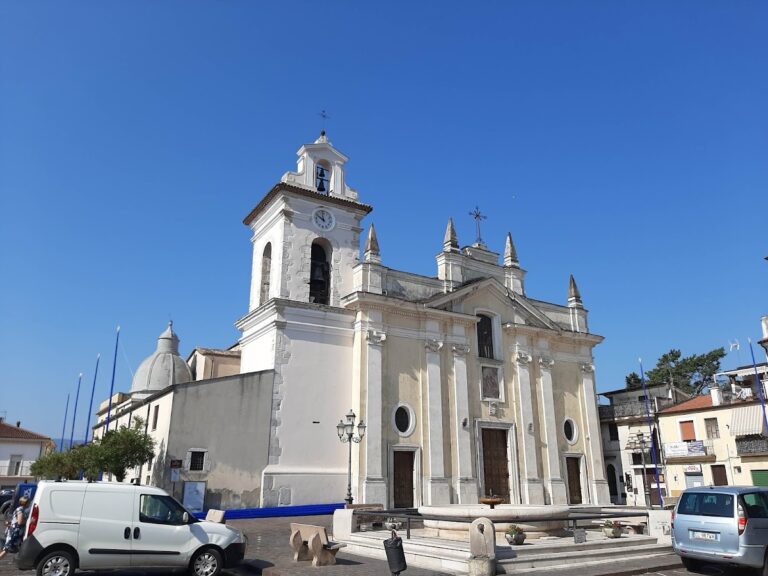
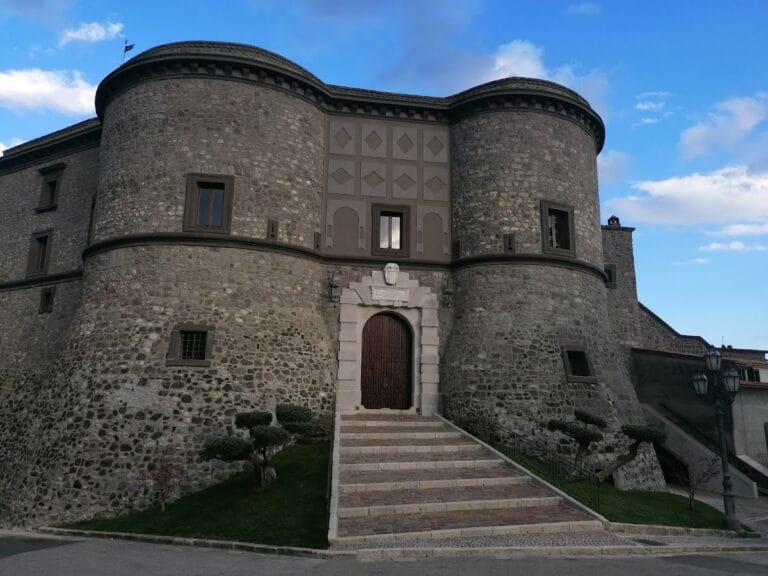
The facade is built of dressed stone and has a stepped profile. It has been rebuilt several times. The original facade was probably Gothic and included a pointed-arch portal and rose window. Pre-war photographs show a semicircular window, a stepped roofline, and a rectangular portal. The facade rebuilt in 1948 is Romanesque, with a simple oculus and a central round-arched portal.
Bell Tower
The lateral bell tower is a sturdy square structure resting on very large blocks of stone, which may have been reused from an ancient Samnite building. The Samnites were an ancient Italic people who lived chiefly in the central and southern Apennines. Before the Second World War, the tower ended in a Neapolitan Baroque onion dome. After 1948 it was given an octagonal domed drum with a civic clock and an octagonal pyramidal roof, and it later received another onion-dome form.
South Wall and Garden of the Pentri
The south wall contains the walled portal and rose window made in 1239 at Bishop Giovanni’s order. Like other sculptural elements embedded in this side of the church, they were probably reused during reconstruction after the earthquake of 1456. The Garden of the Pentri extends along the cathedral’s south and east sides, with Corso dei Pentri to the north and Piazza Duomo and the bell tower along its southern side. Its north-eastern side contains thirteen eleventh-century tomoli, medieval units of capacity, and a Lombard-period capital beneath the niche holding a statue of the Madonna. A Roman inscription is set into the wall to the left of the north entrance portal. The garden also contains two fountains and a monument to the fallen of the First World War.
Interior and Liturgical Furnishings
Aisles, Chapels, and Entrance Atrium
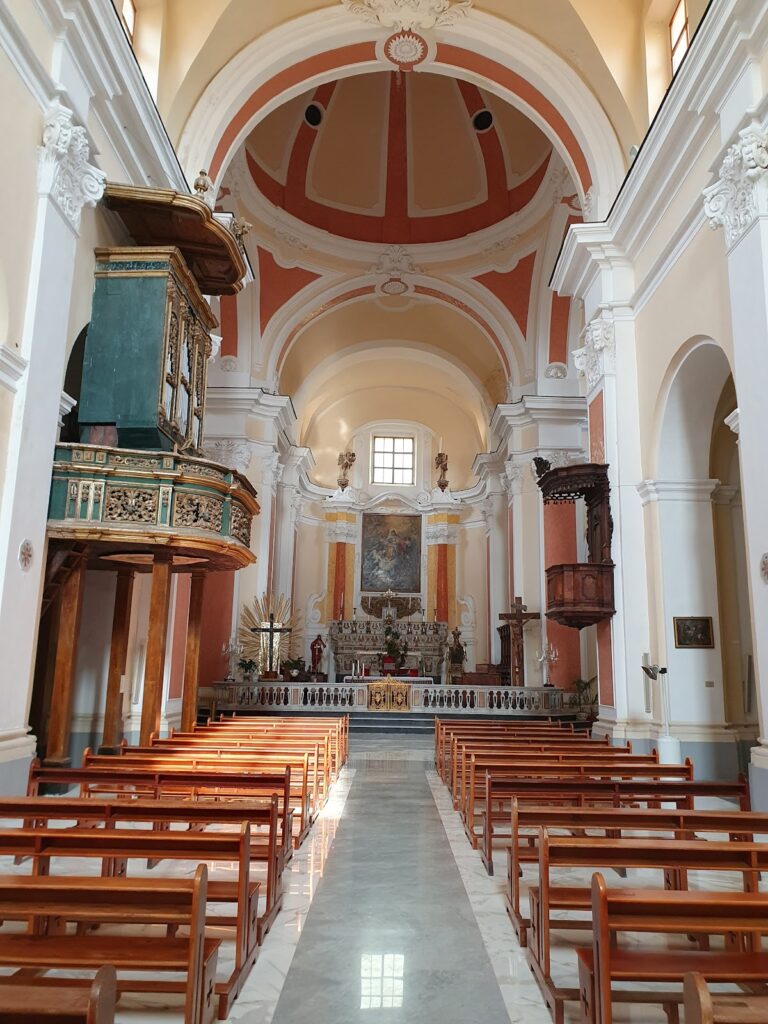
The interior has three aisles and a barrel vault with lunettes. The entrance atrium contains a funerary altar belonging to a noble Bojano family. Above it, an inscription dated 1513 shows Bishop Silvio Pandone wearing a mitre.
The right aisle contains a Crucifix throne and statues of Saint Lucy, Saint Joseph, Saints Cosmas and Damian, Saint Teresa of Avila, Our Lady of Mount Carmel, and Saint Donatus. The Chapel of Our Lady of Pompeii holds statues of the Risen Christ and Saint Michael, together with Antonio Romano’s 1987 painting of the Assumption.
The left aisle incorporates a medieval column and capital, episcopal inscriptions, a wooden pulpit, and the cover of the baptismal font. Other niches contain statues of Saint John Bosco, Saint Anne, and Saint Anthony of Padua. A glass case displays ninth- to fifteenth-century ceramics, liturgical furnishings, and the bishop’s ring recovered during the 1996 crypt excavations.
High Altar and Nave
The high altar at the end of the central aisle was rebuilt during the second quarter of the nineteenth century. It carries a statue of the Immaculate Virgin enthroned among angels. Beside it stands the new wooden episcopal cathedra, or bishop’s chair, remade in 1910 after the earlier cathedra had been transferred to the cathedral in Campobasso.
The side stained-glass windows were made by Nobile De Grandis in 1990. Paintings dated 1793 by Massimo Raffaele Giosia depict the Preaching of Saint Bartholomew in the Indies and the Conversion and Baptism of King Polymnius. The balustrade dates from the eighteenth century and bears bishops’ coats of arms from 1818, including that of Nicola Rossetti. The thirteenth-century baptismal font is decorated with sculptures of an anthropomorphic ox and a human face. The organ in the choir loft at the counter-facade dates from 1959.
Modern Fresco Cycle
Rodolfo Papa’s later fresco cycle covers several theological themes. Above the high altar, the Triumph of the Twelve Apostles is joined by representations of the Three Theological Virtues, the Four Cardinal Virtues, and the Last Judgment. Other scenes portray Padre Pio of Pietrelcina, Saint Teresa of Calcutta, and the outpouring of the Holy Spirit in the false cupola. The pendentives contain the Tetramorph, the symbolic representation of the four Evangelists through a human or angel, a lion, an ox, and an eagle.
Chapel of the Blessed Sacrament
The north transept contains the Chapel of the Blessed Sacrament, which is also often used as a sacristy, together with the archpriest’s residence. The chapel includes an inscription reproducing the bull issued by Pope Gregory XIII on 1 October 1578, associated with indulgences granted by popes visiting Bojano. Its polychrome eighteenth-century altar carries a statue of the Sacred Heart. The walls bear inscriptions of Bishop Carlo Carafa from 1572, while other statues represent the Addolorata and Saint Bartholomew the Apostle. The Saint Bartholomew statue was carved in the eighteenth century by the artisan Colombo, and F. Caterina’s 1983 painting depicts the Martyrdom of Saint Bartholomew. Saint Bartholomew, one of the Twelve Apostles and traditionally regarded as a missionary and martyr, gives the cathedral its dedication.
Eleventh-Century Crypt
Structure and Access
The semicircular crypt lies beneath the altar and dates from the eleventh century. It was revealed during the excavation work of 1996 after the earlier roof-consolidation project had exposed the area around the ancient Norman presbytery. Seven steps descend into the crypt, representing the Seven Deadly Sins: pride, avarice, wrath, envy, lust, gluttony, and sloth. A semicircular glass floor in the presbytery allows the crypt to be viewed from above, while its entrance lies to the right of the balustrade beside the thirteenth-century baptismal font.
Paintings and Water Source
The crypt’s paintings form a theological and biblical sequence directed toward the roots of baptism. They depict the Flood, the Crossing of the Red Sea, Jesus meeting the Samaritan woman at Jacob’s Well, the Crucifixion, and the Baptism of Jesus in the Jordan. The artist Fiorata Spina also installed worked stones inscribed with words from the First Letter of Saint Peter.
A spring of flowing water lies beneath the cathedral. This feature may make Bojano Cathedral the only church in the world with such a water source beneath it.