Palazzo Bardi-Guicciardini: A Historic Palace in Florence


Site at a Glance
- Rating
- 4.6
- Popularity
- Low
- Country
- Italy
- Primary era
- Early Modern
- External website
- Open
- Eras represented
- Early Modern, Modern
- Civilizations
- Grand Duchy of Tuscany
- Site type
- Domestic
- Remains
- Elite Residence
On this page9 sections
History
Palazzo Bardi-Guicciardini is a historic palace in Florence, Italy, in the Oltrarno district. Its origins as a large residence date to the late sixteenth century, when Pandolfo de’ Bardi transformed several confiscated Capponi houses into a palace oriented toward Via Santo Spirito. The building later acquired an expanded riverfront façade and was extensively remodeled in the nineteenth century, creating the form associated with Lungarno Guicciardini.
From the Capponi houses to the Bardi palace
The property originally consisted of several houses owned by the Capponi family. Following Roberto Capponi’s involvement in the second Pucci conspiracy of 1575, the Medici, Florence’s ruling dynasty, confiscated the estate. In 1576 they granted it to Pandolfo de’ Bardi of Vernio, who supported the Medici cause.
Pandolfo joined and enlarged the existing properties to create a substantial palace facing Via Santo Spirito. The riverward side had a different character at this stage, with gardens and coach houses extending toward the Arno. The Bardi family retained the residence for more than two centuries.
Eighteenth-century expansion
The palace’s relationship with the river changed during the eighteenth century. An engraving by Giuseppe Zocchi, a Florentine painter and printmaker known for city views, shows a three-bay front open toward the Lungarno. This appearance reflects a major enlargement and remodeling. Leonardo Ginori Lisci later associated the work hypothetically with the 1742 marriage of Carlo de’ Bardi and Margherita Malaspina, a member of the noble Malaspina family.
In 1810, the death of the last Bardi count, Pier Maria de’ Bardi of Vernio, transferred the property by inheritance to the Guicciardini family. It passed to the branch subsequently known as the Lungarno branch. Ferdinando Guicciardini then extended the riverfront elevation, increasing it from three bays to six.
Giuseppe Poggi’s nineteenth-century transformation
From 1840, Ferdinando’s son Carlo commissioned Giuseppe Poggi, a Florentine architect and urban designer, to reorganize the palace completely. The principal entrance moved from Via Santo Spirito to the Lungarno, the river façade grew to seven bays, and a second doorway was added to balance the original entrance. The existing balcony was extended, and a broad entrance hall was built so carriages could pass into the palace.
Poggi also reordered the interior around the river-facing side, which had previously received less attention. Stables, coach houses, kitchens, and a study were placed toward Via Santo Spirito, while a new staircase led to a first-floor reception apartment with halls and salons. The garden loggia belongs to the same phase and increased the building area while preserving the ground-floor garden. Additional work took place in 1884, and the palace housed the Royal Automobile Club in 1937.
In 1901, the Directorate-General of Antiquities and Fine Arts included Palazzo Bardi-Guicciardini on its list of monumental buildings considered part of the national artistic heritage. The palace remains in use.
Remains
Façades and historic fabric
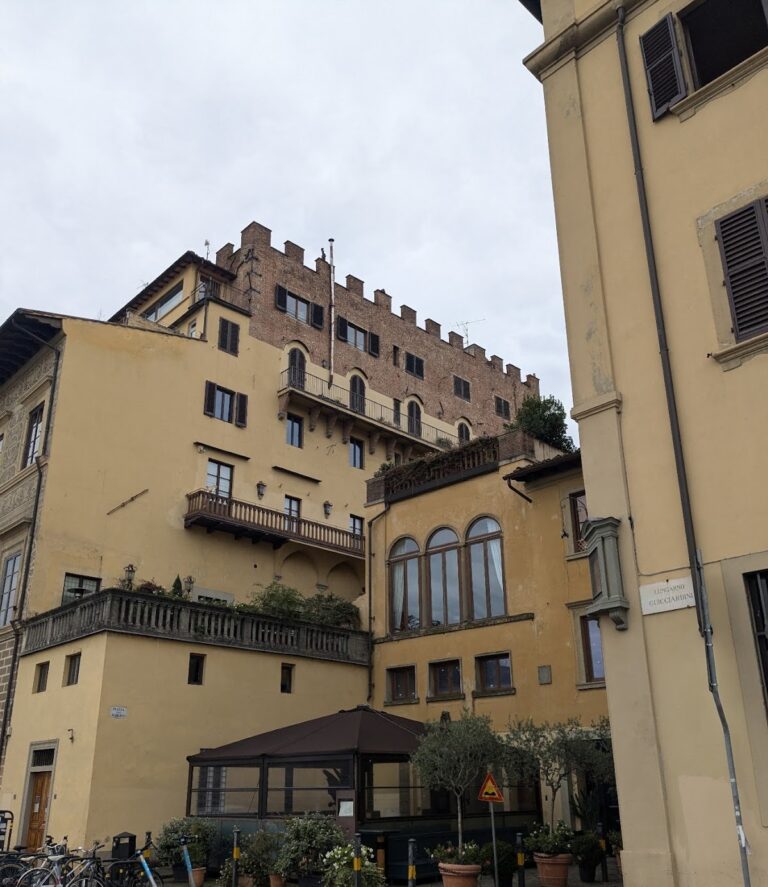
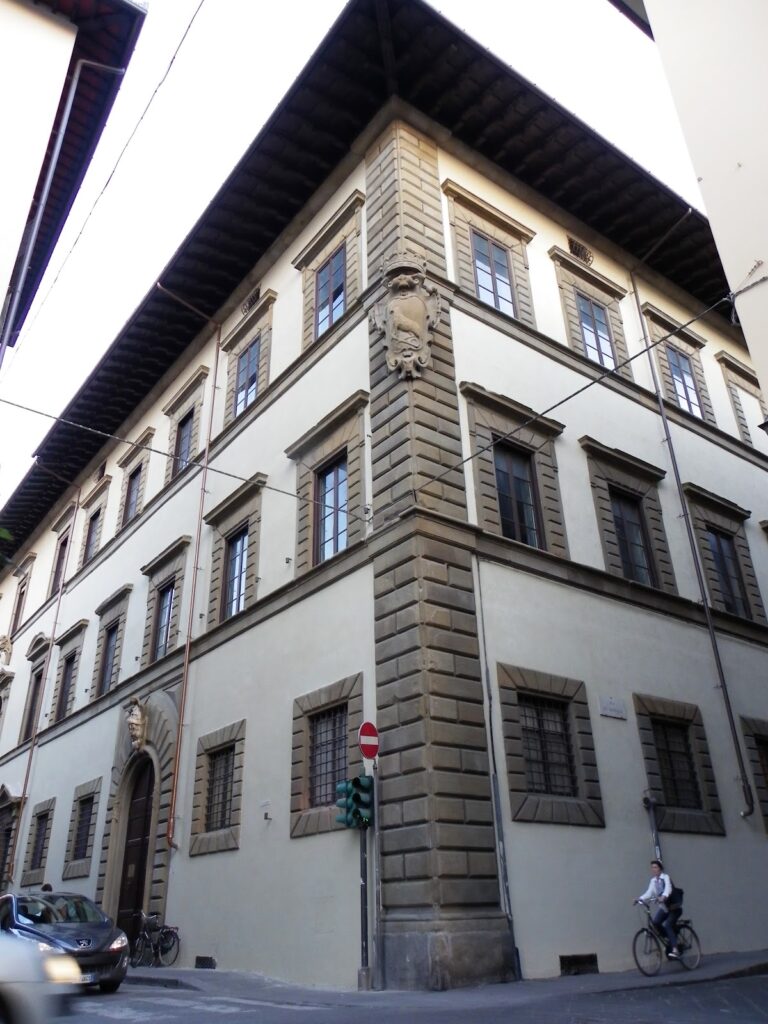
The palace has two principal fronts. The older entrance elevation faces Via Santo Spirito, while the later and more extensively enlarged façade faces Lungarno Guicciardini. Its riverfront division developed from three bays to six under Ferdinando Guicciardini and then to seven during Poggi’s remodeling. A shield bearing the Guicciardini arms is set into the Lungarno façade. Its three hunting horns are shown without enamel colors, arranged one above another.
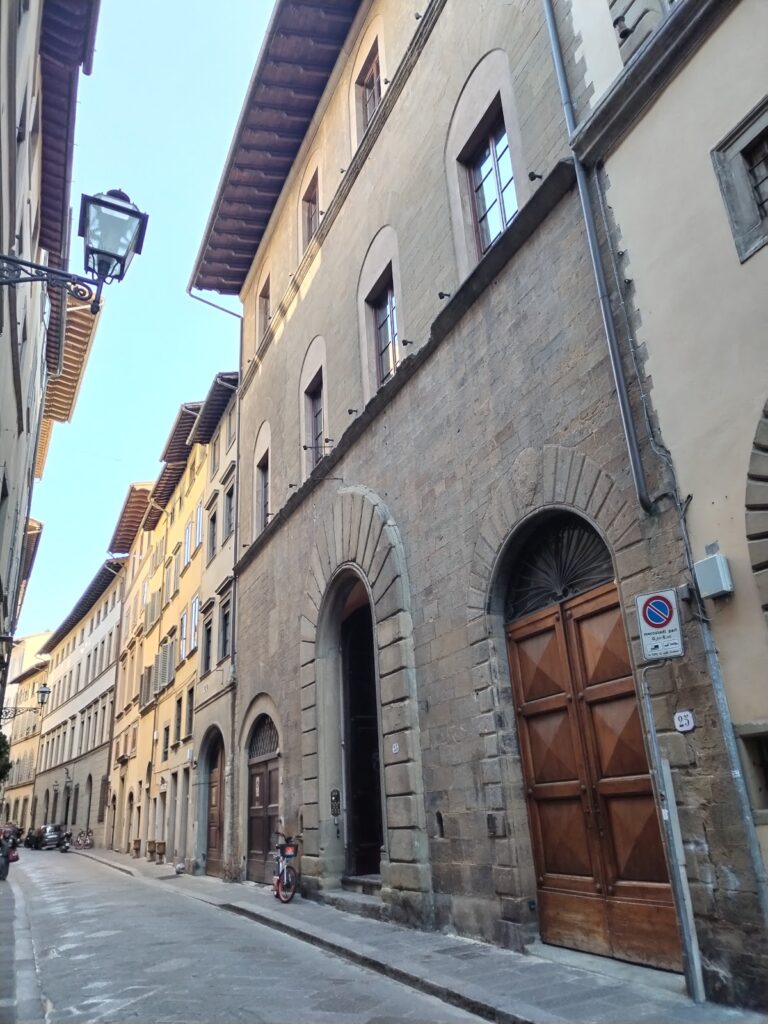
The Via Santo Spirito front belongs broadly to the period from the end of the sixteenth century to the beginning of the seventeenth, although it incorporates an earlier structure. Beneath the plaster on every floor, sections of older masonry can be seen in small, regular courses of stone. These earlier layers remain incorporated into the later palace.
Frescoed rooms and interior arrangement
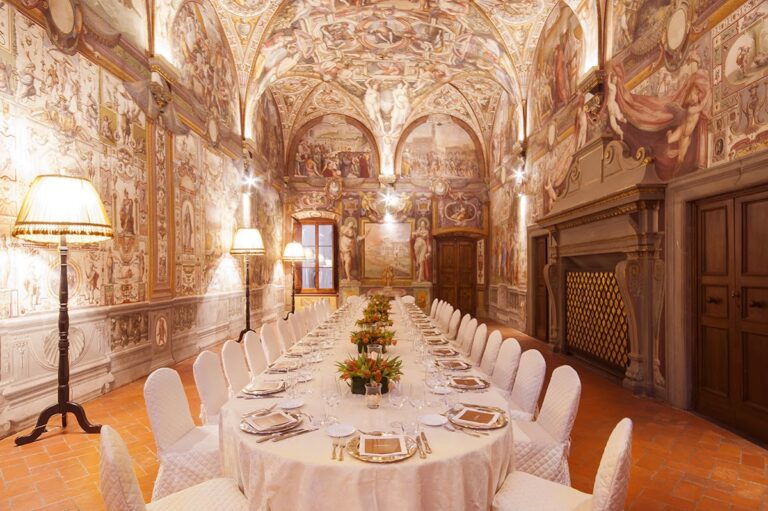
Several ground-floor rooms created or remodeled during the Bardi period retain fresco decoration. One chamber has a ceiling covered with grotesques, ornamental compositions combining foliage, figures, animals, and architectural motifs. The decoration also includes a personification of the Bardi family and lunettes, semicircular painted panels, illustrating the family’s history through its leading representatives. The work belongs to the circle of Bernardino Poccetti, a Florentine painter associated with late sixteenth- and early seventeenth-century Mannerism, and includes substantial contributions by Michelangelo Cinganelli.
The nineteenth-century entrance hall was designed on a scale that allowed carriages to pass through the building. On the first floor, Poggi’s reorganization produced a river-facing reception apartment with halls and salons. Service rooms were concentrated toward Via Santo Spirito, while the garden loggia formed part of the expanded arrangement.
Garden design
The small garden existed during the Capponi period and was later embellished by the Bardi. Its surviving arrangement reflects Poggi’s work, including a Romantic-style mound that rises to first-floor level and conceals an artificial grotto. A path crosses the slope between flower beds edged with low geometric hedges and reaches a terrace above the Arno. From there, the riverfront embankments, Ponte alla Carraia, and Ponte Santa Trinita can be seen. At the garden’s highest point stands a wall-set nymphaeum, an ornamental structure associated with a grotto or water feature, faced with porous stones and shells in an eighteenth-century manner.
Rare plants
During the eighteenth and early nineteenth centuries, Count Pier Maria de’ Bardi of Vernio made the garden known for its rare plants. Its collection included jasmine from Goa, also called Grand Duke jasmine, as well as Fuchsia coccinea and Camellia japonica. Florence’s first Magnolia grandiflora was planted there in 1787 after being brought from London. A black rose imported from France flowered around 1800, and a Ginkgo biloba dating from 1784 was known as the “forty-shield tree” because of its exceptionally high price.
Nearby sites