Palacio de Buenavista: From Aristocratic Residence to Spanish Army Headquarters


Site at a Glance
- Rating
- 4.5
- Popularity
- Low
- Country
- Spain
- Primary era
- Early Modern
- Eras represented
- Early Modern, Modern
- Civilizations
- Crown of Castile, Spanish
- Site type
- Domestic
- Remains
- Elite Residence
On this page7 sections
History
Palacio de Buenavista is a historic palace in Madrid, Spain, occupying the site of the former Altillo de Buenavista royal estate. Its origins reach back to the sixteenth century, when Gaspar de Quiroga, Archbishop of Toledo, gave the estate to Philip II after the king decided to move the court to Madrid and establish the city as Spain’s permanent capital.
From royal estate to aristocratic residence
After passing through several owners, Buenavista became the residence of Isabel of Farnese in 1759, following the death of her stepson, Ferdinand VI, an eighteenth-century Bourbon king of Spain. She remained there until her death in 1766. In 1770, the Duke of Alba commissioned Ventura Rodríguez, a leading Spanish architect, to redesign the gardens in the French style, although the scheme was never executed.
The estate later passed to Fernando de Silva y Álvarez de Toledo, 12th Duke of Alba of Tormes, who acquired it from Isabel of Farnese’s estate in 1796. His granddaughter and heir, María Teresa de Silva Álvarez de Toledo, known as Cayetana, 13th Duchess of Alba, took a more radical approach. In 1777, she ordered the earlier building to be demolished and commissioned Juan Pedro Arnal to design the present palace. The new residence was intended to provide a more sumptuous setting for the House of Alba, one of Spain’s major aristocratic families. Cayetana lived there for much of her life with her husband, José Álvarez de Toledo Osorio, Duke of Alba.
Fire, expropriation, and changing institutions
Fires in 1795 and 1796 brought major changes to the building. The central staircase block was removed, and much of the palace library was lost. When Cayetana died at Buenavista in 1802 without forced heirs, the succession of the House of Alba became incorporated into the House of Berwick, a noble house linked to the British-origin Dukedom of Berwick.
Following an expropriation, meaning the compulsory taking of property by public authority, Madrid City Council assigned Buenavista to Manuel Godoy in 1807. Godoy was the powerful chief minister and favorite of Charles IV, a later Bourbon king of Spain. He invested in refurbishing and decorating the palace but never lived there. After his political downfall, the property was expropriated again and returned to the royal household.
In August 1810, Joseph Bonaparte assigned the palace to a painting museum planned under his rule as king of Spain during the Peninsular War. The projected Josephine Museum was never established at Buenavista. After Joseph Bonaparte left Spain in 1813, another building was chosen for the institution that became the Prado Museum. Buenavista was transferred to the army in 1816.
Military headquarters and heritage status
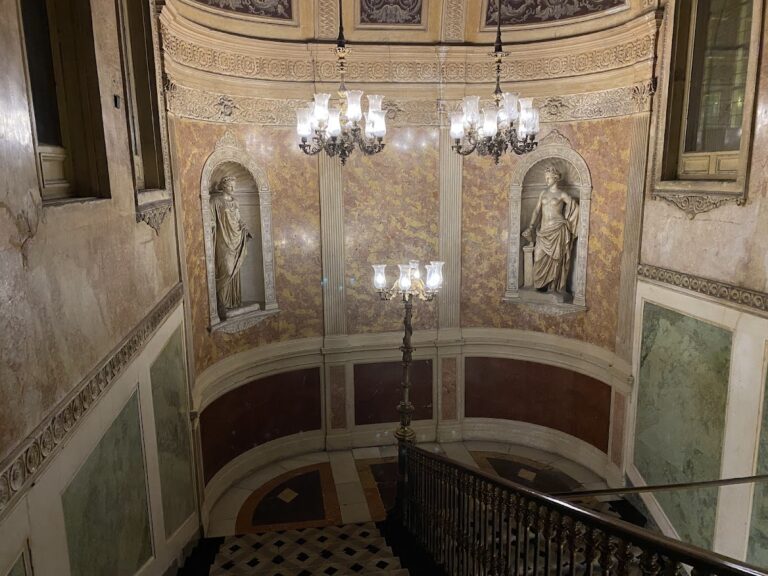
The palace became the headquarters of the Ministry of War in 1847. Extensive renovation and enlargement followed, including the addition of a fourth floor. Since 1981, Buenavista has housed the General Headquarters of the Spanish Army, while continuing to contain numerous works of art.
Palacio de Buenavista is catalogued as a property of cultural interest and forms part of the heritage area known as the “Paseo del Prado and Buen Retiro, Landscape of Arts and Sciences.”
Remains
Palace, grounds, and urban setting
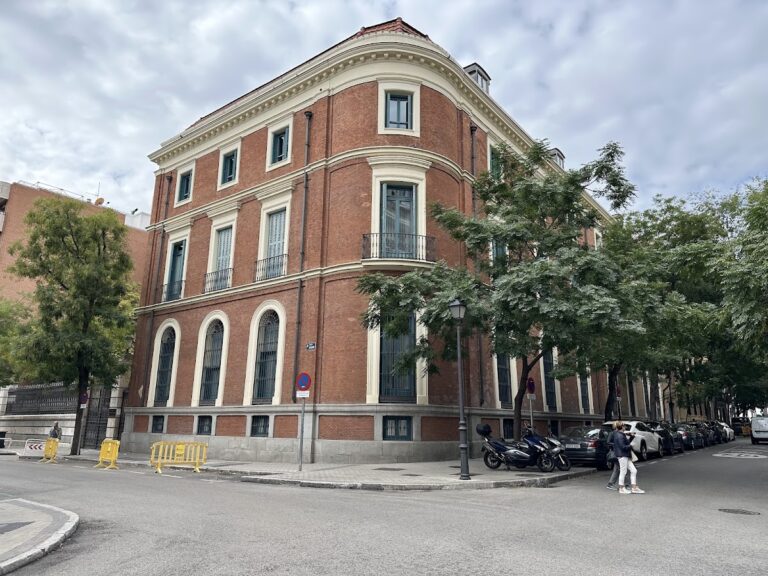
Palacio de Buenavista is a large palace enclosed by a wall on a landscaped promontory in Madrid’s Plaza de Cibeles. Juan Pedro Arnal designed the present building as a complex that combines Italian and French planning traditions. Its urban-facing façade is oriented toward the north. The palace’s form was altered after the fires of 1795 and 1796, when the central staircase block was removed, and it was enlarged during later renovation through the addition of a fourth floor.
The palace stands opposite the headquarters of the Bank of Spain, the Palace of Linares, and the Palace of Communications, placing it within a group of major buildings around Plaza de Cibeles.
Paintings associated with the palace
Works displayed at Buenavista included Diego Velázquez’s The Rokeby Venus, now in the National Gallery in London; Raphael’s Alba Madonna, whose name derives from the Dukes of Alba and which is held by the National Gallery of Art in Washington, D.C.; and Correggio’s The Education of Cupid, also now in the National Gallery in London. These paintings form part of the palace’s recorded artistic history, even though they are no longer housed there.