Ōyama-ji Temple: A Mountain Worship and Fudō Buddhist Temple in Japan
Site at a Glance
- Rating
- 4.2
- Popularity
- Low
- Country
- Japan
- Primary era
- Modern
- External website
- Open
- Eras represented
- Medieval, Modern
- Civilizations
- Ashikaga shogunate, Tokugawa
- Site type
- Religious
- Remains
- Temple
On this page8 sections
History
Ōyama-ji Temple is a Buddhist temple in Japan, located on Mount Takakura in Kamogawa, Chiba. Traditionally founded in 724 by Rōben, an eighth-century monk associated with major Nara-period Buddhist institutions, it developed as a center of mountain worship and a Shugendō institution, a Japanese mountain-based tradition combining ascetic practice with Buddhist, Shinto, and other religious elements.
Foundation and Medieval Development
Ōyama-ji, formally known as Takakura-san Ōyama-ji, was originally affiliated with the Tendai school, a major Buddhist tradition emphasizing the Lotus Sutra and a broad range of teachings. The temple flourished through its connection with Shugendō, and its complex was traditionally regarded as one of the foremost religious establishments in eastern Japan.
The temple’s existence by the late Kamakura period is supported by the 1338 Yasuda Document, which records a donation of rice fields by Ashikaga Takauji, founder of the Muromachi shogunate. Its principal image, a seated Fudō Myōō accompanied by Kongara Dōji and Seitaka Dōji, was made in the middle of the Kamakura period. Fudō Myōō is a Buddhist Wisdom King, a wrathful protector commonly shown with a sword and rope.
Minamoto no Yoritomo, founder of Japan’s Kamakura shogunate, is traditionally said to have visited Ōyama-ji in September 1180 to pray for victory. He is also said to have donated a suit of armor and a sword. The temple later attracted the devotion of Ashikaga Takauji during the Muromachi period and of the Satomi, a regional warrior clan active in the Kantō during the medieval and early-modern periods.
Destruction, Revival, and Later Affiliation
The temple precinct was destroyed during the Eiroku–Tenshō conflicts at the end of the Muromachi period. Ōyama-ji was revived in 1586, and the present Fudō Hall was built in 1802, 216 years after that revival. During the Edo period, the temple became a popular destination near Edo, with more than ten inns standing along its approach.
In 1872, Ōyama-ji became affiliated with Shingon Buddhism, an esoteric Japanese Buddhist tradition. The precinct nevertheless retains elements of Buddhist–Shinto syncretism, the historical coexistence and interweaving of Buddhist worship and kami worship before their formal separation in the modern period. Two guardian komainu stand at the Fudō Hall, and the festival of Takakura Shrine brings a mikoshi, or portable shrine, into the temple’s outer hall.
Ōyama-ji is commonly counted among the Three Great Fudō temples of the Kantō region, alongside Naritasan Shinshō-ji and Afuri-san Ōyama-dera. It is also the thirty-fourth temple of the Awa Thirty-Four Kannon Pilgrimage and number 60 in the Awa Eighty-Eight-Site Pilgrimage. The Fudō Hall and its sanctuary cabinet are National Important Cultural Properties. The wooden Fudō Myōō group is designated a tangible cultural property by Chiba Prefecture, while the stone hōkyōintō pagoda and bell tower have the same status under Kamogawa City.
Remains
Mountain Setting and Layout
Ōyama-ji occupies a position midway up Mount Takakura, a 219-meter mountain at the western edge of Kamogawa City. The mountain forms the highest point at the rear of the Nagasa Plain and lies near the Mineoka mountain range. The temple’s principal structure is the Fudō Hall, while Takakura Shrine stands at the summit, maintaining the precinct’s connection between Buddhist and Shinto worship.
Fudō Hall and Sacred Images
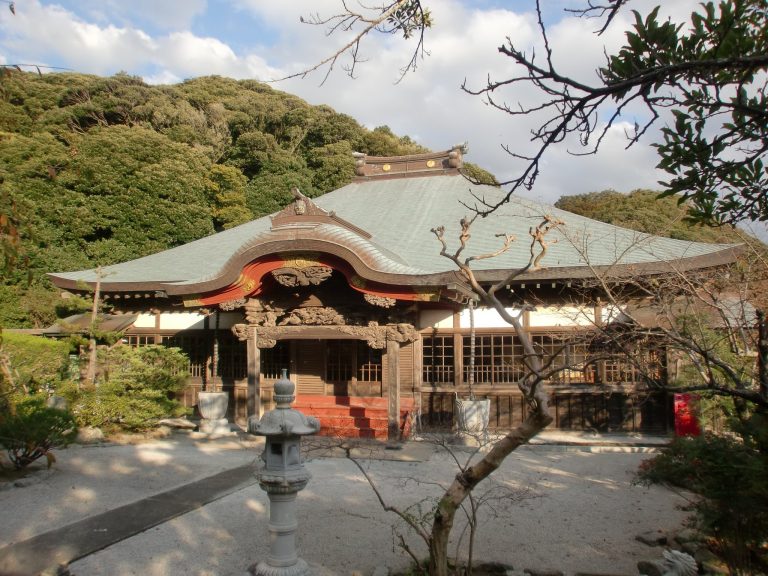
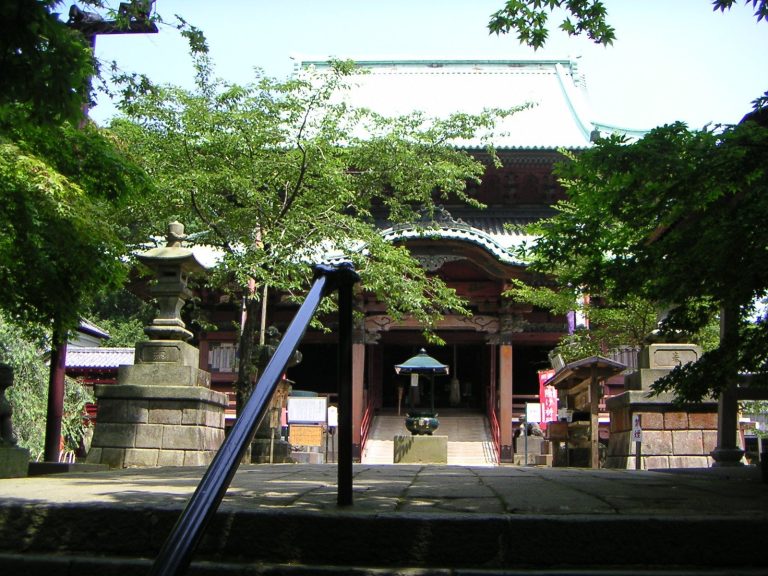
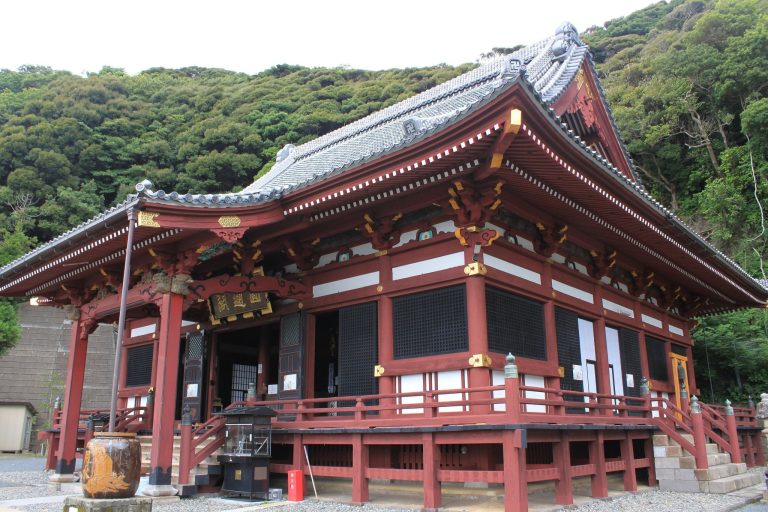
Built in 1802, the Fudō Hall was originally roofed with thatch and received a copper-sheet roof in 1961. Its front projecting worship porch carries a carved dragon by the sculptor known as “Wave I-Hachi.” The hall is integrated with the sanctuary cabinet that houses the principal image. The seated wooden Fudō Myōō and his standing attendants, Kongara Dōji and Seitaka Dōji, date from the middle of the Kamakura period. Each figure was carved from a single block of zelkova, with carved eyes and an uncoated surface. Fudō Myōō measures 87.4 centimeters in height, Kongara Dōji 80.9 centimeters, and Seitaka Dōji 81.0 centimeters. The image group is displayed annually during the Setsubun ceremony on February 3, a seasonal festival associated with driving away harmful influences.
Pagoda and Bell Tower
A stone hōkyōintō pagoda was erected in 1353. This type of Japanese Buddhist pagoda is associated with the enshrinement of a sutra and the accumulation of religious merit. The bell tower is older than the present Fudō Hall, providing another surviving element from an earlier phase of the temple’s history.
Continuing Buddhist–Shinto Features
Two komainu, guardian lion-dogs traditionally placed at the approach to a shrine or temple, guard the Fudō Hall. At the summit, Takakura Shrine remains part of the mountain precinct. During its festival, a mikoshi enters the Fudō Hall’s outer hall, linking the shrine ceremony with the Buddhist temple and preserving the site’s combined religious character.