Hota Myōhon-ji Temple: A Fuji-Lineage Grand Head Temple in Japan


Site at a Glance
- Rating
- 4.7
- Popularity
- Very Low
- Country
- Japan
- Primary era
- Medieval
- Eras represented
- Medieval, Early Modern
- Civilizations
- Ashikaga shogunate, Tokugawa
- Site type
- Religious
On this page15 sections
History
Hota Myōhon-ji Temple is a Nichiren Buddhist temple in Japan, located in Yoshihama, Kyonan, in Chiba Prefecture. Formally known as Nakadani-zan Myōhon-ji, it was founded around 1336 and is traditionally associated with Nichiren, the thirteenth-century Buddhist teacher, and with the lineage of his disciple Nikkō. The temple belongs to the Fuji lineage, a branch of Nichiren Buddhism that traces its religious succession through Nikkō, and is classified today as an independent grand head temple.
Foundation and medieval development
The temple’s founding patron was Nigo, whose role in establishing it is associated with 1333, several years before the traditional foundation date. On 11 March 1338, Ashikaga Takauji guaranteed the temple’s land. In 1341, the religious teacher Nichiei received instruction from Nigo at the temple, reinforcing its place within the developing Fuji religious network.
In 1353, Nigo placed the principal image and scriptures in the Yoshihama treasure repository and admonished the temple’s adherents. On the same day, he entrusted Yoshihama Hokke-dō, identified with Myōhon-ji, to Gyōōmaru, the son of Nanjo Tokitsuna. Gyōōmaru later became the priest Nichiden. Until he entered the clergy, the hall remained in the care of Nichimyō. The temple also received a land guarantee and the office of steward from an official named Ujikiyo, while Nigo transferred a Hokke-dō in Ito Village, within Anzai in Awa, to Nichimyō. Nigo died on 25 April at the age of 61.
In 1354, Nichimyō wrote down a seventeen-article doctrinal debate by Nichiei. Nichike, Nichiei’s younger half-brother, carried part of Nigo’s remains to Hyūga. That year, a wooden-board principal image was carved for Myōhon-ji at the request of its second head, Nikken.
Land, leadership, and regional connections
The temple continued to receive protection and land guarantees from regional authorities. Hōichi of Hyūga donated land to the hall at Ainoyatsu in 1382. Naruyoshi guaranteed the temple’s land in 1395, followed by Ashikaga Mochiuji, the Kamakura Kubō, in 1401. The Kamakura Kubō was the Ashikaga official who governed the Kamakura region. A further wooden-board principal image was commissioned in 1419, and Ashikaga Shigeuji issued a regulatory notice at the temple in 1454.
Myōhon-ji reconciled with its affiliated temples in Hyūga in 1477. In 1506, the mother of Fujihira donated rice-producing land to the temple. Nichiyō, the eleventh head of both Hota Myōhon-ji and Koizumi Kuon-ji, died in 1514 at the age of 79. From the fourth head, Nigo, through the forty-ninth, Nippō, the two temples operated under a dual-head system in which one chief abbot served both institutions. They consequently became known as the “two mountains of Kuon and Myō.”
War, rebuilding, and Satomi protection
War-related fire destroyed the temple in 1553, and it was rebuilt in 1577. Ube Hiromasa donated rice land in 1580. The following year, during the 300th memorial observance for Nichiren, the head Nichikan and retired head Niga petitioned the Shimazu domain to protect Myōhon-ji’s affiliated temple network in Hyūga.
During the rule of the Satomi clan, Myōhon-ji received their protection and was also made available as a fortified position. Satomi records identify it as a frontline base in the clan’s conflict with the Later Hōjō, one of the regional warrior powers that contested territory during Japan’s Sengoku period of political fragmentation and military conflict. Satomi Yoshiyasu guaranteed one-third of the temple estate and exempted it from public duties in 1591. In 1593, he donated one-third of the rice land at Sakuma, assessed at five kan. Satomi Tadayoshi later donated an estate producing 50 koku, 6 to, 6 sho, and 4 gō in 1606.
Early modern and modern institutional history
In 1648, the head Nichizen asked Koizumi Kuon-ji and the temple’s lay congregation to appoint a successor. In 1686, Hota Myōhon-ji withdrew its dispute involving Nishiyama Honmon-ji. The guest hall was rebuilt in 1732, but the main hall burned in 1858. A new guest hall was completed in 1865.
Hota Myōhon-ji and thirteen affiliated temples joined the unified Fuji-lineage organization Nichiren-shū Kōmon-ha in 1876. The organization was renamed Nichiren Honmon-shū, or Honmon-shū, in 1899. In 1941, Honmon-shū united with mainstream Nichiren-shū and the sectarian Kempon Hokke-shū to form the modern Nichiren-shū.
In 1957, Hota Myōhon-ji and four former affiliated temples left Nichiren-shū and joined Nichiren Shōshū, while nine other former affiliates remained in Nichiren-shū. The main hall was rebuilt in 1960. After leaving Nichiren Shōshū, the temple became an independent religious corporation in 1995. Along with the Fuji Five Mountains, Kyoto Yōbō-ji, and Izu Jitsujō-ji, it forms one of the Fuji lineage’s Eight Head Temples. Historical names for the institution include Chiba Myōhon-ji, Awa Myōhon-ji, and Yoshihama Myōhon-ji.
Remains
Principal temple buildings
Main hall
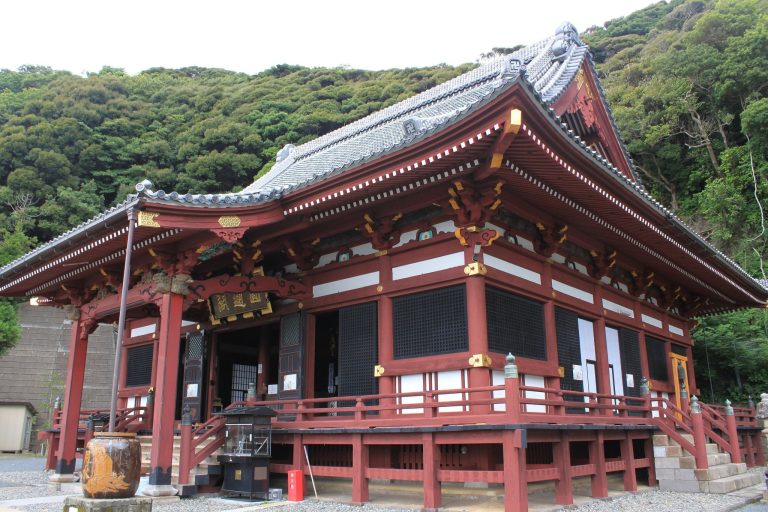
The principal religious complex includes a main hall rebuilt in 1960. Its present structure belongs to the temple’s modern rebuilding phase, following the destruction of the earlier hall by fire in 1858. The building serves as the central hall of the complex and is associated with the temple’s continuing religious identity as Nakadani-zan Myōhon-ji.
Guest hall
The guest hall was rebuilt in 1732 and reconstructed again in 1865. These successive building phases preserve the role of the hall within the temple complex across the late early-modern and nineteenth-century periods. Together with the main hall, it forms the principal group of surviving religious buildings at Hota Myōhon-ji.
Repository and associated hall
Yoshihama treasure repository
The Yoshihama treasure repository was used in 1353 to house the temple’s principal image and scriptures. Its recorded function connects the repository with the preservation of the objects central to the temple’s worship and teaching during the fourteenth century.
Yoshihama Hokke-dō
Yoshihama Hokke-dō, identified with Myōhon-ji, was recorded as a distinct hall entrusted by Nigo to Gyōōmaru. Nichimyō cared for it until Gyōōmaru entered the clergy. The hall’s history forms part of the early organization of the temple and its relationship with its religious custodians.
Principal images
Wooden-board principal images
A wooden-board principal image was carved for the temple in 1354 at the request of the second head, Nikken. Another wooden-board principal image was carved in 1419. These images represent successive phases in the material expression of the temple’s central Buddhist worship.
Mannen Kugō Honzon
The temple preserves the “Mannen Kugō Honzon,” one of Nichiren’s genuine handwritten principal honzons. A honzon is the principal Buddhist object of worship; in this case, the handwritten form is a religious inscription or mandala attributed to a revered teacher. A woodblock reproduction is enshrined in the True Relic Hall at Minobusan Kuon-ji and at the Shishinkaku rest facility on Mount Minobu, while a carved reproduction of the wooden-board honzon is enshrined in the Great Lecture Hall of Taiseki-ji.