Senryū Shōgunzuka Kofun: An Elite Kofun-Period Burial Mound in Japan
Site at a Glance
- Rating
- 3.7
- Popularity
- Very Low
- Country
- Japan
- Primary era
- Classical
- External website
- Open
- Eras represented
- Classical
- Civilizations
- Unclassified
- Site type
- Burial
- Remains
- Burial Mound
On this page12 sections
History
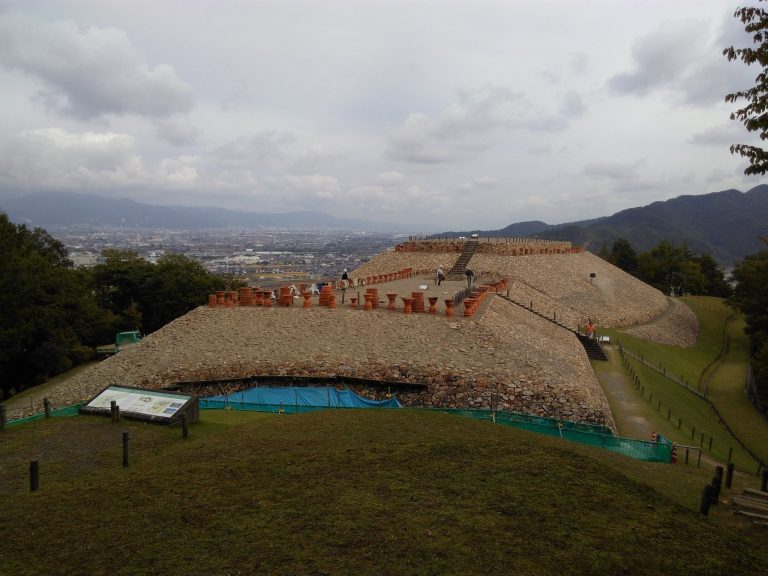
Senryū Shōgunzuka Kofun is a large elite burial mound in Japan, in Nagano City, built by the society of the Kofun period around the end of the fourth century or the beginning of the fifth century. The Kofun period, which lasted approximately from the third to the sixth centuries, was marked by monumental tombs for powerful members of society. Senryū Shōgunzuka was one of the principal chiefly tombs of the Shinano region, corresponding broadly to present-day Nagano Prefecture.
An Early Regional Chiefly Tomb
The tomb belongs to the early part of the middle Kofun period and was built as a keyhole-shaped mound, a form with a circular rear section joined to a rectangular front section. Its large group of bronze mirrors and other ritual objects sets it apart from other important keyhole tombs on the Zenkoji Plain, where weapons feature more strongly among the burial goods. This contrast has led to an interpretation of Senryū Shōgunzuka as the burial place of a ruler associated especially with ritual or magical authority rather than with military power.
A bronze arrowhead connected with the tomb has close formal and dimensional parallels at Yanai Chausuyama Kofun in Yamaguchi Prefecture. The resemblance points to links between the ruling elite of the area and the Yamato polity, a powerful center in the Kinai region that later developed into the Japanese imperial state. Such connections are considered through similarities in elite burial goods and tomb forms.
Excavation and Archaeological Interpretation
Farmers from Shimo-Ishikawa opened the tomb on May 12, 1800, recovering grave goods. The Matsushiro domain took possession of the finds, which were returned to the local area after the domains were abolished and transferred to Fuse Shrine. The objects traditionally associated with that discovery are now held by the Nagano City Museum, although the group appears to include material from other finds as well.
A further local excavation took place around 1893. In the early twentieth century, archaeologist Morimoto Rokuro gathered testimony from local elders, investigated the mound, and examined the objects. His work helped make Senryū Shōgunzuka important in the development of Japanese archaeology. In 1929, the Shōgunzuka Preservation Association found a cylindrical haniwa coffin while planting trees during improvements to the mound’s surroundings, and Morimoto reported the discovery that same year.
Archaeologist Iwasaki Takuya and others surveyed Senryū Shōgunzuka in 1968. Himezuka Kofun, a related mound on the same ridge, was surveyed in 1975 and was then recognized as a front-rear square tomb rather than a keyhole mound. Senryū Shōgunzuka and Himezuka were designated together as a National Historic Site on July 14, 1977. The objects associated with the 1800 excavation had already become a Nagano Prefectural Treasure in 1974, while the cylindrical haniwa coffin received designation as a Nagano City tangible cultural property in 1967.
Himezuka and the Southern Zenkoji Plain
Himezuka Kofun lies about 200 meters north of Senryū Shōgunzuka, higher on the same ridge. It is thought to date to around the middle of the fourth century, making it earlier than Senryū Shōgunzuka. Its early front-rear square form, consisting of two joined rectangular sections with the rear section larger than the front, is important for understanding the emergence of Kofun-period society in the southern Zenkoji Plain, where such tombs are rare in Nagano Prefecture. The mound was surveyed in 1975, and its burial facilities have not been investigated.
Remains
Layout and Mound Construction
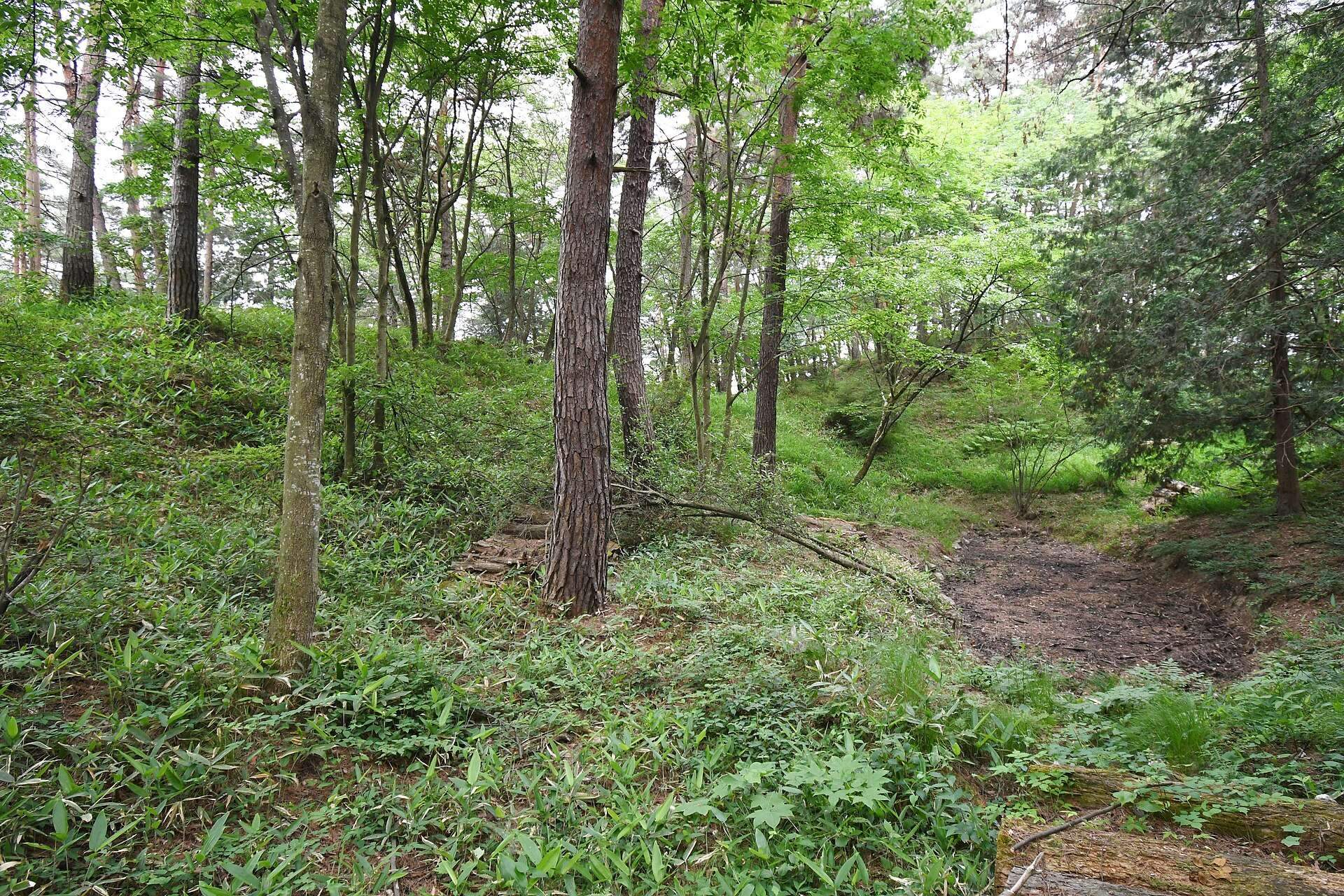
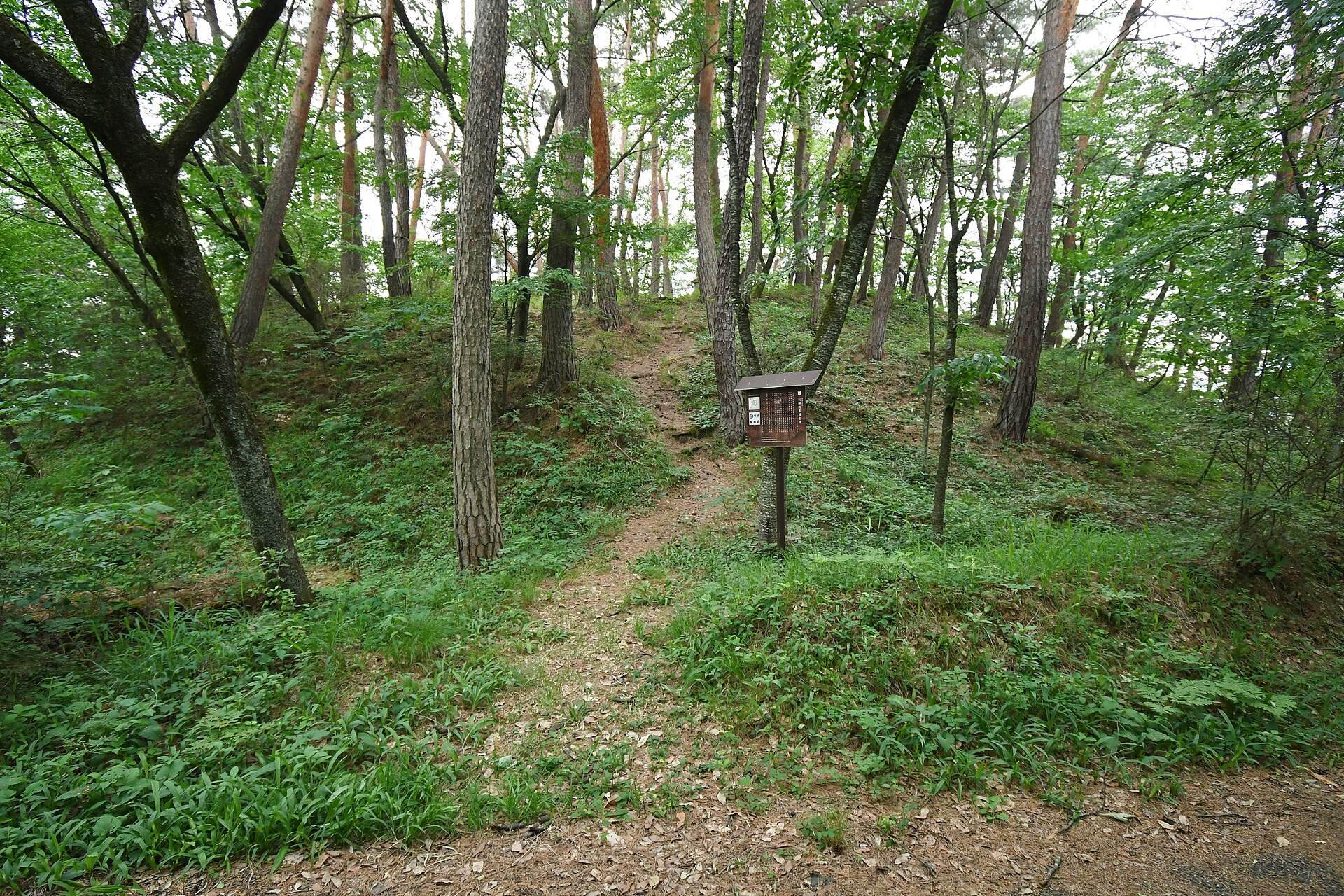
Senryū Shōgunzuka occupies a flat area at an elevation of about 470 meters on the end of a mountain ridge west of the Chikuma River. A small settlement ruin and rice fields lie at the foot of the slope. The mound is oriented toward the north-northeast and measures 93 meters in length, making it the largest kofun in Nagano City and the second largest in Nagano Prefecture after the 100-meter Mori Shōgunzuka Kofun.
The circular rear section is approximately 45 meters across and 10 meters high. Its rectangular front section extends about 26 meters and rises roughly 5 meters. Stones known as fukiishi covered the mound surface, while cylindrical haniwa, hollow clay objects placed around elite tombs, stood on or around it. A moat-like surrounding feature once accompanied the mound, and small traces survive. Smaller kofun are distributed on the eastern side of the front section. Haniwa fragments collected from the surface resemble those from Mori Shōgunzuka Kofun.
Burial Facilities
Rear Burial Chamber
A vertical stone burial chamber was constructed in the circular rear section, parallel to the mound’s main axis. It was reportedly formed from split stone blocks arranged edgewise. The chamber measured approximately 5.4 to 7.2 meters in length and 1.8 meters in width. Its walls were painted red, and it had a broad level floor and several capstones. The chamber contained no stone coffin.
Front Burial Chamber
A second vertical stone chamber stood in the rectangular front section, also parallel to the main axis. It measured about 2.7 meters long and 1.2 meters wide. The details of both chambers remain uncertain because they have not been archaeologically investigated.
Cylindrical Haniwa Coffin
In front of the mound’s rectangular section, an associated burial contained a specially manufactured cylindrical haniwa coffin. The coffin was placed horizontally, with each end sealed by large unglazed pottery vessels and fragments of cylindrical haniwa. It stands 82 centimeters high, with an elliptical base measuring 47 centimeters along its longer axis and 35 centimeters along its shorter axis. Its walls average 1.8 centimeters in thickness.
The coffin was made by stacking large jar-shaped vessels rather than by reusing an ordinary cylindrical haniwa. Its projecting band has a lip-like shape and includes two triangular openings. The unusual construction distinguishes this associated burial from a simple arrangement of standard mound fittings.
Mirrors and Other Burial Goods
The objects attributed to the 1800 discovery include many bronze mirrors, beads and other jewelry such as magatama, earrings, stone objects, bronze arrowheads, and tubular bronze objects. Records give different totals for the mirrors, either 27 or 42. Six from the large group are presently known. One follows the Western Han tradition, referring to the Chinese dynasty that ruled from 206 BC to AD 9, while the others were made in Japan.
The bronze arrowhead associated with the kofun is approximately 7.8 centimeters long and 3.1 centimeters wide. Its close resemblance to an arrowhead from Yanai Chausuyama Kofun provides material evidence for connections across western Japan. Some objects in the attributed assemblage do not fit its expected chronology and may have come from other sites, a complication that shapes interpretation of the surviving burial group.
Himezuka Kofun
Himezuka is a 31-meter-long front-rear square tomb on the same ridge. Its front section faces south, while the rear section rises approximately 4 meters and the front section about 2 meters. The mound’s form and position preserve evidence of an earlier stage in the development of elite burial monuments in the southern Zenkoji Plain.