Ouvrage Bois-Karre: A Maginot Line Infantry Fortification in France


Site at a Glance
- Rating
- 4.8
- Popularity
- Very Low
- Country
- France
- Primary era
- Modern
- Eras represented
- Modern
- Civilizations
- French
- Site type
- Military
- Remains
- Fort
On this page9 sections
History
Ouvrage Bois-Karre is a small French infantry fortification of the Maginot Line in France, built during the interwar period in the Fortified Sector of Thionville. Designed under the Commission for the Organization of Fortified Regions, or CORF, it was constructed between 1931 and 1935 and became operational in 1935. The Maginot Line was a permanent system intended to support a strategy of static defense, with its fortifications grouped into sectors and arranged to provide mutually supporting fire.
Planning and construction
CORF surveyed the Bois-Karre site in 1930. The construction firm Degaine-Dubois began work the following year, and the project continued until 1935 at a cost of approximately 10 million francs. Bois-Karre was designated A12 and formed part of the Hettange-Grande sub-sector, a smaller administrative and operational division within the wider Fortified Sector of Thionville.
The fort was planned as an anchor point for a fortified line of retreat from the Cattenom salient. A salient was an outward projection of a defensive line into territory held or potentially approached by an enemy. In this case, the projection was formed by the larger ouvrages of Kobenbusch and Oberheid. Bois-Karre’s firing positions were intended to cover the planned Cattenom reinforcing line, whose opposite anchor was to be Block 2 of Ouvrage Galgenberg. That reinforcing line was never built.
Role in the defensive system
Bois-Karre stood on the main line of resistance between the Boust interval casemates to the west and the Basse-Parthe West casemate to the east. Its position was supported by artillery fire from the surrounding ouvrages of Molvange, Soetrich, Kobenbusch, Galgenberg, and Métrich. Nearby infantry positions protected the intervals between the principal fortifications, allowing the small ouvrage to operate as one element in a wider network rather than as an isolated position.
The theoretical garrison comprised 91 men of the 168th Fortress Infantry Regiment. Lieutenant Jumel commanded the detachment, with Sub-Lieutenant Boulay as his deputy. The fort contained only 52 beds, so the garrison also had access to a nearby military camp.
The 1940 campaign and later preservation
Germany’s campaign in France and the Low Countries began on 10 May 1940. German forces advanced through the Ardennes and bypassed most of the Maginot Line. Because Bois-Karre lay far from the German bridgehead, it did not take part in the fighting. Its garrison surrendered in June 1940 under the Franco-German armistice and was taken prisoner.
Damage during the German occupation was minimal, and most of the fort’s equipment remained in working order after the Second World War. A local preservation association began work on Maginot Line fortifications in 1989. After merging with two other local associations in 2007, it became the Ligne Maginot de Cattenom et Environs. Its preservation program included Bois-Karre and other nearby fortifications.
The association restored the ouvrage inside and out, returned its engines and generators to service, repainted the mechanical equipment, and improved the weatherproofing of the structure. Bois-Karre now functions as a preserved museum.
Remains
The single combat block
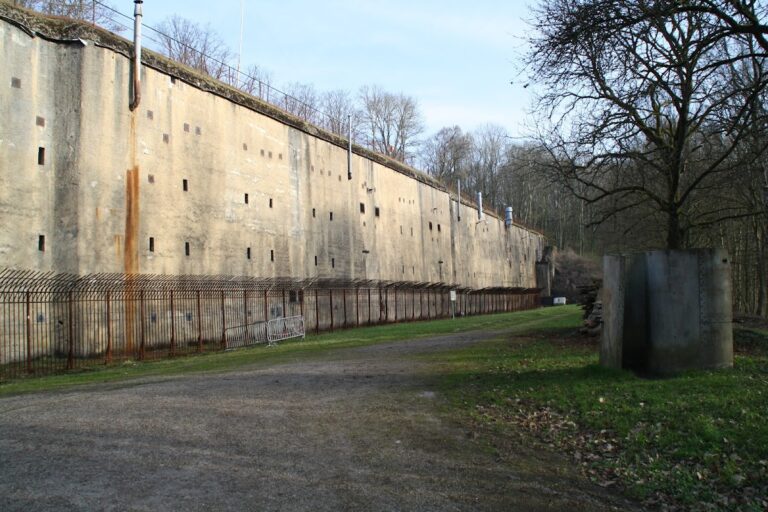
Bois-Karre stands in the Cattenom Forest, about 1 kilometre east of Boust and southeast of the village, west of the Moselle River. It lies between the larger ouvrages of Soetrich and Kobenbusch. Unlike most Maginot ouvrages, it consists of a single two-level combat block without an underground gallery system or a separate entrance placed at a distance. The entrance passes directly through the block, which was not excavated deeply in the manner of many other fortifications in the system.
The block contains two firing chambers and a machine-gun turret. The western chamber has one combined embrasure for twin-mounted machine guns and a 47 mm antitank gun, together with another embrasure for twin machine guns alone. The eastern chamber has two combined embrasures for twin machine guns and 47 mm antitank guns, as well as one embrasure for twin machine guns. Its east-facing positions covered the fortified front.
Roof defenses and observation
The roof carries an electrically operated machine-gun turret and three GFM cloches. These armored cupolas provided observation and machine-gun fire. A fourth GFM cloche, serving as a dummy, was positioned below the ouvrage. One of the functional cloches operated as an observation post with a periscope and was tactically associated with Ouvrage Métrich. The machine-gun turret has been restored to working order.
Power plant and interior spaces
The small integral power plant held two Renault engines rated at 40 horsepower each, an unusual arrangement among Maginot ouvrages. Two generators, each rated at 50 kilovolt-amperes and 220 volts, supplied power to the fort’s systems. The electrical installation provided lighting and operated the retractable turrets. The restored engines and generators now supply power to the preserved ouvrage.
Inside, the two-level block included stores, soldiers’ quarters, a kitchen, a dining room, and other support spaces. Much of the original equipment survives. Mechanical equipment and interior areas have been repainted, while reproductions of frescoes have been installed. Work has also improved the waterproofing of the roof slab and turret.
Related casemates and shelters
Several separate fortifications formed part of the surrounding defensive arrangement. Basse-Parthe West and Basse-Parthe East were casemates assigned western and eastern flanking roles. Each contained a combined 37 mm antitank-gun and twin-machine-gun embrasure, a twin-machine-gun embrasure, and a GFM cloche.
Other associated positions included Abri du Bois-Karre, a surface shelter for one infantry section with two GFM cloches; Abri du Rippert, a subsurface shelter for two infantry sections and the quartermaster command post, also with two GFM cloches; and Abri du Bois-de-Cattenom, a surface shelter for one infantry section with two GFM cloches. These casemates and shelters were separate from Bois-Karre and from one another.
During peacetime, the Casernement de Cattenom provided above-ground barracks and support services for Bois-Karre and other ouvrages in the area. Together, the combat block, its power plant, and the surrounding positions express the layered organization of the Maginot defenses in the Cattenom sector.
Nearby sites