Our Lady of Częstochowa Church in Lipie: A Gothic Parish Church
Site at a Glance
- Popularity
- Very Low
- Country
- Poland
- Primary era
- Early Modern
- Eras represented
- Medieval, Early Modern, Modern
- Civilizations
- Duchy of Pomerania, German, Holy Roman Empire, Kingdom of Prussia
- Site type
- Religious
- Remains
- Church
On this page11 sections
History
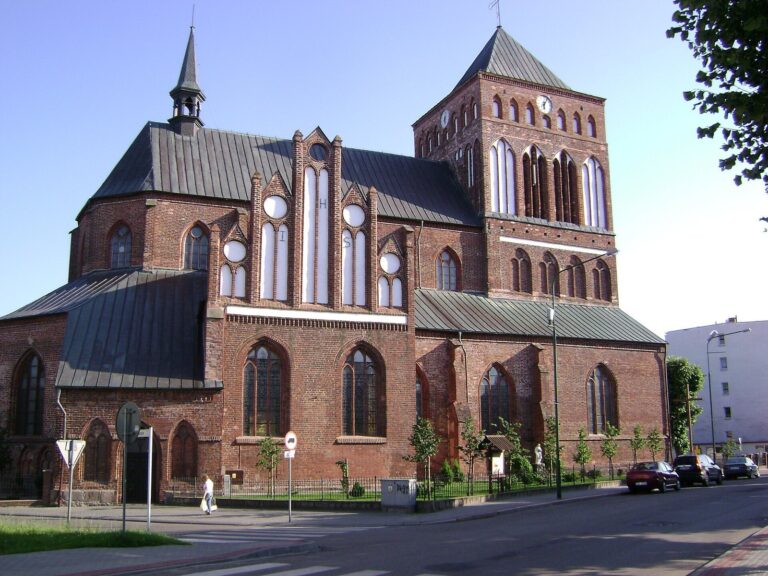
Our Lady of Częstochowa Church in Lipie is a church in Poland whose foundations are traditionally dated to 1462. It is a Gothic building, part of a medieval architectural style marked by pointed arches. Originally dedicated to St. Gertrude of Nivelles, it served as the center of a large parish before the Reformation.
Medieval church and Reformation
Before the Reformation, Arnhausen was a church village in the Diocese of Cammin, a historic Catholic diocese in Pomerania. Around 1538, its inhabitants adopted Lutheranism, a branch of Protestant Christianity. The pastor, Benedikt Zarne, had previously served as a chaplain at a convent in Koszalin in 1519. During his ministry, the church was altered or rebuilt in 1568. Its nave in its present form is thought to date from 1586. The landowner Eccard, also known as Egkart, von Manteuffel was buried in the church in 1613.
The Protestant parish
The parish remained Protestant until 1945. It belonged to the Belgard church district, a regional unit within the Pomeranian province of the Evangelical Church of the Old Prussian Union, a Protestant church body in Prussia. Three filial churches served Langen, Retzin, and Zwirnitz. Each community had its own patronage, but only the Arnhausen patronage could choose the pastor. By the end of this period, that patronage comprised 44 co-owners of the estate.
From 1903, the parish also served Groß Rambin. Before 1945, its 3,858 members included 1,718 in Groß Rambin and 2,140 in Arnhausen and its three filial communities: 960 in Arnhausen, 462 in Langen, 508 in Retzin, and 210 in Zwirnitz. During the Nazi period, Pastor Egbert Zieger brought in auxiliary preachers associated with the Confessing Church, a Protestant movement resisting Nazi control of German churches. This provoked conflict with the provincial church leadership, which was dominated by the pro-Nazi German Christians, and with the Belgard superintendent.
War and Catholic use
Early in the Second World War, young pastors were sent into military service, leaving the parish without a pastor. With special permission from the church, and later from the Russian and Polish administrations, Gerda Zieger took over her husband’s duties. The flight and expulsion of the local population then made church work in the parish almost impossible. Before 1945, the few Catholics in Arnhausen were served by the Church of the Sacred Heart in Białogard.
After the war, Polish arrivals in the area were almost entirely Roman Catholic. They began using the former St. Gertrude church on 7 January 1946, after it was reconsecrated and dedicated to Our Lady of Częstochowa, a title of the Virgin Mary associated with a revered image at the Jasna Góra monastery in Poland. A separate Roman Catholic parish in Lipie was established on 1 May 2006. It belongs to the Połczyn-Zdrój deanery in the Diocese of Koszalin-Kołobrzeg and serves about 1,900 members, including communities in Nielep and Rzecino, whose former Protestant churches are also used as Catholic churches, as well as the outlying villages of Jezierzyce and Dąbrowa Białogardzka. The parish has one priest’s post; a chaplain based in Modrzewiec has assisted the priest since 1983.
Remains
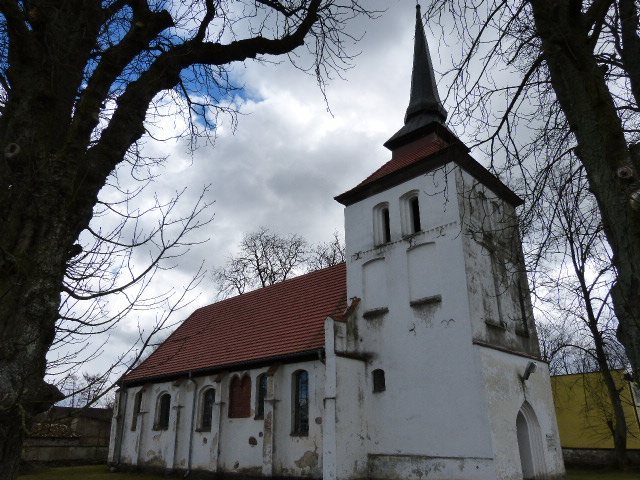
The church stands in western Lipie near the main road and the Mogilica stream. Its Gothic masonry combines fieldstones and brick, and the building is organized around a tower, nave, and eastern choir end. The choir end, the eastern part of the church, was added in 1816.
Church fabric
Exterior
The tower doorway has a pointed arch, with four rectangular setbacks on its outer side and one on its inner side. On each side of the uppermost tower floors are two pairs of shallow-arched recesses or windows. The tower and nave have simple projecting base mouldings, while the windows have shallow arches. On the south wall, a recess is framed by a pair of rounded arches, and the south doorway is plain. The wall supports end below the main cornice and have a single bevel on their sides and fronts.
A nearly illegible inscription on the tower’s south side preserves the words “PASTOR. ECC…1586.” It appears to refer to the pastor and perhaps to the builder, possibly the landowner Eccard, also called Egkart, von Manteuffel. After 1945, the building was coated in grey plaster, and its former sheet-metal roof was covered with tiles.
Interior
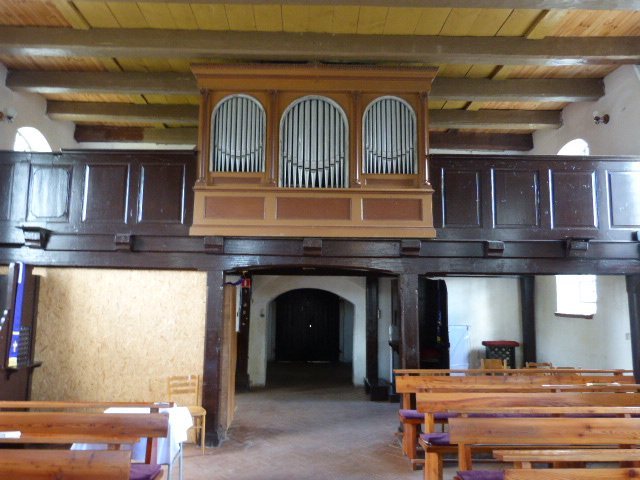
Before 1945, the furnishings included a pulpit above the altar, dated 1782, with carved Baroque leaf decoration on its wooden panels. A small, plain pew beside the door carried an inscription saying that Pastor Engelcken’s wife had it made “to the glory of God” in 1731. Else von Manteuffel donated a communion chalice in 1532. The church received a new organ in 1891, after its interior had been repainted.
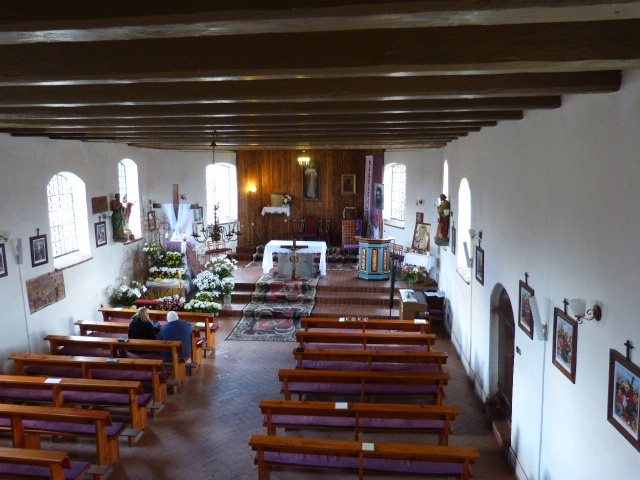
The described interior has two apostle figures beside the altar area, an image of Christ on the choir wall, and an image of Our Lady of Częstochowa to the altar’s left. The altar is a tabletop on a stone base. The pulpit on the right appears to be a modified version of the 1782 pulpit. Present-day pews replaced earlier benches, and a brass lamp hangs over the middle of the nave.
Bells
The 1616 bell
The larger of the church’s original bells was cast in 1616. It measured 90 centimeters across and weighed eight Zentner, a historical German weight unit whose value varied by period and region. Its inscription names Margareta von Blankenb., widow of Egkardt Manteuffel, their sons Christian, George, Churt, and Egkart, and Pastor Ernst Johann Krüger. It also credits Joachim Karstede with casting the bell, states that God created it, and invokes the Lord’s blessing.
The later bells
The smaller bell, made in 1852 by master bell-founder Strehl of Kolberg, weighed four and a half Zentner. Its inscription quotes, “Come to me, all who labor and are heavy laden, and I will refresh you,” and names Hermann Müller as church patron and Fritz Schmidt as pastor. The bell was removed in 1917 and sent to Połczyn-Zdrój to be melted down for ammunition. A replacement, cast by master bell-founder Schilling in Apolda, was dedicated on 4 October 1925 and carried the inscription, “Land, land, land, hear the word of the Lord!” One bell was lost during the Second World War; the church’s peal now consists of one bell.