Świdwin Castle: A Medieval Teutonic and Johanniter Commandery in Poland


Site at a Glance
- Rating
- 4.5
- Popularity
- Medium
- Country
- Poland
- Primary era
- Medieval
- External website
- Open
- Eras represented
- Medieval, Early Modern
- Civilizations
- Crusader, Holy Roman Empire, Knights Hospitaller, Margraviate of Brandenburg, Teutonic Order
- Site type
- Military
- Remains
- Castle
On this page11 sections
History
Świdwin Castle is a medieval castle in Poland, in the town of Świdwin. The Ascanian margraves of Brandenburg established its first fortress at the end of the thirteenth century, after acquiring the surrounding area from the Bishopric of Cammin in 1258. The complex later developed through Gothic, Baroque, and classicizing Baroque phases, reflecting successive changes in ownership and administration.
Ascanian and Wedel foundations
The first castle belonged to the territorial expansion of the Ascanian margraves, a German ruling dynasty whose Brandenburg branch controlled lands in northeastern Germany. By 1319, the noble Wedel family owned Świdwin. Represented by the court marshal Wedego von Wedel, the family began enlarging and developing the castle in the early fourteenth century. Financial difficulties eventually led the Wedels to sell the complex to the Teutonic Order in 1384.
Teutonic administration
The Teutonic Order was a medieval religious and military order that governed territories and maintained local administrative centres across parts of northeastern Europe. At Świdwin, it made the castle the seat of a bailiff’s district, with the bailiff acting as the order’s administrator. The order substantially expanded the complex at the end of the fourteenth century and around the beginning of the fifteenth.
This rebuilding included the demolition of the older residential building and the construction of a new eastern wing, a large brick administrative building along the northern wall, a new entrance, and a gate tower. These works changed the earlier defensive complex into a more extensive five-sided castle arranged around a courtyard.
Return to Brandenburg and the Johanniter commandery
In 1445, Elector Frederick II of Brandenburg, known as “the Iron,” bought the castle back for the Brandenburg margraviate. The entrance was remodelled at the beginning of the sixteenth century, when an outer defensive foregate was added.
A territorial exchange in 1540 transferred the castle from the Schivelbein district to the Johanniter commandery at Quartschen. The Johanniter Order was the German Protestant branch of the medieval Order of St. John. Świdwin then became a commandery, a local administrative and estate centre of the order. Two further wings were built, completing the enclosure around the courtyard. Veit von Thümen is regarded as the principal builder of this phase.
The commandery was administered through a combined office held by the commander and territorial governor. A territorial governor, or Landvogt, administered a district for a higher ruler. Melchior von Barfuß, formerly commander at Quartschen, later governed the Schivelbein and Dramburg districts while also serving as commander at Świdwin. Franz von Neumann became commander in 1545 and later rose to become a master of the order, although his reputation among the Johanniters remained controversial. Other commanders associated with the castle included Detlof von Winterfeld the Elder, Georg von Winterfeld(e), Bogislaf von Schwerin, and Heino Henrich von Fleming, who held office from 1688 and remained in office after 1720.
Baroque remodelling and state use
The castle underwent extensive alteration in the eighteenth century. Baroque extensions and classicizing changes transformed much of the Gothic complex while retaining elements from the fourteenth century. The largest rebuilding campaigns took place under commanders Leopold Alexander, Count von Wartensleben, Karl Wilhelm Finck von Finckenstein, who commanded in the 1770s, and Friedrich Wilhelm von Kalckstein. Wartensleben, a friend of Frederick the Great, an early Freemason, and a recipient of the Pour le Mérite, died while serving as commander of the Schivelbein commandery.
The Schivelbein Johanniter commandery was dissolved in 1808. After the associated Brandenburg bailiwick became a foundation and the order’s property was effectively confiscated, the castle passed into Prussian state ownership and housed government offices. A castle mill still existed in 1939 as part of an agricultural holding covering 8.5 hectares. The complex was later used for a girls’ school with boarding facilities.
War damage and rebuilding
After the Second World War, Świdwin came under Polish administration following a period of Soviet administration. The castle had been plundered and was subsequently used as an agricultural school. It burned in 1952 and was rebuilt between 1962 and 1968. The complex now houses a regional cultural centre. It is listed in the register of protected monuments of the West Pomeranian Voivodeship under A-1191, with entries dated 29 June 1953 and 28 August 2013.
Remains
Świdwin Castle stands on the left bank of the Rega River, within a bend northwest of the town and northwest of the medieval chartered town. Its earliest defensive complex had an irregular trapezoidal plan, with a long residential building set against the northern curtain wall. Later medieval rebuilding produced a five-sided enclosure organized around an inner courtyard. The present complex combines Gothic and Baroque elements, including reconstructed sections shaped by the rebuilding after the 1952 fire.
Enclosure and principal buildings
Eastern and northern wings
The Teutonic Order replaced the original residential building with an eastern wing and a large brick building along the northern curtain wall. The northern structure served the bailiff’s administration. Further wings added during the eighteenth-century remodelling completed the courtyard enclosure. These buildings preserve the layered character of the castle, where later Baroque and classicizing work stands alongside architectural elements dating from the fourteenth century.
Entrance complex
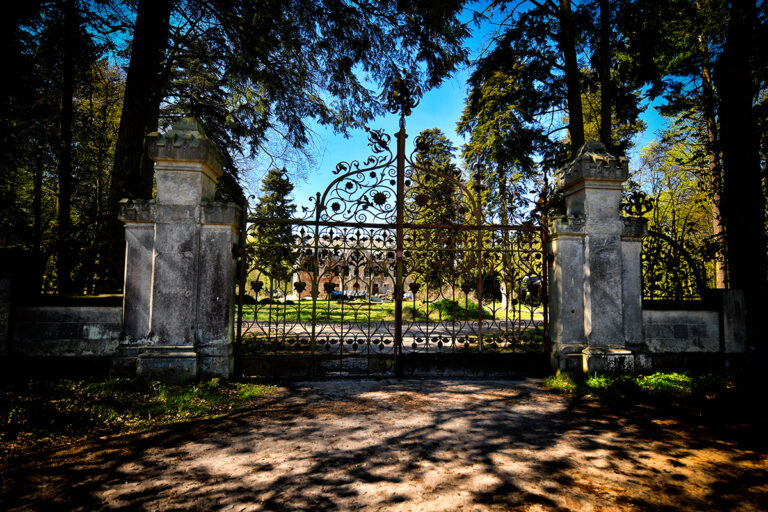
The entrance consists of the main gate, gate tower, and foregate. The Teutonic Order created the gate and tower during its enlargement of the castle, while the entrance was remodelled at the beginning of the sixteenth century. The foregate, an outer defensive entrance structure placed before the main gate, belongs to that later phase. Three commanders’ coats of arms are set in the frieze above the entrance. They represent Leopold Alexander von Wartensleben, Karl Wilhelm Finck von Finckenstein, and Friedrich Wilhelm von Kalckstein, and were installed on the orders of King Frederick William III of Prussia.
Round keep
The round keep, or Bergfried, dates from the fifteenth century. A Bergfried was the principal defensive tower of a medieval castle, used chiefly as a strong refuge and lookout rather than as the lord’s ordinary residence. At Świdwin, the tower survived the later alterations better than most of the medieval complex and remains a distinct part of the castle’s reconstructed and surviving fabric.