Our Lady of Perpetual Help church in Świdwin: A Gothic Basilica in Poland


Site at a Glance
- Rating
- 4.5
- Popularity
- Low
- Country
- Poland
- Primary era
- Medieval
- External website
- Open
- Eras represented
- Medieval, Early Modern, Modern
- Civilizations
- Brandenburg-Prussia, Duchy of Pomerania, Holy Roman Empire
- Site type
- Religious
- Remains
- Church
On this page7 sections
History
Our Lady of Perpetual Help church in Świdwin, Poland, is a Gothic, predominantly dark-brick church first recorded in 1338. It was once the only church in the town, then known as Schivelbein, and originally served Catholic worship before being converted for Protestant use in 1538.
From Catholic church to Protestant parish
Until 1945, the church belonged to the Pomeranian ecclesiastical province of the Evangelical Church of the Prussian Union, a Protestant church formed by uniting Lutheran and Reformed congregations in the Prussian territories. From 1858, Schivelbein was the seat of a church district and its superintendent, the senior cleric responsible for administering that district. In 1940, the parish had about 10,000 members. Its territory included the filial congregation of Simmatzig and the villages of Botenhagen and Nemmin, while the city magistrate held the right of patronage.
The church was enlarged with a north-side chapel in 1475. Christoph von Polenz, a fifteenth-century Pomeranian nobleman, founded the chapel in memory of his father. In 1505, the tower received a new copper-covered roof structure. The copper was brought from Stettin and weighed 41½ Zentner.
Lightning struck the tower in 1644, causing the roof structure to burn and collapse. The great city fire of 1689 then destroyed the church’s furnishings, including the organ installed in 1572, its extensive renovation in 1599, the altar, the choir galleries, and the elaborate pulpit made in a Stargard workshop. By order of Frederick III of Brandenburg, who later ruled as Frederick I, the first King in Prussia, collections were organized throughout the state to pay for reconstruction. The church was rebuilt and modestly enlarged between 1690 and 1692, and a new altar and pulpit made in Kolberg were installed in 1695.
A second lightning strike in 1771 damaged the tower. In 1773, its slender roof was replaced by a two-tiered wooden Baroque structure, a curving or tiered tower roof characteristic of Baroque architecture. Further restoration took place in 1827–1833 and 1880–1881, when the interior was given a restrained Neo-Gothic appearance. A major renovation followed in 1987 and included renewal of the roof covering.
Destruction and reconstruction after 1945
During the Red Army occupation of Schivelbein on 3 March 1945, the church survived apart from an artillery strike on the tower. On the following day, fires set in the city center destroyed it for a second time. Only the enclosing walls remained.
A reconstruction committee was formed in 1947, and rebuilding began in 1948. Reconstruction continued between 1947 and 1950 according to plans by the German architects Albert and Luise Altenburg, who were still being held in Poland at the time. After roughly four centuries as an Evangelical church, the building was expropriated for use by the Polish Roman Catholic Church. It was dedicated for Catholic worship on 21 December 1947 and consecrated on 16 December 1982.
After 1984, parish priest Tadeusz Piasecki began a program to dry the building, install a new copper roof, and renovate the Chapel of Our Lady of the Gate of Dawn. Restoration of the tower began in the 1990s under parish priest Jan Wszołek and continued under parish priest Ryszard Kizielewicz from 2005. During Kizielewicz’s tenure, new pews and a stained-glass window were added. The interior was repainted in 2006, while the exterior masonry was structurally renovated that year with support from Poland’s Ministry of Culture and National Heritage. Drainage around the church walls was installed in 2007.
Rudolf Virchow, the nineteenth-century German physician, pathologist, politician, and historian of Świdwin, was baptized in the church in 1821. Otto Georg Bogislaf von Glasenapp, who later became vice president of the German Reichsbank, was baptized there in 1853. Evangelical services are now held in the cemetery chapel, and the Świdwin congregation forms a filial congregation of the Koszalin parish within the Pomeranian–Greater Poland Diocese of the Polish Evangelical-Augsburg, or Lutheran, Church.
Remains
The basilica and interior structure
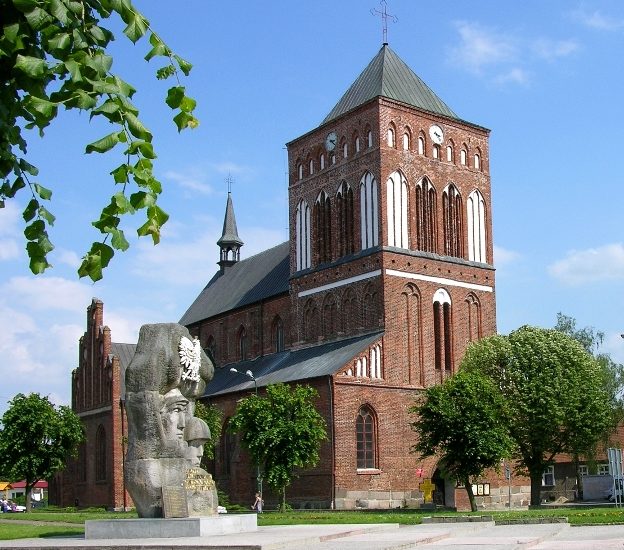
The church stands in central Świdwin at present-day Constitution 3 May Square, formerly the market square. Its surviving form is a three-aisled basilica, a church with a high central nave and lower side aisles. The building is predominantly constructed of dark brick, and its eastern end closes on three sides. Star vaults span the nave, giving the main interior space its complex, radiating ceiling pattern.
Side chapels were added along the north side in 1475. These spaces included the memorial chapel founded by Christoph von Polenz and a sacristy. The Chapel of Our Lady of the Gate of Dawn was later renovated as part of the post-1984 works. The church’s interior was repainted in 2006, and the present furnishings include new pews and a stained-glass window added during the later restoration campaign.
The tower and roof
A tower adjoins the church. It originally carried a tall, slender roof structure, which was destroyed by lightning in 1644 and replaced after another strike in the eighteenth century by a two-tiered wooden Baroque form above an intermediate roof, ending in a low shingled spire.
The present tower roof is a simple brick pyramidal structure installed during the reconstruction after 1945. The church as a whole has a sheet-copper roof. The tower masonry was restored from the 1990s onward, with further work continuing after 2005, while structural repairs to the exterior masonry were carried out in 2006.
Destroyed furnishings and surviving walls
The 1572 organ and the pulpit installed in 1614 were lost in the fire of 1689. The pulpit had been made by craftsmen in a Stargard workshop and was replaced in 1695 by a pulpit produced in Kolberg. The same fire also destroyed the historical altar and choir galleries. After the 1945 city fires, the enclosing walls formed the principal surviving fabric around which the church was reconstructed between 1947 and 1950.