Oltu Castle: A Historic Fortress in Türkiye


Site at a Glance
- Rating
- 4.3
- Popularity
- Medium
- Country
- Turkey
- Primary era
- Medieval
- External website
- Open
- Eras represented
- Iron Age, Classical, Medieval
- Civilizations
- Georgian, Urartian
- Site type
- Military
- Remains
- Castle
On this page11 sections
History
Oltu Castle is a historic fortress in Oltu, Türkiye, built on a mountain pass at the meeting point of waters from Narman and Sivri Creek that form the Oltu River. Its builder and exact foundation date are uncertain, although one tradition places its construction in the fourth century BC and another, considered weaker, attributes it to the Urartians, an Iron Age kingdom centered in the Armenian Highlands and around Lake Van, in the tenth century BC. The fourth century BC is also given as its completion date. In the nineteenth century, its architecture was characterized as Georgian, and the castle later served successive Byzantine, Georgian, Seljuk, Aq Qoyunlu, Ottoman, and Russian authorities.
Early foundations and Georgian connections
Oltu occupied an important position on a mountain route. Georgian inscriptions were mentioned in an 1888 Georgian-language article, while the German botanist Karl Heinrich Koch reported in 1843 that Georgian inscriptions and carved figures appeared on large stones in the castle and in the town’s outer fortifications. During the final quarter of the nineteenth century, T. Masalskiy of the Petersburg Geographical Society described the castle’s architecture as Georgian. These references connect the surviving fortress and its religious remains with the medieval Georgian presence in the region.
Medieval rule and the Samtskhe-Saatabago period
After its earlier use by the Byzantine Empire, Oltu Castle came under the Georgian Kingdom, the Great Seljuks, and the Aq Qoyunlu. The Great Seljuks were a major medieval Sunni Turkic dynasty whose empire extended through much of the Middle East and Anatolia. The Aq Qoyunlu, or White Sheep Turkmen, ruled parts of eastern Anatolia and neighboring regions during the fifteenth century.
Before the Ottoman capture of Oltu in the mid-sixteenth century, the castle was an important center for the rulers of Samtskhe-Saatabago, a medieval Georgian principality governed by the Jakeli dynasty in southwestern Georgia. Its position on the rocky hill above the river junction supported its continuing role through these changes of power.
Ottoman and Russian administration
Under Ottoman rule, the castle was used as a caravanserai, a roadside lodging and service complex for traveling merchants and caravans, and it was later restored. Oltu became the administrative center of the Oltu sanjak, an Ottoman district below the level of a province, within Çıldır Province.
Following the Russo-Turkish War of 1877–1878, the Treaty of Berlin transferred Oltu from Ottoman to Russian control. The treaty was the 1878 diplomatic settlement that revised the war’s territorial consequences. Under Russian administration, Oltu remained the center of the Oltu sanjak, and a barracks stood in the town.
Descriptions of the town and fortress
In 1907, the Georgian historian and archaeologist Ekvtime Takaishvili described Oltu as extending along both banks of the Oltu River. He identified the barracks on the left bank and the castle on the right as the center of the town’s old quarter. His description preserves the relationship between the fortress, the river, and the administrative settlement during the period of Russian rule.
Remains
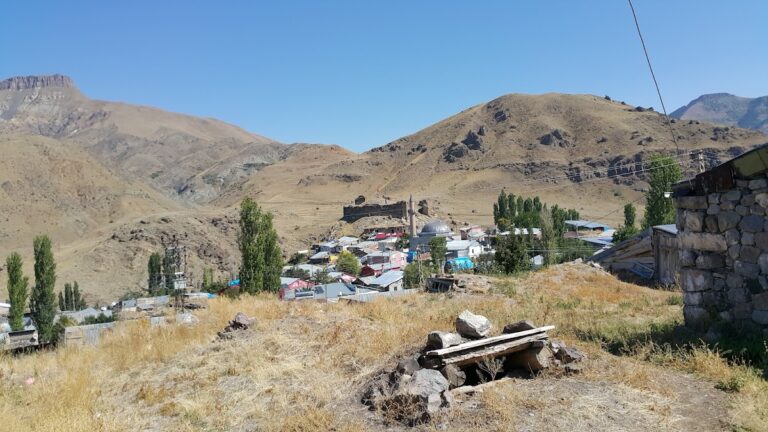
Oltu Castle stands on a steep, relatively low rocky hill in the center of Oltu. The complex is divided into an inner castle and an outer castle, and its masonry was built from carefully dressed cut stone. The inner enclosure is entered through a single gate on the south side. Within its courtyard are the remains of a Georgian church, while two towers survive on the northern side and a bathhouse ruin lies east of the castle.
Courtyard buildings and defensive remains
Inner castle
The inner castle forms the principal surviving enclosure on the rocky hill. Its southern gate provides the documented entrance, and the courtyard contains the remains of the Georgian church. The castle’s cut-stone construction and elevated position preserve the core of a fortified complex that was also adapted for later administrative and commercial uses.
Oltu Castle Church
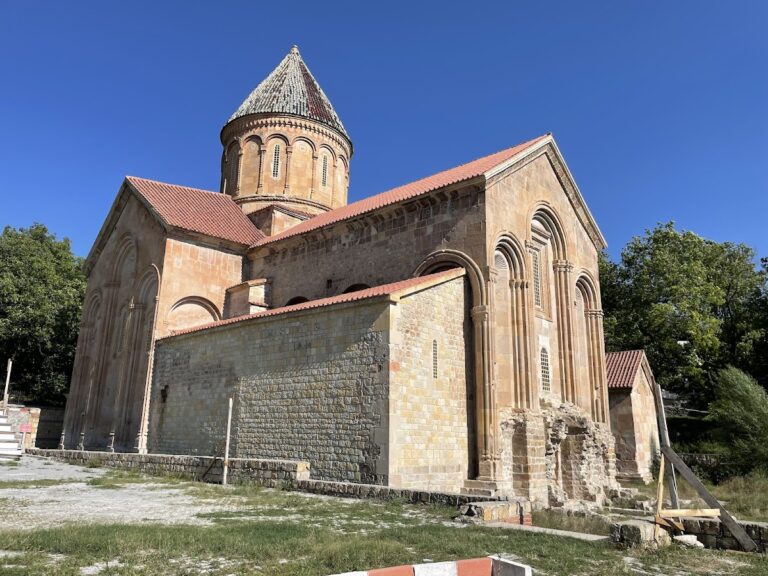
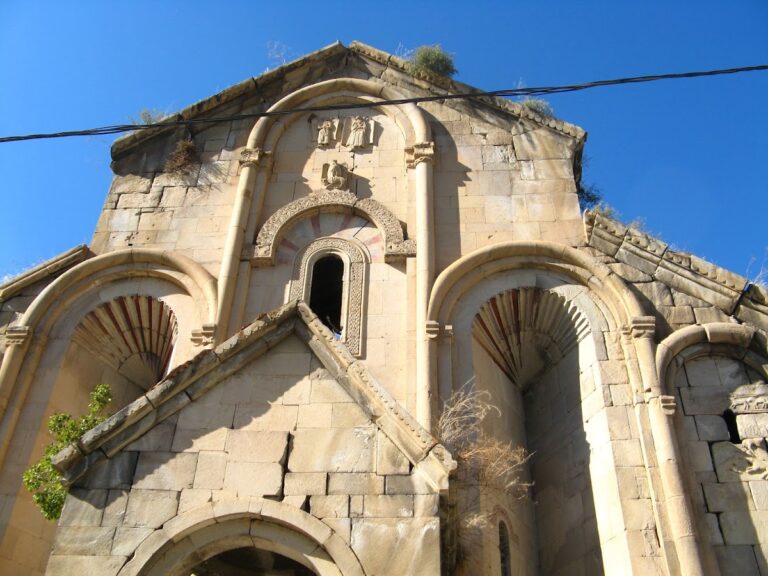
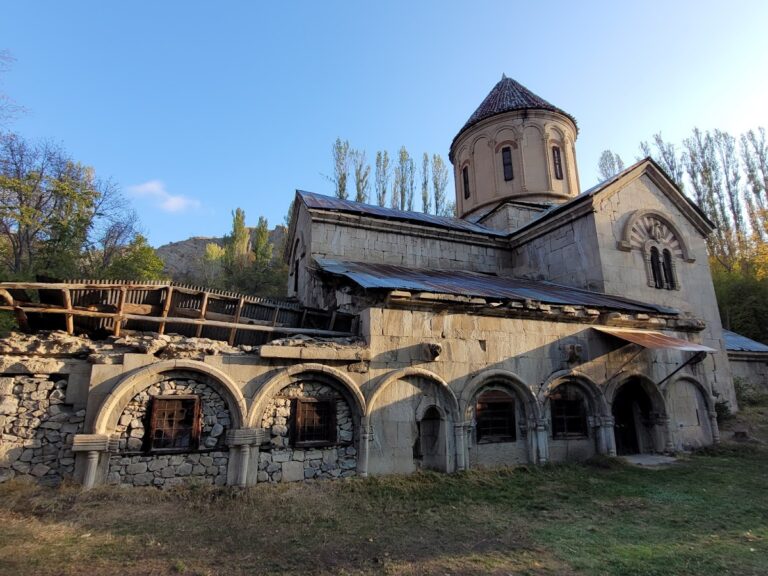
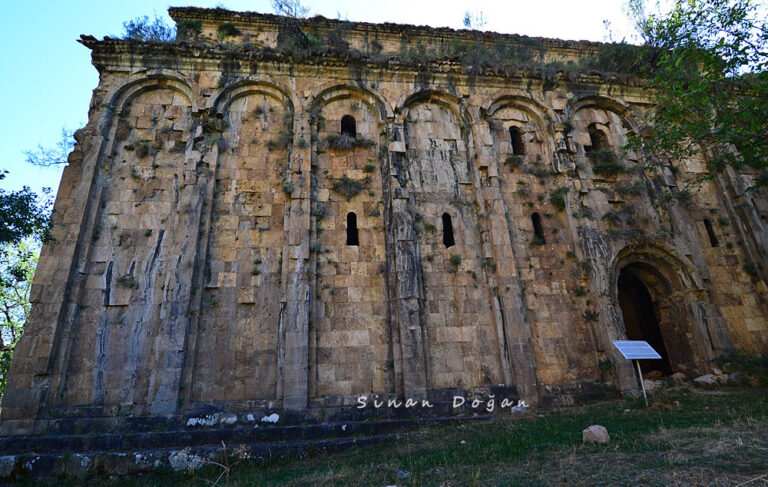
The northeastern part of the courtyard contains the ruins of an old Georgian church known as the Oltisi Church or Oltu Castle Church. It was a domed building with six apses, or rounded spaces opening from the central church. A Georgian inscription identifies the church as dedicated to Saint George.
Northern towers and mausoleum
Two relatively well-preserved towers stand along the northern side of the castle. The tower on the left was converted into a domed mausoleum dedicated to Judge Zinnun, a qadi, or judge who administered Islamic law, who died in the inner castle. The conversion gave the tower a later funerary function while retaining it within the castle complex.
Bathhouse
Ruins of a bathhouse lie to the east of the castle. This surviving structure forms a separate part of the complex from the inner enclosure, church, and northern towers, and reflects the range of facilities associated with the occupied fortress.
Nearby sites