Okazaki Shrine: A Guardian Shrine of Kyoto


Site at a Glance
- Rating
- 4.4
- Popularity
- Medium
- Country
- Japan
- Primary era
- Medieval
- External website
- Open
- Eras represented
- Medieval
- Civilizations
- Unclassified
- Site type
- Religious
- Remains
- Sanctuary
On this page7 sections
History
Okazaki Shrine is a Shinto shrine in Kyoto, Japan, founded in 794 when Emperor Kanmu established Heian-kyo as the imperial capital. Traditionally counted among the four Great General shrines, it was created to protect the capital from harmful directional influences. Because it stood east of the city, it was also known as East Tenno Shrine.
Foundation and guardianship
In 869, Emperor Seiwa had the shrine constructed and brought Gozu Tenno from Hiromine in Harima Province. Gozu Tenno, a premodern syncretic deity often identified with Susanoo-no-Mikoto and associated with protection against epidemics, became the shrine’s principal sacred presence. Okazaki Shrine then served as the guardian shrine of the nearby Tokoji temple.
The shrine’s connection with childbirth developed in 1178, when it received imperial offerings for the childbirth of Tokuko, consort of Emperor Takakura. It consequently came to be revered in connection with safe childbirth and conception. Its principal deities are regarded as having many children, while rabbits, considered highly fertile, became associated with the same prayers.
Rebuilding and later history
In 1319, Emperor Go-Daigo ordered the shrine buildings to be rebuilt and granted the shrine the rank of Senior First Rank together with sacred treasures. During the Onin War, the civil conflict fought mainly in and around Kyoto from 1467 to 1477, the temple was destroyed by fire, while the shrine itself survived.
During the Keicho era, the shrine was renamed Okazaki Shrine. In the Meiji period, when a modern system of shrine rankings was established, it was classified as a village shrine. On September 21, 1934, strong winds associated with the approach of the Muroto Typhoon caused the worship hall to collapse.
Religious associations and observances
Okazaki Shrine remains associated with protection against harmful directional influences because of its foundation as a guardian of the capital. It is also connected with the Kyoto Sixteen Shrines pilgrimage and with a national association linked to 59 shrines that enshrine Susanoo-no-Mikoto. Its principal festival, the “Osuzumi” cool-evening observance, is held on July 16.
Remains
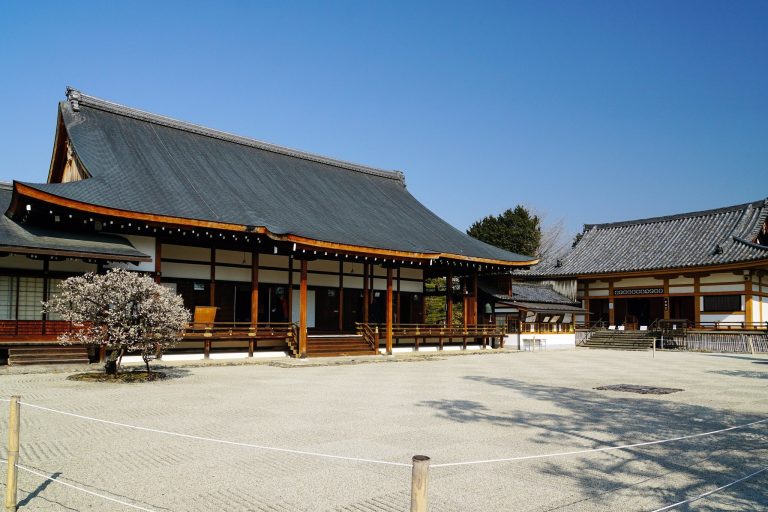
The shrine complex contains a main sanctuary, a worship hall, the Rain Shrine, an administrative office, and the subsidiary Miyashige Inari Shrine. Its religious layout brings together the principal shrine buildings with smaller sacred spaces and numerous stone representations of rabbits, which serve as the shrine’s sacred messengers.
Principal and subsidiary shrines
The principal deities are Susanoo-no-Mikoto, Kushinada-hime-no-Mikoto, and eight child deities, comprising three daughters and five sons. Susanoo is a major Shinto deity associated with storms and protection, while Kushinada-hime is the deity he rescued and married in the traditional serpent-slaying myth. The Rain Shrine enshrines Ōyamatsumi-no-Mikoto, Kukunochi-no-Mikoto, Kunisatsuchi-no-Mikoto, Toyoukehime-no-Mikoto, and another deity. Miyashige Inari Shrine enshrines Ukanomitama-no-Kami, Ebisu-no-Ōkami, and Ōkuninushi-no-Ōkami.
Rabbits as sacred messengers
The area around the shrine was formerly inhabited by wild rabbits. Rabbits therefore became its sacred messengers, and numerous stone rabbit statues are distributed throughout the grounds. Their presence also relates to the shrine’s association with conception and safe childbirth.