Shinshōgokuraku-ji Temple: A Tendai Buddhist Temple in Kyoto


Site at a Glance
- Rating
- 4.5
- Popularity
- Medium
- Country
- Japan
- Primary era
- Early Modern
- External website
- Open
- Eras represented
- Early Modern
- Civilizations
- Tokugawa
- Site type
- Religious
- Remains
- Sanctuary
On this page14 sections
History
Shinshōgokuraku-ji Temple is a Tendai Buddhist temple in Kyoto, Japan, founded in 984 by Kaisan, a monk of Enryaku-ji on Mount Hiei. Its formal name is Reishōzan Shinshōgokuraku-ji, and its present common name developed from Shinnyo-dō, originally the popular name of its main hall. The temple became a center of Amitabha devotion and nenbutsu, the practice of reciting Amitabha’s name in the hope of rebirth in the Western Pure Land.
Foundation and early devotion
The tradition preserved in the Shinnyo-dō engi states that Kaisan installed an Amitabha image from the Jōgyōdō Hall at Enryaku-ji in the detached palace of Senshi, the mother of Emperor Ichijō, in the eastern part of Kaguraoka. The main hall was reportedly built there in 992 with the emperor’s authorization, and Shinshōgokuraku-ji was regarded as his prayer temple. Its name means “the truly authentic temple of the Pure Land,” distinguishing it from the many temples called Gokuraku-ji.
The buildings declined during the conflicts of the Jishō–Juei era, a period of civil warfare that caused extensive destruction in Kyoto. The monk Jōkei led fundraising efforts for their restoration. The temple subsequently became a center for continuous nenbutsu practice, drawing both committed devotees and ordinary worshippers, particularly women.
Destruction and movement during the Ōnin War
The Ōnin War, which began in 1467 and brought widespread destruction to Kyoto, burned the temple buildings. The principal Amitabha image was evacuated to Seiryū-ji at Kurotani on August 3, 1468, and then moved to Hōkō-ji at Anō in Ōmi Province on March 15, 1470.
After the war, Shinshōgokuraku-ji was transferred to the Ichijō–Nishinotōin area on March 26, 1478. Ashikaga Yoshimasa ordered its return to its former site in eastern Kaguraoka on May 6, 1484. The temple returned on June 1, and Yoshimasa donated two chō of land at Hanazono in eastern Kaguraoka to provide lamp oil. The main hall was rebuilt on August 15, 1493.
Relocations and rebuilding
In 1567, Ashikaga Yoshiaki ordered the temple to move to the former residence of Ashikaga Yoshiteru at Muromachi Kagaikyōji, designating it as Yoshiteru’s mortuary temple, a Buddhist institution responsible for memorial and funerary rites. When Yoshiaki later planned to build his own residence there, a new site north of Ichijō Street was selected, and the temple moved again in 1569.
Toyotomi Hideyoshi relocated Shinshōgokuraku-ji to Kyōgoku–Imadegawa in 1587 to clear ground for Jurakudai. Toyotomi Hideyori financed the rebuilding of the main hall in 1604. That building burned in 1661 and was reconstructed in 1690, but another fire destroyed the temple in 1692. In 1693, Emperor Higashiyama ordered its relocation and rebuilding at the present site. The current main hall was completed in 1717.
Religious associations and later history
Shinshōgokuraku-ji remains affiliated with the Tendai school, a major Japanese Buddhist tradition based on teachings transmitted from China. It is linked with several pilgrimage systems. Through its subtemple Shin-Hasedera, it is the fifth station of the Rakuyō Thirty-Three Kannon Pilgrimage, and it is the first station of the Rakuyō Six Amitabha Pilgrimage. Through Yakushi Hall, it is also the 111th station of the Shinto-Buddhist Sacred Sites Pilgrimage and the fifth station of the Kyoto Twelve Yakushi Pilgrimage.
The temple is the mortuary temple of the Mitsui family, whose tombstones, including that of Takatoshi Mitsui, stand within the grounds. The Jūya, meaning “ten nights,” is an extended nenbutsu observance associated with Pure Land practice and is said to have originated at Shinshōgokuraku-ji.
A legend in the Shinnyo-dō engi concerns Abe no Seimei, who was said to have died accidentally and appeared before Enma, the Buddhist judge of the dead. Seimei’s personal devotional image of Fudō Myōō pleaded for his life, and Enma granted Seimei a “Five Elements Seal,” also called the “secret seal of assured rebirth.” Seimei was said to have returned to life and distributed the seal until his death at the age of 85. On July 25, the temple holds a ritual for health and longevity connected with this legend during its treasure airing and insect-removal observance. The seal is also issued at the main hall as a talisman associated with revival and rebirth in the Pure Land.
Shinshōgokuraku-ji also has a place in the history of Japanese cinema. In 1908, Shōzō Makino filmed The Battle of Honnō-ji, described as his first dramatic film, in the temple precincts with a cinematograph. The temple holds National Treasure status for six Lotus Sutra scrolls and Important Cultural Property status for the main hall, the standing Amitabha image, and other associated works.
Remains
Temple precinct and principal worship buildings
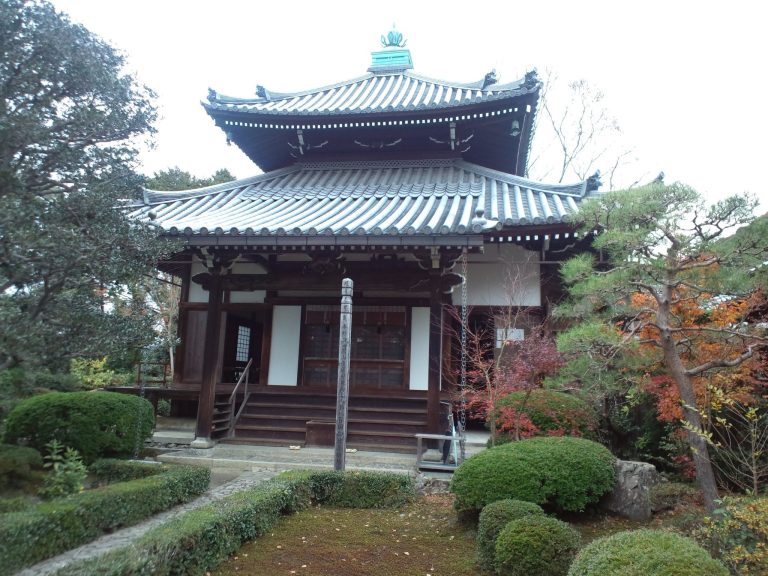
Shinshōgokuraku-ji stands in Jōdōji Shinnyo-chō, Sakyō Ward, Kyoto, under the mountain name Reishōzan, an honorific religious designation traditionally attached to a Buddhist temple in Japan. The precinct includes the main hall, a three-story pagoda visible from it, the subtemple Shin-Hasedera, and Yakushi Hall. These buildings represent the surviving organization of a temple repeatedly rebuilt and moved before the present main hall was completed in 1717.
Sacred images
Standing Amitabha
The principal Amitabha is a wooden standing statue 108 centimeters high. Its style places it in the late tenth century, and it is considered probably to have been made when the first main hall was built. The image is regarded as the oldest surviving example of a standing Amitabha image. Amitabha is the Buddha associated with the Western Pure Land, traditionally called Sukhāvatī, and devotion to him is expressed through prayer and nenbutsu.
The Nodding Amitabha and Fudō Myōō
The image is known as the “Nodding Amitabha.” Its legend says that Ennin, a prominent ninth-century Tendai monk also known as Jikaku Daishi, carved it from sacred timber found at Namasaka Shrine, making three bows for each stroke. When Ennin asked the image to become the principal image for practitioners on Mount Hiei, it shook its head three times. When he asked it instead to descend to Kyoto and save all living beings, especially women, it nodded three times.
Fudō Myōō, the Buddhist deity Acala associated with protection and the defeat of obstacles, is installed beside the principal Amitabha as an attendant. Tradition identifies this image with Abe no Seimei’s personal devotional image in the revival legend.
Scriptures and painted works
Lotus Sutra scrolls
Six surviving Lotus Sutra scrolls, numbers two through seven, are National Treasures. They belong to an eight-scroll set initiated by the Buddhist sculptor Unkei. The first scroll is lost, while the eighth is privately held elsewhere. The set was initiated during the Angen era, around 1175–1177, and copied in 1183 with assistance attributed to a woman named Ako-maru. Kaikei and other Buddhist sculptors also participated, and the text was written by Chinga. The scroll shafts use surviving wood from Tōdai-ji after its destruction in a military conflagration in January 1181.
Shinnyo-dō engi
The three-volume Shinnyo-dō engi, painted as a handscroll in 1524, is an Important Cultural Property. Its first volume explains the origins of the Amitabha image associated with Ennin. The second recounts the foundation of Shinshōgokuraku-ji and stories about Kaisan, Jōkei, and Hōnen. The third depicts the image’s movements and the temple’s rebuilding after the Ōnin War. Hisakuni, who held the title Kamon no Suke, wrote the calligraphy, and the circumstances of the work’s production are recorded from the drafting of its text through its execution.
Other Important Cultural Properties include a silk painting of Fugen, the bodhisattva Samantabhadra associated with practice and virtue, an ink-and-light-color painting of the Chinese Buddhist figures Hanshan and Shide by Kanō Sansetsu, and a letter by the monk Jien.
Mitsui family tombs
Tombstones belonging to the Mitsui family are arranged within the precincts. They include the monument of Takatoshi Mitsui and those of other family members, reflecting the temple’s continuing role as the family’s mortuary temple.