Eikan-dō Zenrin-ji Temple: A Buddhist Head Temple in Kyoto


Site at a Glance
- Rating
- 4.6
- Popularity
- Medium
- Country
- Japan
- Primary era
- Early Modern
- External website
- Open
- Eras represented
- Medieval, Early Modern, Modern
- Civilizations
- Ashikaga shogunate, Japanese, Tokugawa, Toyotomi regime
- Site type
- Religious
- Remains
- Monastery
On this page24 sections
History
Eikan-dō Zenrin-ji Temple is a Buddhist temple in Kyoto, Japan, founded in 853 within the Heian-period Buddhist tradition. It began as a Shingon institution devoted to Vairocana and the four directional Buddhas, and later became the head temple of the Seizan Zenrin-ji branch of Jōdo-shū, a Japanese Pure Land tradition centered on devotion to Amida Buddha and recitation of the Nenbutsu.
Foundation and Imperial Recognition
The temple’s foundation is traditionally associated with Shinshō, a senior disciple of Kūkai, the founder of Japanese Shingon Buddhism. In 853, Shinshō acquired the mountain villa of Fujiwara no Sekio, a poet and court literary figure, and intended to establish a Shingon temple there. The planned institution was dedicated to Vairocana, the cosmic Buddha, and the four Buddhas of the directions, together known as the Five Wisdom Buddhas.
Private temples could not freely be founded in Kyoto at that time. Zenrin-ji therefore received imperial authorization from Emperor Seiwa in 863 and was formally recognized under that name. In 877, Emperor Yōzei granted the temple four chō of public land in Yamashiro Province, ordered the construction of a Buddhist hall, and designated Zenrin-ji as an imperial prayer temple.
A Center of Buddhist Learning
During its early centuries, Zenrin-ji developed beyond its original foundation as a Shingon temple. It became a center of Buddhist learning and doctrinal debate, and was one of Kyoto’s three institutions known as Kangaku-in, or centers for scholarly study.
The temple’s seventh head monk, Yōkan, lived from 1033 to 1111 and was regarded as its principal reviver. The son of the literary scholar Minamoto no Kunitsune, he entered Zenrin-ji at the age of eleven under Shinkan, a son of Emperor Kazan. After studying Sanron Buddhism at Tōdai-ji, Yōkan returned to Zenrin-ji in 1072.
Yōkan became a fervent devotee of Amida, the Buddha of the Western Pure Land, and recited the Nenbutsu ten thousand times each day. He encouraged both monks and lay devotees to follow the practice. His religious work was closely connected with charity. He established Yakuō-in near a charitable institution in Higashigojō, where medical care and relief were organized for sick and needy people.
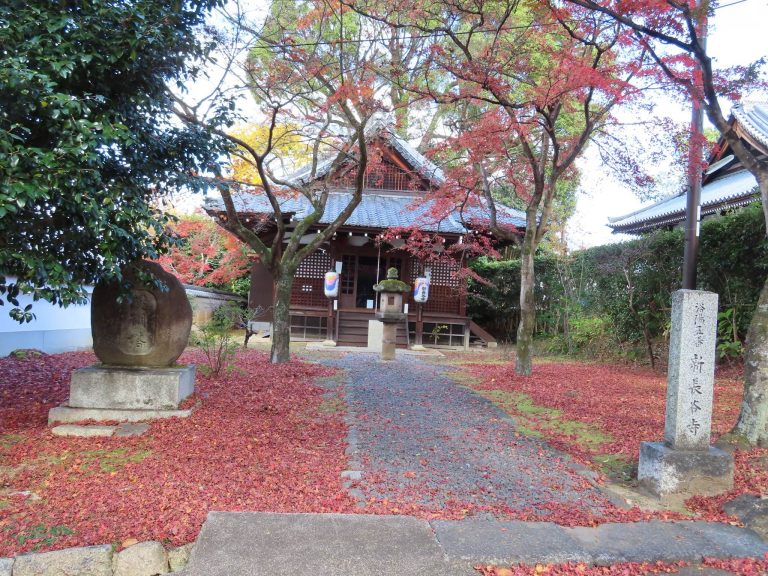
In 1097, Yōkan created a charitable facility and a medical institution within the temple precincts. He also planted many plum trees and distributed their medicinal fruit to patients. The fruit became traditionally known as Hidenbai. Yōkan’s residence at Zenrin-ji gave rise to the name Eikan-dō, while the temple’s autumn foliage inspired the expression that Eikan-dō in autumn is the temple of maple leaves.
Growth of Pure Land Associations
Zenrin-ji received further support in 1198, when Minamoto no Yoritomo, founder of Japan’s Kamakura shogunate, visited the temple. He donated a copy of the Great Perfection of Wisdom Sutra and endowed Zenrin-ji with 360 koku of rice, a historical unit used for taxation and land-based endowments. The rice grant thereafter became a regular institution.
Jōhen, who lived from 1166 to 1224, was the temple’s twelfth head monk. He had originally been a Shingon priest and a critic of Hōnen, the principal founder of Jōdo-shū. Jōhen later became Hōnen’s disciple and joined the Pure Land movement. He transferred the title of eleventh head of Zenrin-ji to Hōnen, although Hōnen never resided at the temple, and Jōhen himself assumed the title of twelfth head.
Hōnen’s disciple Shōkū is said to have followed Jōhen as abbot. Under Shōkū’s successor, Jōon, Zenrin-ji became an important center of the Seikoku tradition, a lineage within the Jōdo-shū movement, and flourished alongside Kōmyō-ji.
Destruction, Reconstruction, and Institutional Change
The entire temple complex suffered major damage during the fires of the Ōnin War, a late-fifteenth-century conflict that devastated parts of Kyoto. Reconstruction took place approximately from 1472 to 1497. Emperor Go-Tsuchimikado is associated with sponsorship of the rebuilding of the Founder’s Hall, while Emperor Go-Kashiwabara is associated with the rebuilding of the abbot’s quarters, study hall, and guest hall.
In 1607, Toyotomi Hideyori, the son and successor of the military ruler Toyotomi Hideyoshi, had the Mandala Hall from Shitennō-ji in Settsu Province dismantled and moved to Zenrin-ji. The building was reused as the Amida Hall.
Zenrin-ji became the eastern head temple of the Seizan branch of Jōdo-shū in 1876. When the Seizan branch divided in 1919, it separated into the Seizan Kōmyō-ji, Seizan Zenrin-ji, and Seizan Fukakusa branches. Zenrin-ji became the head temple of the Seizan Zenrin-ji branch.
The temple’s principal Amida image was designated an Important Cultural Property in 1999. Its associated treasures include two National Treasures, the Yamakoshi Amida Painting and a gilt-bronze ritual gong decorated with a lotus motif. Both are deposited at the Tokyo National Museum. Zenrin-ji also remains connected with religious pilgrimage as the second place in the Rakuyō Six Amida pilgrimage, an affiliated site linked with the Twenty-Five Sacred Places of Hōnen, and the eighth place in the Seizan National-Teacher Sacred Sites pilgrimage.
Remains
Mountain Layout and Entrances
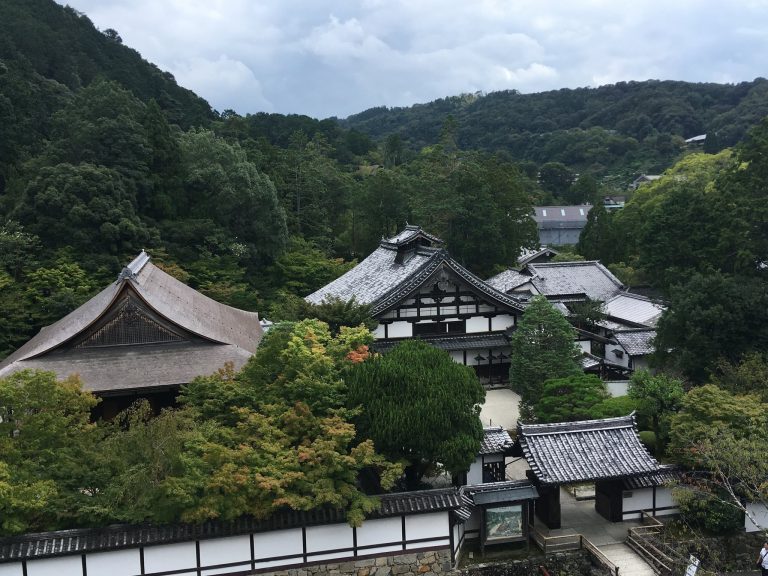
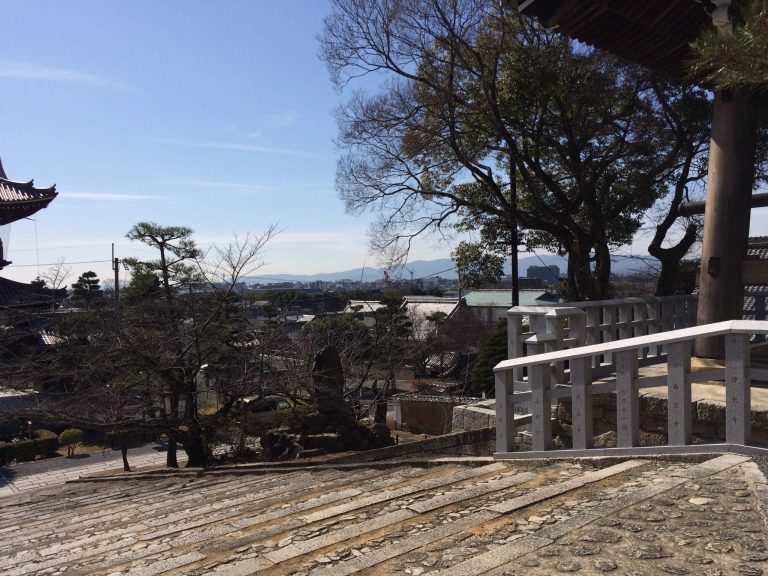
The compound occupies the lower slopes of Kyoto’s Higashiyama range. Its buildings are arranged at different elevations and linked by covered wooden corridors, stairways, and passages that follow the uneven ground. The surviving layout therefore combines separate structures with routes adapted to the mountain slope.
Kōrai-mon
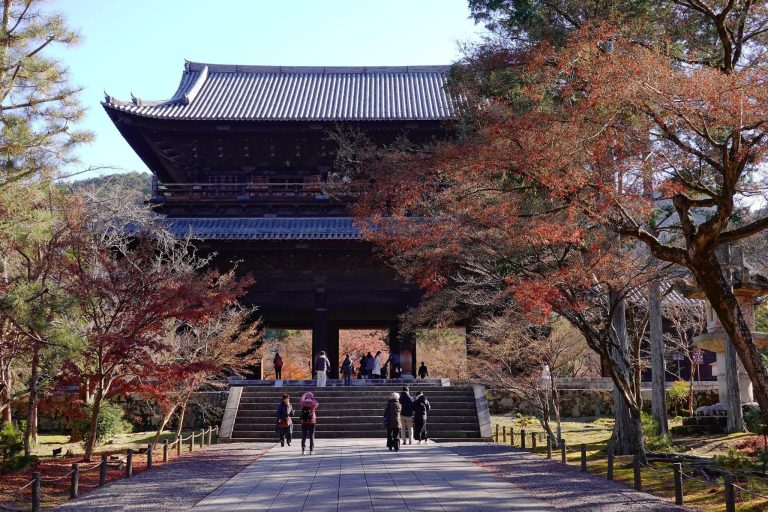
The Kōrai-mon, or main gate, dates from the late Edo period, around the middle of the nineteenth century. Its name refers to Goguryeo, an ancient Korean kingdom. Together with the inner gate, it derives from the fortification that formerly surrounded Fujiwara no Sekio’s aristocratic residence, and its position and form are said to preserve aspects of that earlier origin.
Yakui-mon
The Yakui-mon is the compound’s inner gate. The present structure dates to 1744. Its position and architectural form, like those of the Kōrai-mon, are associated with the gates of the former residence of Fujiwara no Sekio.
Principal Halls and Upper Structures
Founder’s Hall
The Goe-dō, or Founder’s Hall, enshrines and honors Hōnen. The present building was completed in 1912 and is larger than the Amida Hall. Its role reflects the temple’s later identity within the Pure Land tradition.
Amida Hall
The Amida-dō, or Amida Hall, houses the temple’s principal object of worship, the Mikaeri Amida. It stands higher on the mountain than the Founder’s Hall, and the present building dates from the beginning of the seventeenth century. The structure incorporates the Mandala Hall transferred from Shitennō-ji in 1607.
Tahōtō
The Tahōtō occupies the highest point of the compound. This two-level pagoda has a square lower story and a rounded upper story. The present structure was completed in 1928.
Residential and Garden Buildings
Hōjō
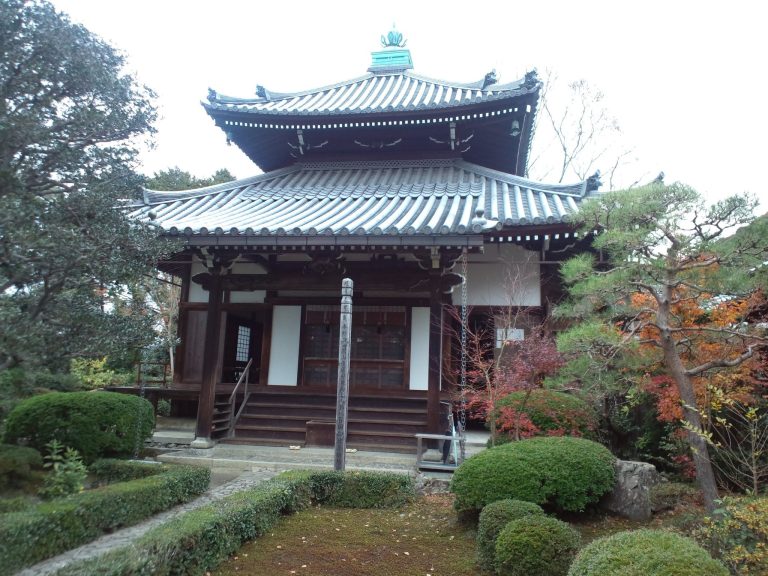
The Hōjō, or chief priest’s chamber, is built in the Zen style even though Zenrin-ji is not a Zen Buddhist temple. Its construction is traditionally said to have been ordered by Emperor Go-Kashiwabara, although the building itself was not erected until the Edo period.
Shakadō
The Shakadō, or Hall of Shakyamuni, contains painted sliding doors. A small rock garden lies nearby, forming part of the hall’s immediate setting.
Hōjō Pond
The Hōjō pond is surrounded by a garden crossed by streams. A small shrine stands on an island in the middle of the pond.
Mikaeri Amida and Temple Treasures
The wooden Mikaeri Amida is 77.6 centimeters high. Amida turns the head to the left, which is the viewer’s right, rather than facing directly forward. The figure also bends the left knee slightly and extends the left foot as if walking.
The image was formerly attributed to the Kamakura period but is now generally dated to the late Heian period, probably the second half of the twelfth century. Its head was shaped with a slightly enlarged right side and a reduced left side so that the unusual profile would remain visually balanced when seen from the front.
The turned head and walking gesture have been interpreted as Amida looking back to watch over a person being welcomed into the Pure Land. The Mikaeri Amida is considered the oldest known Japanese example of this type. Comparable earlier examples are known from Northern Song-period cave sculpture in Sichuan, while a small number of later Japanese examples also survive.
Other cultural treasures associated with Zenrin-ji include Buddhist paintings of Amida, Shakyamuni, Yakushi Nyorai, the Buddha associated with healing, and the Buddha’s Parinirvana, or final passing beyond the cycle of rebirth. Paintings by Kanō Motonobu, Tosa Mitsunobu, and Hasegawa Tōhaku are also held among the temple’s treasures.
Traditions of the Precincts
Old Abbot’s Quarters
A transom painting in the old abbot’s quarters is connected with the tradition of the “missing sparrow.” The rightmost section is said to contain one fewer sparrow because one bird flew out of the painting.
Garyūrō
The Garyūrō is a strongly curved stairway and corridor leading toward the Founder’s Hall. Its shape is said to resemble a reclining or extended dragon.
Hidenbai
The Hidenbai is a plum tree traditionally connected with Yōkan’s charitable activities. The tree preserves the name given to the medicinal fruit that Yōkan distributed to patients.
Sanko-no-matsu
Near the Garyūrō stands the Sanko-no-matsu, a pine whose unusually long needles divide into three parts. Tradition holds that placing one needle in a purse brings accumulated wealth, while putting one in a chest brings an abundance of clothing.
Other Natural Features
A frog in the precincts is traditionally said to make a sound resembling the striking of a wooden fish, although those who claim to have heard it are said never to have seen the animal. On the steep slope behind the temple grows the Iwagaki maple. Its name comes from a poem by Fujiwara no Sekio in the Kokin Wakashū, which refers to autumn maple leaves growing among rocky cliffs.
Nearby sites