Ōharano Shrine: A Kasuga Branch Shrine in Kyoto


Site at a Glance
- Rating
- 4.3
- Popularity
- Medium
- Country
- Japan
- Primary era
- Medieval
- External website
- Open
- Eras represented
- Medieval, Early Modern, Modern
- Civilizations
- Japanese, Tokugawa
- Site type
- Religious
- Remains
- Sanctuary
On this page10 sections
History
Ōharano Shrine is a Shinto shrine in Kyoto, Japan, founded in 784 as a branch of Kasuga Shrine in Nara. Its four principal sanctuaries were built in Kasuga-zukuri style, a form defined by a compact sanctuary with a projecting front gable and emphasized entrance. Located at the foot of Mount Oshio on the western edge of the Kyoto Basin, the shrine is also known as Kyoto Kasuga.
Foundation and Fujiwara patronage
Ōharano originated when Emperor Kanmu transferred the capital to Nagaoka-kyo in 784. Empress Fujiwara no Otomuro invited a divided spirit of the Fujiwara clan’s tutelary deity from Kasuga and enshrined it at Ōharano. The Fujiwara were a powerful aristocratic family whose members frequently supplied consorts to the imperial household, while Kasuga in Nara served as their principal tutelary shrine. The empress often practiced hawking in the Ōharano area. The shrine’s original location remains uncertain, although the site of Irino Shrine in Ōharano Kamihaba Town is regarded as the most likely position.
In 850, Emperor Montoku ordered shrine buildings to be constructed at the present site. A Buddhist temple to the west then functioned as the shrine’s associated administrative temple. Ōharano, Kasuga Shrine, and Yoshida Shrine in Kyoto came to be counted as the three tutelary shrines of the Fujiwara clan. Ōharano was traditionally regarded as Kasuga’s first branch shrine and, after Kasuga itself, its second most important branch.
Imperial recognition in the Heian period
Imperial visits and patronage increased from 861. Empresses visited repeatedly, while Emperors En’yu and Ichijo also made frequent visits. During the Heian period, Ōharano entered the Nijunisha, or Twenty-Two Shrines, a medieval list of major shrines that received special recognition and ritual attention from the imperial court.
Fujiwara families prayed at Ōharano for their daughters to become empresses or imperial consorts. When such prayers were fulfilled, the daughter traditionally returned in a formal procession. In 876, Fujiwara no Takako, a consort of Emperor Seiwa, visited the shrine, accompanied by the poet Ariwara no Narihira, who composed a poem associated with the occasion.
Decline, rebuilding, and modern status
Wars at the end of the Muromachi period reduced the shrine’s landed revenues. After the Onin War, its condition declined and its rites were suspended. Restoration began during the reign of the retired Emperor Go-Mizunoo, and the four main sanctuaries were rebuilt in 1822.
Official state rites were revived in 1865. During the Meiji period, the separation of Shinto and Buddhism ended Ōharano’s institutional relationship with the Buddhist temple west of the shrine. In 1871, the shrine became a Kanpei-chusha, a prewar category for an imperial shrine supported and ranked by the Japanese state. It became a Beppyo Shrine of the Association of Shinto Shrines in 1948, a status assigned to prominent shrines because of their historical or institutional importance.
Ōharano is among Kyoto’s designated cultural properties. Eight buildings, including the four main sanctuaries, middle gate, east and west corridors, and Wakamiya Shrine, are designated Kyoto City tangible cultural properties. Seven received designation in 2003, and Wakamiya Shrine was added in 2017. The shrine’s sacred sumo, a ritual form of sumo performed at the shrine, became a Kyoto City intangible folk cultural property in 2015. The annual festival is held on April 8, and the principal sacred sumo event takes place on the second Sunday of September. The four principal deities are Takemikazuchi, Futsunushi, Ame-no-Koyane, and Himegami, collectively known as the Kasuga deities.
Remains
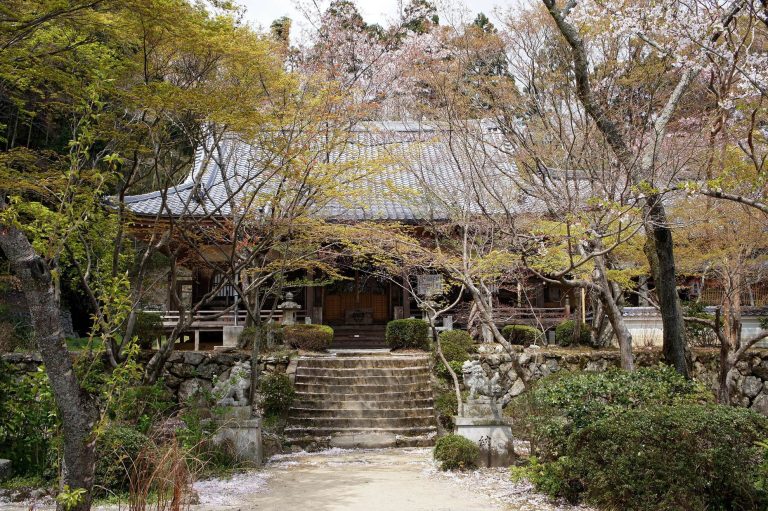
The precinct occupies the Ōharano area at the foot of Mount Oshio, one of the western mountains bordering the Kyoto Basin. Its buildings and features are arranged around the principal sanctuary group, associated corridors, gates, ritual spaces, ponds, springs, and auxiliary shrines. The main sanctuary group follows the Kasuga pattern, while the surviving buildings show later rebuilding and repair within that tradition.
Main sanctuaries
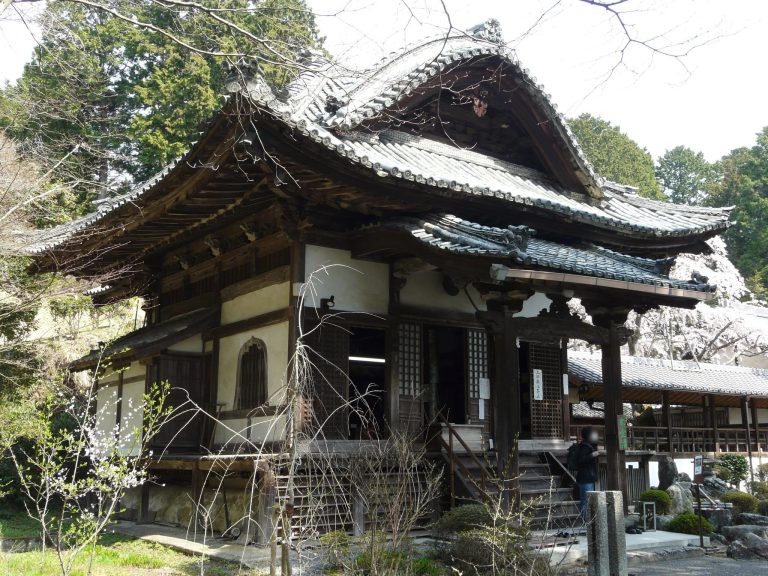
The main sanctuary consists of four separate one-bay buildings arranged in a row, following the arrangement at Kasuga Taisha. Each is built in Kasuga-zukuri style. The first sanctuary houses Takemikazuchi, the second Futsunushi, the third Ame-no-Koyane, and the fourth Himegami. All four were rebuilt in 1822. Inscriptions dated to that year on their ornamental roof finials indicate that the buildings were either rebuilt or extensively repaired at that time.
Gates and ritual spaces
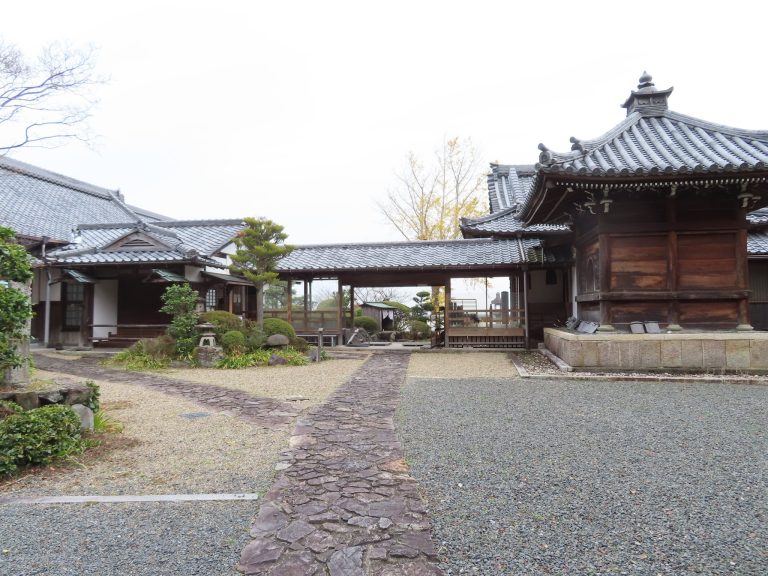
A cloister and a middle gate form part of the central precinct. The middle gate also serves as a place of worship. Other buildings include a storehouse for the portable shrine used in ceremonial processions, a hall for sacred-food offerings, and the shrine office. A sumo ground with a raised ring provides the setting for the shrine’s sacred sumo tradition.
Pond, spring, and landscape features
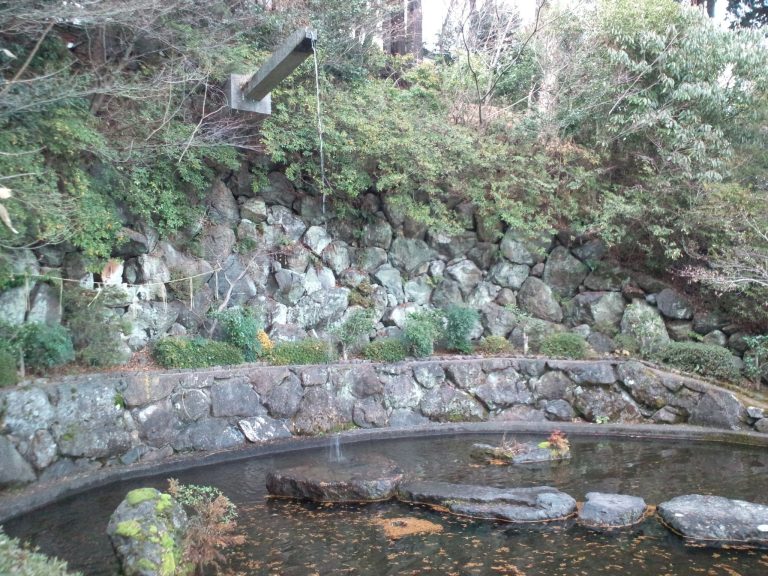
Koisawa Pond is traditionally said to have been created by Emperor Montoku as a reproduction of Sarusawa Pond in Nara. The spring called Segai is traditionally regarded as the source of water used for Emperor Seiwa’s birth bath. A cherry tree on the grounds blooms for only a few days and is consequently known as the phantom cherry.
Wakamiya Shrine
Wakamiya Shrine is a one-bay building with a cypress-bark roof in Kasuga-zukuri style. It is the oldest building in the precinct and stands east of Koisawa Pond, facing west. A ridge tag found during repairs in 2013, together with the building’s architectural style, placed its construction as early as 1701. The building remains well preserved.
Auxiliary shrines
An outlying auxiliary shrine dedicated to Emperor Nintoku was rebuilt in March 2017 with a former shrine building transferred after the 2013 rebuilding cycle at Ise Grand Shrine. Other auxiliary shrines within the precinct are dedicated to the deities or institutions of Yasaka, Inari, Hachiman, purification, and the local tutelary deity. The Hachiman shrine also houses the deities of Shirahige and Fujimori in a shared sanctuary.