Sanko-ji Temple: Head Temple of the Nishiyama Pure Land School in Kyoto


Site at a Glance
- Rating
- 4.2
- Popularity
- Very Low
- Country
- Japan
- Primary era
- Medieval
- External website
- Open
- Eras represented
- Medieval
- Civilizations
- Unclassified
- Site type
- Religious
- Remains
- Monastery
On this page9 sections
History
Sanko-ji Temple is a Pure Land Buddhist temple in Kyoto, Japan, and the head temple of the Nishiyama school, a branch centered on devotion to Amida Buddha. It stands on the mid-slope of Kamoseyama, beside Yoshimine-dera, and traces its traditional beginnings to 1074, when the monk Gensan established a mountain hermitage for his retirement.
From hermitage to Nishiyama center
The original retreat was called Kitao Ojo-in. Its early succession included Kansei Hōkyō as the second patriarch, Jichin, also known as Jien, as the third, and Shōkū as the fourth. Shōkū was a disciple of Hōnen, the founder of Japan’s Pure Land movement, which emphasized devotion to Amida Buddha.
In 1213, Shōkū inherited the religious tradition and developed the temple into a center of the Nishiyama branch. At that time, the institution was renamed Sanko-ji. The earlier name, Ojo-in, was considered unsuitable for prayers seeking protection for the state and long life for the imperial lineage. The new name referred to the three peaks of Kamojidake behind the temple, whose form was believed to resemble a Buddhist three-pronged vajra, a ritual implement associated with spiritual power and protection.
Emperor Go-Saga designated Sanko-ji as an imperial prayer site. The temple also functioned as a center for continuous nenbutsu, the devotional recitation of Amida Buddha’s name. Shōkū died at Kengō-in in 1247 and was buried at Sanko-ji.
Memorial foundation and later traditions
During the Kenchō era, from 1249 to 1256, Renshō, the religious name of the warrior and patron Utsunomiya Yoritsuna, built a tahōtō pagoda for Shōkū. A tahōtō is a Buddhist pagoda with a lower square section and an upper cylindrical section. The memorial complex was named Kannen Sanmai-in Katai Mausoleum.
From 1335, Sanko-ji remained a Nishiyama Pure Land temple while also becoming a place for the study and practice of Tendai, Shingon, Ritsu, and Pure Land Buddhism. Its buildings fell into ruin during the Ōnin War, a fifteenth-century civil conflict that caused widespread destruction in Kyoto, but the temple was later restored. In the middle of the Edo period, the precinct was moved to its present position on the mountain opposite, across the valley to the east.
In 1951, Sanko-ji separated from Nishiyama Jōdo-shū and became the head temple of an independent Nishiyama school. It is also associated with the Kyoto Rakusai Kannon pilgrimage as its fifth station and with the Nishiyama National Teacher Historic Sites Pilgrimage as its twelfth.
Remains
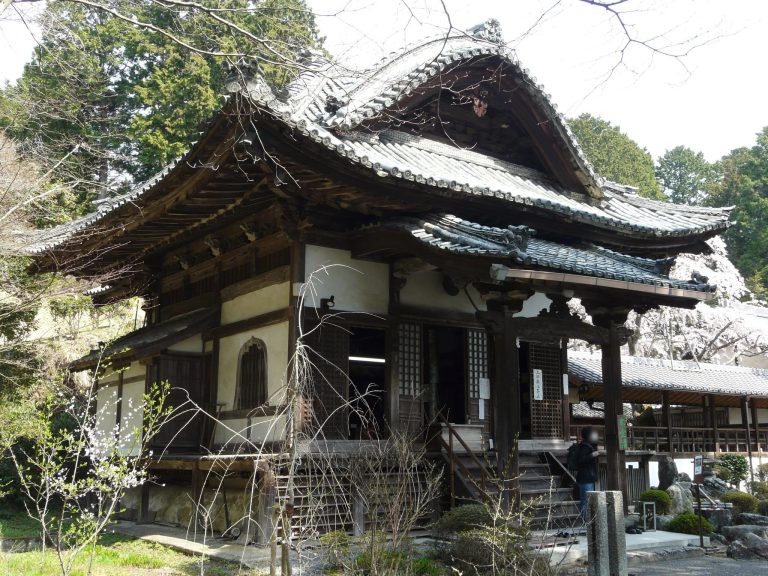
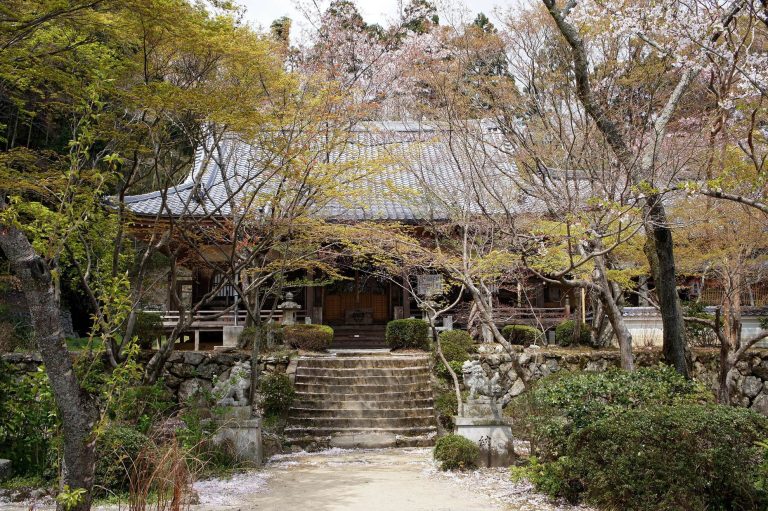
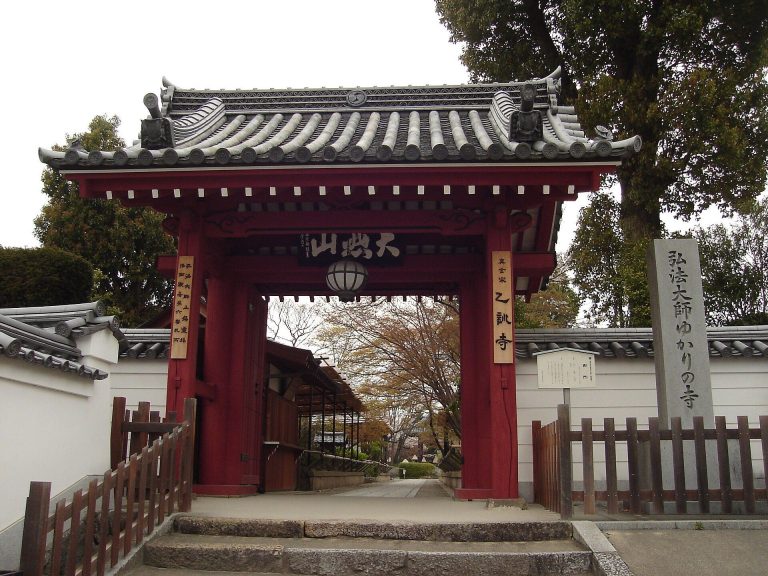
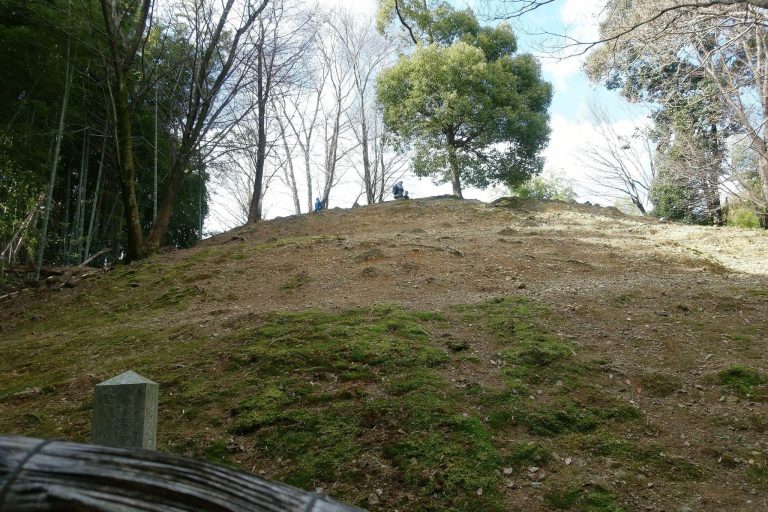
The present precinct occupies the mid-slope of Kamoseyama, with Yoshimine-dera adjoining its southern side. Its principal buildings include the main hall, the connected Katai Mausoleum, monks’ quarters, a guest hall or study, and a temple gate. Behind the temple, the three peaks of Kamojidake provide the landscape feature associated with the name Sanko-ji.
Principal worship buildings
Main hall
The main hall enshrines the Nyoho Butsugan Mandala as the temple’s principal image. The mandala is deposited with the Nara National Museum, while a golden statue of Fudō Myōō serves as the principal front image in the hall. Fudō Myōō is a Buddhist wisdom deity traditionally represented as an immovable protector, and other Buddhist images are also enshrined there.
Eleven-Faced Kannon
To the right of the central image stands an Eleven-Faced Kannon, a form of Kannon, the bodhisattva associated with compassion. The image is traditionally attributed to Shōkū and serves as the principal image of the Kyoto Rakusai Kannon pilgrimage.
Katai Mausoleum
Connected to the main hall, the Katai Mausoleum functions as Shōkū’s memorial hall. A wooden statue of Shōkū is enshrined inside, and the statue’s pedestal houses a gorintō, a five-ringed Buddhist funerary monument representing the elements, which serves as Shōkū’s gravestone.
Supporting buildings and mountain setting
The precinct also contains monks’ quarters, a guest hall or study, and a temple gate. The guest hall is noted for its view over Kyoto city. The three peaks of Kamojidake rise behind the temple and are associated with the three-pronged vajra shape that inspired the temple’s name.