Atsuta Jingū: A Shinto Shrine and Custodian of Kusanagi


Site at a Glance
- Rating
- 4.5
- Popularity
- Very High
- Country
- Japan
- Primary era
- Modern
- External website
- Open
- Eras represented
- Early Modern, Modern
- Civilizations
- Japanese
- Site type
- Religious
- Remains
- Sanctuary
On this page21 sections
History
Atsuta Jingū is a Shinto shrine in Japan, located in Nagoya, and is traditionally associated with Kusanagi no Tsurugi, the sacred sword among the Three Imperial Regalia. Shinto is Japan’s indigenous religious tradition, centered on reverence for kami, sacred presences associated with deities, ancestors, natural phenomena, and important places. The sword’s enshrinement is traditionally dated to AD 113, although other traditions give different dates, while the shrine itself is variously assigned to the first year of Emperor Chūai’s reign or to AD 646. Atsuta was revered from ancient times and later became known as one of the great protector shrines of Japan, after Ise Jingū and Iwashimizu Hachimangū.
Foundation traditions and the sacred sword
The shrine’s principal deity is Atsuta no Ōkami, understood by the shrine as Amaterasu Ōmikami manifest through Kusanagi no Tsurugi. Amaterasu is the solar kami traditionally regarded as the ancestor of Japan’s imperial institution. The associated deities are Amaterasu, Susanoo, Yamato Takeru, Miyazu-hime, and Takeinadane, all connected with traditions surrounding the sword.
According to the foundation tradition, the legendary prince Yamato Takeru received Kusanagi from Yamato-hime during an eastern expedition. Yamato Takeru is celebrated in tradition for military expeditions in eastern Japan. After his death, his wife Miyazu-hime safeguarded the sword. Through divination, she selected the place where it would be enshrined. A burning maple tree that remained hot after falling into a rice paddy was said to have given the site the name Atsuta.
The sword’s enshrinement and the shrine’s institutional foundation are treated as separate events. Tradition places the sword’s enshrinement in the forty-third year of Emperor Keikō’s reign, equivalent to AD 113, while other traditions give the forty-first or forty-ninth year. The shrine itself is variously dated to the first year of Emperor Chūai’s reign or to AD 646. The precise date and circumstances of the sword’s transfer to the Atsuta site remain unclear in these foundation narratives.
Miyazu-hime’s former residence at Hikami was later commemorated by Hikami Aneko Shrine. One later tradition says that the sword moved from Hikami through an intermediate island shrine to the present Atsuta location in AD 646 after a divine revelation. Another places its return to Atsuta in AD 686. These traditions preserve the memory of the sword’s custody and movement before it became associated with the present shrine.
Kusanagi was reportedly stolen by the Silla monk Dogyō in AD 668 and returned during the reign of Emperor Tenmu. A substitute or associated form of the regalia was also traditionally said to have been lost at the Battle of Dan-no-ura in 1185, although the sacred sword itself was believed to remain protected at Atsuta.
Priestly institutions and medieval importance
The Owari clan traditionally supplied Atsuta’s chief priests. In the late Heian period, the high-priest office passed to Fujiwara no Suenori, a descendant of the Fujiwara clan. Afterward, the Fujiwara-derived Chiaki family held the chief-priest position, while the Owari family held the deputy office. Fujiwara no Suenori was also the maternal grandfather of Minamoto no Yoritomo through his daughter Yura Gozen.
Atsuta was listed among the major shrines of the Owari region and entered the Engishiki list of major shrines in 907. By the late twelfth century it was classified as Owari Province’s third-ranked shrine, although earlier records may have treated it as a first-ranking or separately privileged institution.
The shrine’s association with Kusanagi gave it political importance during the Northern and Southern Courts period, a civil conflict in the fourteenth century between rival imperial courts. Ashikaga Takauji appointed a rival shrine attendant in 1335 and prayed at Atsuta while advancing toward the capital. The Southern Court attendant Atsuta Masayoshi joined Emperor Go-Daigo at Mount Hiei in 1336 and commanded troops for the Southern Court in 1337. Kitabatake Akiie, a commander of that court, prayed at Atsuta in 1338 before being killed in battle, after which Ashikaga control was consolidated.
Several military leaders made offerings at Atsuta and its affiliated shrines. Minamoto no Yoshitomo reportedly visited Hikami Aneko Shrine while fleeing after the Heiji disturbance in 1160 and offered a sword. Minamoto no Yoritomo offered swords in 1190, 1194, and 1195. Ashikaga Takauji made an offering in 1335, while Ashikaga Yoshimochi and other members of the Ashikaga house contributed during later rebuilding and shrine-transfer ceremonies.
Warrior patronage and the Edo-period center
During the Sengoku period, Oda Nobunaga donated the Nobunaga Wall in 1560 in gratitude for his victory at the Battle of Okehazama. He repaired the shrine in 1571. Toyotomi Hideyoshi repaired it in 1591 and sponsored roof repairs to the main sanctuary in 1593. Tokugawa Ieyasu repaired the shrine in 1600 and rebuilt Hachikengū in 1603. Tokugawa Yoshinao later repaired several shrine structures.
In the Edo period, the settlement of Miya-juku became the forty-third station of the Tōkaidō and the departure point for the Shichiri ferry to Kuwana. This connection supported Atsuta’s position as a major pilgrimage and commercial center.
Modern institutional history and reconstruction
In 1868 the shrine received the title Jingū and changed its official name from Atsuta Shrine to Atsuta Jingū. In 1871 it was classified as a Kanpei-taisha, a shrine in the pre-1946 state-sponsored system that received official imperial offerings. After that system ended, Atsuta became a Beppyo Jinja in 1948, placing it on the Association of Shinto Shrines’ special administrative list.
The buildings and grounds were reorganized and improved before the commemorative celebrations of 1935. Air raids during the Pacific War destroyed or damaged numerous structures. The Kaijō-mon burned on May 17, 1945, and the Chinkō-mon burned on July 29. On August 21, 1945, Army assistance enabled the sacred sword to be transferred to Minashi Shrine in Hida to protect it from possible seizure at the end of the war. It returned to Atsuta Jingū on September 19.
The principal shrine buildings were reconstructed with old timbers obtained from the rebuilding cycle of Ise Jingū, and the work was completed in October 1955. During repairs to the main sanctuary in 2007, the sacred object was moved to a temporary sanctuary and returned in 2009. The shrine now includes the main shrine, one betsugū, eight sessha, and nineteen massha within the main precinct, as well as four sessha and twelve massha outside it, making forty-five shrines in total including the main shrine. It also houses the Aichi Prefecture Shrine Association and Atsuta Jingū Gakuin, a training institution for Shinto priests.
Ritual continuity
Atsuta Jingū has been the setting for more than seventy annual ceremonies and festivals. Important observances include the sword-return festival in May, a mikoshi procession to the western gate with prayers for the security of the Imperial Palace, the June 5 Atsuta Festival, archery rites, Bugaku court dance and music, and ceremonies associated with rainfall, agricultural fertility, and purification.
The shrine held a festival in 2013 to mark 1,900 years since the traditional enshrinement of the sword. In 2021, a renovated public plaza and the Kusanagi-kan sword treasury opened as part of an imperial accession commemorative program. In 2022, a digital reconstruction of the lost Kaijō-mon was created from drawings, historical photographs, and surviving foundation traces.
Remains
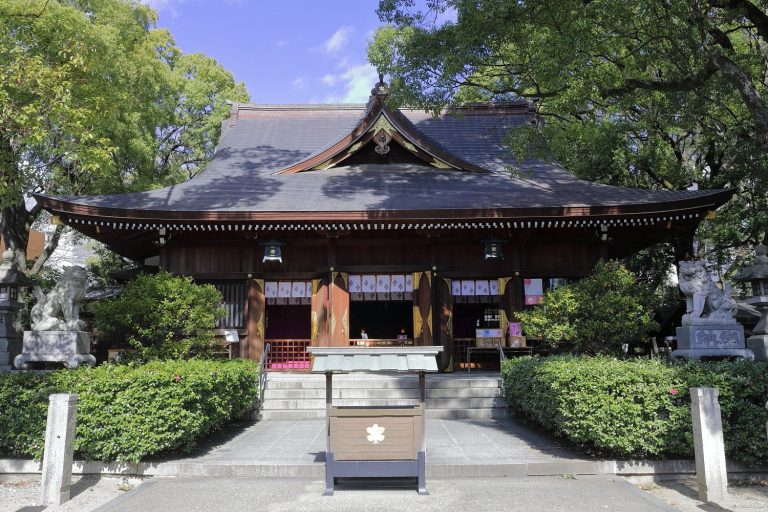
Atsuta Jingū occupies the southern end of the Atsuta Plateau and covers approximately 200,000 square metres. It formerly stood on a cape projecting into Ise Bay near the tidal flat called Ayuchigata, although later land reclamation changed that maritime setting. The present main sanctuary follows the Shinmei-zukuri style associated with Ise Jingū. This style uses a relatively austere raised timber sanctuary, a steep roof, and distinctive projecting roof ornaments. Before the 1893 rebuilding, Atsuta used the regional Owari-zukuri style.
Sanctuary and precinct structures
Main sanctuary
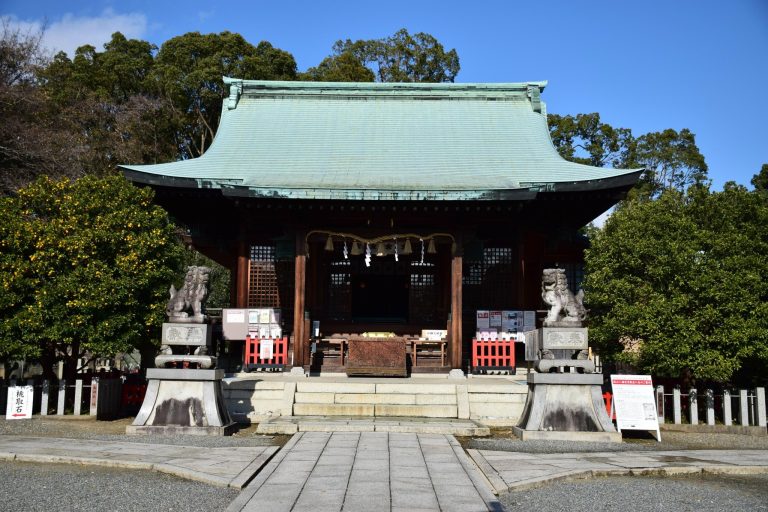
The principal sanctuary enshrines Kusanagi no Tsurugi as the sacred body of Atsuta no Ōkami together with the five associated deities. Earlier traditions placed the sword separately in the Doyōden while the five deities occupied the main sanctuary. After the Doyōden was abolished in 1893, the sword and the five deities were enshrined together in the main sanctuary. The present buildings were rearranged and rebuilt after wartime destruction, using old timbers from the rebuilding cycle of Ise Jingū.
Precinct buildings and water features
The grounds contain the Kaguraden, Saikan, Chokushikan, Cultural Hall and Treasure Hall, Ryūeikaku, West Music Office, Seisetsu Gate, Doyōden, Niju-gobanchō Bridge, Sakuma Lantern, and Nobunaga Wall. They also include Magatama Pond and a pond garden modeled on the sacred jewel among the imperial regalia.
Ryūeikaku
Ryūeikaku was built as an imperial resting pavilion for Emperor Meiji and is a nationally registered tangible cultural property. Its surroundings include the Nobunaga Wall and Magatama Pond.
Niju-gobanchō Bridge
Niju-gobanchō Bridge consists of twenty-five stone slabs. Local tradition associates it with the priest and poet Saigyō, who was said to have rested there, and regards it as Nagoya’s oldest stone bridge.
Walls, gates, and lost structures
Nobunaga Wall
The Nobunaga Wall is a roofed mud wall approximately 7.4 metres high. Oda Nobunaga donated it in 1560 after his victory at Okehazama, and it remains a historic structure within the shrine grounds.
Kaijō-mon
Kaijō-mon, also called Kaizō-mon or the Sea Gate, was a wooden gate connected to the Nobunaga Wall. It received National Treasure status in 1920 but burned in the air raid of May 17, 1945. The gate has not been physically reconstructed. In 2022, its appearance was recreated in three-dimensional computer graphics from historical drawings, photographs, and traces of its foundation stones.
Chinkō-mon and Shunkō-mon
Chinkō-mon was a large western wooden gate used during imperial processions. Katō Kiyomasa dedicated it, and it burned on July 29, 1945. A simple wooden torii replaced it. Shunkō-mon was another former gate associated with a local tradition concerning Yang Guifei, the celebrated consort of the Tang emperor Xuanzong.
Collections and archaeological material
Treasure Hall and Kusanagi-kan
The Bunkaden, or Treasure Hall, was completed in 1966 to house relics, manuscripts, documents, sacred garments, furniture, utensils, mirrors, weapons, masks, and other ritual and court-related materials. Its collection contains more than 4,000 objects, including more than 174 designated Important Cultural Properties and a designated National Treasure dagger. The shrine also preserves approximately 450 swords, more than thirty of them designated cultural properties by national or prefectural authorities. The sword collection is displayed in the Kusanagi-kan, while other historical materials are preserved and displayed in the Treasure Hall and associated museum.
Ritual and historical objects
The collections include Bugaku masks and objects connected with court dance, sacred garments and utensils known as koshinpō, historical maps, ritual masks from the Nanboku-chō and Muromachi periods, medieval and early-modern swords, mirrors, ritual bells, drums, horse equipment, Buddhist and Shinto manuscripts, and documents concerning shrine repairs and worship. Koshinpō are sacred garments, furnishings, and utensils offered for the use of enshrined deities.
Shiratori Kofun and associated traditions
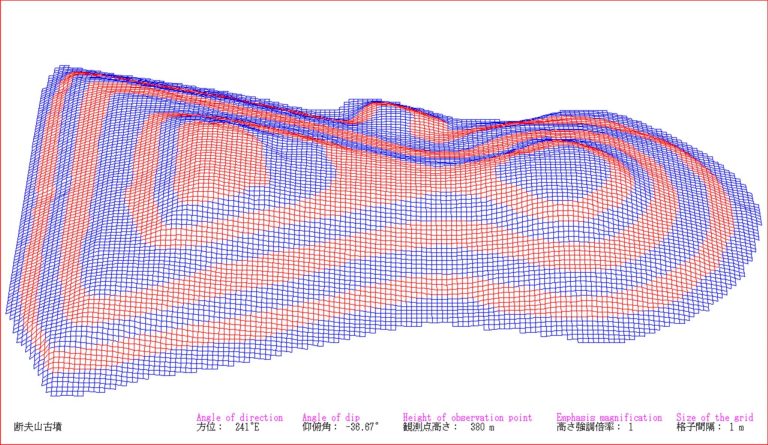
Iron horse equipment recovered from Shiratori Kofun and later offered to the shrine is identified as a Kofun-period archaeological object. Shrine tradition identifies Shiratori Kofun as the tomb of Yamato Takeru and Dantōyama Kofun as the tomb of Miyazu-hime.
Hikami Aneko Shrine
Hikami Aneko Shrine lies outside the main precinct and preserves the memory of Miyazu-hime’s former residence according to shrine tradition. Its worship remains connected with the story of her custody of Kusanagi before the sword’s transfer to Atsuta.