Ogrodzieniec Castle: A Medieval Fortress and Renaissance Residence in Poland

Site at a Glance
- Rating
- 4.7
- Popularity
- Very High
- Country
- Poland
- Primary era
- Medieval
- External website
- Open
- Eras represented
- Medieval, Early Modern
- Civilizations
- Kingdom of Poland
- Site type
- Military
- Remains
- Castle
On this page8 sections
History
Medieval origins
The date of Ogrodzieniec Castle’s earliest fortifications is uncertain, but wooden-and-earth defenses known as “Wolf’s Jaw” probably existed during the reign of Bolesław III Wrymouth, a medieval ruler of Poland. They were probably destroyed during the Mongol-Tatar invasion of Poland in 1241, the year the castle was first mentioned. King Casimir III the Great later ordered a stone castle to be built on the site. Przedbór of Brzezie, who became Marshal of the Kingdom of Poland, administered the project, spent heavily on strengthening the fortress, and eventually received the castle as a lifetime fief, together with financial compensation and the castle of Dobczyce and its lands.
In the late 1380s, King Władysław II Jagiełło transferred Ogrodzieniec, along with Włodowice, Kocurów, and the fortifications at Wesołka, to a Kraków nobleman. The castle soon passed to the Włodek family of the Sulima line, which held it for almost a century. In 1470, the wealthy Kraków burghers Ibram and Piotr Salomon purchased the castle and its adjoining lands. It later came to Jan Feliks Rzeszowski, a canon of Przemyśl and Kraków, who exchanged it in 1492 for Zawiercie and an additional payment, transferring Ogrodzieniec to Jan Pilecki.
From noble estate to Renaissance residence
After Jan Pilecki died in 1496, his son Mikołaj inherited the property. Mounting debts led Mikołaj to pledge the castle to Mikołaj Chełmiński, after which it passed to Jan Boner, a Kraków burgher, banker, and administrator of the salt mines. The Włodek family briefly recovered Ogrodzieniec in 1522, but debt caused them to lose it again the following year.
Severin Boner acquired the castle in 1530 and rebuilt it during the 1530s and 1540s. The work transformed the medieval Gothic fortress into a Renaissance residence known as the “Little Wawel.” Renaissance architecture favored classical forms, ordered façades, and more comfortable residential spaces than the earlier Gothic tradition. After Boner’s four sons died without heirs, his daughter Zofia inherited Ogrodzieniec. Her marriage in 1562 transferred the castle to Jan Firlej, Voivode of Lublin, a high-ranking provincial governor. Firlej continued its development and strengthened the defenses with a bastion, a projecting gun platform, a bulwark, and a dry moat. His son Mikołaj, Voivode of Kraków and a royal envoy, inherited the property in 1574.
War, fire, and abandonment
In 1587, troops led by Archduke Maximilian III of Austria, who contested the Polish succession, captured Ogrodzieniec. The castle suffered little damage during that seizure. More serious destruction followed during the Swedish Deluge, the seventeenth-century Swedish invasion and occupation of much of the Polish-Lithuanian Commonwealth. The castle was plundered and partly destroyed. Stanisław Warszycki, castellan of Kraków, a senior official responsible for a castle or territorial district, became its owner in 1669 and repaired or rebuilt some of the Swedish damage, but the residence never returned to its former condition. Traditions also portray Warszycki as exceptionally cruel, alleging that he murdered a servant and tortured his third wife, Jadwiga.
Around 1695, Ogrodzieniec passed through the female line to the Męciński family. In 1702, a fire caused by the forces of Charles XII, king of Sweden during the early eighteenth-century campaigns in Poland, destroyed more than half of the castle. The complex was not substantially rebuilt afterward. Around 1784, Tomasz Jakliński bought the property from the Męciński family and used parts of its stone walls as building material for a church in nearby Ogrodzieniec. The last inhabitants left the ruined fortress around 1810.
Dismantling, conservation, and later use
Under the subsequent owner Ludwik Kozłowski, the remains became a source of building stone. Walls and other masonry were systematically dismantled, and the stone was sold for local construction. The Wołoczyński family, from a nearby estate, became the final owners before the Second World War after acquiring the castle from Firsza Appel in 1899. After the war, the state nationalized Ogrodzieniec.
Conservation and partial reconstruction took place from 1949 to 1973. The work stabilized surviving walls and towers while preserving Ogrodzieniec as a permanent ruin. In 2001, Andrzej Wajda used the ruins as a filming location for The Revenge. Large sections of scenery built for the production remained at the castle afterward.
Remains
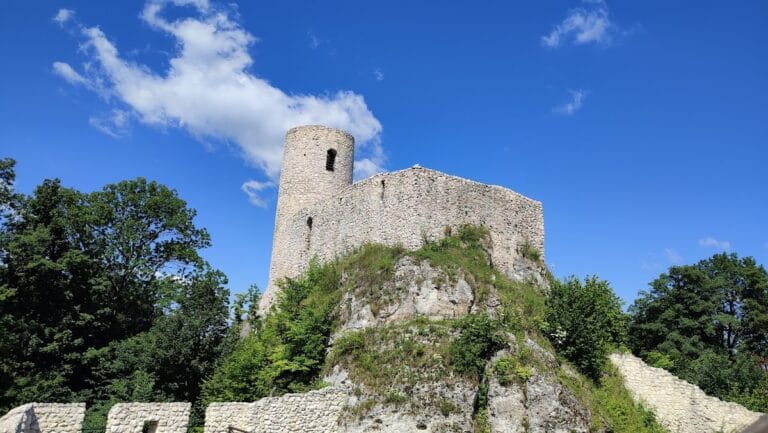
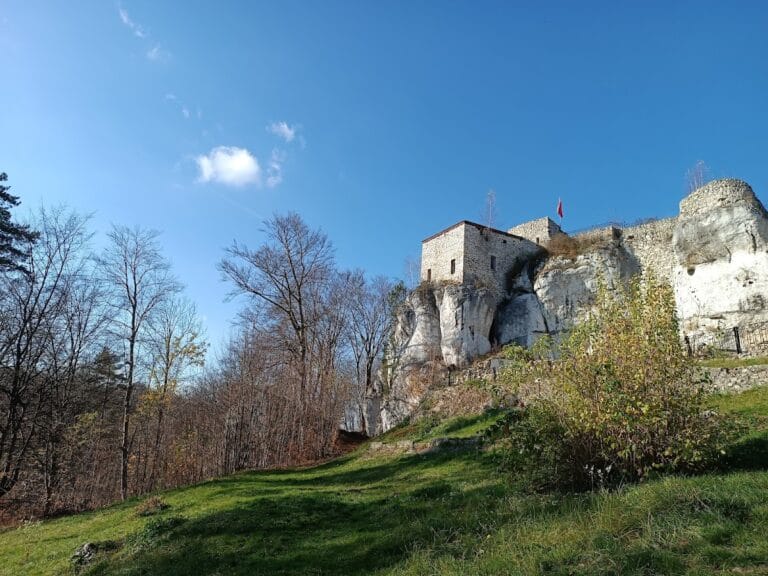
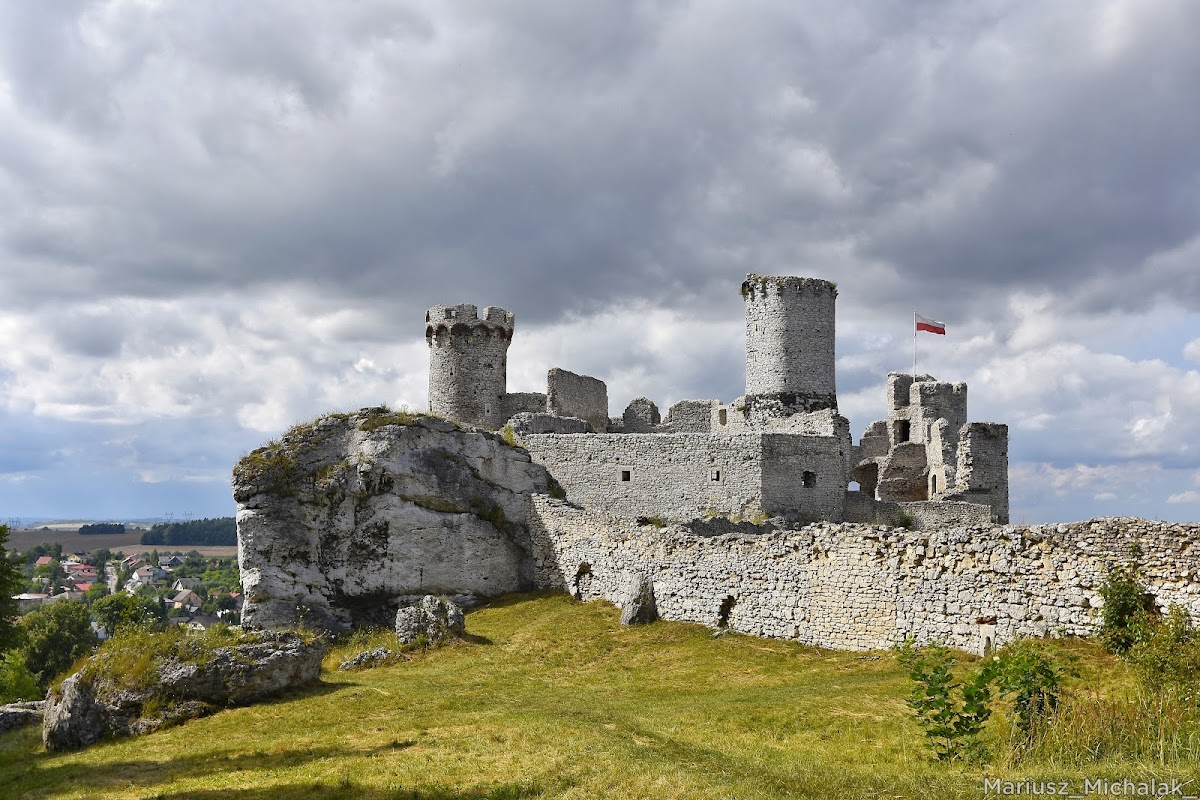
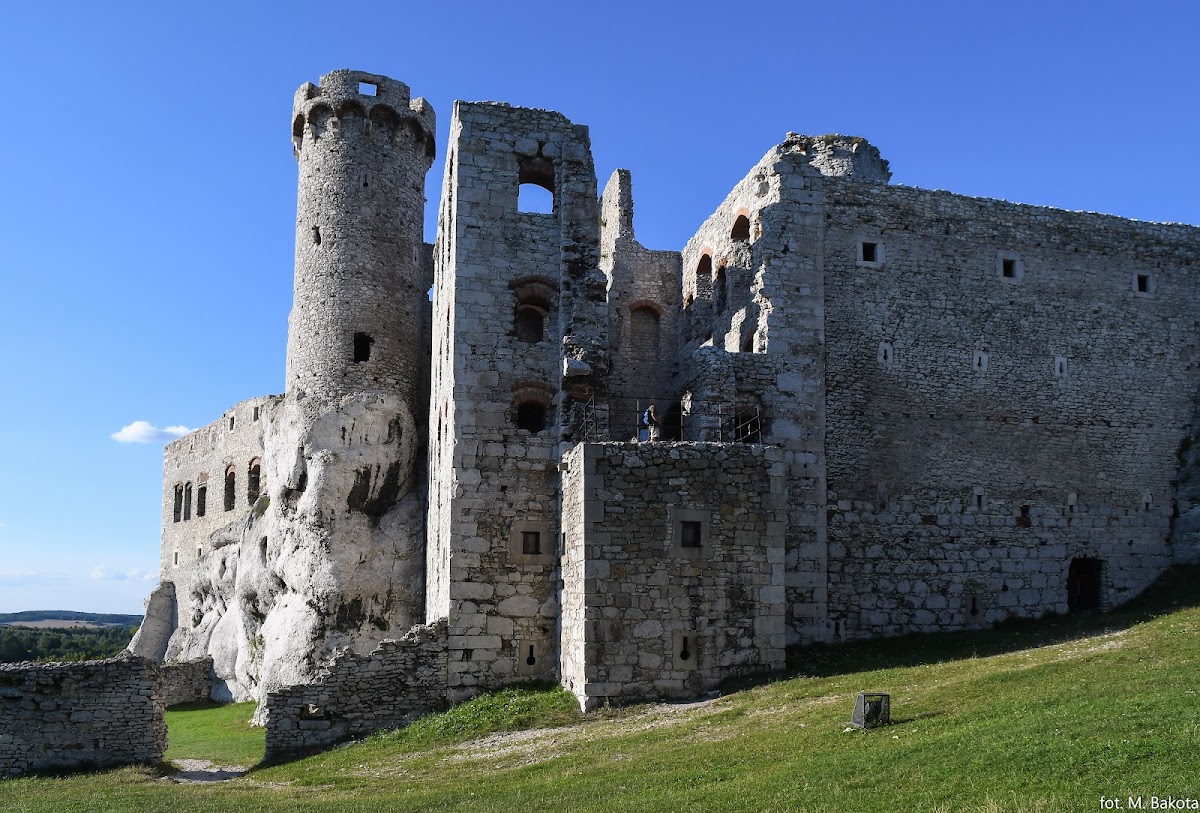
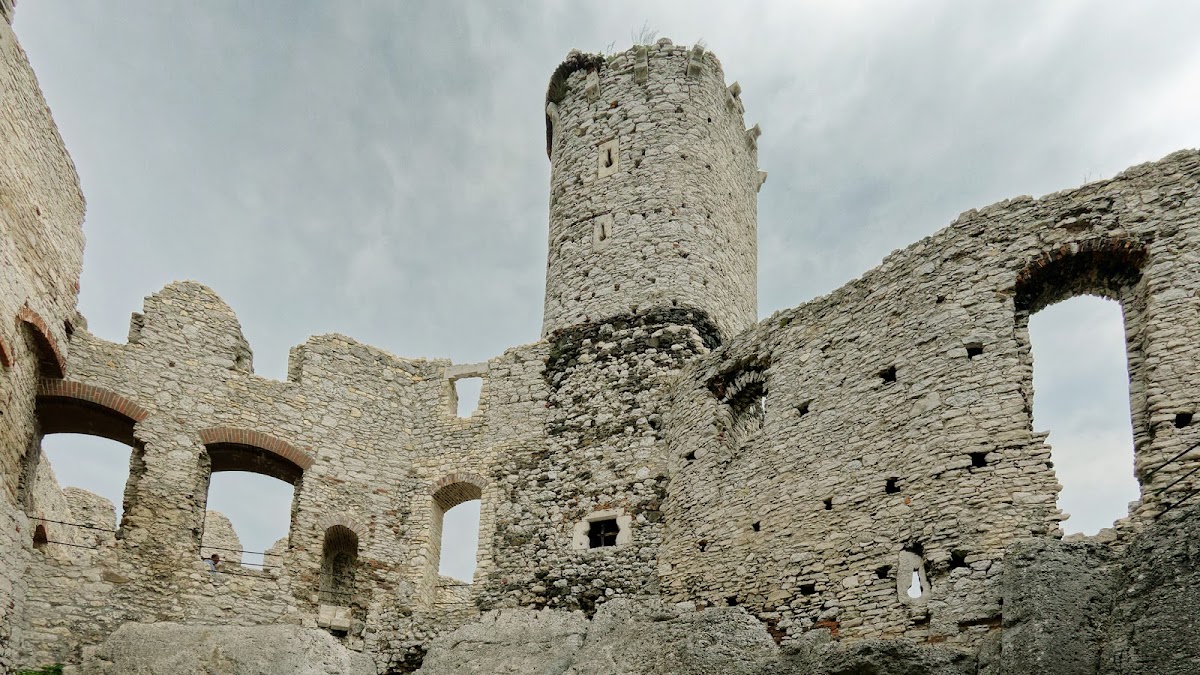
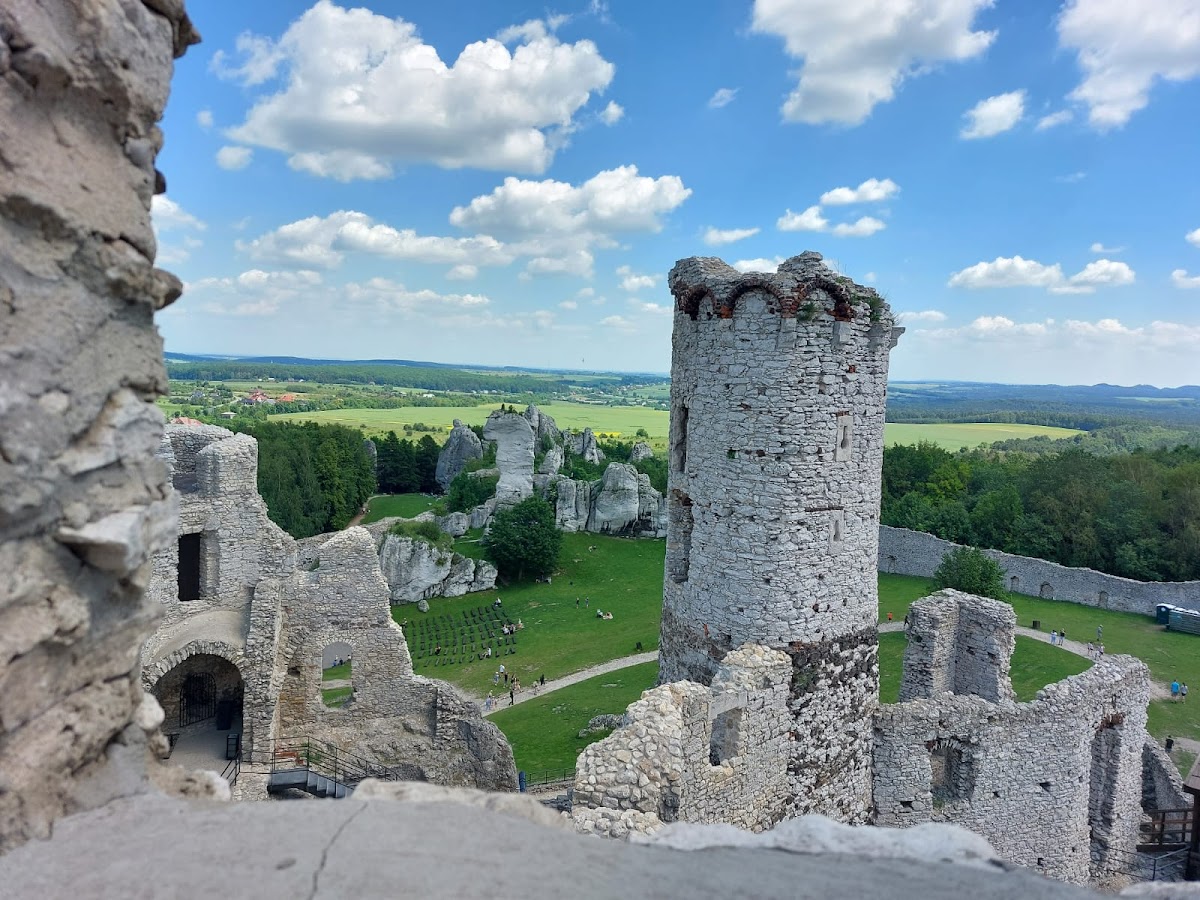
Ogrodzieniec stands on Castle Mountain, at 515.5 meters above sea level, within the rocky landscape of the Kraków-Częstochowa Upland. High cliffs protect three sides of the site, while a stone wall encloses the perimeter. The entrance runs through a narrow gap between the rocks and was defended by powerful towers. A substantial adjoining area was also enclosed by a stone wall, extending the fortified complex beyond the central citadel.
Fortifications and residential complex
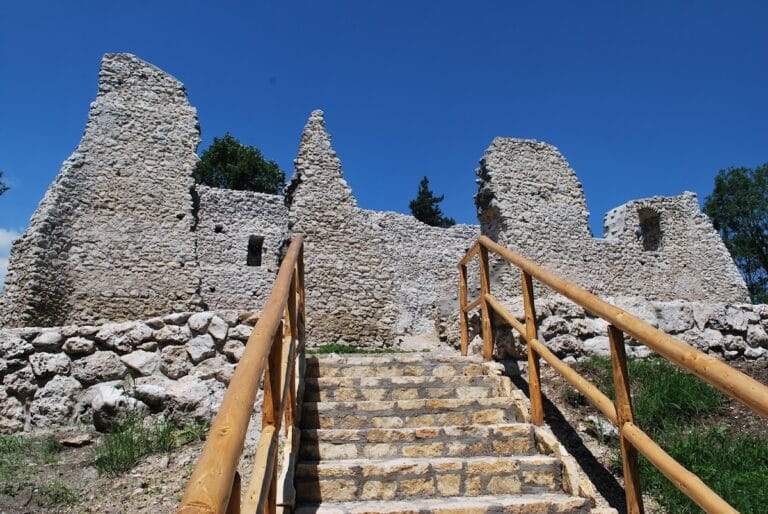
The surviving castle combines the remains of the medieval Gothic fortress with the expanded Renaissance residence. The later rebuilding added a new wing and residential spaces, while the defensive system included a bastion, a bulwark, and a dry moat. Portions of the former residential buildings, towers, perimeter walls, a castle bridge, and the inner courtyard remain. Much of the complex is ruined, although some walls and towers have been partially reconstructed or conserved. Renaissance frescoes showing lilies are still visible on the lowest level of the castle.
Chapel elements at Podzamcze
A chapel on the market square of nearby Podzamcze incorporates architectural elements taken from Ogrodzieniec, including a portal, a curved volute, and a cornice. It also preserves original pieces from the castle chapel once located in the gate tower. These include a vault keystone, a cannonball believed to have entered the castle during the Swedish Deluge, and a Renaissance statue of the Virgin Mary. Local people later repainted the statue in an oil-based folk style, obscuring its original appearance.