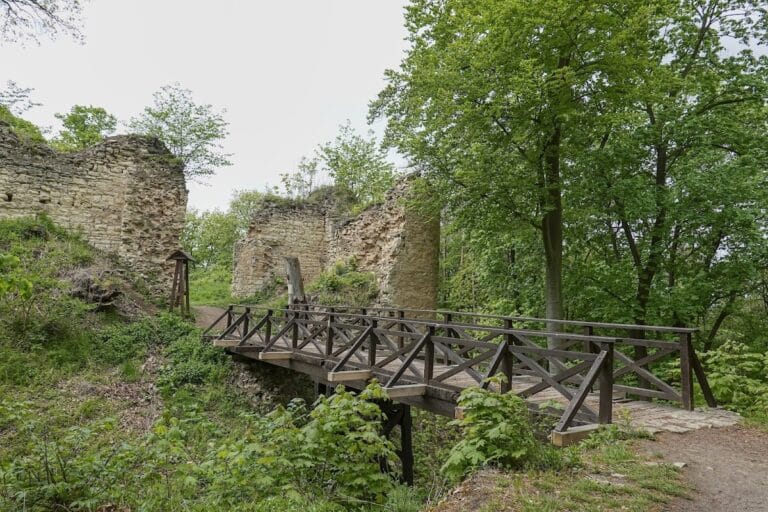
Nový Hrad: A Renaissance and Baroque Château in Czechia


Site at a Glance
- Rating
- 4.6
- Popularity
- Medium
- Country
- Czechia
- Primary era
- Early Modern
- External website
- Open
- Eras represented
- Medieval, Early Modern
- Civilizations
- Holy Roman Empire, Kingdom of Bohemia
- Site type
- Domestic
- Remains
- Castle
On this page15 sections
History
Nový Hrad is a castle later transformed into a Renaissance and Baroque château in Czechia, located on a hill south of Jimlín near Louny. King George of Poděbrady authorized its construction on 2 May 1465 for Albrecht Bezdružický of Kolowrat, and the rough building was completed around 1474, when Albrecht’s family moved there. The new castle was established on an inherited hill near the older fortress of Jimlín, creating the seat of a new Kolowrat family branch.
The Kolowrat Foundation
Albrecht abandoned the name Bezdružický and adopted the designation Novohradský, giving rise to the Novohradský line of the Kolowrats. The family already held estates in the region and had founded the Premonstratensian monastery at Dolní Ročov, which became their family burial place. They also created numerous fishponds around Jimlín.
Family disputes among Albrecht’s descendants resulted in the first known description of Nový Hrad in 1511. In 1552 the estate came under one owner again, Jan Novohradský of Kolowrat, and then included twelve villages. Although the Novohradský branch survived until 1802, Nový Hrad itself passed from the family before the end of the sixteenth century.
Renaissance Rebuilding and Confiscation
Volf Novohradský of Kolowrat sold the estate to the related Lobkowicz family in 1573. Two years later it passed by exchange to Václav Franěk of Liběchov, who began rebuilding the castle in Renaissance forms. His son Adam sold it to the Vřesovec family in 1588, adding Nový Hrad to their expanding possessions in the region.
Volf Vřesovec supported the Bohemian Estates’ uprising, a rebellion by Bohemian nobles against the Habsburg monarchy, and his property was confiscated. The estate was later acquired by his Catholic relative Volf Ilburk of Vřesovec. During the Thirty Years’ War, a prolonged European conflict that also brought repeated military movement through Bohemia, the château suffered from passing troops. Imperial soldiers attacked it in 1623, forcing Volf Ilburk to escape through a window into the moat and flee on foot to Louny. Troops plundered the estate again in 1647, while insurgent subjects had done so in 1639. These events impoverished the demesne and damaged the château.
Strahov and the Hohenzollerns
Count Jan of Aldringen, an imperial general who accumulated wealth during the war, bought Nový Hrad in 1630. After his death in 1634, his testament separated the estate from most of his inheritance and assigned it to the Premonstratensian monastery at Strahov in Prague. The bequest required the monastery to pay 40,000 florins to four other monasteries in Vienna and Luxembourg.
The Strahov Premonstratensians carried out building work after the war and adapted the castle to accommodate religious members who had fled Prague during a plague epidemic. The financial burden created by the bequest and the rebuilding eventually led to a sale. In 1651 the monastery sold Nový Hrad for 50,000 florins to Prince Christian William of Hohenzollern, a member of the family of the Brandenburg margraves. His marriage to Barbara Eusebia of Martinic, whose maternal ancestry included the Novohradský Kolowrats, helped connect the estate with this foreign ruling family.
Christian William repaired the château and lived there permanently. His heir Friedrich Wilhelm continued the work after 1665. In 1670 Count Gustav Adolf of Varrensbach bought Nový Hrad from Christian William’s heirs for 50,000 florins, intending to make it a representative residence.
Baroque Transformation
Varrensbach began a major Baroque rebuilding campaign in the 1670s. The work unified the exterior façades, enriched the interiors, and completed the Chapel of Saint Joseph, whose construction had been started by the Strahov Premonstratensians. The possible participation of A. della Porta and F. Caratti remains unconfirmed.
After Varrensbach’s death, the estate passed to his stepdaughter Anna Marie von Waldburg-Zeil, who was married to Count Jan Volkart of Concin. Alterations made under Anna Marie of Concin at the turn of the eighteenth century included the last richly decorated boarded ceilings in several château rooms.
Anna Barbora Tondeur, married von Löwenegg, purchased Nový Hrad in 1715. During her ownership the château became a major social center, but imperial intervention in 1734 ended the gatherings connected with her improper contacts with the Michna brothers of Vacínov. The estate then entered guardianship for the underage Leopold of Löwenegg.
Schwarzenberg Estate and Economic Use
In 1767 Marie Josefa of Löwenegg, Leopold’s widow, sold Nový Hrad for 280,000 florins to Prince Joseph of Schwarzenberg. The Schwarzenbergs repaired the château after damage from the Seven Years’ War, an eighteenth-century conflict involving the major European powers. From that time the complex ceased to function mainly as a manorial residence and increasingly served economic and administrative purposes.
The family later favored its residence at Postoloprty for occasional stays in northern Bohemia, and furnishings from Nový Hrad were transferred there. The château was progressively adapted for agricultural use, although estate administration remained on the site until 1879, when the estate was merged administratively with Postoloprty. During the nineteenth and early twentieth centuries, the complex primarily supported the economic needs of the demesne.
From 1813 to 1816, during the Napoleonic Wars, Nový Hrad housed a military hospital for soldiers wounded in the battles of Chlumec and Leipzig. The hospital use damaged the building. A local pheasantry garden was abolished in the 1820s, and an imperial-royal cavalry unit occupied the château from 1851 to 1870. After the cavalry left, deterioration was so advanced that estate administration moved to Postoloprty, leaving Nový Hrad as an agricultural yard.
State Ownership and Restoration
Land reform during the First Czechoslovak Republic reduced the estate. In 1947 the château passed to the state under the Lex Schwarzenberg, postwar Czechoslovak legislation used to transfer Schwarzenberg property to state ownership. An agricultural cooperative, a state-socialist farming institution, used part of the complex from 1953, and this economic use severely damaged the surviving historic interiors.
A proposed training-center project in the late 1960s and early 1970s was not implemented. Static stabilization was nevertheless carried out on the chapel and south palace, followed by gradual reconstruction under the Regional Museum in Louny. The district administration of Louny acquired the château in 1994. After that administration was dissolved, legal responsibility passed to the Ústecký kraj in 2001.
Restoration continued under regional and museum administration. The east wing was repaired and restored in 2006 and 2007, and an exhibition of agricultural and household equipment was installed in the château. Since 1 January 2012, Nový Hrad has been a contributory organization administered by the Ústecký kraj. The complex has been protected as a cultural monument since 1964, while reconstruction continues, including work on the surfaces of paths in its three courtyards.
Remains
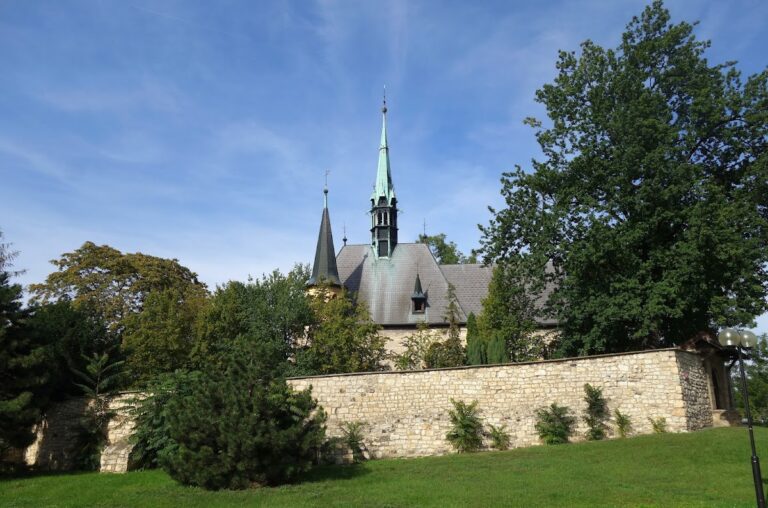
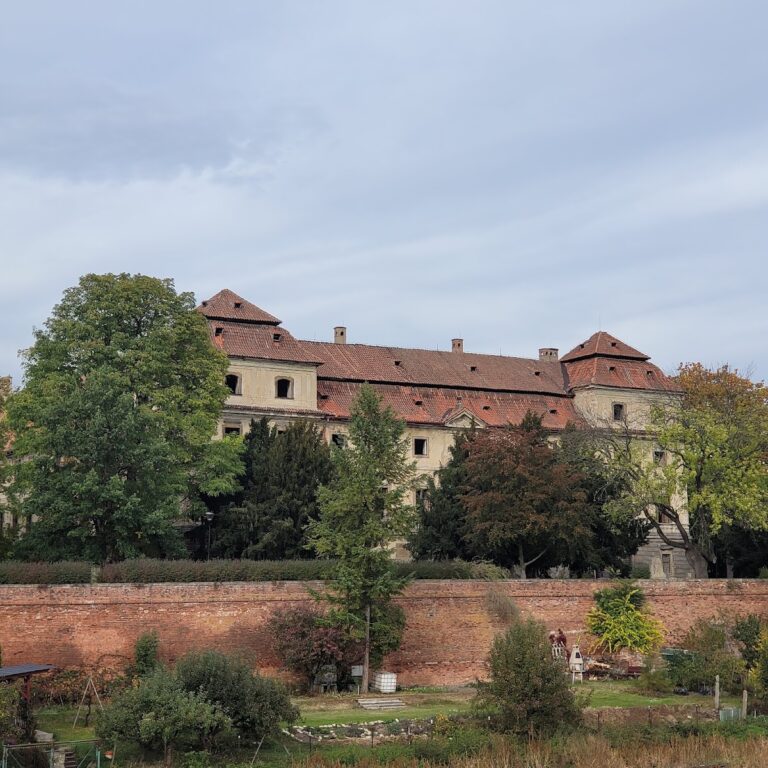
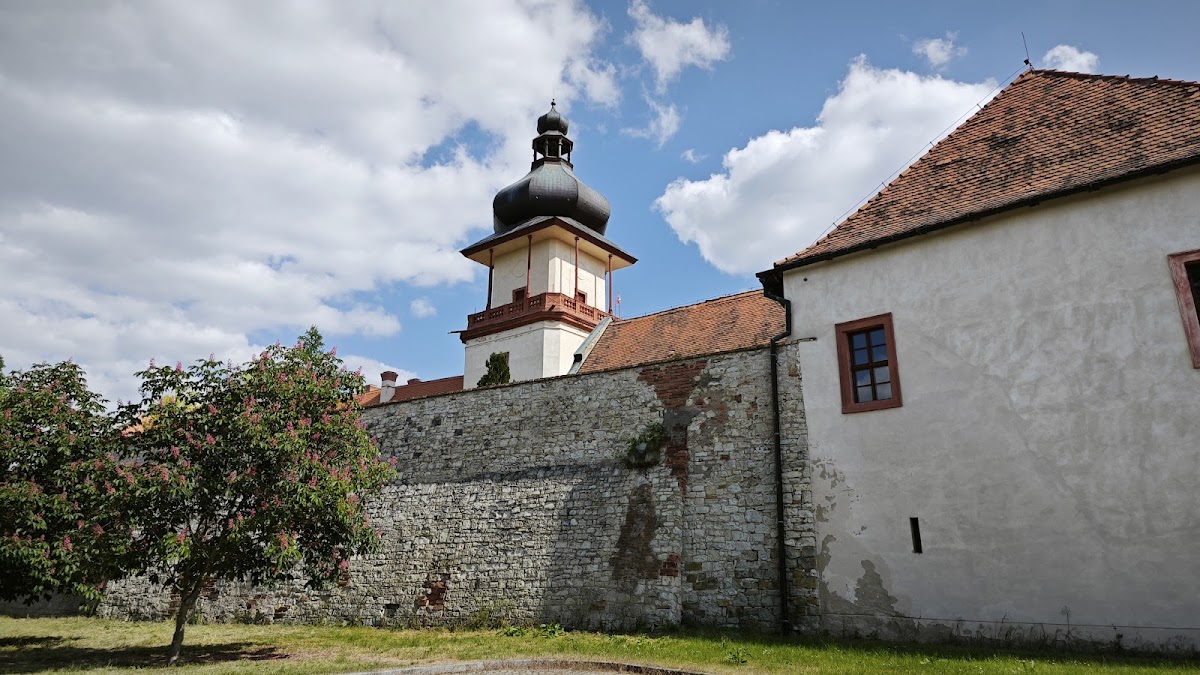
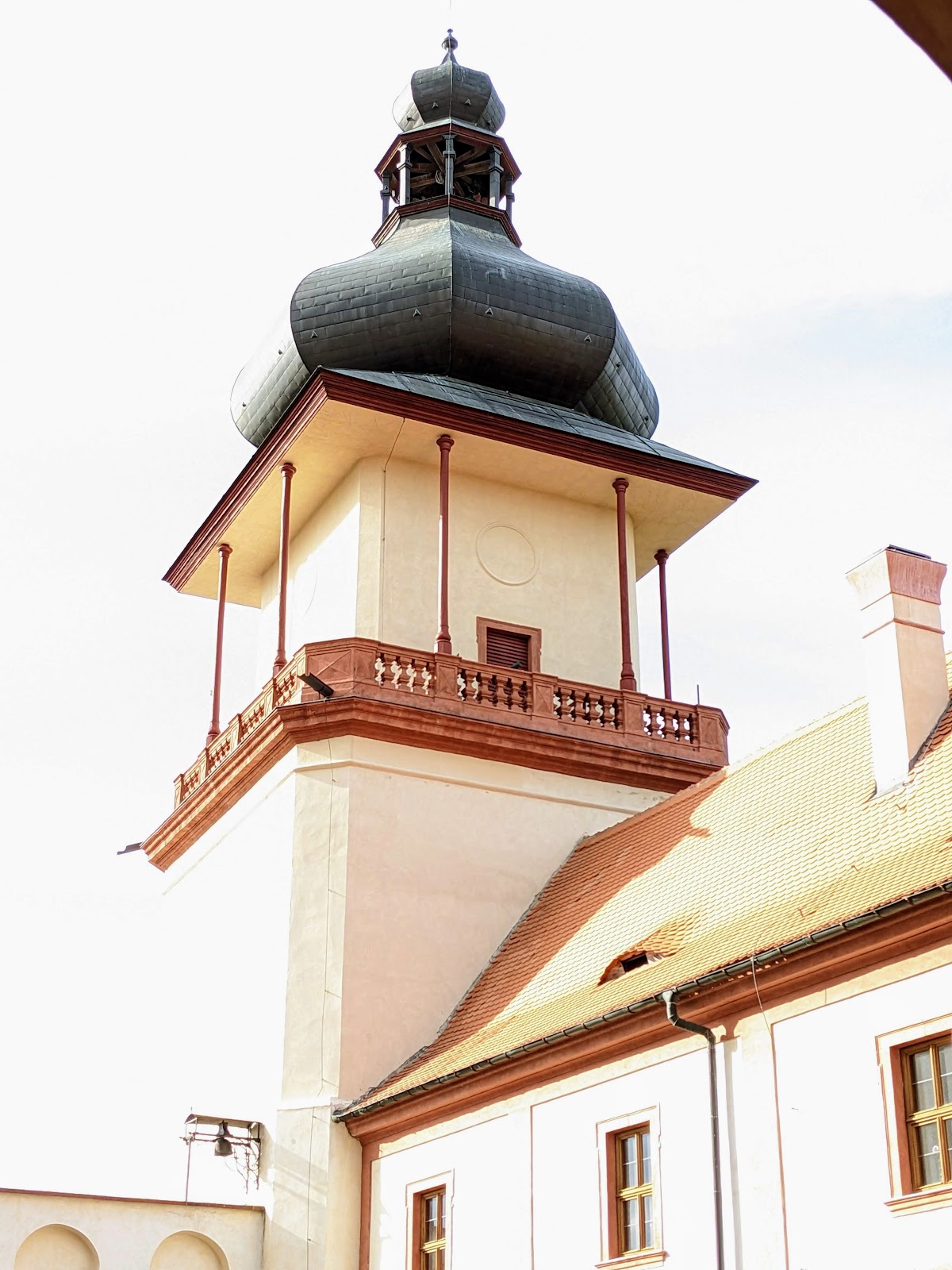
Nový Hrad occupies a raised site between Jimlín and Zeměchy, about six kilometres southwest of Louny, on a hill opposite a bend in the Hasina stream. Its elevated position and tall tower make it a prominent landmark. Residential and service buildings form an extensive complex around three courtyards, while the ground plan remains essentially that of the fifteenth-century castle despite later Renaissance and Baroque changes.
Medieval Castle Core
Fortifications and Entrance
The earliest surviving parts are concentrated on the northern and eastern sides of the fortified complex. The original approach came from the west through a simple screen-like gate, now blocked. Immediately north of it stands a square tower with chamfered corners. The castle core was defended by an earthen bank with a masonry front wall, and a trapezoidal outer bailey formed the area before the principal defensive side.
Late Gothic Tower and Palaces
The late Gothic tower at the entrance to the third courtyard is the château’s dominant vertical feature. Remains of a palace survive to the right of the tower, while the late Gothic castle palace occupies the eastern side. The original south palace was called the “High Building” in historical records. The eastern wing also had residential functions, whereas the northern wing, rebuilt in the Baroque period, originally contained stables and a chapel.
Chapel and Interior Decoration
Chapel of Saint Joseph
The Chapel of Saint Joseph stands south of the eastern palace and was added in 1681 and 1682. Its plan ends in a polygonal termination. The Strahov Premonstratensians began the work, and Gustav Adolf of Varrensbach’s rebuilding campaign brought it to completion. The chapel later underwent stabilization as part of the broader effort to secure the damaged complex.
Wall Paintings and Ceilings
Wall paintings on the ground floor of the eastern wing date from the end of the fifteenth century and depict a tournament together with swordsmen or wrestlers. A second painting cycle in the ground floor of the eastern wing’s northern section dates from the beginning of the sixteenth century. It may portray the life of Najhart, although that interpretation remains uncertain.
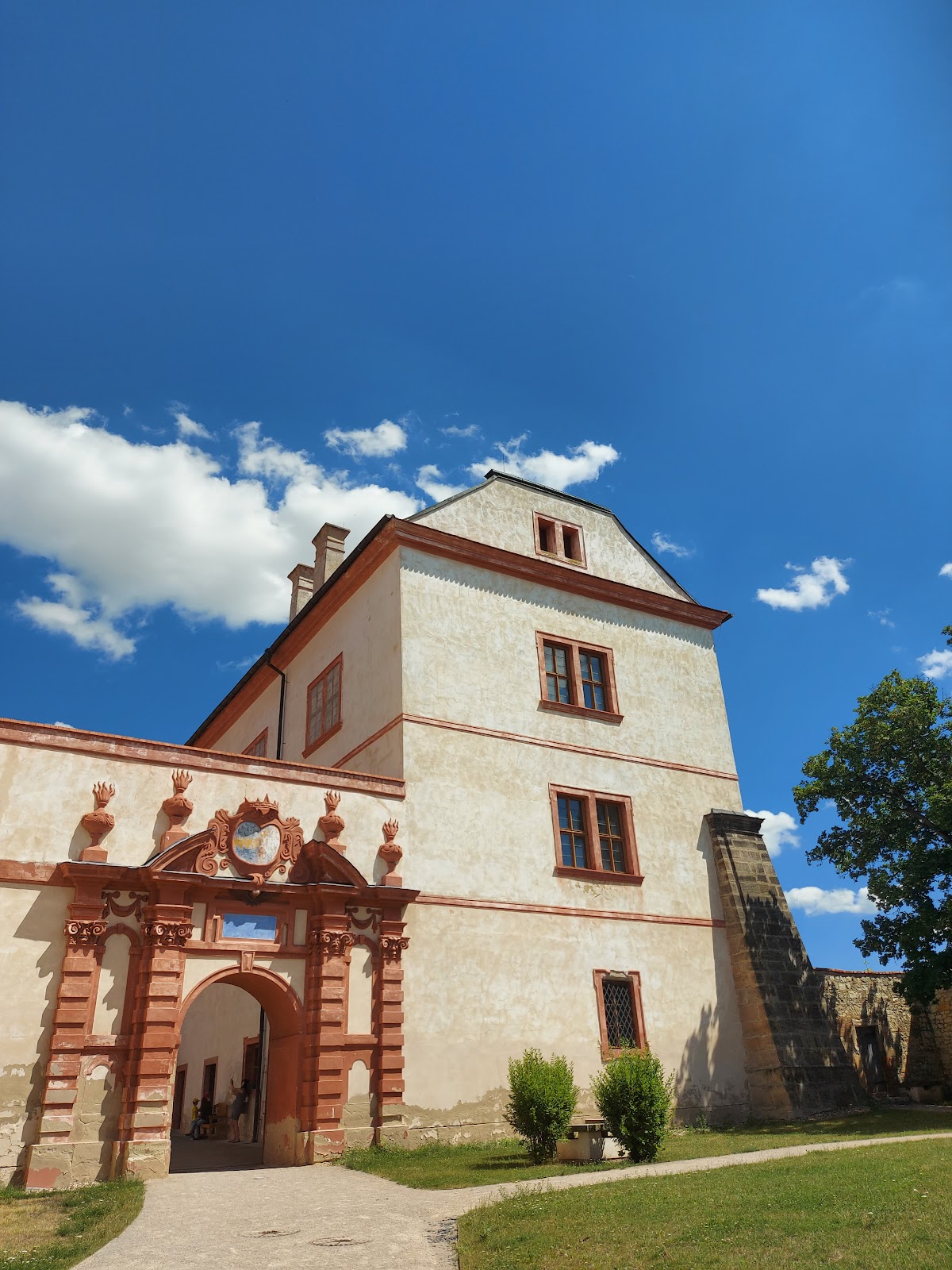
Baroque rebuilding produced unified façades and elaborate stucco decoration in the halls on the first and second floors of the south palace. Several rooms retain richly decorated boarded ceilings from the late seventeenth or early eighteenth century. These include the ceiling in the Knights’ Hall and stucco ceiling decoration in the Varrensbach Salon.
Courtyards, Heraldry, and Service Areas
The gate leading to the third courtyard carries heraldic decoration associated with the Varrensbach and Schlik families. The entrance gate also bears the Schwarzenberg coat of arms, installed after the family acquired the château in 1767. An officials’ house and the garden known as Barbořina Garden form part of the wider complex.
The historic agricultural and administrative role of Nový Hrad is reflected in the later exhibition of economic and household implements. Agricultural use, military hospitalization, neglect, and technically inappropriate repairs badly damaged or altered parts of the château. Stabilization and subsequent restoration have affected the chapel, south palace, east wing, interiors, courtyards, and circulation surfaces.
Nearby sites