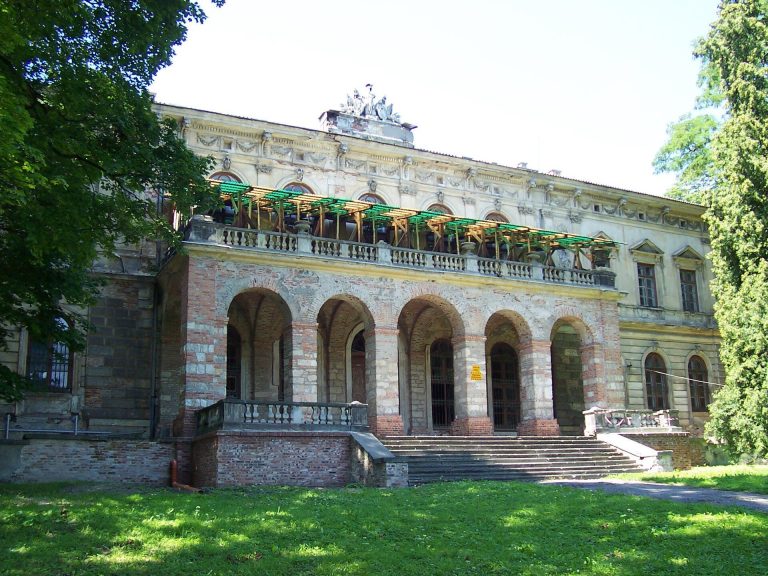
Włodowice Palace: A Ruined Baroque Residence in Poland


Site at a Glance
- Rating
- 4.1
- Popularity
- Low
- Country
- Poland
- Primary era
- Early Modern
- Eras represented
- Early Modern, Modern
- Civilizations
- Polish–Lithuanian Commonwealth
- Site type
- Domestic
- Remains
- Elite Residence
On this page7 sections
History
Włodowice Palace is a ruined Baroque palace in Poland, built between 1669 and 1681 in the Polish Baroque style. It replaced a wooden manor owned by the Firlej family and later became a residence associated with royal journeys, noble ownership, and an agronomic school.
From the Firlej manor to the Baroque palace
The earlier Firlej manor was burned during the Polish–Swedish War of 1655–1660, a conflict that brought fighting between the Polish–Lithuanian Commonwealth and Sweden. Stanisław Warszycki, Castellan of Kraków, a senior administrative and military official in the Commonwealth, then commissioned a masonry palace on the site. Construction began in 1669 and was completed in 1681.
King John III Sobieski stayed at the palace on 26 July 1683 while travelling to Vienna. Sobieski, who ruled Poland and Lithuania from 1674 to 1696, is especially associated with the relief of Vienna during the Ottoman siege later that year.
Eighteenth- and nineteenth-century ownership
During the eighteenth century, Włodowice Palace belonged to the Męciński family, a Polish noble family. They redecorated the interiors in the Classicist style. King Augustus III stayed overnight at the palace on 12 March 1734. Augustus ruled Poland and Lithuania from 1733 to 1763.
In the nineteenth century, ownership passed to the Poleski family, who held the property by the 1850s. Michał Antoni Kazimierz Poleski, a naturalist and participant in the January Uprising, settled at Włodowice around 1870. The January Uprising was a Polish insurrection against the Russian Empire that began in 1863. Poleski established a higher private agronomic school in the palace, and it operated there from 1870 to 1880.
Twentieth-century decline and protection
The final owner was Countess Maria Elwira O’Rourke, a member of a Polish noble family of Irish origin. She probably left Włodowice in 1927 or 1928 and sold the palace to a local family. Fires in 1924 and 1956, the latter lasting six days, followed by many years of neglect, left the palace in ruins.
The palace and its associated outbuilding were entered in the register of immovable monuments in 1967. Their entries were removed on 10 September 1989 and 10 February 2010, respectively, leaving only the remains of the palace park in the register. The palace ruins were entered again on 31 August 2023 under designation A/1254/23. The property is currently owned by the State Treasury.
Remains
The surviving complex consists of the ruined palace, an associated outbuilding, and remains of the palace park. The palace stood behind an entrance courtyard and gate, with a garden extending behind it along the slope of a hill. This arrangement follows the entre cour et jardin plan, in which a building is placed between a front courtyard and a rear garden.
Palace building
Włodowice Palace was constructed from brick and stone. Its original form had two storeys, basements, and an attic beneath a mansard roof, whose two slopes on each side created additional usable space below. Later changes preserved its Baroque character, while rebuilding probably undertaken around the turn of the twentieth century introduced Neo-Gothic features. The building survives as a ruin.
School interiors and associated grounds
When the agronomic school occupied the palace from 1870 to 1880, its second storey contained the school. One chamber served as a chemistry and physics laboratory, another as a library, and the institution held a collection of minerals and specimens of Jurassic flora.
The palace-and-park complex also includes the associated outbuilding and surviving portions of the palace park. The park occupied the garden area behind the palace on the hillside, while the outbuilding formed part of the documented estate complex.