Obere Sachsenburg: A Medieval Spur Castle Ruin in Germany


Site at a Glance
- Rating
- 4.5
- Popularity
- Very Low
- Country
- Germany
- Primary era
- Medieval
- External website
- Open
- Eras represented
- Medieval
- Civilizations
- Holy Roman Empire
- Site type
- Military
- Remains
- Castle
On this page9 sections
History
Origins and medieval development
Obere Sachsenburg is a medieval castle ruin in Germany, located above Sachsenburg in the town and rural municipality of An der Schmücke, Thuringia. Probably built during the second half of the thirteenth century, with a construction period of approximately 1252 to 1310, it secured access to the central Thuringian Basin and reinforced the Lower Sachsenburg, which had been built in the twelfth century.
Archaeological finds point to an earlier Frankish predecessor on the site, dating from the seventh or eighth century. The later castle’s construction is attributed to Count Siegfried of Anhalt, who occupied parts of the Palatinate of Saxony after the death of Heinrich Raspe IV, the last Ludowinger landgrave, during the Thuringian-Hessian War of Succession.
The relationship between the castle and an earlier stronghold called Saxinberg remains uncertain. The Treaty of Weißenfels of 1249 required Saxinberg to be demolished, but it is not clear whether that order was carried out. Obere Sachsenburg was certainly in existence by 1287, when it was successfully defended against Adolf I of Nassau. A document from 1319 clearly distinguished between the Upper and Lower Sachsenburgs.
Changes of ownership
Through the marriage of Dietrich of Hohnstein to Sophia of Anhalt, the castle passed to the Counts of Hohnstein in 1316. Another marriage-related transfer brought it to the Counts of Beichlingen, who owned it from 1335 to 1407.
From 1407, Obere Sachsenburg belonged to the Wettin landgraves of Thuringia and dukes of Saxony. The Wettins were a German ruling dynasty whose members held both territories. Unlike the Lower Sachsenburg, Obere Sachsenburg remained outside the jurisdiction of the Sachsenburg office.
In 1539, Duke George of Saxony granted the castle to the Bendeleben family of Kannawurf. The family occupied the site until the Thirty Years’ War, the European conflict of 1618 to 1648 that caused extensive political, military, and demographic disruption in the German lands. The Bendelebens retained ownership until the family became extinct in 1825.
Abandonment and preservation
The deteriorating castle complex was abandoned around 1640. In 1890, an inn was established in the ruins of the Palas, the principal residential and representative building of a medieval castle. The inn burned out in 1945.
The Sachsenburgenverein was founded on 15 April 1992 to preserve and secure the ruins of Obere and Untere Sachsenburg. Since 2002, both castle ruins have been owned by the Foundation of Thuringian Palaces and Gardens, a public heritage institution responsible for conserving historic monuments in Thuringia.
Remains
Setting and layout
Obere Sachsenburg is a ruined spur castle at approximately 250 metres above sea level. It occupies woodland north of Sachsenburg on the east-southeastern slope of the Hainleite, a wooded ridge in northern Thuringia. The castle stands high above the Thuringian Gate, the geographic passage through which the Unstrut flows, and lies about 450 metres northwest of the Lower Sachsenburg, also known as Hakenburg.
Surviving buildings
Keep
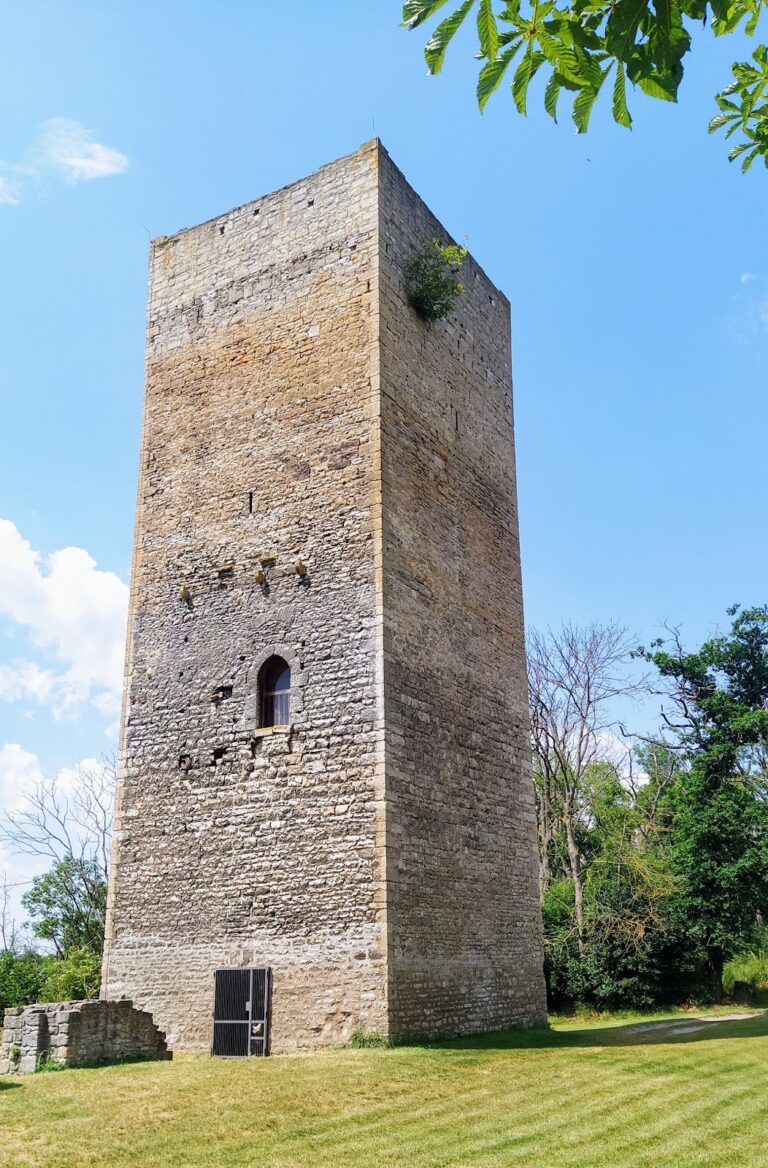
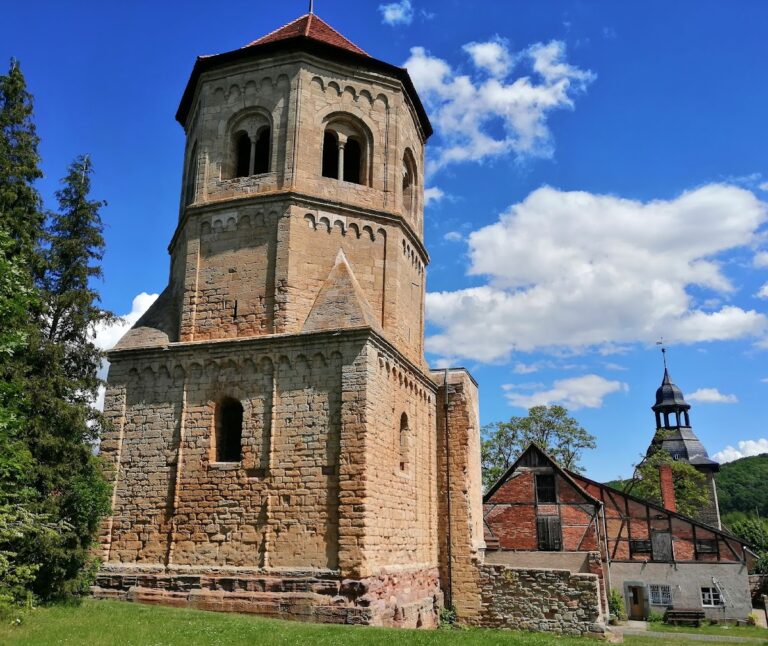
The surviving medieval fabric includes the keep, the castle’s main fortified tower. Such a tower could combine defensive, residential, and symbolic functions. At Obere Sachsenburg, it remains as part of the ruined castle complex.
Palas
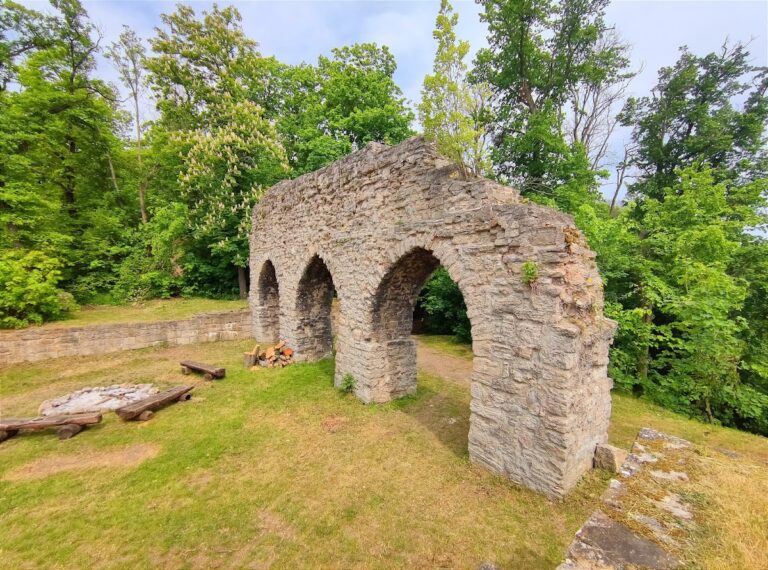
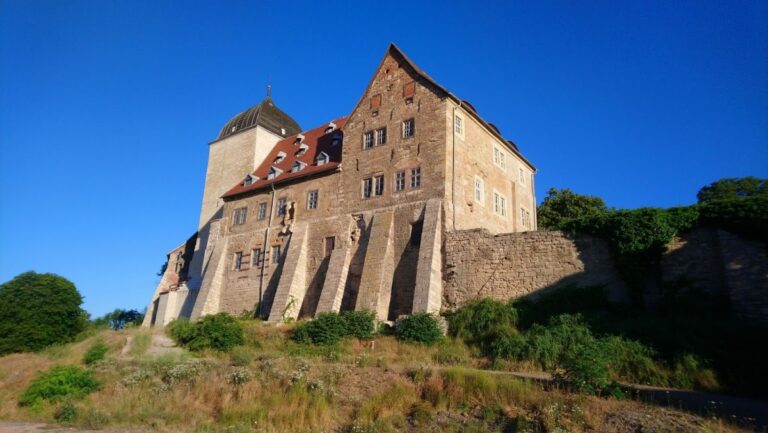
The other principal surviving element is the ruin of the Palas, or main residential hall. It served as the castle’s principal residential and representative building, containing the lord’s living and ceremonial rooms. An inn was installed within its ruins in 1890, and the building burned out in 1945.
Nearby sites