Untere Sachsenburg: A Medieval Hilltop Castle in Germany


Site at a Glance
- Rating
- 4.6
- Popularity
- Low
- Country
- Germany
- Primary era
- Medieval
- External website
- Open
- Eras represented
- Medieval
- Civilizations
- Holy Roman Empire
- Site type
- Military
- Remains
- Castle
On this page10 sections
History
Untere Sachsenburg is a medieval hilltop castle ruin in Germany, generally dated to the period between 1100 and 1200. Also known as Unterburg or Hakenburg, it is the older of the two Sachsenburg castles and secured access into the central Thuringian Basin.
Origins and early lordship
The castle’s exact construction date remains uncertain. A literary tradition claims that a knight of Hake built it around 940, but this claim has no supporting evidence. The Counts of Orlamünde may have been involved in its construction, although they held the lordship only until the middle of the eleventh century. The Landgraves of Thuringia held it by no later than 1180.
The Hagke family of Thuringia may have administered the lordship as ministerials, medieval service nobles who held office for a higher-ranking lord, until the thirteenth century. These changing relationships reflect the castle’s place within the territorial politics of central Germany.
Thirteenth-century conflicts
After Heinrich Raspe, the last male member of the Ludowingian dynasty and its landgrave, died in 1247, Count Siegfried of Anhalt occupied the Palatinate of Saxony. This was a medieval territorial lordship, distinct from the modern state of Saxony. Siegfried probably also captured Untere Sachsenburg and had Obere Sachsenburg built to reinforce his position.
The Margraves of Meissen later prevailed in the conflicts surrounding the two castles. The Treaty of Weißenfels in 1249 required the castle’s demolition, but whether that order was carried out is uncertain. Untere Sachsenburg was successfully defended against Adolf of Nassau in 1287.
Hohnstein, Beichlingen, and Saxon administration
Through the marriage of Dietrich of Hohnstein to Sophia of Anhalt, the castle passed to the Counts of Hohnstein in 1316. A charter from 1319 provides the first explicit distinction between the upper and lower castles. After a feud, the Counts of Hohnstein had to recognize the feudal overlordship of Landgrave Friedrich I of Thuringia.
Another marriage transferred the castle to the Counts of Beichlingen, who held it from 1335 to 1407. From 1407, Untere Sachsenburg belonged to the Landgraves of Thuringia and the Dukes of Saxony. It then served as the seat of the Sachsenburg administrative office, a territorial unit governed by an appointed official.
Abandonment and preservation
In 1815, the administrative seat moved into the village. Untere Sachsenburg consequently lost its administrative importance and was abandoned. Since 2002, the ruins have been owned by the Thuringian Castles and Gardens Foundation.
Remains
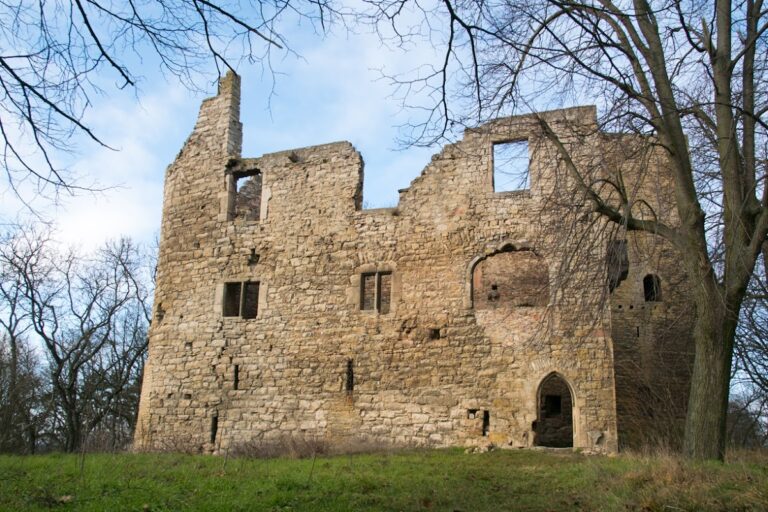
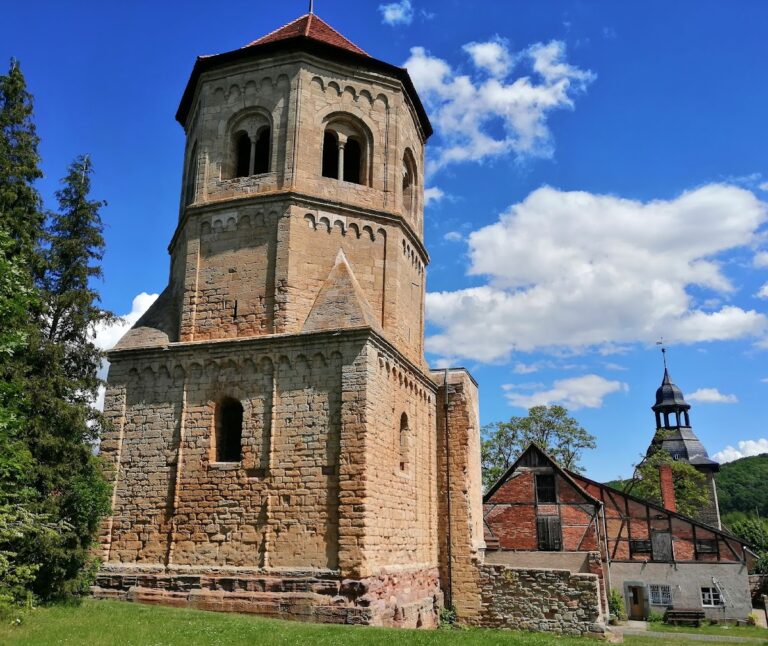
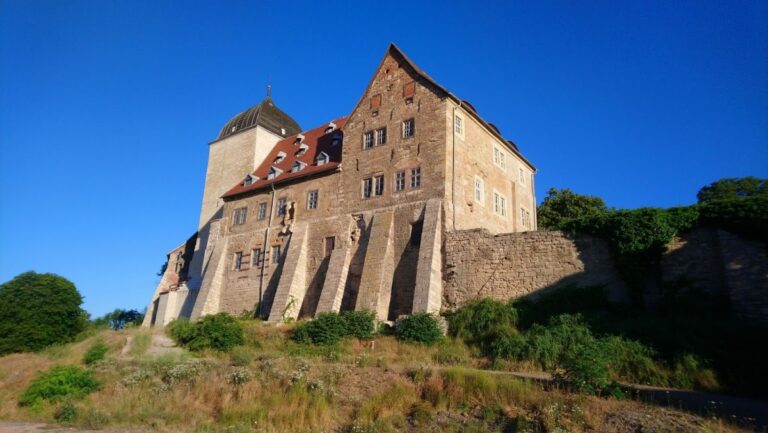
Untere Sachsenburg occupies the summit of the outer southeastern spur of the Hainleite ridge at an elevation of 190 metres above sea level. The wooded ruin lies north of the village of Sachsenburg, slightly above the Thuringian Gate through which the Unstrut flows. It stands approximately 450 metres southeast of Obere Sachsenburg. The surviving layout consists principally of the main defensive tower, sections of the enclosing wall, underground cellars, and remains of a vaulted structure.
Defensive and enclosed structures
Bergfried
The surviving bergfried, the principal defensive tower of a medieval German castle, forms the main element of the ruin. Such a tower served primarily for defense and refuge rather than as the castle’s ordinary residential quarters. At Untere Sachsenburg, the tower survives together with adjoining wall remains.
Enceinte and wall remains
Parts of the enceinte, the main enclosing defensive wall of a fortified site, remain around the castle area. These wall fragments preserve the outline of the fortified summit and are part of the ruin’s surviving defensive fabric.
Subterranean and vaulted remains
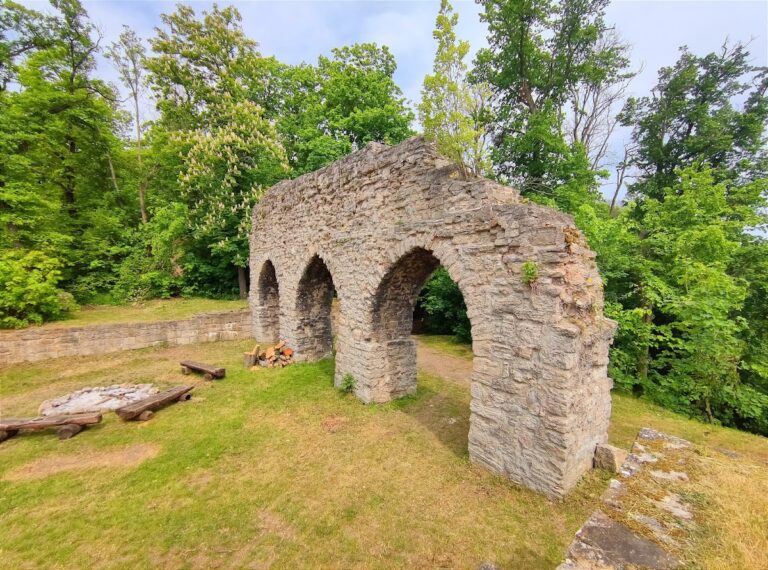
Cellars survive within the castle ruin, along with remains of a vaulted structure. Together with the bergfried and wall fragments, these elements represent the principal surviving physical evidence of the medieval hilltop castle.
Nearby sites