Nyakutakuji: A Shingon Buddhist Temple in Matsumoto, Japan
Site at a Glance
- Popularity
- Medium
- Country
- Japan
- Primary era
- Early Modern
- Eras represented
- Medieval, Early Modern
- Civilizations
- Ashikaga shogunate, Takeda, Tokugawa
- Site type
- Religious
- Remains
- Temple
On this page24 sections
History
Nyakutakuji was a Shingon Buddhist temple in Hata, Matsumoto, Japan, traditionally founded around 750 by the monk Gyōki during the Nara period. It was said to be among the oldest temples in Shinano, the historical province corresponding broadly to present-day Nagano Prefecture.
Origins and religious setting
Tradition places the earliest temple near the mountain summit, at grounds later known as the former temple site. That area is understood as a remnant of mountain worship. A further tradition links the temple’s repair and construction to 806–809, when the imperial general Sakanoue no Tamuramaro directed Buddhist sculptors under his command to work there.
Nyakutakuji belonged to Shingon, a Japanese school of esoteric Buddhism, and was affiliated with Chishaku-in, a Shingon temple in Kyoto. It had four subsidiary temples and served as the 25th station on the Shinano Thirty-three Kannon pilgrimage. Kannon is a bodhisattva associated with compassion, and numbered pilgrimages connect temples devoted to this figure. The temple also belonged to a wider religious landscape shaped by mountain worship, the blending of Buddhist and Shinto practices, and Shugendō, a tradition of ascetic practice centered on mountains. The main complex eventually developed lower down the mountainside, apart from the earlier summit grounds.
Medieval and Edo-period patronage
Military patrons supported the temple during the medieval period, including the sixteenth-century ruler Takeda Katsuyori. In the Edo period, successive Tokugawa shoguns, among them Tokugawa Iemitsu, confirmed Nyakutakuji’s estate allotment of 10 koku, a measure based on rice yield. The temple received eight such confirmations.
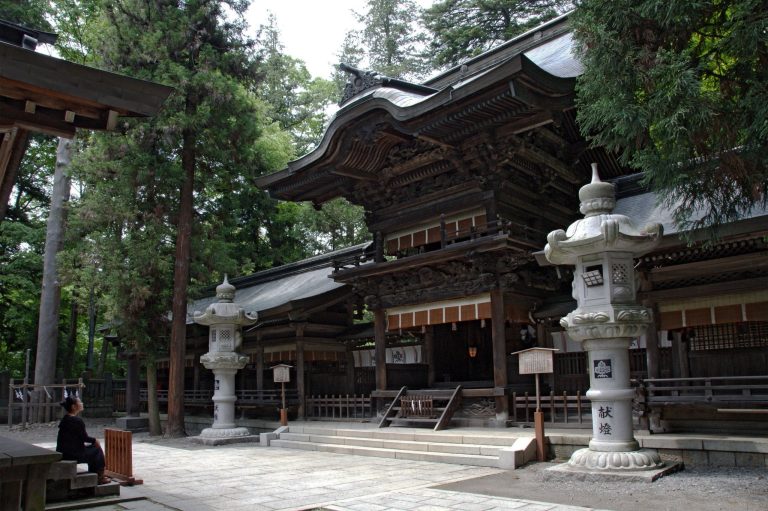
A major rebuilding in 1804 gave Nyakutakuji a grand complex. It attracted writers and other cultural visitors and acquired the honorific “Shinano’s Nikkō,” a comparison that emphasized its scale and grandeur.
Abolition and preservation
In the early Meiji period, which began in 1868 with the restoration of imperial rule, Matsumoto Domain lord Toda Mitsunori promoted the anti-Buddhist movement. The campaign suppressed Buddhist institutions and removed or destroyed religious objects. Toda’s actions were partly intended to regain the new government’s confidence after he was punished for delaying support for the imperial side in the Boshin War, the 1868–1869 conflict that ended the Tokugawa shogunate. Confucian and nationalist influences among his officials also contributed to the severity of the campaign.
In the domain, all ten Shingon temples and all four Nichiren temples were abolished. Closures also affected 27 of 30 Pure Land temples, 31 of 40 Sōtō temples, a Zen Buddhist school, and one of eight Jōdo Shinshū temples. Nyakutakuji was abolished in September 1871, with few parishioners and its incumbent priest entering lay life. Although some temples sought revival after the domain was abolished later that year, Nyakutakuji did not reopen. Its former abbot returned to his original temple; the former incumbent took up farming and died in 1875.
The temple ruins became a Matsumoto City Special Historic Site on 22 March 2011, and the former summit area received city cultural-property designation in 2012. The relocated Tamura Hall image cabinet was designated a National Important Cultural Property in 1953. A preservation association formed in March 2010. Volunteers cleared undergrowth and trees brought down by snow, while cutting overgrown cedar and larch began in October 2013 to protect the remains.
Remains
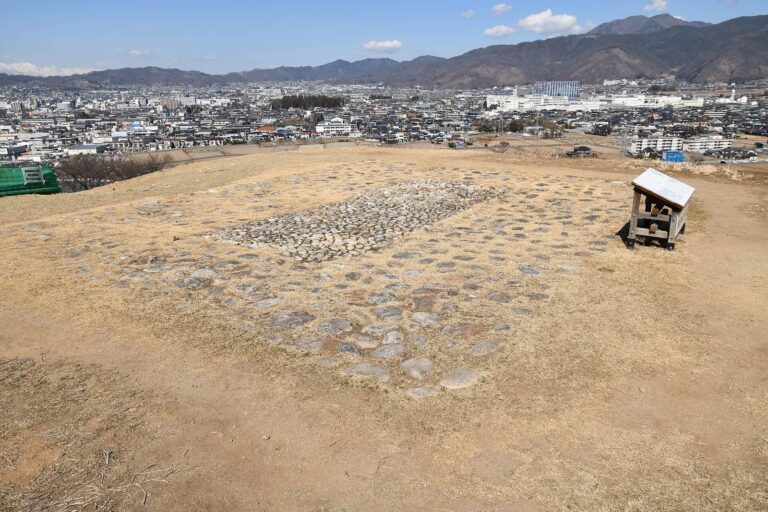
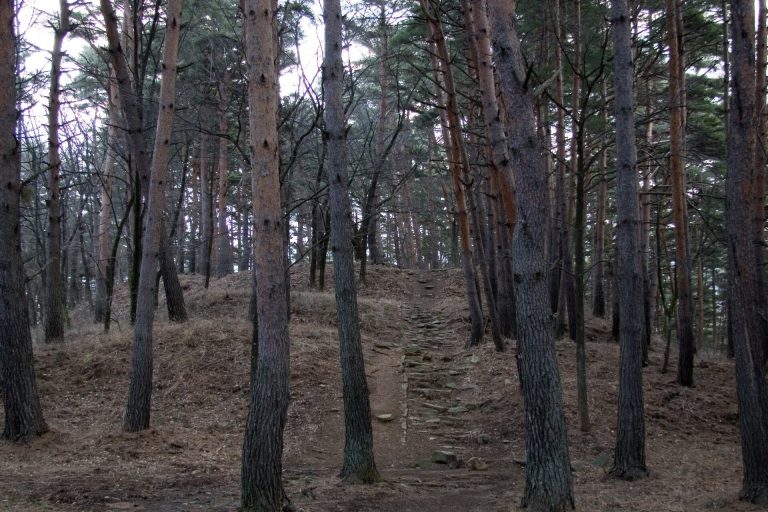
The remains occupy about 11,000 square metres on a mountainside at roughly 940 metres above sea level, surrounded by national forest. The earlier temple grounds near the summit are distinct from the lower site of the later complex. The former precinct was said to have extended around a perimeter of about 13 kilometres. At the lower site, the Edo-period complex spread across several terraces, with foundation stones marking the positions of its principal buildings.
The terraced complex and its records
Building terraces
The lower complex included the abbot’s quarters, a central hall, the Golden Hall, and Tamura Hall. Their surviving foundation stones preserve the arrangement of the former buildings across the terraces.
Bird’s-eye view of the temple
A bird’s-eye woodblock view depicts the complex’s former arrangement. The image is carved on a cherry-wood block measuring 28 by 41 centimetres and 2 centimetres thick. Comparison with excavated remains indicates that it represents the layout relatively accurately. An Inari shrine appears in the scene; because that shrine was established in 1799, the block was made later. The Matsumoto City Board of Education has held it since 2008.
Structures beyond the mountain complex
Tamura Hall image cabinet
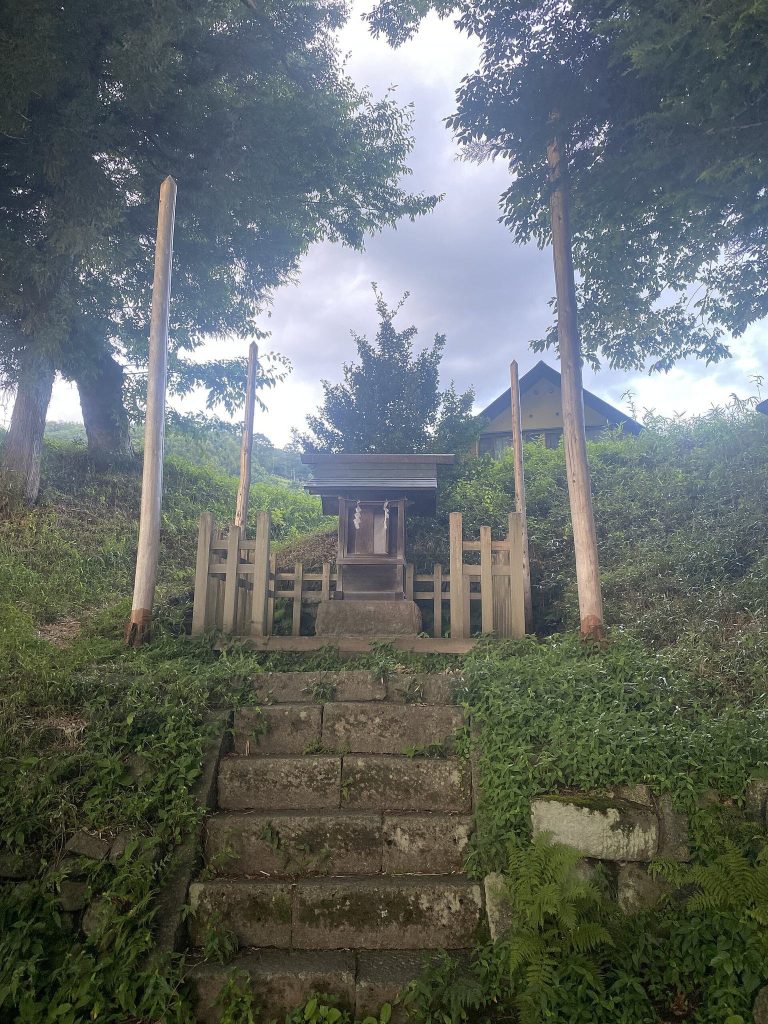
Tamura Hall is a small enclosure for a Buddhist image. It originally housed Nyakutakuji’s principal image and later enshrined Sakanoue no Tamuramaro. The cabinet now stands within a shelter in a nearby Hata settlement. A separate Edo-period cabinet was made to replace the one used as Tamura Hall. Its base depicts a sea with a swimming golden turtle; a clay pagoda covered in gold stands on the turtle’s back, and the Four Heavenly Kings occupy the four corners.
Guardian-kings gate
The gate of the guardian kings stands on a road in the settlement, away from the mountain complex. Its two guardian images were made in 1322 for a subsidiary temple, and an inscription inside them names their patron and sculptor. The gate was moved to its present position around 1700 and then served as Nyakutakuji’s main entrance. Facing the images, the open-mouthed figure is on the right and the closed-mouthed one on the left. Children continue a local rite using the open-mouthed image: a young child is passed between its right leg and the edge of its garment. The practice is associated with a tradition that this helped ease measles during an outbreak.
Bell tower frame
The temple’s former bell tower was dismantled during Nyakutakuji’s abolition. Its frame was carried to another temple in Azusa, Matsumoto, and reassembled there.
Buddhist images associated with Nyakutakuji
Bronze bodhisattva
A 22-centimetre bronze bodhisattva in a half-lotus contemplative pose, formerly at Nyakutakuji, is preserved at a local Sōtō Zen temple. Its small facial features and gentle expression support a late Nara-period date.
Medicine Buddha images
A late-Kamakura-period bronze seated figure attributed to the Medicine Buddha, associated with healing, is thought to have been a hanging image mounted on a mirror. Its gentle face, flowing drapery, and balanced proportions reflect the period’s style; the medicine jar in its left hand and its halo were added later. Another late-Kamakura-period image of the Medicine Buddha, also believed to have belonged to Nyakutakuji, was originally mirror-backed. Its unusually wavy hair distinguishes the image.
Standing image associated with an Amida triad
A standing image from the early Muromachi period, preserved at the local Sōtō temple, wears an octagonal jeweled crown. Its hands form a gesture associated with a scripture box. The figure is thought to have served as an attendant in a Zenkōji-style arrangement of Amida, a Buddha associated with rebirth in the Pure Land, and two attendants.
Fudō images
A late-Kamakura-period image of Fudō Myōō, a protector of Buddhist teaching, formerly served as the principal image in Nyakutakuji’s ritual hall. Known as the “Mizusawa Fudō,” it stands on a rocky base, holding a sword in its right hand and a lasso in its left. Its eyes are inlaid, and its flames were added later. A separate early-Muromachi-period painting depicts standing Fudō with a flame-shaped halo and two attendants; it is said to have served as the ritual hall’s principal image.
Late-Muromachi-period wooden image
A wooden image formerly at Nyakutakuji is assembled from joined blocks, with the joins clearly visible. Much of its paint has worn away, and the figure is badly damaged.
Stone features and archaeological finds
Entrance-path monuments
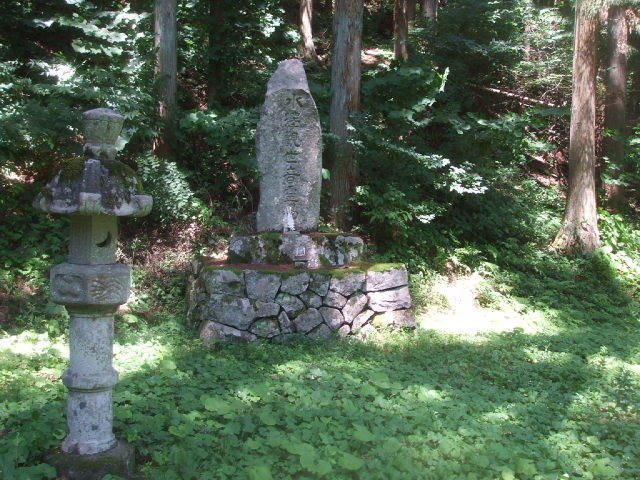
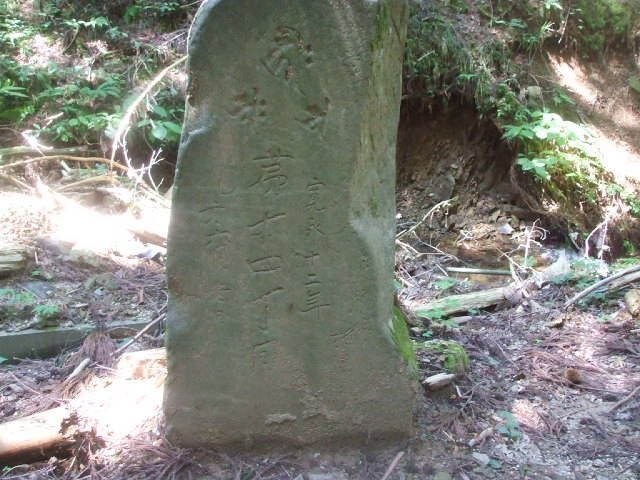
A stone monument beside the entrance path carries a carving of an Amida triad, represented by sacred syllables, beneath a canopy. The carving sits on a lotus pedestal within a circular halo. Its inscription names a donor and gives the date 28 May 1458, making it the oldest dated monument identified in Hata. A second monument, erected in 1575 by a monk from Kii, commemorates the Nyakutakuji road. Its inscription includes sacred syllables representing an Amida triad and Dainichi, a central Buddha in esoteric Buddhism.
Approach stones
A natural stone carved with Enma, the judge of the dead in Buddhist tradition, dates to 1574. It stood in the Hall of the Ten Kings midway along the approach. Stone distance markers, placed along the route in 1635, counted successive units from the guardian gate to the temple at the eighteenth marker. Each bears sacred syllables representing an Amida triad at its top.
Burial jars from the summit area
Two Kamakura-period jars made in the region around Seto were found at the former summit-area site. Each contained cremated human remains and had been used as a burial urn. They are thought to have begun as ritual sake vessels.
Devotional woodblock portrait
Kōbō Daishi
A woodblock portrait of Kōbō Daishi, the honorific name of the monk Kūkai, traditionally regarded as the founder of Shingon, bears the inscription “Shinshu Mizusawa Jigenzan Nyakutakuji.” It was probably distributed to worshippers at the temple. The image measures 25 by 21 centimetres and is held by the Matsumoto City Board of Education.