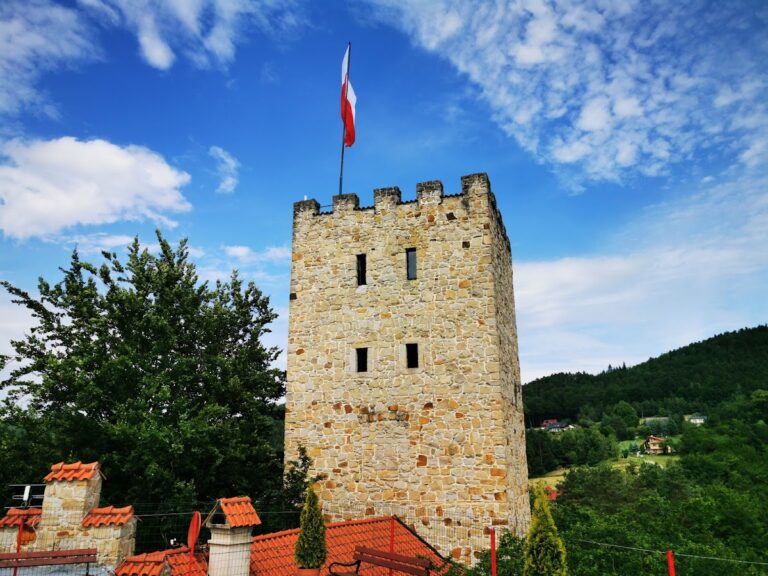
Nowy Sącz Castle: A Medieval Royal and Administrative Fortress in Poland


Site at a Glance
- Rating
- 4.3
- Popularity
- Medium
- Country
- Poland
- Primary era
- Medieval
- External website
- Open
- Eras represented
- Medieval
- Civilizations
- Kingdom of Poland
- Site type
- Military
- Remains
- Castle
On this page9 sections
History
Nowy Sącz Castle is a medieval Polish royal castle in Nowy Sącz, Poland, built between 1350 and 1360 within the city’s northwestern defenses. Its foundation is generally associated with Casimir III the Great, the fourteenth-century king whose reign brought extensive royal building and administrative development, although the initiative has also been attributed to Wenceslas II of Bohemia and Poland.
Royal foundation and medieval use
The castle occupied the northwestern corner of the city and formed part of its defensive system. A moat separated it from the urban area, probably together with a wall and gate. The complex became the seat of the castellans, officials who governed the surrounding medieval administrative district, as well as the district’s judicial and administrative offices. It also housed the starost, a royal official responsible for administering the district.
The castle was associated with several important royal visits. Louis of Hungary stayed there in 1370 while travelling to Kraków to become king of Poland. In autumn 1384, Jadwiga of Anjou arrived at the castle before her coronation as king of Poland in Kraków on 16 October. The title reflected the legal form of her royal status. Władysław Jagiełło, the Polish king who founded the Jagiellonian dynasty and had previously ruled as Grand Duke of Lithuania, was a frequent guest.
In April 1410, Jagiełło met Vytautas, Grand Duke of Lithuania, at Nowy Sącz Castle to confer before the war with the Teutonic Order, a medieval religious-military order that controlled territory around the eastern Baltic. In later centuries, Polish monarchs visited less often, and the castle became chiefly the residence of the starost.
Decline and changing functions
Swedish invasions, fires, and the economic crisis of the seventeenth century brought deterioration. Another fire in 1768, associated with the march of the Bar Confederation, an association of Polish nobles formed against Russian influence and the Polish king, destroyed the castle. The fire was linked to the carelessness of the confederates.
During the Partitions of Poland, the late-eighteenth-century divisions of the Polish-Lithuanian Commonwealth among neighbouring powers, Austrian authorities partly repaired the former royal property for use as police offices. A major flood in August 1813 undermined the escarpment and caused the western wing to slide toward the Dunajec River.
The surviving section was converted into military barracks and storage facilities in 1838, then into a prison in 1846. The government sold the castle to the city in 1848, but the city could not finance repairs and leased the site to the Austrian army for storing uniforms and weapons.
Destruction, restoration, and heritage protection
The ruins underwent partial rebuilding in 1905, including the restoration of a tower. After Poland regained independence, further conservation work culminated in the opening of the Museum of the Sącz Region within the castle walls in 1938. The castle had already been entered in Poland’s heritage register under registration number NoS-2-Ke-36 on 20 October 1936.
During the German occupation, the castle served as barracks and an ammunition depot. In 1945, the depot exploded and caused the castle’s near-total destruction. The ammunition had been intended for mining Kraków’s historic centre. Restoration in the 1950s reconstructed the Renaissance Kowalska Tower, a corner tower shaped by Renaissance forms, together with parts of the perimeter walls and wall sections crowned by attic walls, which rise above a building’s main cornice or roofline.
A local legend concerns a spring at the foot of the Kowalska Tower. Its water was said never to freeze and to taste sulphurous. According to the story, young knights guarding the castle disappeared without trace until one knight protected himself with a blessed circle drawn in chalk and a rosary, driving away the supernatural beings held responsible. The spring reportedly disappeared in the 1945 explosion.
Remains
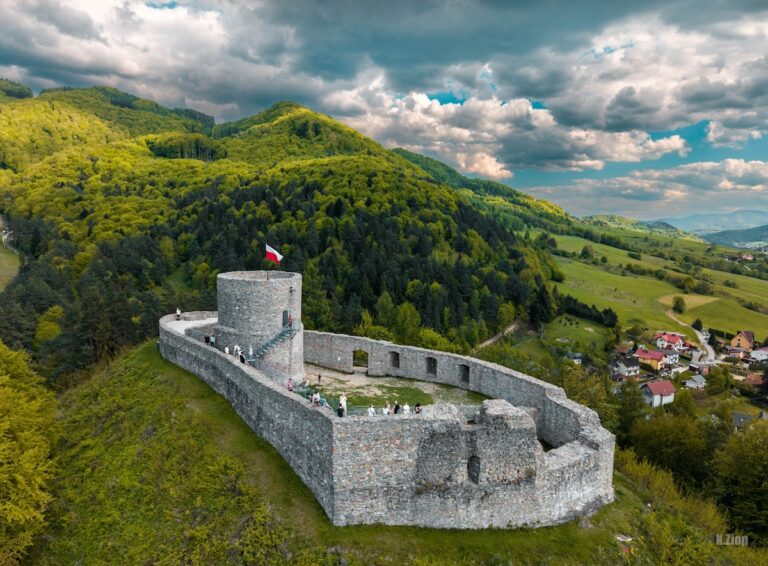
The castle stood on an escarpment at the confluence of the Dunajec and Kamienica rivers, within the fortifications of Nowy Sącz. Its former complex included two corner towers, a central tower, a residential building, and an adjoining forecourt or outer-castle area. The surviving ruins are now set within a municipal park.
Walls and towers
Kowalska Tower
The reconstructed Kowalska Tower is a Renaissance corner tower and the most prominent surviving component of the castle. Its restoration formed part of the work carried out in the 1950s after the 1945 explosion.
Perimeter walls
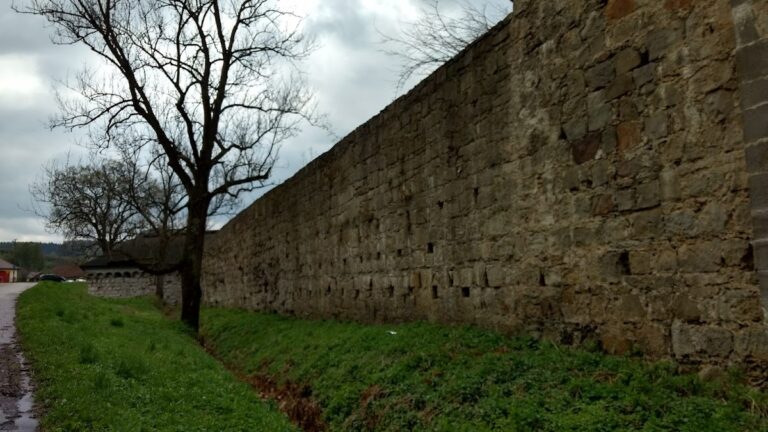
Fragments of the perimeter walls survive around the former complex. Restored sections include walls crowned by attic walls. Together with the reconstructed tower, these fragments convey part of the castle’s former defensive enclosure.
Lost western wing
The western wing was positioned above the escarpment facing the Dunajec. During the major flood of August 1813, the ground beneath it was undermined, and the wing slid toward the river. Its loss formed part of the physical transformation that preceded the later military and prison uses of the surviving castle section.
Nearby sites