Rietburg: A Medieval Hillside Castle in Germany


Site at a Glance
- Rating
- 4.6
- Popularity
- Low
- Country
- Germany
- Primary era
- Medieval
- Eras represented
- Medieval, Modern
- Civilizations
- German, Holy Roman Empire
- Site type
- Military
- Remains
- Castle
On this page14 sections
History
Rietburg is a ruined medieval hillside castle above Rhodt unter Rietburg in Germany. Built by the Lords of Riet between 1200 and 1204, it occupied a strategic position on the northeastern flank of the Blättersberg in the Haardt mountains. Its history reflects the changing fortunes of noble families, bishops, and regional powers in the medieval German Empire.
Foundation and the Lords of Riet
The castle’s construction is attributed to Conrad II of Riet. The Lords of Riet had first been associated with the Benedictine Abbey of Weißenburg before entering the service of Hohenstaufen lords. As ministeriales, members of the medieval German service nobility who could hold administrative or military offices and possess fiefs, they served higher-ranking rulers despite not originally belonging to the highest aristocracy. The family also held feudal rights from the Bishopric of Speyer and was connected with the area between Speyer and Germersheim. Its origins were thought to lie near Otterberg, and the family appears in a document of Eußerthal Abbey from 1149.
After Conrad II died, the castle lordship passed to his cousin or brother Hermann of Rietberg. In the political conflict between the Hohenstaufen and Welf dynastic factions, rival power groups in the medieval German Empire, Hermann seized Queen Elisabeth of Brunswick, the wife of King William of Holland, in 1255. He held her and her retinue at Rietburg. Adolf of Waldeck, an imperial judge and prominent supporter of the Rhenish League of Towns, may have been Hermann’s actual intended target.
The siege of 1255 and rebuilding
Pressure from neighbouring princes and towns led to a siege of Rietburg. The attackers used advanced weapons for the period, including a trebuchet, a siege engine that hurled heavy projectiles against fortifications. The queen was released on 4 December 1255, but the older castle was destroyed during the assault. A new stronghold was built soon afterward from its remains, with a particularly powerful shield wall protecting its most vulnerable side.
Hermann of Rietberg survived the crisis but was required to enter Eußerthal Abbey. His son, Hermann the Younger, then took control of the castle. Both men died without further male heirs between 1256 and 1260. The lordship consequently reverted to Heinrich of Leiningen, Bishop of Speyer, who transferred it to his brother Emich IV of Leiningen-Landeck.
Changing lordship and late medieval decline
After the Leiningen-Landeck line died out in 1289, Otto of Ochsenstein was probably enfeoffed with Rietburg. In the 1280s, the marriage of his daughter Katharina to Emich V of Leiningen-Landeck brought the castle to a branch of the Leiningen family. The Bishopric of Speyer acquired ownership in the early fourteenth century. Rietburg was then repeatedly pawned, and its feudal holder changed several times.
By the late fourteenth century, the castle had suffered major structural damage and was repaired and enlarged. Around 1460, during the conflict between Frederick I, the Victorious, Elector Palatine, and the Archbishop of Mainz, the Duke of Zweibrücken-Veldenz, and the Count of Leiningen, Leiningen troops plundered Rietburg. The castle apparently remained inhabited after this attack.
When Bishop Matthias of Rammung visited in 1464, he described the furnishings as being in miserable condition, indicating that the castle was already declining. Its garrison nevertheless joined the unsuccessful siege of Kropsburg in 1470 during the Weißenburg Feud, so Rietburg still had occupants and a military function. In 1472, the castle’s Chapel of St. Catherine was transferred to the newly built castle at Hanhofen, another sign of its reduced importance. Rietburg’s involvement in the Peasants’ War of 1525 remains uncertain.
Final military use and preservation
Troops of Albrecht II Alcibiades of Brandenburg-Kulmbach occupied Rietburg briefly in 1552 during the Second Margrave War, a conflict involving his campaigns against imperial and regional opponents. The garrison withdrew as troops of Emperor Charles V approached. This was the last recorded use of Rietburg as a military stronghold.
The castle may have been destroyed during the Thirty Years’ War, although the event is not documented. It was explicitly described as a ruin by 1681. Excavations in 1872 recovered 580 gold and silver coins dating from the sixteenth century. The municipality of Rhodt carried out extensive preservation work in 1925 to slow the deterioration of the remains. Since 1991, the Rietburg Club has continued conservation efforts, including work on the historic approach and its bridge.
A local legend tells of a robber baron who abducted a young woman and demanded a ransom from her father. After receiving the payment, he allegedly threw her from the battlements. The story says that her father and his followers stormed the castle and killed the robber, whose spirit has supposedly wandered through the ruins at night ever since.
Remains
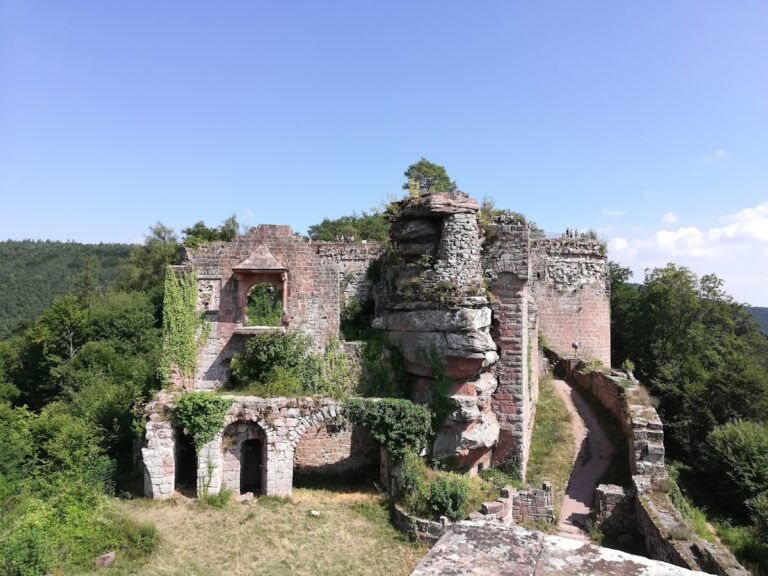
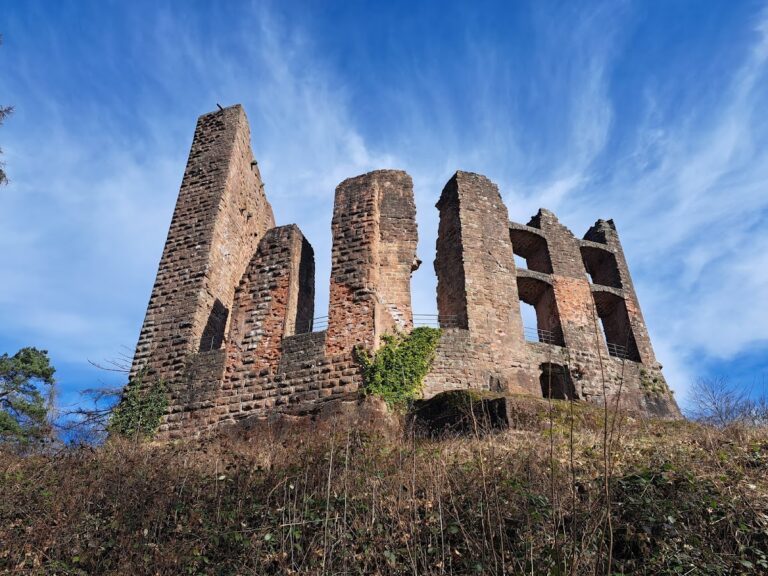
Rietburg occupies a hillside position at approximately 531 to 535 metres above sea level on the northeastern flank of the Blättersberg, a mountain of the Haardt range at the eastern edge of the Palatinate Forest. The surviving fabric belongs primarily to the castle rebuilt after the destruction of 1255. It includes part of the shield wall, sections of the surrounding defensive enclosure, and parts of the outer defensive area between the main walls and an additional barrier.
Defensive structures
Shield wall
The shield wall formed the strongest section of the later castle’s defences. It was erected after the earlier stronghold was destroyed in the siege of 1255 and protected the main defensive core on the side most exposed to attack. Part of this wall survives among the principal remains.
Enclosure and outer defences
Sections of the enceinte, the surrounding defensive wall or enclosure, remain alongside parts of the zwinger, an outer defensive area between the main wall and an additional barrier. Together, these fragments show the layered defensive arrangement of the later castle. Their surviving form reflects both the thirteenth-century rebuilding and subsequent repairs and enlargement.
Neck ditch and bridge
A historic neck ditch cuts across the approach to the castle. This type of ditch defended a narrow approach or ridge and probably once carried a drawbridge, a movable bridge that could be raised to obstruct passage. A wooden bridge was installed across the ditch in 2012 as part of conservation work.
Later structures within the ruins
Refuge hut
The Palatinate Forest Club built a refuge hut within the ruins in 1931. It forms part of the modern physical fabric of the site and occupies space inside the surviving castle remains.
Castle restaurant
A castle restaurant was constructed within the ruins in 1955. Its addition followed the earlier refuge hut and represents a later use of the remains after the site had long been treated as a ruin.
Chapel
The castle’s former Chapel of St. Catherine was removed from Rietburg in 1472 and transferred to the newly built castle at Hanhofen. Its relocation belongs to the late medieval changes that altered the site’s arrangement as Rietburg declined in importance.
Nearby sites