Nishiki Tenmangū: A Shinto Shrine Dedicated to Tenjin in Kyoto


Site at a Glance
- Rating
- 4.3
- Popularity
- Medium
- Country
- Japan
- Primary era
- Medieval
- External website
- Open
- Eras represented
- Medieval, Modern
- Civilizations
- Japanese
- Site type
- Religious
- Remains
- Sanctuary
On this page16 sections
History
Nishiki Tenmangū is a Shinto shrine in Kyoto, Japan, dedicated to Sugawara no Michizane and established in 1003 during the Heian period. It began at the former residence of Michizane’s father, Sugawara no Koreyoshi, known as Sugawara-in. Michizane was a Heian-period scholar and politician who later became revered as Tenjin, the divine patron of learning and letters.
Foundation and Buddhist association
The shrine’s origins are connected with the relocation of Kanki-ji from the Sugawara-in site to the former Rokujo Kawara-in residence of Minamoto no Toru, a ninth-century court noble and poet. Tenman Tenjin, the deified form of Michizane, was enshrined there as the temple’s guardian deity. A guardian shrine was a Shinto institution historically associated with protecting a Buddhist temple.
In 1299, the regent Kujo Tadanori donated the site to Zendo-ji, the head temple of the Rokujo branch of the Jishu school, a Buddhist tradition. Zendo-ji moved there, incorporated Kanki-ji, and took the name Kankiko-ji. Nishiki Tenmangū continued as its guardian shrine, and Kujo Tadanori provided buildings for it. Emperor Go-Fushimi also granted the shrine an imperial handwritten inscription bearing the name “Tenmangu.”
Relocations and the present site
Following the Onin War, a fifteenth-century conflict that caused widespread destruction in Kyoto, the temple and shrine moved to Takatsuji-Karasuma. In 1587, during Toyotomi Hideyoshi’s reconstruction and reorganization of Kyoto in the late-sixteenth-century Azuchi-Momoyama period, they were transferred to their present location at the eastern end of Nishiki. The new site stood on the grounds of Shijo Dojo Konren-ji, and the shrine gradually became known as Nishiki Tenmangū after its location.
An illustrated guide to Kyoto’s famous places published in 1780 depicted the shrine as Nishiki Tenjin and showed it as more imposing than Kankiko-ji. The precinct was then said to cover more than 1,400 tsubo, a traditional Japanese unit of land area. The shrine and temple were separated in 1872 under the policy of separating Buddhism and Shinto. Kankiko-ji later merged with Hokkoku-ji in 1907 and moved to Higashiyama, then moved again to Yamashina in 1975. Nishiki Tenmangū remained at its present location.
Continuing religious identity
Tenjin is associated with learning, literature, examinations, and academic success, and Nishiki Tenmangū is also revered for commercial prosperity. Students, worshippers, and local merchants seek these benefits through the shrine’s continuing religious practices. It is listed as the second site in the Twenty-Five Sacred Sites of Sugawara no Michizane and as the twenty-fifth site in the Twenty-Five Pilgrimage Sites of Rakuyo Tenmangu.
Reverence for a messenger ox and the use of a plum-shaped wooden amulet remain part of the shrine’s traditional practice. Spring and autumn festivals, together with observances held on Tenjin days, continue this ritual identity.
Remains
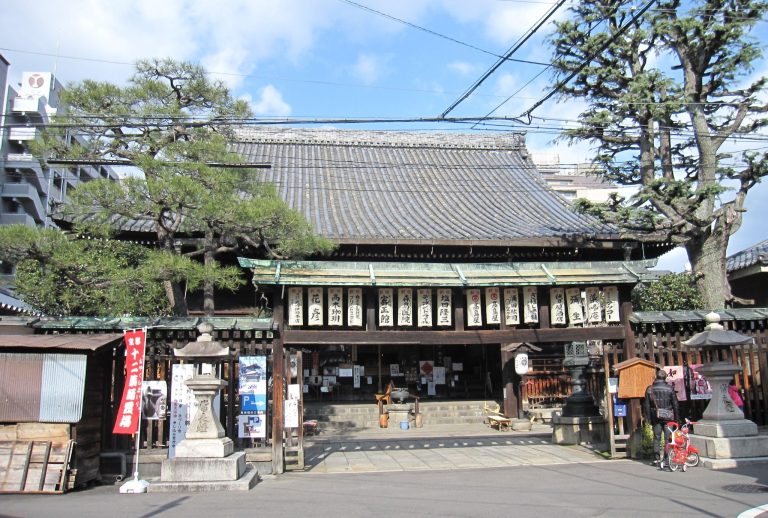
Nishiki Tenmangū stands at the eastern end of Nishiki Market in central Kyoto’s Nakagyo district. Its main approach enters from the commercial street at Teramachi, between Teramachi and Shinkyogoku. The present precinct took shape after the preceding buildings burned in 1889 and were reconstructed in 1890. It was smaller than the earlier precinct, and its rebuilt structures were more modest.
Main precinct structures and features
Sanctuary and worship buildings
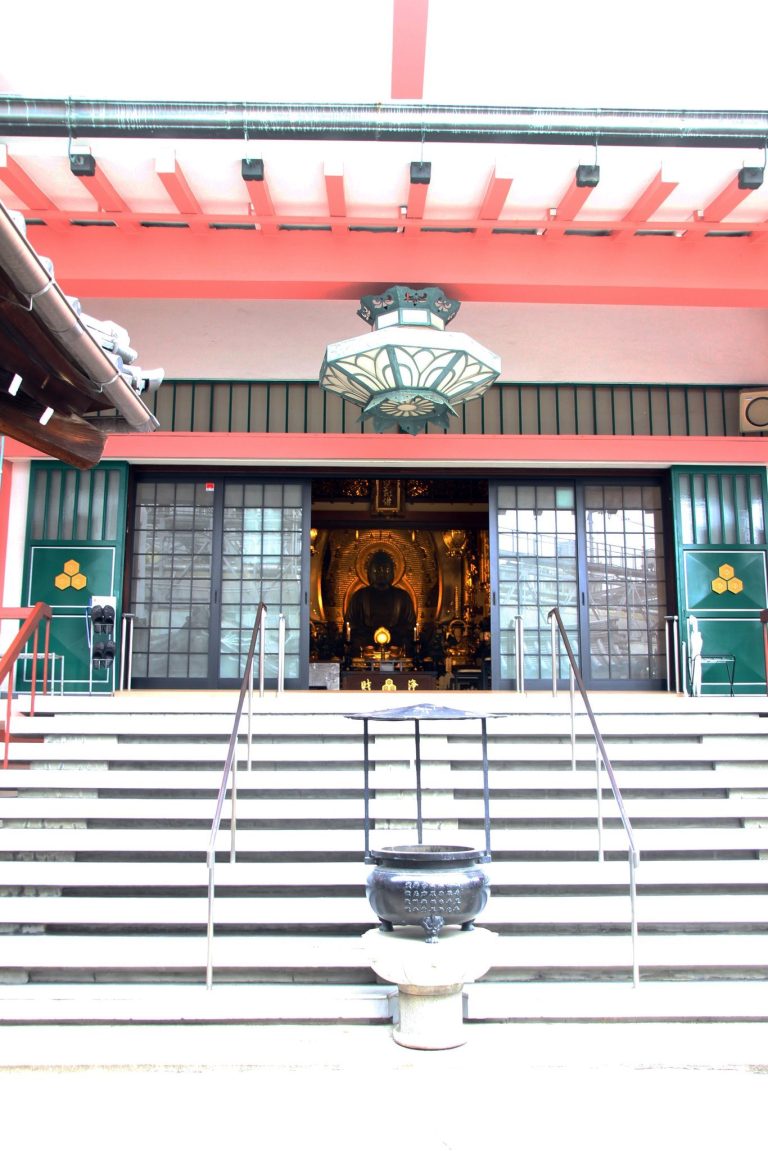
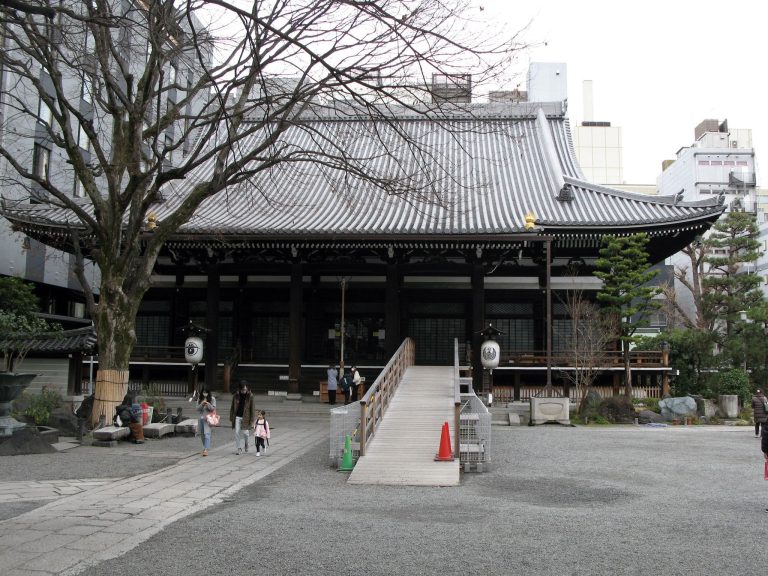
The principal buildings are the honden, or main sanctuary, the haiden, or worship hall, and the shrine office. Together they form the central built group of the surviving precinct, which occupies the shrine’s reduced post-1890 site.
Entrance torii
The entrance torii, a gateway marking entry into a Shinto sacred precinct, was erected in 1935. The surrounding buildings were laid out according to the width between the gateway’s pillars rather than around the projecting upper ends. As a result, those ends extend into the buildings on both sides of the street.
Nishiki no Mizu
Nishiki no Mizu is a natural spring regarded as one of Kyoto’s notable waters. Worshippers and local merchants draw and drink it, and traditional access to the spring remains open while the shrine is open.
Nade-ushi
A polished bronze statue of the nade-ushi, the messenger ox of the shrine’s kami, stands within the precinct. The statue is associated with the practice of touching or stroking the ox as part of the shrine’s religious observance.
Karakuri Omikuji
The shrine office contains a Karakuri Omikuji fortune-telling automaton. Karakuri refers to traditional Japanese mechanical puppets and automata. When someone approaches, the device plays kagura, ritual music and dance associated with Shinto. After a coin is inserted and one of six fortune-slip options is selected, a mechanical lion dances and delivers the omikuji, a written shrine fortune.
Daigan-ume
The plum-shaped wooden amulet called Daigan-ume contains a written wish. Once the wish has been enclosed, the amulet is hung on the plum tree planted within the precinct. Its form reflects Michizane’s traditional association with plum trees.
Subsidiary shrines
Shiogama Jinja
Shiogama Jinja enshrines Minamoto no Toru. It was established when Kankiko-ji was formed and formerly stood on an islet in Chidori Pond, which once lay within the precinct.
Hinode Inari Jinja and Shirataifu Jinja
Hinode Inari Jinja is dedicated to Ukanomitama no Mikoto, while Shirataifu Jinja is dedicated to Watarai Haruhiko. They form part of the group of subsidiary shrines within Nishiki Tenmangū.
Shichisha-no-miya
Shichisha-no-miya comprises seven shrines dedicated to Hachiman, Tokoura, Kamado, Ichikishima, Kumano, Ebisu, and Kotohira. These subsidiary sanctuaries add several distinct devotional traditions to the precinct surrounding the main shrine.