Kennin-ji Temple: Kyoto’s Historic Rinzai Zen Head Temple


Site at a Glance
- Rating
- 4.5
- Popularity
- Medium
- Country
- Japan
- Primary era
- Early Modern
- External website
- Open
- Eras represented
- Medieval, Early Modern, Modern
- Civilizations
- Japanese, Tokugawa, Toyotomi regime
- Site type
- Religious
- Remains
- Monastery
On this page25 sections
History
Kennin-ji Temple is a historic Rinzai Zen temple in Kyoto, Japan, founded in 1202 by the monk Myōan Eisai with land and patronage from Minamoto no Yoriie, the second shogun of the Kamakura shogunate. Named after the era then in force, it was established as a center for Rinzai Buddhism in Kyoto and is traditionally regarded as the city’s oldest Zen temple. Shōfuku-ji in Hakata, founded earlier by Eisai, is identified as the oldest Zen temple in Japan.
Foundation and Three Buddhist Traditions
Kennin-ji began as a deliberately inclusive institution. Its founders were required to accommodate Shingon and Tendai, two established Buddhist traditions that predated the temple’s Zen community and held strong positions in Kyoto. In 1202, a Shingon Hall and a Calming-and-Insight Hall were established alongside the Zen facilities, allowing all three traditions to coexist. The temple received official recognition in 1205.
Eisai is traditionally credited with formally transmitting Rinzai Buddhism to Japan. He trained in China and received Dharma transmission from Xuyuan Huai-chang in 1191. He later founded Shōfuku-ji in Hakata, became the founding abbot of Jufuku-ji in Kamakura in 1200, and then established Kennin-ji in Kyoto. Eisai died in 1215, probably at Kennin-ji, although another tradition places his death at Jufuku-ji.
The temple also became associated with Eihei Dōgen, who later founded the Sōtō school in Japan. Dōgen studied at Kennin-ji from 1217 to 1223 under the second abbot, Ryōnen Myōzen. His presence belongs to the period when the institution still accommodated several Buddhist traditions.
Transformation into a Rinzai Zen Institution
Repeated fires affected Kennin-ji during its early history. The complex burned in 1246, 1247, and 1256, creating a need for repeated rebuilding. Enni Ben’en entered the temple in 1258 and restored the Buddha Hall and other facilities. From 1259, Lanxi Daolong, a Chinese Zen master and the temple’s eleventh abbot, led a stricter phase of institutional development.
In 1265, Kennin-ji was made a Rinzai Zen temple and was temporarily renamed Kennei-ji. Under Lanxi Daolong, Zen regulations were rigorously enforced, and the temple became a purely Rinzai Zen institution. Lanxi’s leadership gave the temple a disciplined training structure, while his Japanese title, Daikaku Zenji, remained associated with the temple’s religious memory. Kennin-ji was renamed in 1342.
During the Nanboku-chō conflict, a struggle between the Northern and Southern Courts in medieval Japan, Kennin-ji sheltered the young Ashikaga Yoshimitsu. In 1340, parts of the complex were destroyed when Sasaki Dōyo burned Myōhō-in. Further fires damaged the temple in 1397, during the Ōnin War, in 1481, and during the Tenmon-era fire. These disasters explain why no building from the original foundation period survives.
Medieval Rank and Institutional Continuity
In 1386, Kennin-ji became the third-ranked temple in the Kyoto Gozan, the medieval “Five Mountains” ranking system for major Zen temples in Kyoto, under Ashikaga Yoshimitsu. Its position reflected the institutional standing it had acquired within the Rinzai world.
Kennin-ji has continued as the head temple of its own Rinzai branch, one of the fourteen divisions of the Rinzai school. The branch includes about seventy affiliated temples and approximately 25,000 adherents. Fourteen subtemples remain within the precincts, while related branch temples elsewhere include Kōdai-ji, which enshrines Toyotomi Hideyoshi, and Hōkan-ji, associated with the Yasaka Pagoda. The temple’s historical reputation also includes the description “the scholarly face of Kennin-ji,” reflecting its associations with learning, books, and painted works.
Early Modern Reconstruction
Reconstruction took a new direction in 1599, when the Abbot’s Quarters were transferred to Kennin-ji by Ankoku-ji Ekei. Repairs continued throughout the Edo period. In 1614, Tokugawa Ieyasu confirmed the temple’s estate of 820 koku, preserving an important material basis for its religious institution.
The precinct’s subtemples also acquired new connections during this period. Shōden-in, founded in the Kamakura period and first located in Gion, was revived in 1618 by Oda Urakusai, who had retired to Kyoto after the Winter Siege of Osaka and pursued tea practice there. Eigen-an, founded during the Nanboku-chō period, served as a memorial temple for eight generations of the Hosokawa family of the Izumi Kamimori branch and later for Hosokawa lords of Kumamoto. After Eigen-an declined and became unstaffed in the early Meiji period, Shōden-in moved onto its grounds and took the combined name Shōden Eigen-in.
Other subtemples were revived or relocated during the early modern and modern periods. Kinoshita Iesada, a relative of Toyotomi Hideyoshi, revived Jōkō-in in 1604, and it moved to its present location in 1872. Seijū-in was associated with Ranshū Ryōhō, Kennin-ji’s fifty-fourth abbot in 1378 and a trusted figure of Ashikaga Yoshimitsu; the subtemple moved from Hanamikoji Street in 1873.
Meiji Reorganization and Twentieth-Century Fires
The Meiji-era anti-Buddhist movement known as haibutsu kishaku, which sought to suppress Buddhism and promote state-supported Shinto, greatly reduced Kennin-ji’s subtemple network. Its number of subtemples fell from thirty-four to fourteen, and Kennin-ji became the head temple of an independent Kennin-ji branch within Rinzai Buddhism.
On September 29, 1924, a fire deliberately set by a nun in training destroyed the Main Hall, the Kuri, and the Shoin across an area of about 1,000 tsubo. National Treasure works and other temple cultural properties survived, but scholarly materials belonging to Buddhist researchers staying at Daitō-in were lost. The Main Hall was rebuilt in 1930. The Kuri, which had been rebuilt in 1814, later collapsed in the strong winds accompanying the approach of the Muroto Typhoon on September 21, 1934.
Kennin-ji commemorates Eisai through annual observances including the Founder’s Birthday ceremony and the Shitō Tea Gathering on April 20, the Founder’s Memorial Service on June 5, the Fusatsu penitential and ordination rite on July 30, and the Yoriie Memorial Service on August 18. The Shitō gathering preserves an early Zen monastic tea ritual associated with Eisai’s transmission of tea seeds and tea-drinking methods from China. Daily tea rituals using bancha also continue.
In 2002, the temple marked its eight-hundredth anniversary. That year, Koizumi Junsaku’s Twin Dragons ceiling painting was installed as a commemorative work. A monthly meditation gathering called Senkō-kai takes its name from Eisai’s posthumous title, Senkō Kokushi. In 2009, a wooden seated statue of Eleven-faced Kannon was stolen on January 31 and recovered after the thief’s arrest on March 2. Kennin-ji’s heritage holdings include National Treasure works, Important Cultural Properties, and tangible cultural properties designated by Kyoto Prefecture.
Remains
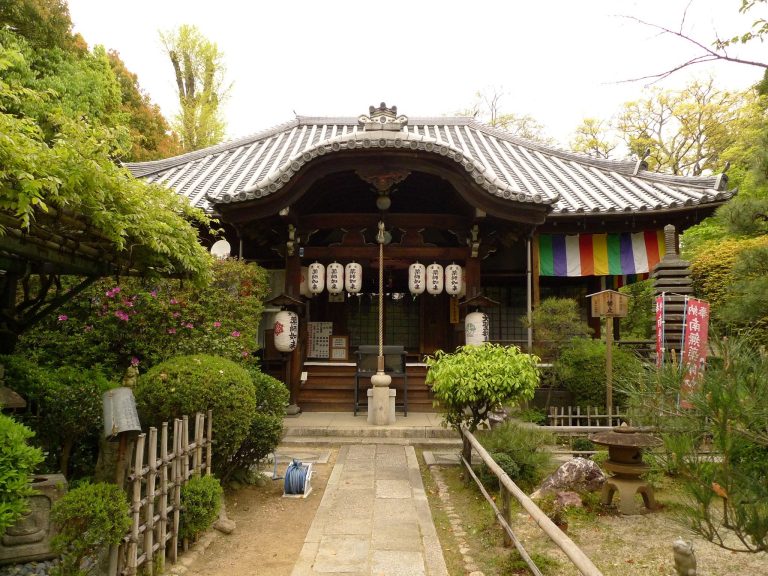
Kennin-ji was originally planned in imitation of Chinese Song-period public monasteries, especially the Baizhang Mountain model. The complex was arranged along a north-south axis and initially contained seven principal buildings. The surviving precinct combines reconstructed central buildings, later halls, gardens, tea facilities, painted works, books, and a network of subtemples that preserves different stages of the temple’s history.
Central Buildings and Historical Structures
Main Hall and Dharma Hall
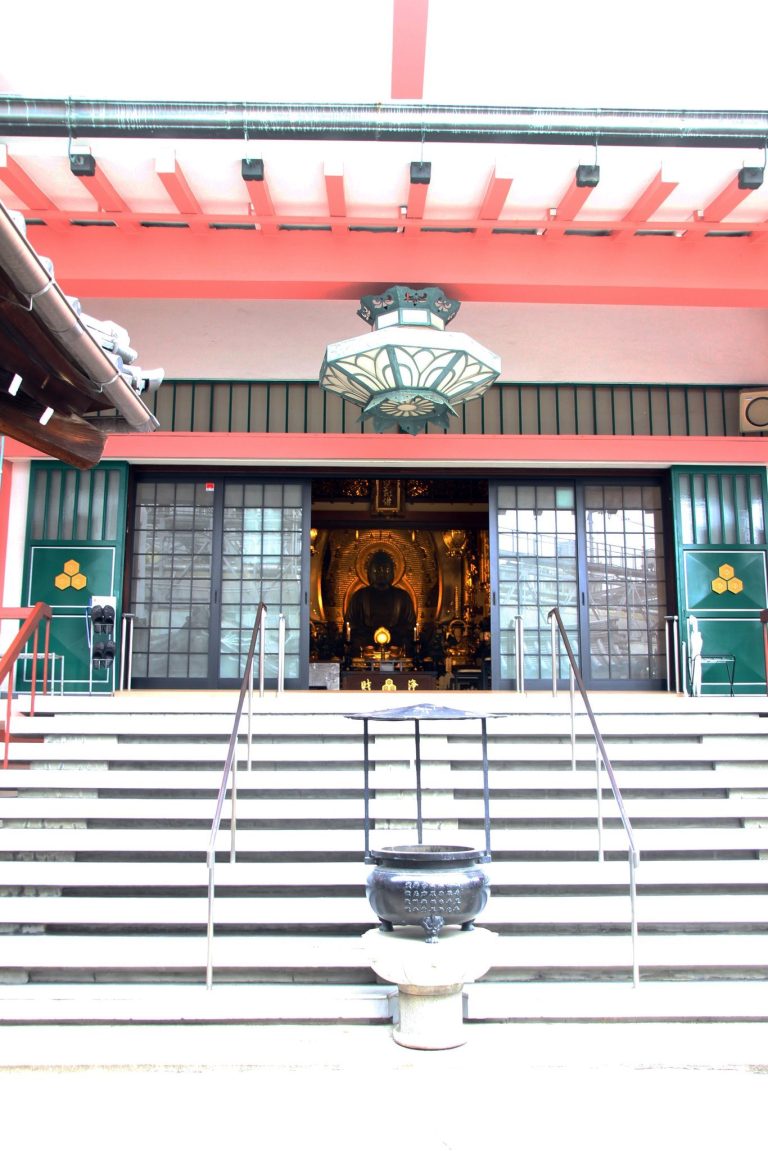
The Main Hall is a 1930 rebuilding of the structure destroyed in the 1924 fire. It forms part of the temple’s reconstructed central complex. The Dharma Hall dates from 1765, providing an Edo-period building within the later architectural fabric.
Abbot’s Quarters
The Abbot’s Quarters, or hōjō, serve as the abbot’s residential and administrative quarter. The building was transferred from Ankoku-ji to Kennin-ji in 1599. Its former sliding-door paintings, associated with the school of Kaihō Yūshō, include Bamboo Grove of the Seven Sages, Birds and Flowers, Literati Pastimes, Dragons in Clouds, and Landscape. The paintings were later remounted as hanging scrolls.
Imperial Messenger Gate
The Imperial Messenger Gate, or Chokushimon, is traditionally said to date from the Kamakura period. Marks attributed to arrows remain on the gate, preserving a physical reminder of the warfare associated with the temple’s long history.
Other principal buildings reflect later rebuilding. The Kuri was rebuilt in 1814, Reito-in in 1853, and the Founder’s Hall in 1884. The Founder’s Hall is a kaisan-dō, a hall dedicated to the temple’s founding master. The present Main Hall belongs to the reconstruction after the 1924 fire.
Gardens and Tea Architecture
Dry Landscape Garden
The grounds include a dry landscape garden, or karesansui, formed with arranged stones and raked sand rather than flowing water. Its materials evoke a natural landscape through composition rather than through a watercourse.
Tea Houses
A tea house built in 1587 follows designs by the tea master Sen no Rikyū and was made for Toyotomi Hideyoshi. The precinct also contains the Suigetsu-tei and Rinchitei, tea facilities associated with Oda Urakusai’s preferences. Together, these structures preserve the connection between Kennin-ji’s Zen institution and the tea practices associated with its founders and patrons.
Paintings, Books, and Sacred Images
Wind God and Thunder God Screens
The National Treasure Wind God and Thunder God screens were painted by Tawaraya Sōtatsu on a pair of two-panel screens with gold grounds. The Wind God occupies one screen and the Thunder God the other. Broad areas of open space suggest an expansive sky and heighten the sense of movement. Neither screen bears a seal or signature.
The screens were commissioned from Sōtatsu by the Kyoto merchant Uda Kin’nori, also known as Itō Jūemon, to commemorate the revival of Myōkō-ji, a temple of the Kennin-ji branch. Myōkō-ji later donated them to Kennin-ji. The original screens are deposited at the Kyoto National Museum and are not permanently displayed at the temple, which presents a replica and a ceramic-panel reproduction.
Painted and Written Collections
Kennin-ji preserves painted works associated with Kaihō Yūshō’s school, Tamura Sōryū, and Hashimoto Kansetsu. Its collections also include numerous old Japanese, Chinese, and Korean books. At Ryōsoku-in, a Song-printed edition of Su Shi’s collected works comprises fifty-three volumes from a set of 111 volumes.
Twin Dragons
Koizumi Junsaku’s Twin Dragons is painted in ink on heavy traditional Japanese paper. Measuring 11.4 by 15.7 meters, the work covers the equivalent of 108 tatami mats. It was produced in the gymnasium of an elementary school in Hokkaido over slightly less than two years before being installed on the temple ceiling in 2002.
Subtemples and Their Features
Ryōsoku-in
Ryōsoku-in is traditionally attributed to Ryūzan Tokken, Kennin-ji’s thirty-fifth abbot. It developed through the union of Chisoku-in and its subsidiary, Yasukuken. The subtemple contains gardens and a Bishamonten Hall. Bishamonten, a Buddhist guardian deity associated with protection and martial power, is represented by an image said to have originally been kept at Kurama. Tradition also connects the image with Kuroda Nagamasa’s helmet and his service at the Battle of Sekigahara.
Ryōsoku-in contains the grave of the Confucian scholar Miwa Shissai and the Song-printed edition of Su Shi’s collected works. It is also traditionally regarded as the place where the Song monk Lin Jingyin transmitted the culture of manju, steamed filled cakes, to Japan. Kuroda Nagamasa’s family donated the Bishamonten image during the Meiji period.
Sairai-in
Sairai-in was founded by Lanxi Daolong after he became Kennin-ji’s eleventh abbot in 1262. Its Main Hall houses a life-size wooden seated statue of Daikaku Zenji, the Japanese title granted to Lanxi. The subtemple, formerly closed to the public, opened after renovation on March 23, 2024.
Daitō-in
Daitō-in was founded in 1352 by Seizan Jiei, a Dharma heir of Musō Soseki. It stands on the southeastern edge of the precincts and retains a memorial connection with Seizan Jiei. The subtemple’s history includes repeated destruction by warfare and major fires followed by several rebuildings.
Daichū-in
Daichū-in was founded by Tōkai Chikugen and was rebuilt several times after destruction by warfare and major fires. Its Abbot’s Quarters face south and are traditionally regarded as remnants of the reconstruction carried out by the monk Sessō. Above the central front room hangs a plaque bearing the posthumous title “An-i Zen Master,” written by Emperor Go-Kōgon. The room contains a standing image of White-robed Kannon.
Shōden Eigen-in
Shōden Eigen-in occupies the grounds where the separate subtemples Shōden-in and Eigen-an were joined. Shōden-in began in the Kamakura period and was revived by Oda Urakusai in 1618. Eigen-an, founded in the Nanboku-chō period, served the Hosokawa family as a memorial temple before declining in the early Meiji period. Shōden-in subsequently moved onto its grounds and adopted the combined name.
Other Subtemples
Jōkō-in contains the legacy of its revival by Kinoshita Iesada in 1604 and its relocation in 1872. Seijū-in retains its association with Ranshū Ryōhō and moved from Hanamikoji Street in 1873. Kōun-an enshrines Dakini Sonten as its guardian Inari. Dakini Sonten is a protective deity associated with Inari worship.
Taiun-ken was founded in 1346 by a Zen master of the Rido-in branch. Kyūshō-in was founded in 1608 by Okudaira Nobumasa as the Okudaira family memorial temple, with Sankyō Jōeki as its founding abbot. Its name is traditionally linked to Nobumasa’s posthumous name. Zenkyo-an, founded by Daikan Zenji, a monk from the Yuan dynasty known as Seisetsu Shuchō, contains a Marishiten Hall and guardian boars rather than guardian dogs. Marishiten is associated with protection, invisibility, and victory. Rokudō Chinnō-ji is an outlying subtemple of the complex.