Bukkō-ji Temple: Head Temple of the Bukkōji-ha in Kyoto


Site at a Glance
- Rating
- 4.2
- Popularity
- Medium
- Country
- Japan
- Primary era
- Unclassified
- External website
- Open
- Eras represented
- Unclassified
- Civilizations
- Unclassified
- Site type
- Religious
On this page9 sections
History
Bukkō-ji Temple is a Jōdo Shinshū Buddhist temple in Kyoto, Japan, and the head temple of the Bukkōji-ha, one of the tradition’s institutional branches. Its principal devotion centers on Amitabha Buddha, whose vow and Pure Land form the focus of Shin Buddhist faith and the nembutsu, the invocation of Amitabha’s name. The institution’s historical foundation dates to 1320, when Ryōgen moved its base to Shibutani in eastern Kyoto and established the community that developed into Bukkō-ji.
Origins and foundation at Shibutani
Temple tradition attributes Bukkō-ji’s beginnings to Shinran, the founder of the Shin Buddhist tradition. According to this account, Shinran established a small temple in Yamashina in 1212 after returning to Kyoto from exile in Echigo Province. He supposedly called it Kōshō-ji, received an imperial prayer commission associated with Prince Shōtoku, and entrusted the temple to his disciple Shinbutsu before departing for the Kantō region. The historical basis of this tradition is weak, and Shinran’s role as founder remains disputed.
Ryōgen is instead regarded as the historical founder. In 1320, he transferred his base from Yamashina to Shibutani, also called Shirutani or Imabiei Shirutani, in the area now associated with the Kyoto National Museum. This move formalized Ryōgen’s earlier hermitage and created the institutional foundation of Bukkō-ji. The name Kōshō-ji became associated with Kakunyo, the third head of Hongan-ji and a descendant of Shinran. Kakunyo initially supported Ryōgen and arranged for his son Zonkaku to study under him, but later broke with both Zonkaku and Ryōgen over interpretations of the teachings of Hōnen and Shinran.
Kōshō-ji was established without Hongan-ji’s support, and Zonkaku later renamed it Bukkō-ji. The name means “Temple of the Buddha’s Light.” A temple tradition connects it with the recovery of a stolen wooden image of Amitabha at a place where Emperor Go-Daigo was said to have dreamed of a ray of light entering from the southeast. Historically, however, the name is understood as having been adopted on Zonkaku’s advice, making the miraculous explanation a foundation tradition rather than an established account.
Growth and religious propagation
Bukkō-ji’s movement developed from the Araki followers in Musashi Province and the Asabu followers, associated respectively with Genkai and Ryōkai. Ryōgen, later counted as the seventh head of Bukkō-ji, worked with Zonkaku and was influenced by the Ji-shū, another Japanese Pure Land movement. He spread devotion to Amitabha’s primal vow through images representing the Buddha’s light, illustrated teacher-lineage diagrams, and registers of followers. A register of this kind, called a myōchō, recorded people who declared faith in Amitabha, while an ekeizu traced a follower’s teacher back through earlier Pure Land masters.
These methods helped Bukkō-ji become a major center for spreading Shin Buddhist nembutsu teaching west of the Kinai region. During the fourteenth and early fifteenth centuries, the temple became more powerful than Hongan-ji and developed branch temples across western Japan. Its former network is said to have eventually exceeded 3,000 affiliated temples when later branches and temples absorbed into other Hongan-ji lineages are included. Kakunyo criticized Bukkō-ji’s propagation methods and illustrated lineages in his 1337 work Gaijashō, rejecting them as inconsistent with Shin Buddhism.
Ryōgen was murdered by bandits while traveling through the provinces in 1336. His son Genran, born in 1318, succeeded him as head of the temple but died in 1347. After its move to Shibutani, Bukkō-ji continued to attract worshippers and expand its influence. This growth brought increasing pressure from the Tendai establishment and Enryaku-ji, the major Tendai temple complex on Mount Hiei.
War, division, and decline
Bukkō-ji’s halls were burned during the Ōnin War, the civil conflict that began in 1467, while Kōkyō served as the thirteenth head. The destruction weakened the temple at a time when Hongan-ji was expanding rapidly under Rennyo. In 1471, Rennyo established Yoshizaki Gobō in Echizen Province and built a wider religious following for the Hongan-ji lineage.
In 1481, Kyōgō, the fourteenth head of Bukkō-ji, entered Rennyo’s following. He led 42 of Bukkō-ji’s 48 powerful branch temples into the Hongan-ji movement, took the name Renkyō, and founded a new Kōshō-ji beside Yamashina Hongan-ji as a subordinate temple. The six remaining major branch temples recalled Kyōgō’s brother Kyōyo from Chion-in to become Bukkō-ji’s fourteenth head, while Kyōgō was excluded from the temple’s official succession. This rupture sharply reduced Bukkō-ji’s influence. Many affiliated temples were later absorbed into organizations connected with Hongan-ji, although the Bukkōji-ha remained technically independent.
Relocation and later institutional history
At Toyotomi Hideyoshi’s request, Bukkō-ji moved in 1586 from Shibutani to Ryūgajō, at its present site near Gojo Bōmon. The former grounds were needed for construction of the Great Buddha and Great Buddha Hall at Hōkō-ji. The six remaining major branch temples also moved to sites in front of Bukkō-ji.
During the Edo period, the head priest administered Bukkō-ji jointly with the heads of these six branch temples, whose influence had grown after the fifteenth-century division. The six temples later adopted the names Daizen-in, Kōon-in, Chōsei-in, Kuon-in, Kyōon-in, and Shōzō-in. Shinran’s relics were long kept within the Bukkō-ji precincts, but they were transferred during the Edo period to the Higashiyama area, where a mausoleum and main hall were built.
From the Muromachi period onward, Bukkō-ji’s head priests were customarily adopted into the Nijō family and ordained under the abbot of Myōhō-in. The institution later received quasi-monzeki status, a high clerical position associated with the imperial or aristocratic court, and successive heads held the senior Buddhist rank of sōjō. After the Meiji government required public surnames, the heads adopted the surname Shibutani. In 1896, chief administrator Shibutani Ryūkyō became a baron and entered the peerage. The current head priest, Shibutani Shinkaku, assumed office in 2016.
Remains
Present temple precinct
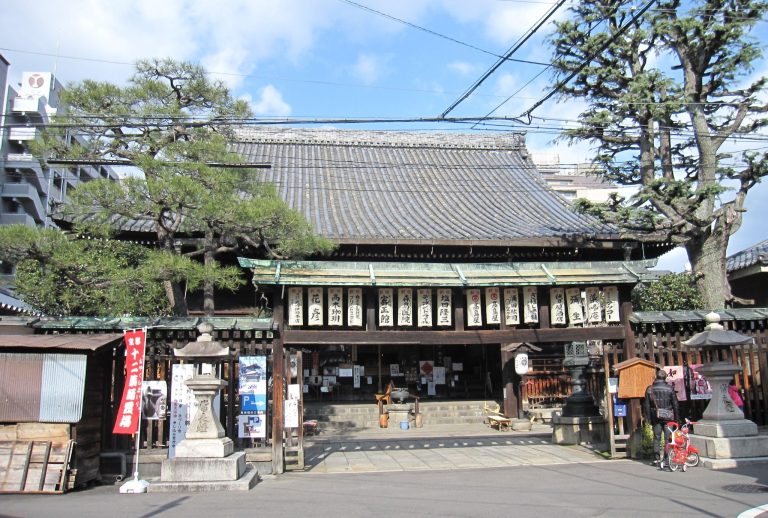
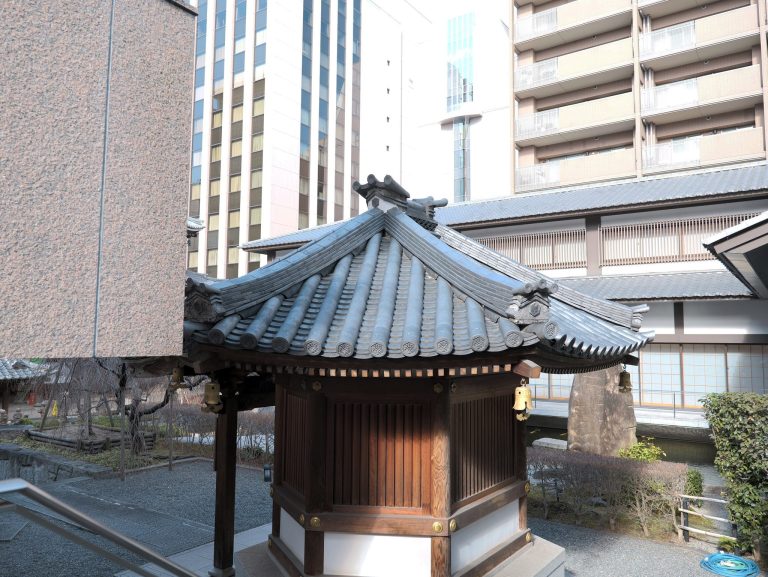
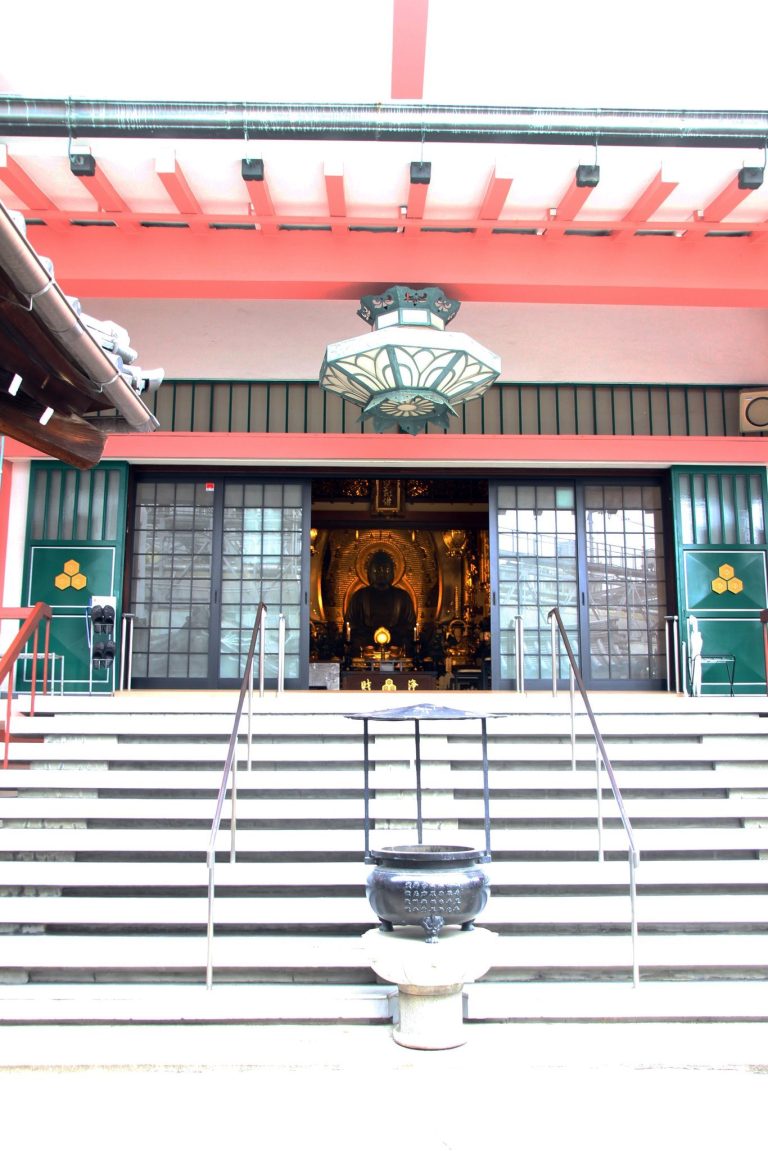
The present Bukkō-ji complex stands at 397 Shinkaichō in Shimogyō Ward, on Takakura-dōri south of Bukkō-ji Street. Its principal object of worship is Amitabha Buddha, and the precinct includes a hall identified as the Daishi Hall. The present grounds occupy the site to which the temple was moved in 1586 from Ryūgajō near Gojo Bōmon. Earlier centers at Yamashina and Shibutani form part of the institution’s historical geography, while the former Shibutani grounds were later incorporated into the Hōkō-ji Great Buddha complex.
Shinran’s funerary precinct
Bukkō-ji Honbyō is a detached precinct northeast of Shōren-in. Established during the Edo period, it serves as a cemetery for the Bukkōji-ha and is centered on Shinran’s mausoleum. It represents the branch’s continuing connection with Shinran, whose relics had earlier been kept within the main Bukkō-ji precinct before being transferred to the Higashiyama area.
Associated cultural properties
Several protected cultural properties are associated with Bukkō-ji. They include a standing wooden image of Prince Shōtoku, a colored genealogy on paper, and a standing wooden image of Amitabha. The objects preserve religious associations central to the temple’s history, including its traditions concerning Prince Shōtoku and its devotion to Amitabha.