Rokkaku-dō Temple: Kyoto’s Kannon Pilgrimage Temple and Birthplace of Ikenobō Flower Arrangement


Site at a Glance
- Rating
- 4.3
- Popularity
- Medium
- Country
- Japan
- Primary era
- Medieval
- External website
- Open
- Eras represented
- Medieval
- Civilizations
- Japanese
- Site type
- Religious
- Remains
- Sanctuary
On this page15 sections
History
Foundation and Medieval Development
Rokkaku-dō Temple, formally Chōhō-ji, is a Tendai Buddhist temple in Kyoto, Japan, whose history is traditionally traced to 587 and Prince Shōtoku. Its principal object of worship is a concealed image of Nyōirin Kannon, a compassionate Buddhist figure associated with wishes and protection. The traditional foundation story places the temple in the Asuka period, an era of early Japanese state formation, but excavations in 1974 and 1975 found no remains earlier than the late tenth century. The actual foundation date therefore remains uncertain and is generally placed around the end of the tenth century.
According to another foundation legend, the temple hall stood in the way when Heian-kyō, the imperial capital established at present-day Kyoto in 794, was being laid out. After black clouds appeared, the hall was moved about 15 metres north. The temple was said to have become an imperial prayer site in 822, and tradition records a visit by the retired Emperor Kazan in 996. Its first clear appearance in historical documentation comes in the early eleventh century, when Fujiwara no Michinaga’s diary recorded the place-name “Rokkaku-kōji” on 21 March 1017.
By the later Heian period, Rokkaku-dō had become an important destination for Kannon worship. The poem collection Ryōjin Hishō names it together with Kiyomizu-dera, Ishiyama-dera, and Hase-dera as a temple where worshippers could experience Kannon’s miraculous signs. Its religious reputation continued through later centuries, and the temple remains the eighteenth station of the Saigoku Kannon Pilgrimage, a historic circuit of 33 Kannon temples in the Kansai region. It is also the first station of the Rakuyō Thirty-Three Kannon Pilgrimage and the twenty-fifth site on the Prince Shōtoku Sacred Sites pilgrimage.
Shinran and the Urban Community
Rokkaku-dō also occupies an important place in the history of Japanese Buddhism through its association with Shinran. In 1201, the 29-year-old monk Han’en of Enryaku-ji spent 100 days in retreat at the temple. Tradition relates that on the ninety-fifth day he experienced a vision or dream involving Prince Shōtoku, which directed him toward Hōnen. Hōnen founded the Jōdo school, a movement centred on devotion to Amida Buddha through recitation of the nembutsu. Shinran later became the founder of Jōdo Shinshū, which developed from that movement.
During the Muromachi period, Rokkaku-dō hosted the lottery ceremony that determined the order of floats in the Gion Festival procession. The ceremony continued at the temple until the end of the Edo period. Its central position in Shimogyō, especially after the Ōnin War, also gave it a civic role. The temple functioned as a town hall and became a centre of urban culture and local self-government. Its warning bell was rung when danger threatened Shimogyō, while the grounds served as a gathering place for troops during disturbances including the Tenbun-Hokke Rebellion and for representatives of the district’s town organizations.
During the Great Yamashiro Famine of 1461, Ashikaga Yoshimasa, the eighth shōgun, ordered a relief hut to be built in front of the temple. The Ji-sect monk Gan’ami was placed in charge of distributing rice porridge to impoverished people who had entered Kyoto. The Ji sect was a Buddhist movement associated with itinerant religious practice and public recitation of the nembutsu. This episode illustrates the temple’s practical role in the life of the urban community as well as its religious importance.
Rebuilding and the Ikenobō Tradition
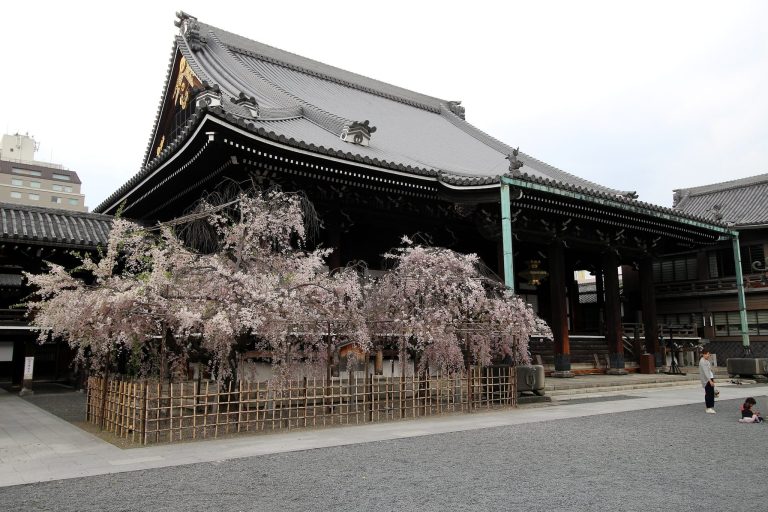
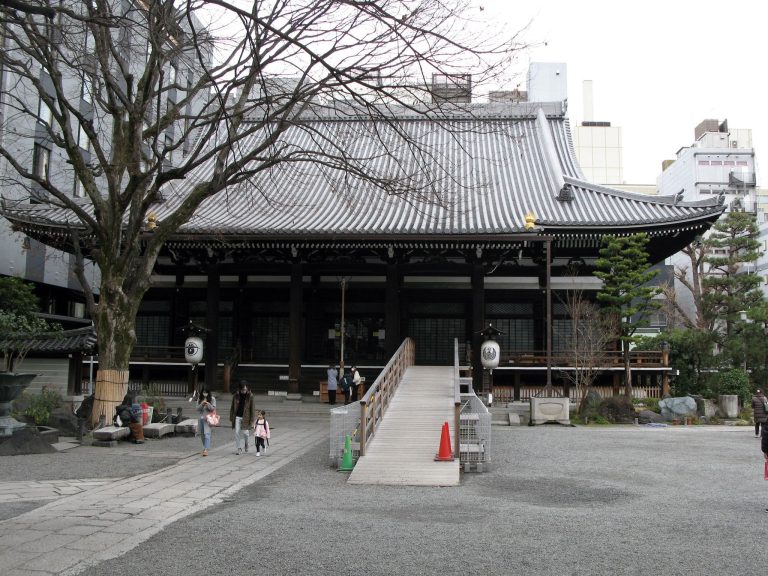
Rokkaku-dō suffered at least 18 documented disasters between a fire in 1125 and the end of the Edo period. Its importance to worshippers and to the town community led to repeated rebuilding. The present main hall was reconstructed in 1877. In the early modern period, the temple held a land allotment recorded as one koku and included sub-temples such as Tamon-in, Fudō-in, Jūshin-in, and Aizen-in. These subsidiary institutions no longer survive, but popular devotion continued, and numerous inns for pilgrims developed in the surrounding urban district.
The hall is regarded as the origin site of the Ikenobō school, a major tradition of Japanese flower arrangement. Ikenobō monks served as abbots and were expected to place flowers before the Nyōirin Kannon image. Their skill was already renowned by the fifteenth century. During the Bunmei era, the school’s twelfth head, Senkei, became known for standing flower arrangement, an early formal style in which branches and flowers are composed upright according to prescribed principles. During the Tenbun era, the thirteenth head, Sen’ō, was repeatedly invited to arrange flowers at the Imperial Court and compiled Ikenobō Sen’ō Kuden, the first comprehensive organization of the style’s theory and techniques.
The tradition linking Ono no Imoko directly with the introduction of flower arrangement is a later development. Early legends connect Imoko with Rokkaku-dō and identify him as its head, but do not associate him with flower arrangement. Archaeological investigation, including the excavations of 1974 and 1975, has helped distinguish these traditions from the temple’s historically attested development. The main hall, worship hall, and bell tower are designated tangible cultural properties by Kyoto City. Nationally designated Important Cultural Properties include a wooden standing image of Bishamonten and 93 Ikenobō Senkō flower-arrangement paintings.
Remains
Main Temple Grounds
Hexagonal Main Hall
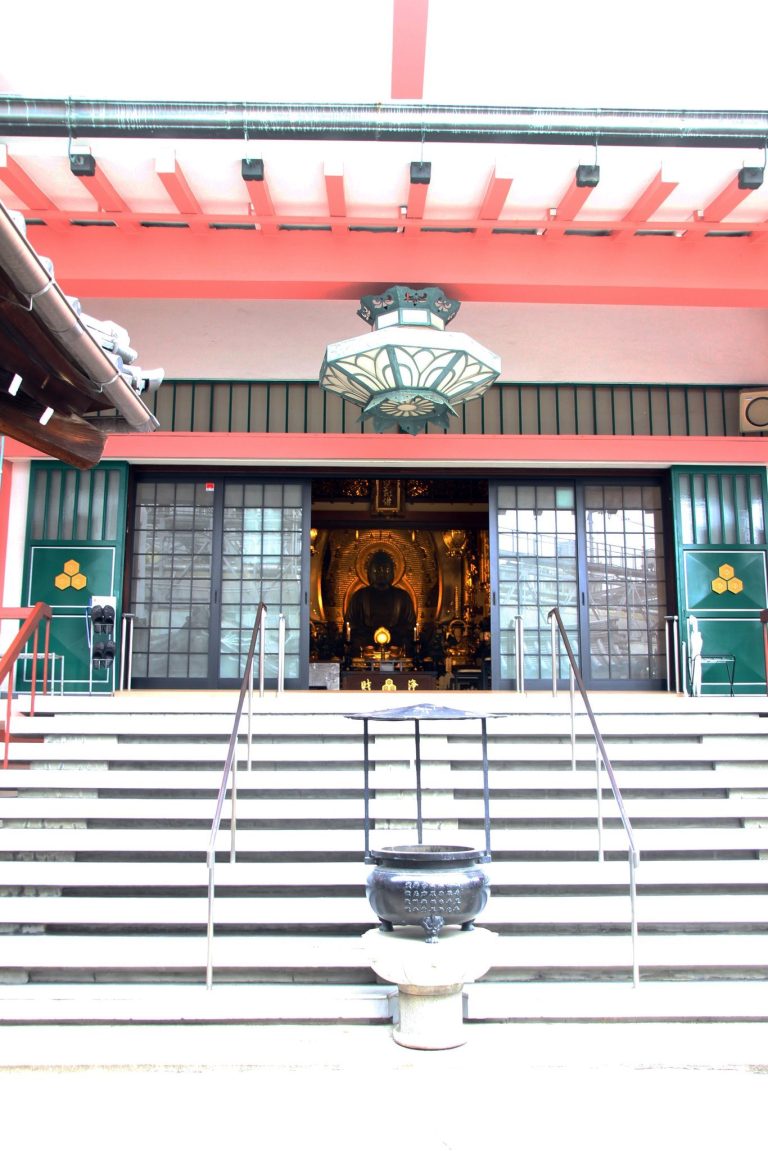
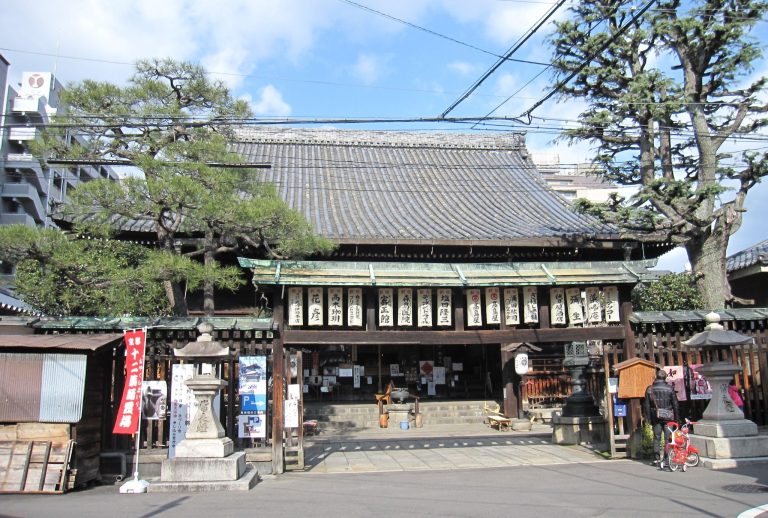
Rokkaku-dō is a compact urban temple complex whose principal hall stands directly beyond the main gate. The hall has a hexagonal plan, and this distinctive form gives the temple its common name, while Chōhō-ji remains its formal name. At the centre of the inner sanctuary, the concealed Nyōirin Kannon is kept inside a three-tiered shrine. The image is traditionally described as a three-inch gilt-bronze figure. One related iconographic record describes a two-armed form, while the image displayed before the shrine and the devotional image distributed to worshippers are six-armed.
The concealed image is traditionally said to have been donated by Taira no Tokuko, also known as Kenreimon’in, in 1178 as a prayer for safe childbirth. Kenreimon’in was the Buddhist name of the twelfth-century imperial consort. The image was opened for special devotional viewings in 2008 and 2009, the first such viewings since 1872, and again from 5 to 14 November 2016. Its date and other detailed characteristics remain unknown because it is not a designated cultural property.
Navel Stone and Prince Shōtoku Hall
The so-called navel stone lies to the right of the main hall, near the Shinran Hall and the sutra-offering office. Behind the main hall are a remnant of the pond associated with Prince Shōtoku’s bathing and a Prince Shōtoku Hall. The name Ikenobō, meaning “pond-side hut,” derives from the lodging or residence traditionally said to have stood beside this pond.
Shinran Hall
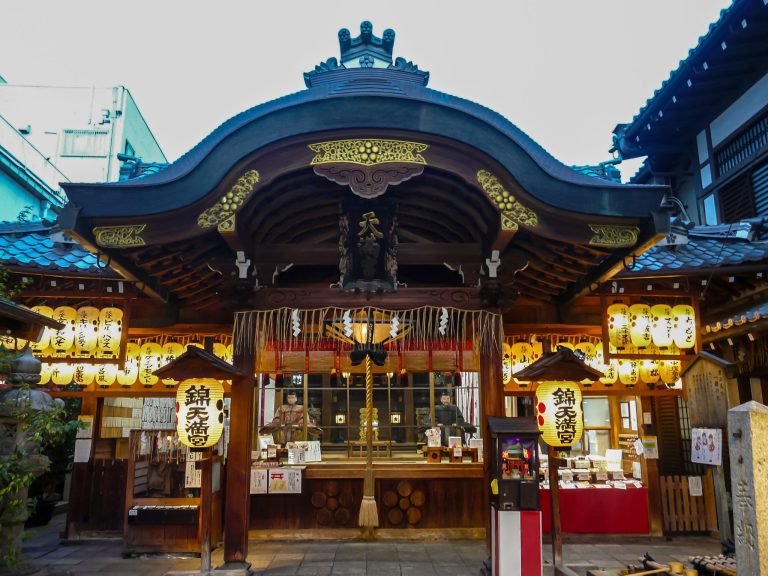
A small hexagonal hall associated with Shinran contains two statues of him. One shows him seated in a dream-like meditative posture, while the other depicts him standing with a staff and prayer beads. Together, the two images preserve the temple’s physical association with the retreat and vision that tradition connects with Shinran’s later religious path.
Bell Tower and Ikenobō Buildings
Bell Tower
The bell tower stands in a detached part of the temple grounds across a public road from the main gate. It forms part of the surviving institutional complex and, together with the main hall and worship hall, is designated a tangible cultural property by Kyoto City.
Ikenobō Headquarters
The Ikenobō headquarters building and Ikenobō Kaikan occupy the north side of the grounds. The third floor contains a museum of ikebana materials, linking the modern institutional facilities with the flower-arrangement tradition that developed through the temple’s abbots and their offerings before the Kannon image.
Movable Cultural Properties
Bishamonten Image
Among the temple’s nationally designated movable cultural properties is a 102-centimetre-high wooden standing statue of Bishamonten from the late Heian period. Bishamonten is a Buddhist guardian deity associated with protection, warfare, and prosperity.
Ikenobō Senkō Paintings
The temple also preserves 93 coloured flower-arrangement paintings associated with Ikenobō Senkō and dating from the Edo period. Five of these paintings are diagrams showing the seating arrangement for a flower-arrangement gathering at the Shishinden, a principal ceremonial hall of the Kyoto Imperial Palace. The group provides a visual record of the formal practices connected with the Ikenobō tradition.