Naminoue Shrine: Guardian Shrine of the Ryukyu Kingdom in Okinawa


Site at a Glance
- Rating
- 4.4
- Popularity
- High
- Country
- Japan
- Primary era
- Early Modern
- External website
- Open
- Eras represented
- Early Modern, Modern
- Civilizations
- Ryukyu Kingdom
- Site type
- Religious
- Remains
- Sanctuary
On this page8 sections
History
Naminoue Shrine is a sacred Shinto and Ryukyuan site in Naha, Japan, associated with the fourteenth and fifteenth centuries and represented today by a main sanctuary in the Nagare-zukuri, or flowing-style, form. It stands on a coastal bluff above Naha Port and Naminoue Beach, where an older place of sea worship became one of the principal religious centers of the Ryukyu Kingdom.
Ryukyuan origins and sacred traditions
Before the modern Shinto shrine system was introduced, the site was a Ryukyuan sacred place connected with the sea and Nirai-kanai, the distant oceanic realm from which deities, life, prosperity, and renewal were believed to come. It was known as Hana gusuku and Nanminsan. The name Hana gusuku means “the headland fortress,” reflecting the site’s position at the tip of Naha and its association with the dwelling place of the gods.
The shrine’s foundation date remains uncertain. One interpretation connects its establishment with the reign of King Satto, a fourteenth-century ruler of the medieval Ryukyu Kingdom, when the associated Gokoku-ji temple was founded in 1368. The shrine may have existed by the fifteenth century. Its early history also links it with an ancient communal burial place and the Naminoue Cave archaeological site, where ancestral veneration became part of the sacred character of the location.
A foundation tradition centers on Sakiyama satonushi, a local official or headman. He is said to have found a luminous stone on the shore that could speak. After prayers before the stone brought him plentiful catches, other deities tried to take it, and he carried it to Naminoue. There, Kumano Gongen, the manifested form of deities in the Kumano religious tradition, commanded him to build a shrine to protect the country. Sakiyama reported the oracle to the royal government, which then established the shrine.
A song completed in 1623 describes the building of Hana gusuku, the gathering of the people, and a pilgrimage to a sacred place. Naminoue has been understood as the site described in the song, linking the shrine with communal ritual and an older sacred landscape. The shrine’s religious character developed through the combination of indigenous Ryukyuan stone and sea worship with traditions associated with Kumano. Its principal deities, Izanami, Hayatama, and Kotosaka, connect it with that religious line.
Royal shrine and maritime protector
Naminoue became the chief guardian shrine of the Ryukyu Kingdom and later the general guardian of Okinawa. The royal government administered it as one of the Ryukyu Eight Shrines, a group of officially supervised shrines with special status, and ranked it highest among them. A religious record from 1605 called Naminoue the first great sacred manifestation of the kingdom. A similar foundation tradition appeared in a royal geographical and historical work presented to the king in 1713.
The site’s importance grew with Naha’s development as a port. Naha had originally been an island settlement, but the Long Rainbow Embankment connected it with Okinawa Island in 1451. The port was then improved for larger foreign vessels, and officials from Satsuma, Chinese immigrants, and other foreign residents settled in the expanding town. Naminoue stood above this maritime center and received prayers for safe voyages, good harvests, good fishing, and peace throughout the kingdom. The king traditionally visited at the beginning of each year to pray on behalf of the country.
Gokoku-ji, whose name means a temple for the protection of the country, served as the shrine’s attached Buddhist institution. It belonged to the Shingon tradition, an esoteric form of Buddhism centered on ritual practice, sacred images, and mantra. The temple later declined and was traditionally said to have been revived in 1522 by Nisshu, a Shingon monk who had drifted to the Ryukyu Islands from Kumano. Nisshu is said to have carved images of Amida Buddha, Yakushi Buddha, and Senju Kannon, understood as Buddhist manifestations of the three Kumano deities.
The complex also supported local forms of worship. The Negumi practice continued into the modern period, with residents placing incense burners on heights near the shrine and praying toward the direction of their respective homelands. The former Chōju Shrine, later called Ukishima Shrine, was established in Wakasa in 1451 after Amaterasu, the Shinto sun deity, was invited from mainland Japan to support the successful construction of the Long Rainbow Embankment. It was later transferred to a temporary inner sanctuary at Naminoue. Chōju Shrine is regarded as the earliest shrine in the Ryukyu Islands whose establishment is confirmed by historical records.
Fire, rebuilding, and modern status
The shrine buildings burned in 1633 and were rebuilt in 1635. Severe structural damage in 1803 led to a change in the arrangement of the Buddhist images. They had previously been housed in three separate halls, but were brought together in a single hall. The images had been transferred to Gokoku-ji before the fire and survived the destruction of the shrine buildings.
After Okinawa was incorporated into Japan, the modern shrine-ranking system designated Naminoue a Kanpei-shōsha, or Imperial-sponsored minor shrine, in 1890. Its formal reestablishment ceremony took place on 17 May that year, and the date became the annual grand festival from 1893. In 1924, Naminoue was designated the center of religious affairs on the island. During the Sino-Japanese War and Russo-Japanese War, women reportedly prayed at the shrine that their sons would be judged unfit for military service in the Japanese Empire.
A three-hundredth anniversary festival for the shrine’s restoration was held in 1935, and the shrine garden was improved by about 1938. During the Battle of Okinawa in 1945, the chief priest evacuated the sacred object to Mabuni Village. Fighting destroyed the shrine precinct, while a torii remained standing.
Reconstruction began in 1952. The main hall and shrine office were rebuilt in 1953 through donations from Okinawan emigrants in Hawaii, and the worship hall was rebuilt in 1961 with support also sought from mainland Japan. A return-to-Japan reporting ceremony took place in 1972, when the Imperial Household presented a ritual offering. The old shrine office and assembly hall were replaced by a new office in 1987. The first torii was rebuilt in 1990, and a major Heisei-period rebuilding reconstructed the main and worship halls before a ritual re-enthronement in 1993. Wider improvements concluded in 1994, and a second shrine office was built in 2003.
Naha City designated the precinct in 2006 as the “Naminoue (Nanmin)” historic and scenic cultural property, recognizing its longstanding religious and scenic importance. Naminoue is a former Kanpei-shōsha, a present Beppyō shrine of the Okinawa Prefectural Shrine Association, and one of the Ryukyu Eight Shrines. The National Association of Ichinomiya also recognizes it as the New Ichinomiya of the Ryukyu Kingdom. The 17 May grand festival and the surrounding Nanmin Festival remain its principal annual observances. The Okinawa Prefectural Shrine Association maintains its office within the precinct, making Naminoue one of the centers of Shinto activity in Okinawa.
Remains
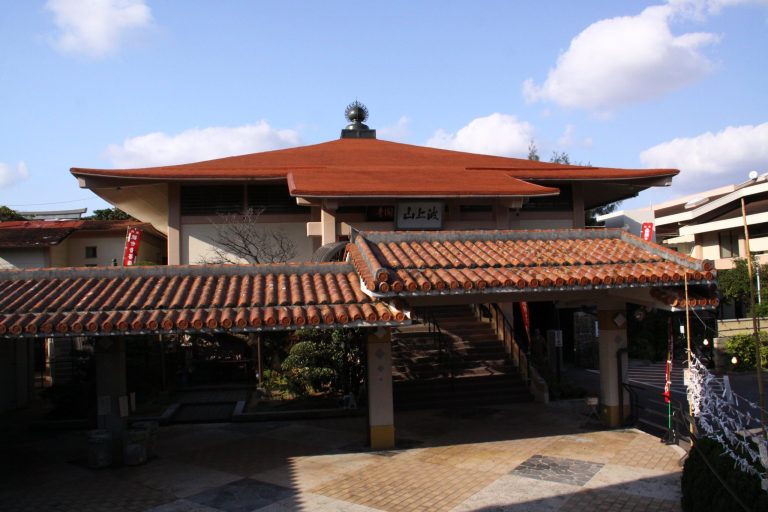
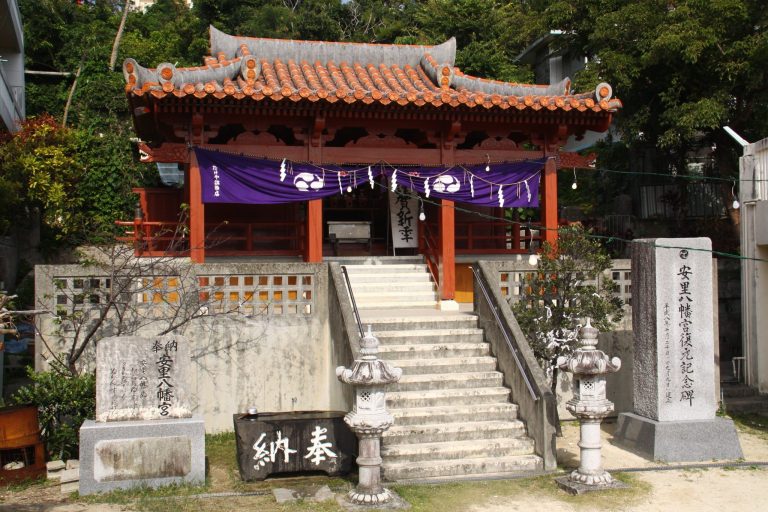
The shrine occupies the summit of a high coastal bluff above Naminoue Beach and the ocean, with views toward Naha Port. Its precinct contains the main hall, worship hall, shrine offices, torii, smaller shrines, a ritual ablution structure, and the associated Gokoku-ji temple. The main sanctuary follows the Nagare-zukuri form, whose curved gabled roof projects forward over the entrance. The principal buildings and several other structures represent the postwar and Heisei-period rebuilding campaigns.
Shrine buildings and Buddhist complex
The main hall serves as the sanctuary for the shrine’s principal sacred presence, while the worship hall provides the space for prayer. Both were reconstructed during the modern rebuilding of the precinct and were rebuilt again during the Heisei-period works completed in 1993. The first torii was reconstructed in 1990. Shrine offices, smaller shrines, and the ritual ablution structure form additional parts of the active precinct.
Gokoku-ji remains associated with the shrine as its attached Buddhist temple. The three images attributed to Nisshu, Amida Buddha, Yakushi Buddha, and Senju Kannon, were brought together in one hall after the 1803 remodelling. Their survival at Gokoku-ji during the 1633 fire preserves a physical connection between the Buddhist temple and the shrine’s earlier religious arrangement.
Naminoue Cave archaeological site
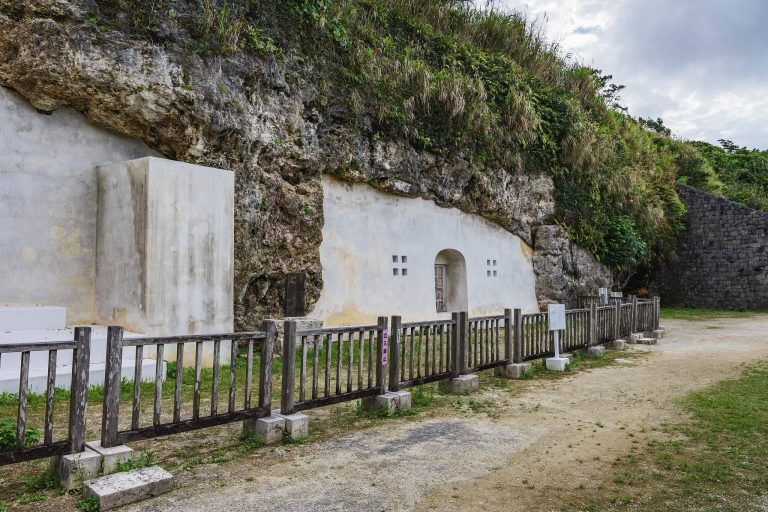
The Naminoue Cave archaeological site lies at the shrine’s location. The cave has been interpreted as an ancient communal burial or exposure-burial place. Its ossuary space became a place of worship, connecting the physical setting of the shrine with ancestral veneration and helping explain why the bluff held sacred importance before the shrine took its later institutional form.
Ukishima Shrine sanctuary
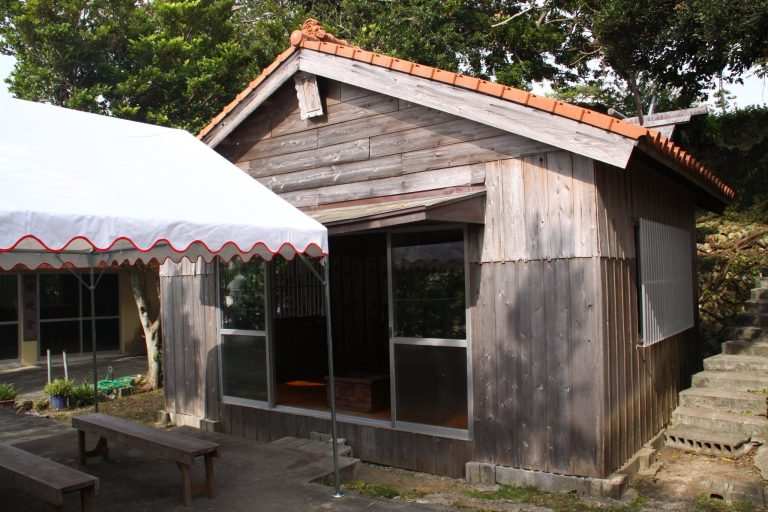
The precinct contains a temporary inner sanctuary for Ukishima Shrine, formerly called Chōju Shrine. Established in Wakasa in 1451, the shrine was transferred to Naminoue in 1988. Its presence adds a separately established shrine tradition to the buildings and sacred spaces gathered within the Naminoue precinct.