Gokoku-ji Temple: A Shingon Buddhist Royal Temple in Okinawa


Site at a Glance
- Rating
- 4.3
- Popularity
- Low
- Country
- Japan
- Primary era
- Medieval
- External website
- Open
- Eras represented
- Medieval
- Civilizations
- Ryukyu Kingdom
- Site type
- Religious
- Remains
- Temple
On this page8 sections
History
Gokoku-ji Temple is a Shingon Buddhist temple in Naha, Japan, dedicated to Kannon Bosatsu, a bodhisattva associated with compassion. Founded in 1367 or 1368 by Raijū, a monk from Japan’s Satsuma Province, it was established under the patronage of the royal government of Chūzan, the Okinawan kingdom that controlled the Naha area before the fifteenth-century unification of the Ryūkyū Kingdom.
Royal foundation and religious role
Gokoku-ji was created as the companion temple, or shrine-temple, of the existing Naminoue Shrine, a Shinto shrine on a coastal bluff. This arrangement provided Buddhist religious services for the associated shrine. Gokoku-ji became a principal national temple of Chūzan and later of the unified Ryūkyū Kingdom. It also served as the royal prayer temple and the head temple of Shingon Buddhism in the kingdom. A separate tradition attributes its foundation to another monk.
Royal tradition connected the temple with prayers for the protection of the state and for abundant harvests. From the reign of King Bunei through that of King Shō Tai, successive Ryūkyū kings reportedly visited Gokoku-ji at their accessions with hundreds of retainers. In the main hall, the king and his subjects exchanged a ceremonial cup that represented their bond.
The Bettelheim occupation
In 1846, Bernard Jean Bettelheim, a Hungarian-born British Christian missionary and physician, took up residence at Gokoku-ji for approximately seven to eight years. He had arrived aboard HMS Starling under the Loochoo Naval Mission. Although the Naha port master protested his landing and the ship’s captain wished to comply, Bettelheim went ashore and accepted shelter at the temple.
Bettelheim expelled Buddhist worshippers and monks, blocked the sanctuary, and discarded much of the temple’s furnishings because he considered them idolatrous. He also used medical treatment in his Christian missionary work, even though Christianity was prohibited in the Ryūkyū Kingdom. The royal government kept him under close observation, built a guard post outside the grounds, and assigned men to watch the temple and accompany him when he travelled.
When United States Navy Commodore Matthew Perry arrived in 1853 as part of an expedition seeking wider American diplomatic and commercial access in East Asia, Bettelheim temporarily acted as his translator and intermediary. Despite Bettelheim’s objections, Perry established an American base within the temple grounds, including a fenced enclosure where cattle could graze. The installation prompted strong protests from the Ryūkyū authorities.
The bell and later nineteenth-century history
During Perry’s second visit in 1854, the Ryūkyū Kingdom offered the United States a temple bell from Shuri. It was judged imperfect and replaced with the bell from Gokoku-ji, partly because the temple had been desecrated and occupied as Bettelheim’s residence for about eight years. Perry intended the bell for installation in or near the Washington Monument, but that proposal was rejected. The bell was instead given to the United States Naval Academy at Annapolis, where it was rung in connection with Navy victories in the annual Army-Navy football game. It returned to Okinawa in 1987.
Bettelheim left Okinawa with Perry, after which Gokoku-ji returned to its Buddhist occupants and its original religious purpose. In 1871, a Ryūkyūan ship was blown off course to Taiwan, where several Okinawans were killed in a conflict with Paiwan people, an Indigenous people of Taiwan. The incident became an international dispute between Japan and China over sovereignty in Okinawa and Taiwan and over possible Chinese reparations to Japan. The dead were said to have been recovered and buried at Gokoku-ji during a major ritual commemorating people believed to have died in the service of the state.
Destruction and reconstruction
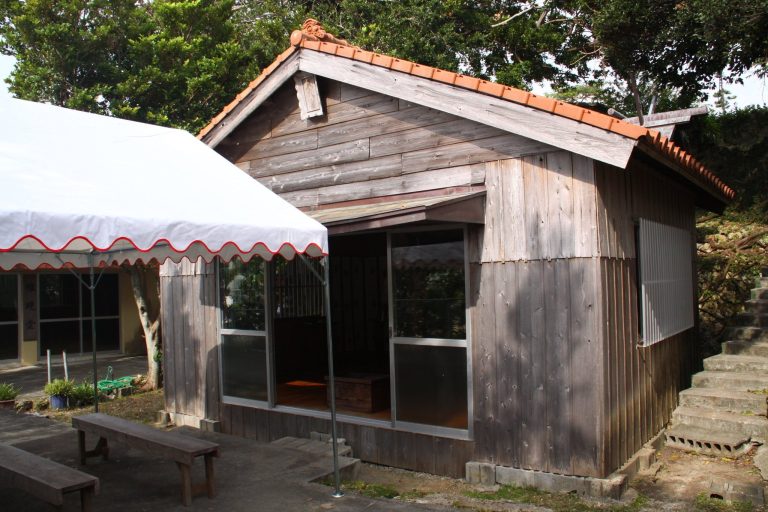
Naval bombardment destroyed Gokoku-ji during the 1945 Battle of Okinawa. All of its prewar buildings, Buddhist images, and historical documents were lost. Unlike some other severely damaged Okinawan temples that were abandoned, Gokoku-ji was rebuilt in 1947 in a barrack-like form on the site of former Okinawa Prison staff quarters. It returned to its original location in 1952 and remains an operating temple. The temple is described as the oldest surviving temple in Okinawa and retains its institutional connection with Naminoue Shrine.
Remains
Temple setting and surviving buildings
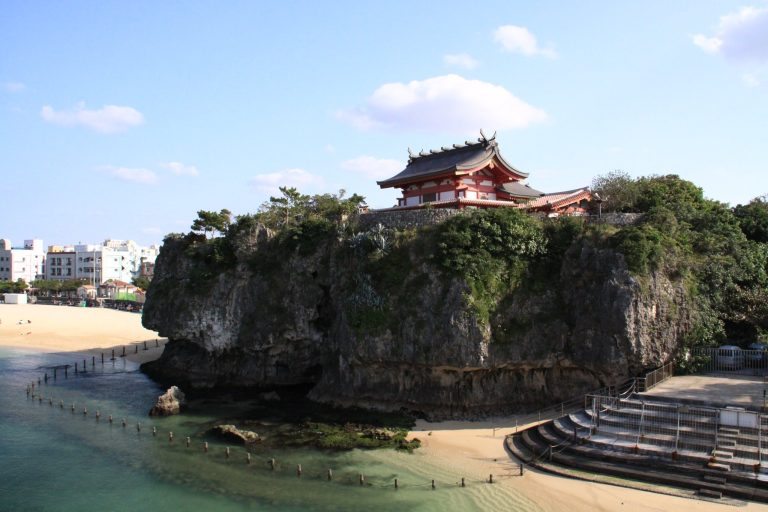
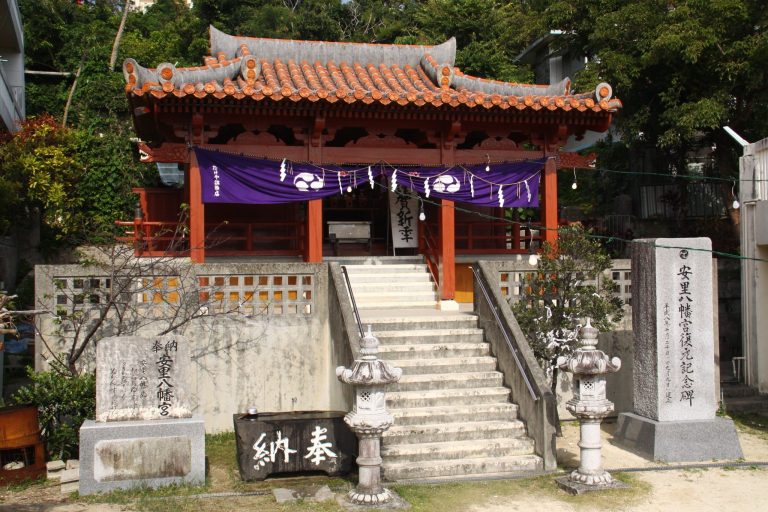
Gokoku-ji stands at 1-25-5 Wakasa in Naha, on a bluff overlooking Naminoue Beach and the ocean, beside Naminoue Shrine. The temple’s formal designation includes the mountain name Naminoue Mountain and an institutional designation in addition to Gokoku-ji, and it is also known as the temple of Naminoue. The surviving site includes a main prayer hall. The Ryūkyuan royal family’s mitsu-tomoe crest and the Japanese government’s paulownia crest appear on opposite sides of its doors.
The bell and commemorative monuments
The Gokoku-ji bell was cast in 1456 during the reign of King Shō Taikyū. Its inscription calls on the bell to dispel illusory dreams and perfect human souls, while expressing the hope that the king and his subjects would live virtuously and leave foreign invaders no opportunity to attack the kingdom. Removed from the temple and transferred to the United States Naval Academy at Annapolis, it was returned to Okinawa in 1987; its later location within Okinawa is not specified.
A stone memorial to Bettelheim, erected in 1926, remains within the temple grounds. A related commemorative monument honors a person who learned cowpox-inoculation methods from Bettelheim.