Himuro Shrine: A Shinto Sanctuary of Ice Worship and Court Music in Nara


Site at a Glance
- Rating
- 4.2
- Popularity
- Medium
- Country
- Japan
- Primary era
- Early Modern
- External website
- Open
- Eras represented
- Medieval, Early Modern, Modern
- Civilizations
- Ashikaga shogunate, Japanese, Kamakura shogunate, Tokugawa
- Site type
- Religious
- Remains
- Sanctuary
On this page18 sections
History
Himuro Shrine is a Shinto shrine in Nara, Japan, traditionally established in 710 during the Nara period. Its foundation tradition relates that Emperor Genmei ordered an ice deity to be enshrined at Tsukihi Rock on Mount Kasugayama, upstream from the Yoshiki River. The first sanctuary was called Shimotsu Iwane Shrine. The institution developed around the preservation and offering of ice to Heijo-kyo, the Japanese capital during much of the Nara period.
Ice Offerings in the Nara Period
An ice pond at Kasugano supplied ice that was stored in an icehouse at Asajigahara, overlooking Arake Pond and Sagi Pond. The ice was offered to Heijo-kyo from the following year. The first imperial ice-offering ceremony took place on June 1, 711, after which ice was supplied annually from April 1 through September 30.
This system continued for more than seventy years under seven successive Nara-period courts. It ended after the capital moved to Heian-kyo in 794, beginning the Heian period. The shrine’s early history therefore joined religious practice with an organized supply system connected to the imperial court.
Relocation and the Court-Music Institution
On February 1, 860, during the reign of Emperor Seiwa, the shrine was transferred to its present location. Its three enshrined kami then became Tsugenoinagi Oyamanushi no Mikoto, Nukata no Onakatsuhiko no Mikoto, and Emperor Nintoku. In the shrine’s tradition, Tsugenoinagi Oyamanushi taught the making and preservation of ice, Nukata no Onakatsuhiko first presented ice to the emperor, and Emperor Nintoku received it.
The shrine buildings are traditionally dated to 1217. During the thirteenth century, Nanto Gakuso, one of Japan’s three principal court-music institutions, was established at Himuro Shrine. The institution included instrumental music and dance, and the shrine became a major center for these arts in Nara. Musicians later served as the shrine’s priests, further joining its religious identity to court performance.
Himuro Shrine belonged to Kasuga Shrine as a subsidiary sanctuary. Its rites, repairs, and other expenses were supported through several sources, including assistance from Kasuga Shrine, Kofuku-ji’s grant of 20,000 koku of rice-based land revenue, income assigned to the shrine precinct, and 2,000 koku allocated to the three principal court-music institutions.
Modern Institutional Changes
The Meiji-period separation of Buddhism and Shinto ended the shrine’s institutional relationship with Kofuku-ji, the Buddhist temple historically associated with Kasuga Shrine. In 1870, Nanto Gakuso was abolished and combined with the other two principal court-music institutions to form the music division of the Imperial Household Ministry, now the Music Department of the Imperial Household Agency.
Himuro Shrine was classified as a village shrine and designated as eligible to receive state offerings of food and ceremonial textiles. It is now maintained through support from parishioners and the frozen-ice industry.
Festivals and Continuing Traditions
The Ice Offering Festival preserves the shrine’s connection with worship of an ice deity. In the Nara period, the ice pond and icehouse were associated with prayers for favorable weather and a good harvest. The present festival is held on May 1, avoiding the industry’s busy month of June, and draws ice manufacturers and sellers from across Japan, who pray for the prosperity of their businesses. Three flower-ice offerings and six ice pillars are presented, followed by four court-dance pieces.
The annual festival is traditionally said to have begun on September 1, 1117, during the reign of Emperor Toba, as a rite intended to suppress epidemics. It temporarily lapsed after the Genpei conflicts, the late twelfth-century wars between the Taira and Minamoto clans, but was revived in 1217 by Emperor Juntoku. He recognized Himuro Shrine as the tutelary shrine of Nanto Gakuso, and an imperial envoy is said to have attended the revived observance.
Until the end of the Edo period, the annual celebration was known as the Himuro Dance Festival and by related names. Records describe performances beginning on the evening of October 1 and continuing through the following day’s post-festival celebration, with as many as thirty-eight dances presented.
Until the Meiji period, the festival procession’s portable shrine was placed at the entrance of the former Ichijo-in palace residence. The Ichijo-in abbot of Kofuku-ji conducted the temporary-shrine rites, and musicians were traditionally said to have accompanied the procession between the shrine and the temporary shrine. After the Meiji period, the temporary shrine was moved to the site of Kofuku-ji’s former South Great Gate.
The procession later passed through the shrine’s parish area of thirty-two neighborhood districts. Traffic conditions led to its suspension in 1962, and it resumed in 2020 after a fifty-eight-year interruption, traveling between Himuro Shrine and the temporary shrine at the former South Great Gate site of Kofuku-ji. Three or four parish districts now take turns organizing the September 30 eve-of-festival observance and the October 1 annual festival. Ice lanterns made from candles placed on votive plaques and perforated blocks of ice are displayed at the shrine and in the parish districts.
Remains
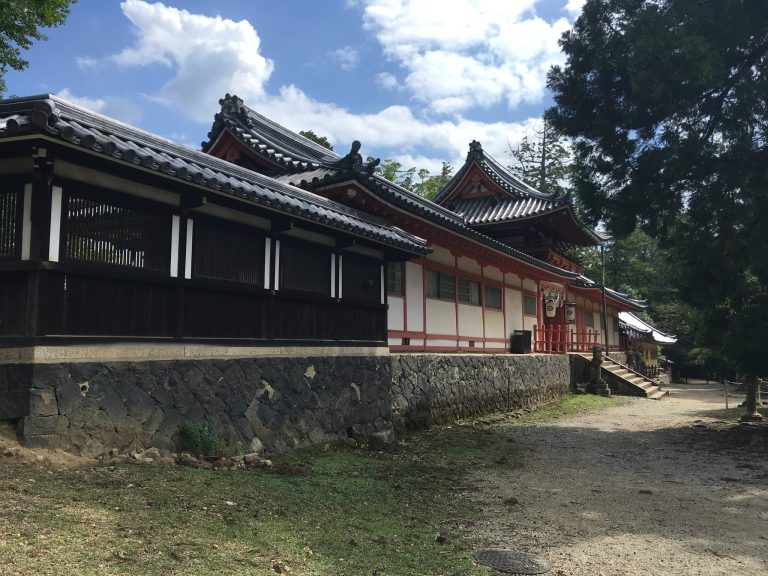
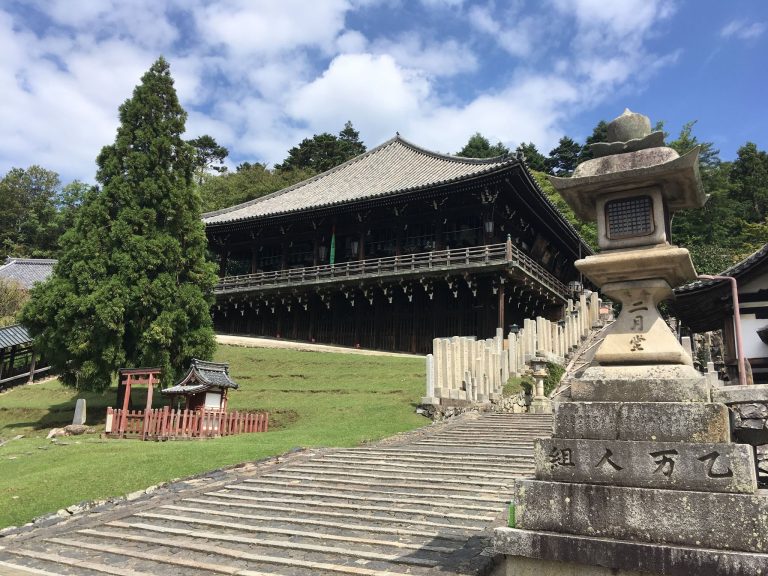
Himuro Shrine is arranged along an approach from Noborioji Street, with a Kasuga-style torii marking the entrance to the sacred precinct. Stone lanterns line both sides of the approach. The water-ablution pavilion stands on the right and the subsidiary Haraedo Shrine on the left, while a mirror pond and a weeping cherry tree lie behind the lanterns and pavilion. A central flight of steps rises toward the main gate.
Approach and Gateways
Torii and Precinct Approach
The first torii is a Kasuga-style gateway, marking the transition into the shrine precinct. Beyond it, the rows of stone lanterns, the water-ablution pavilion, Haraedo Shrine, and Mirror Pond form the initial sequence of the approach. Haraedo Shrine is also called the Haraisho or Sumiyoshi sanctuary.
Main Gate and Galleries
The main gate is a four-legged gate, a form supported by four auxiliary posts, with a tile roof. It originally belonged to the imperial palace and was transferred to Himuro Shrine in 1402. In 1641, the doors of the former palace gate and five pieces of gold were presented to the shrine.
Eastern and western galleries are attached to the main gate. They originally served as palanquin lodgings at the imperial palace and were transferred to the shrine in 1402. Each gallery measures three bays along its length and two bays across.
Sanctuaries and Performance Spaces
Main Sanctuary
The main sanctuary was rebuilt during the Bunkyu era, from 1861 to 1864. It is a three-bay nagare-zukuri sanctuary, a Shinto style with a gracefully curving roof extended over the front, and has a cypress-bark roof. Two chambers fitted with double-hinged plank doors are set beneath the floor.
Worship Hall and Dance Pavilion
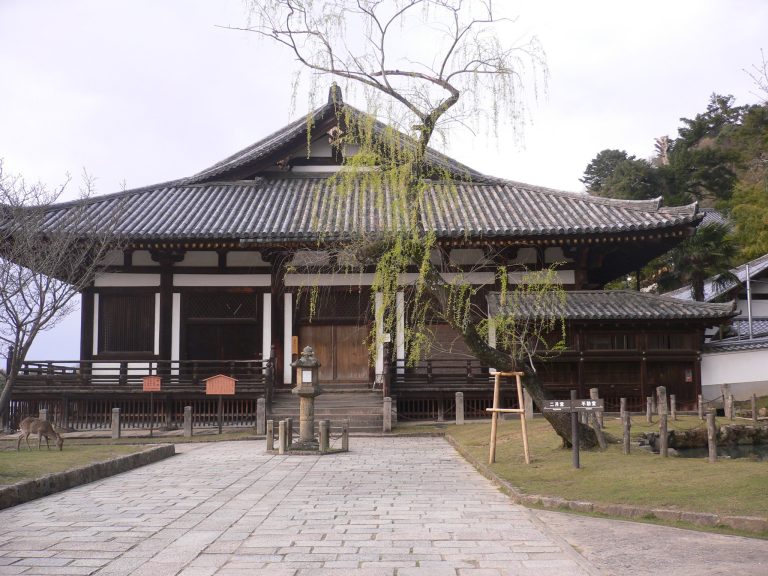
The worship hall also functions as a dance hall. It is a court-dance pavilion with a balustrade and formerly formed the central area of Nanto Gakuso, the court-music institution based at the shrine.
Dance-Light Shrine
The Dance-Light Shrine has a one-bay Kasuga-style sanctuary with an attached display-shelf structure. It enshrines the founder of Nanto Gakuso, who is regarded as the tutelary deity of its musicians.
Additional Precinct Structures
Ancestor-Spirit Shrine
The Ancestor-Spirit Shrine was authorized in 1877, and ancestral spirits were enshrined there on September 21 of that year. Victims of the Satsuma Rebellion, the 1877 armed revolt in southwestern Japan against the Meiji government, were jointly enshrined there in 1889. The south-facing building is made of unpainted timber.
Office and Service Buildings
The reception hall serves as the shrine office and meeting hall. Other components of the precinct include a sacred grove, a treasure storehouse, and a food-offering hall.
Mirror Pond
Mirror Pond is an associated water feature within the precinct, positioned behind the approach lanterns and the water-ablution pavilion.
Cultural Property
A wooden, polychrome Ryo-o dance mask from the Kamakura period is associated with Himuro Shrine. It measures 29.5 centimeters in length and 24 centimeters in width and is deposited with the Nara National Museum.
The main sanctuary, main gate, eastern gallery, and western gallery are designated as tangible cultural properties of Nara Prefecture. The worship hall is designated as a tangible folk-cultural property of Nara City.