Sueyoshi-gū: A Shinto Shrine of the Ryukyu Kingdom in Japan


Site at a Glance
- Rating
- 4.4
- Popularity
- Low
- Country
- Japan
- Primary era
- Medieval
- External website
- Open
- Eras represented
- Medieval
- Civilizations
- Ryukyu Kingdom
- Site type
- Religious
- Remains
- Sanctuary
On this page5 sections
History
Sueyoshi-gū is a Shinto shrine in Naha, Japan, established during the Ryukyu Kingdom between 1450 and 1457 under King Shō Taikyū. Built in the nagare-zukuri style, it became one of the Eight Shrines officially supported by the kingdom and was also known as Shuri Shadan.
Foundation and sacred tradition
The shrine’s principal deities are the Kumano Gongen, Buddhist-Shinto manifestations associated with the sacred Kumano complex: Izanami-no-Mikoto, Hayatamao-no-Mikoto, and Kotosakanowo-no-Mikoto. Other enshrined figures include an earth-ancestor deity, Okitsuhiko-no-Mikoto, Okitsuhime-no-Mikoto, and a local tutelary deity.
The Ryukyu-koku yurai-ki, compiled in 1713, places the shrine’s foundation during the reign of Shō Taikyū, the sixth king of the Ryukyu Kingdom’s First Shō Dynasty. A similar account appears in the Ryukyu Shinto-ki, first published in 1648.
Tradition credits Kakuo, the former head priest of Tenkai-ji, with establishing the shrine. While studying in Yamato, he vowed to make a pilgrimage to Kumano if he completed his religious training. After returning and becoming an abbot, he repeatedly asked King Shō Taikyū for permission to fulfill the vow, but the king refused.
According to the foundation story, Kumano Gongen then appeared to Kakuo in a dream and instructed him to call toward the northern mountains. He followed the echo to a rugged, rocky place that had not previously been visited and found a demon mask there. Kakuo revered the object as a miraculous sign. After hearing of the event, the king experienced an important dream of his own and ordered his ministers to establish a major shrine at the location.
The same tradition relates that Kakuo found a mirror while walking through the site. Believed to emit miraculous light, it was placed in the shrine’s inner sanctuary.
Ryukyu Kingdom administration
Sueyoshi-gū’s associated temple was Manjū-ji, now called Henjō-ji. The temple belonged to the Shingon tradition of Japanese Buddhism, and it may have been established at the same time as the shrine.
As one of the kingdom’s officially supported Eight Shrines, Sueyoshi-gū received priestly salaries and maintenance funds from the royal government. Its religious staff included shrine functionaries, female attendants, and shrine youths. The royal temple-and-shrine office also provided the ceremonial clothing worn by the functionaries and attendants during sacred music and dance.
Decline, destruction, and reconstruction
After the Ryukyu Kingdom was abolished and Okinawa Prefecture was established in 1879, Sueyoshi-gū became an unranked shrine within Japan’s modern shrine-ranking system. A proposal to classify it as a village shrine could not be carried out because of inadequate finances and the poor condition of its buildings and facilities.
Without government support, the shrine entered severe economic and religious decline. By the time it was included in an Okinawa Prefectural Development Project reconstruction plan in 1939, the worship hall that had survived until around the end of the Meiji period had disappeared, while the main hall was seriously decayed.
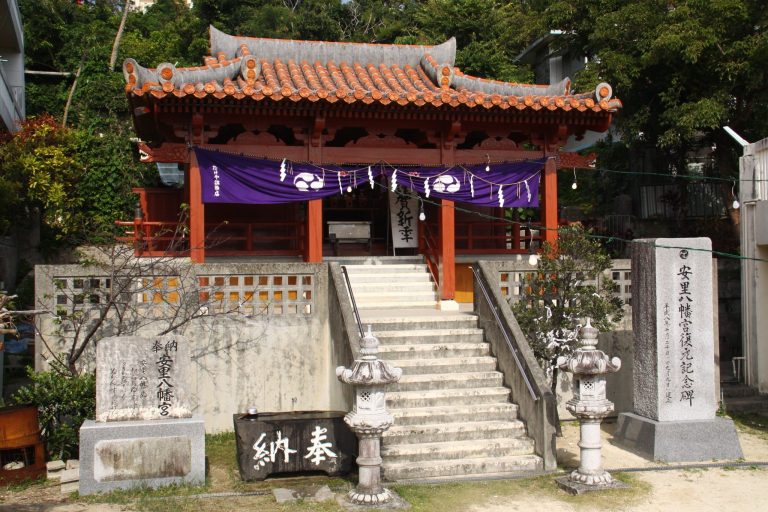
The shrine’s three-bay nagare-zukuri main hall and Okinogu were designated National Treasures in 1936. Artillery fire during the 1945 Battle of Okinawa destroyed the main hall, leaving its foundation stones, two pillars, and a pierced crossbeam. The present shrine building was reconstructed in 1972 with the surviving foundation stones and materials. The grounds were designated a National Historic Site that same year. The principal annual festival takes place on November 23.
Remains
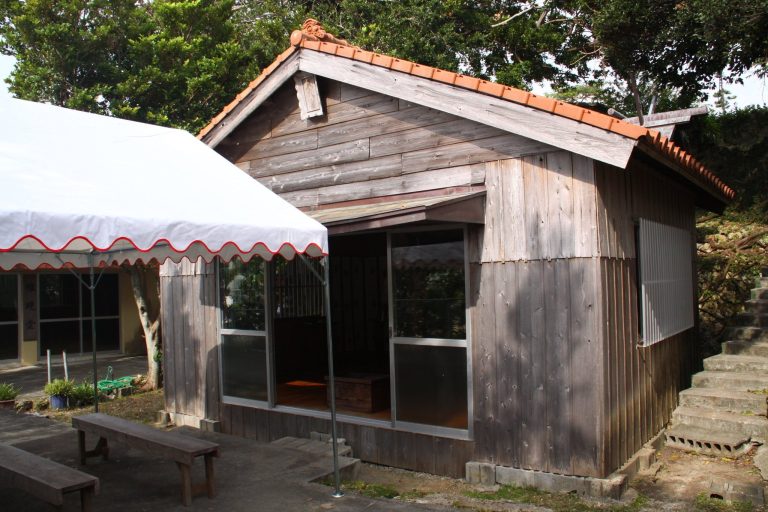
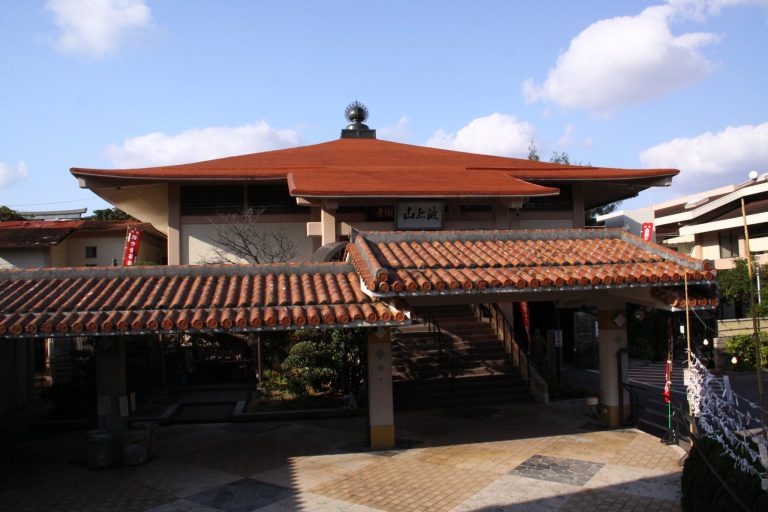
The surviving shrine is centered on a reconstructed main building whose form follows the three-bay nagare-zukuri style. In this design, a gabled roof extends forward on its front slope to create a covered porch, while “three-bay” describes a frontage divided into three structural sections. The present building incorporates foundation stones and other materials that survived from the prewar hall.
Before the 1945 destruction, the main hall had already deteriorated severely. Most of its roof tiles had been lost, two rafters on each of its three sides were missing, and the structure was in a state of decay and disrepair. The foundation stones, two pillars, and pierced crossbeam that remained after the battle provided material links to the earlier building and were used in the 1972 reconstruction.
The shrine’s sacred traditions are also connected with physical objects associated with the site. A mirror found during the traditional foundation story was kept in the inner sanctuary because it was believed to give off miraculous light. A demon mask discovered at a rugged rocky place was revered by Kakuo as evidence of supernatural power and became part of the shrine’s founding tradition.