Asato Hachimangū: A Ryukyu Hachiman Shrine in Naha, Japan


Site at a Glance
- Rating
- 4.1
- Popularity
- Low
- Country
- Japan
- Primary era
- Medieval
- External website
- Open
- Eras represented
- Medieval
- Civilizations
- Ryukyu Kingdom
- Site type
- Religious
- Remains
- Sanctuary
On this page9 sections
History
Asato Hachimangū is a Shinto shrine in Naha, Japan, traditionally founded during the Tenshun period from 1457 to 1464 under the Ryukyu Kingdom. It is one of the Ryukyu Eight Shrines, a group of officially recognized Shinto shrines supported by the royal government, and the only Hachiman shrine in that group. Hachiman is a Japanese Shinto tradition centered on a deity associated with warfare, protection, and Emperor Ōjin.
Foundation traditions
The shrine’s traditional origin is connected with King Shōtoku, the sixth ruler of the First Shō dynasty. The Record of the Origins of the Ryukyu Kingdom relates that Shōtoku led an expedition against Kikai Island and, at Asato, shot down a bird. After returning victorious, he ordered a shrine to be built at the place in honor of Hachiman. The same tradition says that the Ryukyuan fleet recovered a large bell at sea, which the king understood as a gift from Hachiman.
This account also links the shrine’s foundation with Jindokuji, its associated Buddhist temple. The bell was hung at Jindokuji, while the Ryukyu Shintoki attributes the establishment of Asato Hachimangū to the reign of King Shō Taikyū, the fifth ruler of the First Shō dynasty. These traditions preserve two different associations with the shrine’s origin within the fifteenth-century Ryukyu Kingdom.
Royal support and religious administration
Asato Hachimangū was institutionally paired with Jindokuji, one of the eight officially supported Shingon Buddhist temples. Shingon is a major Japanese Buddhist school centered on esoteric ritual and teachings. Under the Ryukyu royal government’s system of state-supported shrines, the government paid salaries for shrine personnel and provided money for repairs. Ritual officials, attendants, and shrine boys served at Asato Hachimangū, while the royal Temples and Shrines Office supplied the garments worn by officials and attendants during kagura, the ritual music, dance, and performance offered in Shinto worship.
The shrine venerates Emperor Ōjin, Empress Jingū, and Tamayori-hime. Its annual festival takes place on the Sunday nearest the ninth day of the ninth month in the traditional lunar calendar. Jindokuji stood across the road to the southwest and remained the shrine’s associated temple within this paired religious arrangement.
Decline, destruction, and rebuilding
After the Ryukyu Kingdom was abolished and Okinawa Prefecture was established during the Meiji period, Asato Hachimangū became an unranked shrine under Japan’s modern shrine-ranking system. A proposal to classify it as a village shrine was not implemented because of financial limitations and the poor condition of its buildings and facilities. Without financial support from the Japanese government, the shrine deteriorated severely and was included in an Okinawa Prefecture development project in fiscal year 1939 because its buildings had become unsafe.
The shrine was destroyed by fire during the Battle of Okinawa. Its elevated location lay within the battlefield of the Battle of Sugar Loaf Hill, one of the campaign’s intense engagements. A temporary shrine building was erected, and worship at the site was revived in 1963. The original precinct had been requisitioned during the postwar period and was returned after Okinawa’s reversion to Japan in 1972. The present shrine building was reconstructed in 1993. Asato Hachimangū continues its association with the Ryukyu Eight Shrines and retains its classification as an unranked shrine.
Remains
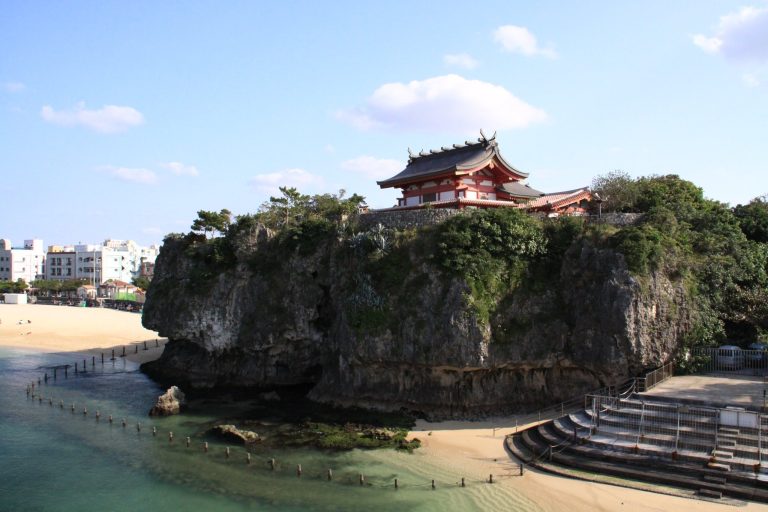
Asato Hachimangū’s present worship hall and principal sanctuary occupy a single building. The principal sanctuary uses irimoya-zukuri, a traditional Japanese roof form with a gabled upper section and sloping hipped sides. The physical form of the shrine also preserves the relationship with Jindokuji, which stood across the road to the southwest as the associated Buddhist temple.
Shrine buildings
Worship hall
Before the wartime destruction, the worship hall had already collapsed by the time of the 1939 prefectural project. Its foundation stones remained, providing the surviving structural evidence for the earlier hall. The present worship hall forms part of the single reconstructed shrine building.
Principal sanctuary
The principal sanctuary had become severely decayed and damaged before the war. It had tilted toward the east and was supported by four or five posts, themselves heavily affected by termites. Years of typhoons and other severe weather had destroyed several roof sections, creating a danger for people using the shrine. The rebuilt building now combines the worship hall and principal sanctuary, with the sanctuary expressed through its hip-and-gable roof form.
Associated temple site
Jindokuji was positioned across the road to the southwest of Asato Hachimangū and functioned historically as its associated Buddhist temple, or bettō temple. A bettō temple was institutionally attached to a shrine and responsible for aspects of its religious administration. The foundation tradition places the large bell recovered by the Ryukyuan fleet at Jindokuji rather than within the shrine itself.